
Every rental property should have a written pet policy attached to the lease or a signed addendum. That single document has to do three jobs: spell out exactly which animals are welcome and under what conditions, lock down the financial terms so nobody argues about fees later, and create a paper trail for enforcement and any reasonable-accommodation requests. Skip any one of the three and you're negotiating pet rules after a dog has already chewed through the baseboards.
Here's what to fix before your next lease signing:
- Add a clause requiring "pets allowed only by written landlord approval"
- Require proof of current vaccinations before move-in
- Pick one financial structure (fee, deposit, or pet rent) and use it consistently across units
The order to work through it:
- Define what's allowed (species, size, number)
- Set the money terms and get them in writing
- Build your documentation and enforcement process before you need it
Key Takeaways
A pet policy for rentals protects landlords only when it pairs specific, enforceable pet rules with a documented financial structure and a clear accommodation process for assistance animals.
| Point | Details |
|---|---|
| Write the policy down | Attach a signed pet addendum to every lease rather than relying on verbal agreements. |
| Separate pets from service animals | Never charge fees, rent, or deposits for verified service or assistance animals under fair housing law. |
| Pick one financial structure | Choose a fee, deposit, or pet rent and label it accurately to avoid deposit cap violations. |
| Enforce progressively | Use notice, cure period, and remediation fees before considering lease termination. |
| Get professional support | OneSource Real Estate drafts compliant pet addenda and handles screening and enforcement for Atlanta-area landlords. |
This article is general information, not a substitute for advice from a qualified lawyer. Consult a qualified legal professional about your own circumstances before acting on anything here.
Table of Contents
- What Types of Pets Should a Pet Policy for Rentals Allow?
- Are Service Animals Treated Differently Than Pets?
- Pet Deposit vs Pet Fee vs Pet Rent: What's the Difference?
- How Do You Screen a Pet Before Approving It?
- Building a Pet Addendum: What Belongs in the Lease
- How Should Landlords Enforce Pet Rules and Violations?
- Can You Change a Pet Policy for Existing Tenants?
- Recordkeeping: What to Save and for How Long
- What Legal Limits Apply to Pet Policies?
- The Legal Mistakes Landlords Make Most Often
- What Property Managers Get Wrong About Occupancy and Risk
- Let OneSource Real Estate Handle the Paperwork for You
- Sources
- FAQ
What Types of Pets Should a Pet Policy for Rentals Allow?
Vague pet clauses cause more disputes than strict ones. "Reasonable number of pets" sounds flexible, but it gives a tenant and a judge nothing concrete to measure against. Name the species you'll accept. Most owners land on domesticated dogs, cats, birds, small caged mammals like hamsters or guinea pigs, and fish. If you want to exclude exotic animals, reptiles, or livestock, say so directly rather than assuming it's implied.
Breed and size limits work the same way. Instead of banning breeds by name (which some jurisdictions restrict or invalidate anyway), consider weight caps, shoulder-height limits, or behavioral criteria like proof of obedience training. Apartments recommends stating species, weight limits, and pet counts explicitly before you even get to fees, since ambiguity here is what tenants exploit when a policy gets challenged.
Cap the number of pets per unit, and require written notice before a tenant adds one. Two cats might be fine in a three-bedroom house and completely unreasonable in a studio.

Pro Tip: Put a maximum combined weight for multiple pets, not just a per-animal limit. A tenant with three 40-pound dogs can do as much damage as one Great Dane.
Are Service Animals Treated Differently Than Pets?
Yes, and this is the section landlords get wrong most often. Service animals and many emotional-support animals are not "pets" under fair housing law. Once a tenant makes a reasonable-accommodation request, you're evaluating it under the Fair Housing Act and HUD guidance, not your standard pet policy. You cannot charge a pet fee, pet rent, or pet deposit for a legitimate assistance animal, and breed or weight restrictions generally don't apply either.
Where the animal's role isn't obvious and the disability isn't apparent, you can ask for documentation connecting the animal to a disability-related need. What you can't do is demand a specific certification, ask about the diagnosis, or require the animal be professionally trained.
Federal fair-housing guidance draws a hard line between assistance animals and pets: landlords may not charge pet fees for bona fide service or support animals, though the tenant remains liable for any actual damage the animal causes.
A workable process looks like this:
- Log the accommodation request in writing, with the date received
- Request supporting documentation only if the disability or need isn't obvious
- Document your decision and keep a copy in the tenant file
- Never require pet insurance or breed disclosure for a verified assistance animal
Pet Deposit vs Pet Fee vs Pet Rent: What's the Difference?
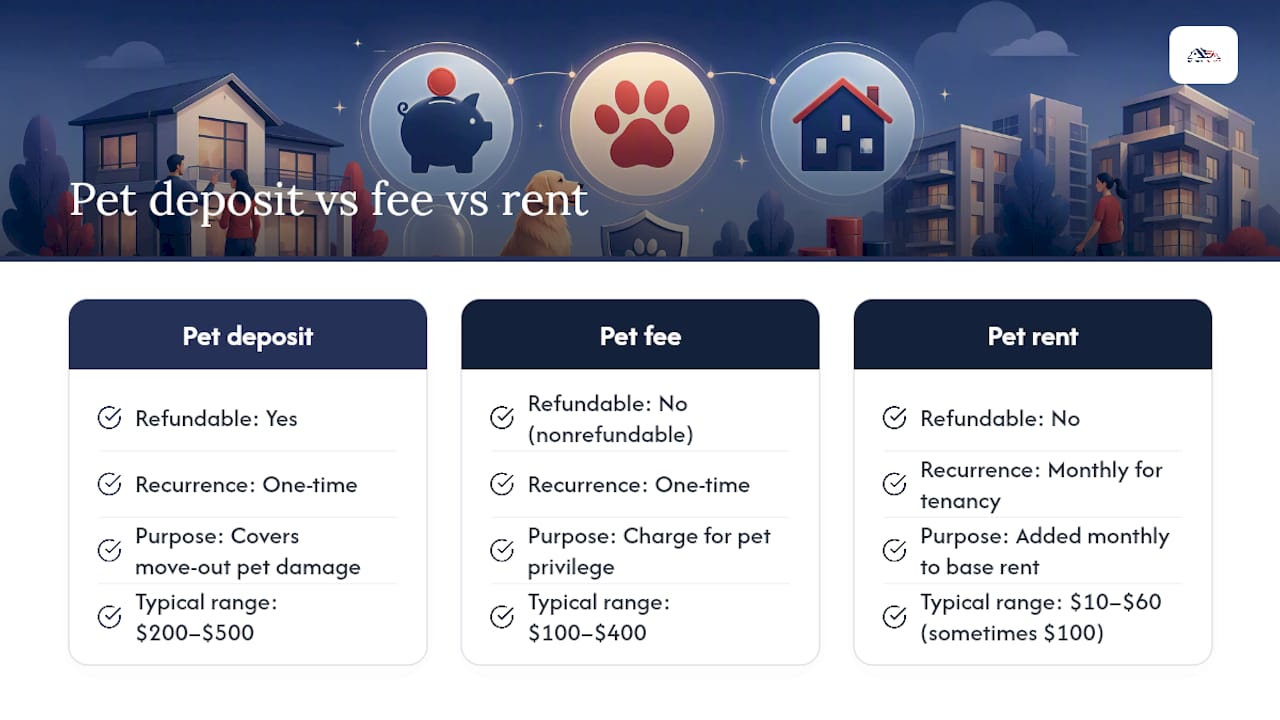
A pet fee is a one-time, nonrefundable charge for the privilege of keeping a pet on the property. A pet deposit is refundable and meant to cover pet-related damage discovered at move-out. Pet rent is a recurring monthly charge added to the base rent for the life of the tenancy. Landlords often default to whichever their market expects, but each carries different legal exposure.

Ranges vary by market and property type. ApartmentList's data puts pet deposits around $200 to $500, one-time pet fees between $100 and $400, and monthly pet rent typically $10 to $60. Zillow Rental Manager cites a similar deposit range with pet rent sometimes running as high as $100 in competitive markets.
The legal trap: relabeling a fee as a "deposit" to sidestep your state's security-deposit cap. Nolo's guidance for landlords flags this as one of the most common pitfalls, and it's an easy one to fall into when you're just trying to collect more money upfront legally.
A note on stacking: some states and cities limit how many separate pet charges you can combine on one lease. Charging a pet fee, a pet deposit, and pet rent simultaneously might be legal in your market or might violate a local deposit cap entirely. Georgia landlords should check how pet charges interact with the state's security deposit rules before finalizing a structure.
How Do You Screen a Pet Before Approving It?
Screen the animal the same way you screen the tenant: with a short application and documentation, not a verbal promise that "he's really well behaved."
- Require a pet application listing breed, weight, age, and temperament
- Collect proof of current vaccinations and, where applicable, licensing or microchip registration
- Ask for a recent photo and, for dogs, a reference from a previous landlord or veterinarian
Watch for red flags during this process: a history of aggressive incidents, evidence of neglect in provided photos, or repeated noise or damage complaints at a previous address. None of these are automatic disqualifiers, but they should prompt follow-up questions.
Once approved, document it properly:
- Get a signed pet addendum before the animal moves in
- Store dated intake photos alongside the vaccination records
- Keep everything in the same tenant file as the lease, not a separate system you'll forget about
Building a Pet Addendum: What Belongs in the Lease
Keep the addendum to one page. State the scope (which unit, which pet, effective date) and require a signature separate from the main lease signature, so there's no ambiguity about whether the tenant agreed to pet-specific terms.
Structure it around these clause categories:
- Allowed animals: species, breed if relevant, weight limit, and count, referencing the specific pet approved
- Vaccination and licensing: proof required before move-in and periodically after, per local law
- Financial terms: whether you're charging a fee, deposit, rent, or combination, stated in dollar figures
- Tenant responsibilities: leashing in common areas, prompt waste removal, noise control
- Damage liability: explicit statement that the tenant is financially responsible for pet-caused damage beyond normal wear
- Remedy for unauthorized pets: what happens if an unapproved animal is discovered
A one-page addendum with explicit registration, vaccination, and remedy language does more to prevent disputes than any amount of goodwill negotiating after the fact.
Reference the addendum inside the main lease itself, not as a floating document. A line like "Tenant's compliance with the attached Pet Addendum is a material condition of this Lease" ties the two together, so a violation of pet rules is a lease violation, full stop. If you're drafting or updating a full lease template, Georgia Realtors' residential lease framework is a useful structure to build the addendum around.
How Should Landlords Enforce Pet Rules and Violations?
Use progressive enforcement, not immediate termination. Start with a written notice, give a defined cure period, escalate to remediation fees if the issue continues, and reserve lease termination for cases that stay uncorrected after every earlier step.
- Issue a written notice describing the specific violation and the required fix
- Set a cure period (commonly 7 to 14 days, depending on your lease and local law)
- Charge remediation or damage fees if the tenant fails to correct the issue
- Move toward lease termination only if violations persist after documented warnings
Build your evidence file as you go:
- Dated photos of damage or unauthorized pets
- Written neighbor or maintenance-staff statements about noise or aggression
- Vet bills, repair invoices, or exterminator receipts tied directly to the pet
Before filing for eviction over a persistent pet violation, confirm your state's notice requirements are met, that you served proper notice, and that you made a documented attempt at resolution first. Georgia landlords should walk through the state's eviction filing process to make sure every procedural box is checked before a judge sees the case.
Can You Change a Pet Policy for Existing Tenants?
You can set new pet rules for future tenancies without restriction. Changing terms mid-lease for a current tenant is different: it requires either mutual written agreement or a lease clause that already permits amendments.
The fairest approach is grandfathering. Let existing pet owners keep their current animal under the old terms while applying new fees or rules only to future pet approvals.
- Notify tenants in writing at least 30 to 60 days before any policy change takes effect
- Offer explicit grandfathering language: "Pets approved before [date] remain under prior terms; new pets are subject to the updated policy."
- Get signed acknowledgment from tenants who accept grandfathered status, so there's no confusion at renewal
Recordkeeping: What to Save and for How Long
Keep the signed pet addendum, vaccination and licensing proof, vet receipts tied to any damage claims, move-in and move-out photos, and any written correspondence about pet issues.
Retention periods depend on your state's statute of limitations for lease disputes, but 3 to 7 years is a reasonable window for most landlords, covering both legal defense and tax documentation needs. Store signed documents and photos electronically with backups; keep any original signed paper addenda in a physical file as well. Organize by unit and tenant name so a single search pulls the entire pet history for that lease.
What Legal Limits Apply to Pet Policies?
Federal law protects service and assistance animals regardless of your pet policy. HUD's handbook for assisted housing goes further, mandating specific pet rules covering inoculations, sanitary standards, and registration, and it caps refundable pet deposits for certain HUD-assisted programs. Even landlords outside HUD-assisted housing can treat that framework as a reasonable baseline for their own policy.
Before setting financial terms, check your state and local deposit caps directly. What's legal in one state as a stacked pet fee and pet deposit can violate a neighboring state's combined-charge limit.
Common pitfalls to avoid:
- Relabeling a fee as a deposit to dodge a statutory deposit cap
- Enforcing breed bans in jurisdictions where breed-specific restrictions are legally unenforceable
- Charging any fee, rent, or deposit for a verified service or assistance animal
Talk to an attorney if you're managing HUD-assisted units, if local code conflicts with your standard lease language, or if you're considering restricting a breed your state or city has separately protected. Georgia landlords managing subsidized tenants should also review how Section 8 program rules intersect with pet policy before drafting anything unit-specific.
The Legal Mistakes Landlords Make Most Often
Three mistakes show up again and again in landlord-tenant disputes over pets.
- Deposit-cap relabeling. Calling a nonrefundable fee a "deposit" to get around state limits invites a legal challenge; Nolo's landlord guidance flags this as a top pitfall. Fix: pick one structure and label it accurately.
- Weak documentation. No signed addendum means no enforceable pet terms. Fix: require the signature before move-in, not after.
- Mishandling accommodation requests. Treating a service animal like a pet, including charging fees, creates fair-housing liability. Fix: separate your accommodation process from your standard pet screening entirely.
Renter demand for pet-friendly units keeps climbing, based on Zillow's rental market data, which makes getting these details right worth the extra hour of drafting time upfront.
What Property Managers Get Wrong About Occupancy and Risk
Allowing pets widens your tenant pool and tends to improve renewal rates, since pet owners often stay longer to avoid re-homing an animal during a move. But that upside only holds if the paperwork behind it is airtight. I've seen renewal rates jump in pet-friendly buildings, and I've also seen a single undocumented damage claim wipe out a year's worth of that gain in legal fees. If you want the occupancy benefit without the exposure, OneSource Real Estate's management services build both pieces in from the start.
Let OneSource Real Estate Handle the Paperwork for You
OneSource Real Estate builds and enforces pet policies as part of full-service property management, so you're not drafting addenda between showings or chasing down vaccination records yourself. That means lease drafting with pet-specific clauses already compliant with Georgia deposit rules, tenant screening that includes pet documentation review, and enforcement support if a violation turns into a dispute.

For landlords managing properties in Atlanta, Marietta, Alpharetta, Johns Creek, Powder Springs, or Austell, that means one point of contact instead of five different vendors for screening, leasing, and enforcement. If you're setting up pet rules for the first time or fixing a policy that's already caused a headache, request a property management consultation and get your lease documents reviewed before your next tenant signs.
Sources
- Pet Deposits, Pet Fees, and Pet Rent: What Landlords Need to Know
- 4350.1 REV-1 CHAPTER 32. PETS (HUD handbook)
- Apartments
- Pet Rent vs. Pet Deposits and Fees (Zillow Rental Manager)
- Pet Fees vs. Pet Rent vs. Pet Deposits (ApartmentList)
FAQ
Can a landlord charge a pet deposit and a pet fee at the same time?
Some states allow it, but many cap combined pet charges, so check your local security-deposit law before stacking a fee, deposit, and pet rent on the same lease.
Do landlords have to allow emotional support animals?
Yes, in most cases. A landlord must process a reasonable-accommodation request for a legitimate emotional support animal and cannot charge pet fees or deposits for it.
How much should a pet deposit be?
Pet deposits are usually set at amounts that reflect local deposit caps and the specific risk profile of the rental unit.
Can a landlord ban specific dog breeds?
It depends on your jurisdiction. Some cities and states restrict breed-specific bans, so weight or behavior-based limits are often safer and more enforceable.
What happens if a tenant has an unauthorized pet?
Start with a written notice and a cure period, then move to remediation fees, and only escalate to lease termination if the violation continues uncorrected. OneSource Real Estate handles this enforcement process directly for the properties it manages.