
TL;DR:
- Property management services handle daily rental operations, reducing owner stress and increasing financial returns.
- They include tenant screening, rent collection, maintenance, legal compliance, and use technology for transparency.
Property management services are specialized solutions that handle the daily operations of rental properties, from tenant screening to maintenance coordination, so owners can focus on growing their portfolios. For residential investors in Atlanta and surrounding areas, these services deliver measurable financial results and eliminate the grind of hands-on landlording. The industry standard now includes housing regulation compliance, transparent financial reporting, and technology-enabled communication. OneSource Real Estate provides a full management suite built specifically for owners who want results without the operational burden.
What core services do property management companies offer?
Professional property management covers every task that stands between an owner and a profitable, low-stress rental. The scope goes well beyond collecting rent. A full-service provider handles the entire tenant lifecycle, from marketing vacant units to enforcing lease terms and coordinating move-out inspections.
The core services break down into four categories:
- Tenant screening and leasing. Managers advertise vacancies, qualify applicants using credit and background checks, and execute lease agreements. Thorough screening reduces eviction risk and protects the owner's asset from the start.
- Rent collection and financial reporting. Managers collect rent, chase late payments, and deliver monthly statements. Detailed reporting gives owners a clear picture of income, expenses, and net cash flow every month.
- Maintenance and property inspections. Routine inspections catch problems before they become expensive. Managers coordinate licensed vendors for repairs, handle emergency calls, and document all work orders.
- Lease enforcement and legal compliance. Managers track lease expirations, issue renewal notices, and handle violations. They also maintain documentation required under local housing codes, reducing the owner's legal exposure.
A lease audit during management transition verifies that existing tenant documents are legally sound, deposits are properly held, and no compliance gaps exist. Skipping this step is one of the most common and costly mistakes owners make when switching managers.
Pro Tip: Ask any prospective management company for a sample lease audit checklist before signing a contract. A firm that cannot produce one likely skips the process entirely.
How do property management firms structure their teams and use technology?
A full-service management firm operates more like a small business than a solo landlord. The team typically includes property managers, maintenance engineers, accounting staff, and lease administrators. Full-service management teams often support 24/7 emergency response with roving maintenance engineers covering large portfolios. That depth of staffing means no single point of failure when a pipe bursts at midnight or a tenant dispute needs immediate attention.

Technology now sits at the center of how these teams operate. Modern platforms handle rent collection, maintenance ticket tracking, tenant communication, and real-time financial reporting in one place. Owners log into a portal and see exactly what is happening with their property without making a single phone call.
AI-powered automation handles routine communication tasks such as answering lease questions, translating messages for non-English-speaking tenants, and scheduling maintenance appointments. That automation reduces management overhead and speeds up response times. Tenants get faster answers, and managers spend less time on repetitive tasks.
The practical result for owners is a higher level of transparency. You see every maintenance request, every payment, and every lease document in real time. That visibility makes it far easier to evaluate whether your management company is actually performing.
What pricing models and contract terms should owners expect?
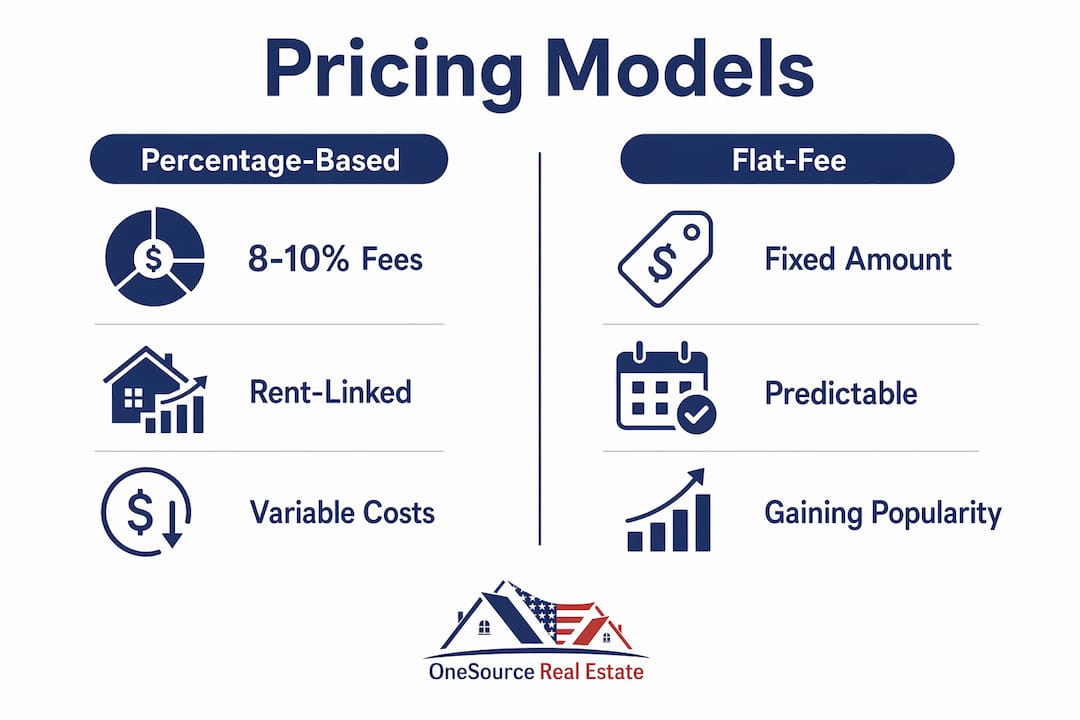
Fee structures vary widely, and the wrong model can quietly erode your returns. The two dominant approaches are percentage-based fees and flat-fee pricing.
| Fee model | How it works | Best for |
|---|---|---|
| Percentage-based | Manager charges 8–10% of monthly rent collected | Owners who want fees tied to performance |
| Flat-fee | Fixed monthly charge regardless of rent amount | Owners who want predictable cash flow |
Flat-fee pricing models are gaining ground nationally as owners demand more predictable cash flow. The percentage model creates a subtle misalignment: a manager earns more when rent is higher but has no direct incentive to control expenses. Flat-fee structures remove that tension.
Lease term strategy matters just as much as the fee model. Longer lease terms of 2–3 years reduce vacancy costs and lower turnover frequency. Some firms achieve an average resident stay of 4.5 years with renewal rates at 70%. That kind of retention translates directly into fewer make-ready costs, fewer leasing commissions, and more stable income.
Pro Tip: Negotiate for a written property condition report delivered within five business days of onboarding. A benchmarked condition assessment protects you from inheriting deferred maintenance costs that predate your management agreement.
Contract terms should also specify how disputes are handled, what notice period is required to terminate the agreement, and whether the manager charges a leasing fee separate from the monthly management fee. Read every line before signing.
How do professional property management services maximize rental income?
The difference between a good management company and a great one shows up in the numbers over time. Proactive managers do not just react to problems. They plan ahead, price correctly, and build tenant relationships that reduce costly turnover.
- Dynamic rent pricing. Managers who use proprietary CRM data to track local rental demand can price units accurately at lease renewal. Underpricing leaves money on the table. Overpricing creates vacancy. Data-driven pricing hits the right number.
- Planned maintenance and capital improvements. Proactive management including scheduled maintenance and capital budgeting delivers higher long-term returns than reactive administration. Replacing an HVAC unit on a planned schedule costs far less than an emergency replacement during peak summer.
- Tenant retention programs. Turnover is the single largest hidden cost in rental ownership. Lease renewal incentives, responsive maintenance, and consistent communication keep good tenants in place. Sophisticated investors prioritize long-term retention because turnover costs routinely exceed any savings from a lower management fee.
- Transparent monthly reporting. Owners who receive clear, detailed financial statements make better decisions. They know when to raise rents, when to invest in improvements, and when a property is underperforming relative to the market.
For owners managing properties across multiple Atlanta suburbs, consistent reporting across every unit is the only way to compare performance and allocate capital effectively. Local market guides for areas like Stockbridge and Decatur show how management responsibilities and market conditions vary even within the same metro area.
Key Takeaways
Professional property management services deliver the highest returns when owners choose firms that combine proactive maintenance, data-driven pricing, and long-term tenant retention strategies.
| Point | Details |
|---|---|
| Lease audits protect owners | Verify all tenant documents and deposits during any management transition to avoid inherited liabilities. |
| Fee model affects alignment | Flat-fee pricing creates more predictable cash flow; percentage-based fees may misalign manager incentives. |
| Tenant retention drives ROI | Turnover costs exceed savings from lower fees; target firms with multi-year lease strategies and high renewal rates. |
| Technology improves transparency | Owner portals and AI automation give real-time visibility into rent, maintenance, and financial performance. |
| Onboarding benchmarks matter | A written condition report within five business days sets the baseline for future rent increases and capital planning. |
What I have learned from working with property management services
After years of working with rental property owners across the Atlanta metro, one pattern stands out clearly. Owners who struggle most are not the ones with the worst properties. They are the ones who hired a management company without doing a proper onboarding.
The condition report is not a formality. It is the document that protects you when a tenant moves out and suddenly claims the carpet was already ruined. Without a written, dated baseline, you are arguing from memory. That is a losing position.
The other mistake I see constantly is choosing a manager based on the lowest fee percentage. A firm charging 7% that lets a unit sit vacant for two extra months costs you far more than one charging 10% that fills it in two weeks. The math is not complicated, but the instinct to minimize the visible cost is strong.
The best management companies I have encountered act like they own the property themselves. They flag a slow drain before it becomes a plumbing emergency. They call a tenant proactively when rent is three days late instead of waiting for it to become a legal issue. That ownership mentality is what separates a real partner from an administrative middleman.
Technology is now a baseline expectation, not a premium feature. If a company cannot show you a live owner portal with real-time financials, that is a red flag. You should never have to call to find out if your rent was collected.
— Matt
Rental property management made clearer with OneSource Real Estate
Managing a rental property in Atlanta involves more moving parts than most owners expect before their first tenant moves in. OneSource Real Estate provides end-to-end property management services for residential owners across Atlanta and surrounding areas, covering everything from tenant screening and rent collection to maintenance coordination and owner portal access.
Owners get transparent monthly reporting, responsive maintenance handling, and a team that treats your property like an investment worth protecting. Whether you own one rental home or a growing portfolio, OneSource Real Estate removes the day-to-day burden so you can focus on what matters. Reach out to learn how the full management suite works for your specific situation.
FAQ
What does a property management company actually do?
A property management company handles tenant screening, rent collection, maintenance coordination, lease enforcement, and financial reporting on behalf of the owner. The goal is to keep the property occupied, compliant, and profitable without requiring the owner's daily involvement.
How much do property management services typically cost?
Most companies charge either a percentage of monthly rent, typically 8–10%, or a flat monthly fee. Flat-fee models are growing in popularity because they give owners more predictable cash flow regardless of rent amount.
What is a lease audit and why does it matter?
A lease audit reviews all existing tenant documents, deposits, and lease terms during a management transition to confirm legal compliance and identify any gaps. Skipping this step can leave a new owner liable for issues that predate their management agreement.
How do property managers reduce vacancy rates?
Managers reduce vacancy through proactive marketing, competitive rent pricing based on market data, and tenant retention programs that encourage lease renewals. Firms that target multi-year leases report significantly lower turnover and more stable annual income.
Do I need a property manager if I only own one rental?
Single-property owners benefit from professional management when they lack time, live far from the property, or want to avoid the legal and operational complexity of landlording. The cost of one missed maintenance issue or a bad tenant placement typically exceeds a full year of management fees.