
TL;DR:
- Property management in Decatur, GA involves licensed professionals overseeing rental properties, ensuring legal compliance and optimal operation.
- Only licensed Georgia brokers can legally manage properties for compensation, with transparent fees and proper escrow handling required.
Property management in Decatur, GA is defined as licensed professional oversight of residential rental properties, covering tenant placement, rent collection, maintenance coordination, and legal compliance on behalf of property owners. For investors in DeKalb County, this service is not optional convenience. It is the difference between a protected asset and a costly liability. Georgia law sets strict licensing, escrow, and fair housing requirements that most self-managing owners unknowingly violate. This guide covers what those rules are, what services to expect, what fees actually cost, and how to choose the right firm in 2026.
What are the licensing requirements for property management in Decatur, GA?
Georgia law is clear: anyone managing property for compensation must hold a real estate broker's license or work directly under one. A salesperson's license is not enough to operate independently. This rule applies to every firm collecting management fees in Decatur.

The Georgia Real Estate Commission enforces these standards under the Georgia Real Estate License Law. 2025 legislative amendments eliminated affiliate exemptions that previously allowed some management firms to operate without full broker licensing. That change narrowed the field of legally operating managers significantly.
Two exemptions still exist under O.C.G.A. §43-40-29(1): property owners managing their own units, and regular employees managing property for a single employer. Both exemptions are narrow and do not apply to third-party management firms.
Licensed brokers must also maintain trust accounts for client funds and complete continuing education requirements. Hiring an unlicensed manager creates real risk. Unlicensed activity can render management contracts unenforceable, leaving owners without legal recourse if the relationship goes wrong.
Pro Tip: Before signing any management agreement, verify the firm's broker license number directly on the Georgia Real Estate Commission's public license lookup tool.
What services do property management companies in Decatur offer?
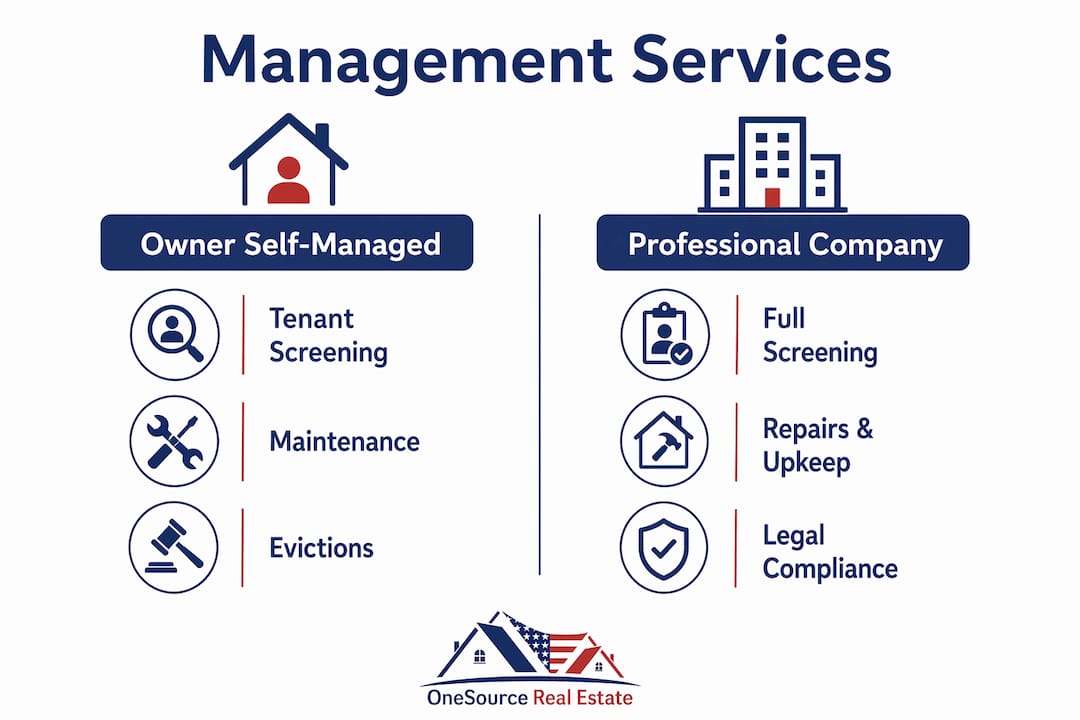
Full-service rental property management covers every operational task between signing a lease and returning a security deposit. For investors who own multiple units or live outside the Atlanta metro, this scope is the core value proposition.
A licensed management firm in Decatur typically provides:
- Marketing and vacancy management. Professional photography, listing syndication across major rental platforms, and showing coordination to minimize vacancy days.
- Tenant screening and lease execution. Credit checks, eviction history review, income verification, and legally compliant lease drafting.
- Rent collection and delinquency management. Automated payment systems, late fee enforcement, and structured communication with tenants who fall behind.
- Maintenance and vendor coordination. A maintenance authorization threshold sets the dollar limit a manager can approve without owner sign-off, controlling costs without requiring constant owner involvement.
- Legal compliance and eviction management. Proper notice procedures, court filing coordination, and fair housing compliance throughout the tenancy.
- Monthly financial reporting. Itemized statements showing income, expenses, and net distributions.
Self-managing owners often underestimate the time cost of these tasks. A single eviction in Georgia can take 30–60 days and require multiple court appearances. Professional management absorbs that burden entirely.
Pro Tip: Ask any prospective manager for a sample monthly financial statement before signing. Clear, itemized reports are a baseline expectation, not a premium feature.
What does property management in Decatur, GA actually cost?
Fee structures in Decatur follow a layered model that catches many owners off guard. The base management fee is only the starting point.
Total effective costs typically run 10–14% of annual rent collected when all fees are added together. That figure includes the base fee, leasing fees, and maintenance markups. Managers typically charge base fees of 8–12% of monthly rent collected, plus leasing fees equal to half to a full month's rent each time a new tenant is placed.
Common additional charges include:
- Lease renewal fees. Charged when an existing tenant signs a new term, often $100–$300.
- Maintenance markups. Some firms add 10–20% to vendor invoices as a coordination fee.
- Vacancy fees. A small number of firms charge a flat monthly fee even when the unit sits empty.
- Early termination fees. Penalties if the owner ends the management agreement before the contract term expires.
Property management companies that openly share full fee schedules help owners avoid unexpected charges and build trust from the start. Any firm that resists providing a written fee schedule in advance is a firm worth avoiding.
Pro Tip: Request a complete fee schedule in writing before your first meeting ends. Compare the total effective cost across at least three firms, not just the headline management percentage.
How must property managers handle security deposits under Georgia law?
Security deposit handling is one of the most regulated areas of Georgia landlord-tenant law, and violations carry serious financial penalties. Owners who hire unlicensed or careless managers face direct liability for those violations.
Key requirements under O.C.G.A. § 44-7-36 include:
- Dedicated escrow accounts. Security deposits must be held in escrow accounts separate from operating funds. Commingling deposits with business revenue is a violation.
- Written move-in inspection reports. Georgia law requires landlords and managers to document the property's condition at move-in with the tenant present and both parties signing the report.
- 30-day return deadline. Deposits must be returned within 30 days of the tenant vacating, along with an itemized written statement of any deductions.
- Treble damages for violations. Failure to comply with return timelines or documentation requirements can result in penalties of three times the deposit amount, plus attorney's fees.
Owners should ask any prospective manager to explain their escrow account setup and show proof of a separate trust account. This is not an intrusive question. It is a basic compliance check that protects your investment.
What fair housing laws apply to rental properties in Decatur?
Georgia's Fair Housing Law mirrors the federal Fair Housing Act and prohibits discrimination in advertising, tenant screening, and lease terms based on protected classes. Decatur property owners and their managers must comply with both state and federal standards.
Protected classes under Georgia and federal law include:
- Race, color, and national origin
- Religion
- Sex
- Familial status (families with children under 18)
- Disability
Georgia Fair Housing violations can lead to complaints filed with the Georgia Commission on Equal Opportunity or the U.S. Department of Housing and Urban Development. Penalties include fines, damages, and injunctive relief.
Accidental violations happen more often than intentional ones. Common examples include advertising language that implies a preference for certain tenants, applying different income standards to applicants of different backgrounds, or refusing to make reasonable accommodations for tenants with disabilities.
Professional property management reduces legal risk by applying consistent, documented screening criteria to every applicant. Compliant screening focuses on verifiable factors: credit score thresholds, income-to-rent ratios, rental history, and eviction records applied uniformly. Owners who self-manage without formal screening criteria carry the highest exposure to fair housing complaints.
For investors managing properties across the Atlanta metro, the same compliance standards apply whether the property is in Decatur, Conyers, or Douglasville.
Key Takeaways
Professional property management in Decatur, GA requires licensed brokers, strict escrow compliance, transparent fee structures, and consistent fair housing practices to protect owner assets and minimize legal exposure.
| Point | Details |
|---|---|
| Licensing is non-negotiable | Only Georgia-licensed brokers can legally manage property for compensation in Decatur. |
| Total costs exceed the base fee | Effective management costs run 10–14% annually when leasing and renewal fees are included. |
| Escrow compliance protects owners | Deposits must be held in separate trust accounts and returned within 30 days with itemized statements. |
| Fair housing applies to every step | Screening, advertising, and lease terms must comply with both Georgia and federal fair housing law. |
| Vetting quality matters more than price | Eviction rates and financial reporting quality reveal more about a manager than their headline fee. |
What I've learned about choosing property managers in Decatur
The biggest mistake I see Decatur investors make is treating property management as a commodity purchase. They compare headline percentages and pick the lowest number. That approach almost always costs more in the long run.
Speed of filling vacancies can be misleading if tenant screening is compromised. A manager who fills your unit in five days by skipping eviction history checks is not saving you money. They are shifting risk onto your balance sheet. I always ask managers directly: what is your current eviction rate across your portfolio? Managers who deflect that question are telling you something important.
Clear, itemized monthly financial statements are the other non-negotiable. If a manager cannot show you a sample statement that you can read and understand in two minutes, their reporting will frustrate you for the entire contract term. Confusing statements are not an accident. They are a sign of poor transparency.
Thorough vetting protects investors from poor asset management and costly evictions. Interview at least three firms. Ask about their emergency maintenance process, their vendor relationships, and how they handle tenants who pay late. The answers reveal whether a firm runs a real operation or just collects fees.
— Matt
OneSource Real Estate: full-service property management for Decatur owners
Decatur rental property owners need a management partner who knows Georgia law, applies consistent tenant screening, and reports finances clearly every month.
OneSource Real Estate is a full-service real estate brokerage specializing in residential sales and property management across Atlanta and surrounding areas, including Decatur. The firm handles marketing, tenant placement, rent collection, maintenance coordination, and legal compliance under one roof. Fee structures are transparent and provided in writing before any agreement is signed. For owners who want to protect their investment without managing day-to-day operations, OneSource Real Estate's property management services are built for exactly that. Contact the team at ListToSellATL to discuss your Decatur rental property today.
FAQ
What license does a property manager need in Decatur, GA?
A property manager in Decatur must hold a Georgia real estate broker's license to manage property for compensation. Salesperson licenses do not qualify for independent management operations.
How much does property management cost in Decatur, GA?
Base management fees typically run 8–12% of monthly rent collected. Total effective costs reach 10–14% annually when leasing fees, renewal fees, and maintenance markups are included.
How long does a landlord have to return a security deposit in Georgia?
Georgia law requires landlords and property managers to return security deposits within 30 days of the tenant vacating, along with an itemized written statement of any deductions.
What happens if a property manager violates Georgia security deposit rules?
Violations of O.C.G.A. § 44-7-36 can result in penalties of three times the deposit amount plus attorney's fees, making compliance a financial priority for every owner.
How do I verify a property manager is licensed in Georgia?
Search the Georgia Real Estate Commission's public license database using the firm's broker name or license number. Verification takes less than two minutes and confirms current, active licensure.