
For most landlords, the right starting point is OneSource Real Estate's managed tenant screening: it pairs credit, criminal, and eviction reports with built-in FCRA compliance support so you get thorough results without navigating the legal paperwork yourself. Here is what you get and what to do next.
What's included:
- Credit report with score, payment history, open debts, and collections
- Nationwide criminal background check covering multi-jurisdictional and county records
- Nationwide eviction report with court filings and judgments
- FCRA/Fair Housing compliance support and adverse action notice guidance
Turnaround: Most reports deliver within minutes to the same business day after applicant authorization.
Next step: Contact OneSource Real Estate to request a sample tenant screening report or start managed screening for your Atlanta-area rental.
Table of Contents
- What does a complete tenant screening package include?
- How does the tenant screening process actually work?
- What red flags should you watch for in screening reports?
- Who pays for screening, and what does it cost?
- How accurate are screening reports, and where do they fall short?
- FCRA and Fair Housing compliance: what landlords must do
- How do you handle errors or disputes in a screening report?
- How to interpret screening results and make a sound rental decision
- Legal considerations beyond FCRA: Fair Housing Act and discrimination risk
- DIY screening platforms vs. full-service tenant screening providers
- How to choose the right tenant screening service
- Key Takeaways
- Why managed screening usually pays for itself
- OneSource Real Estate handles tenant screening for Atlanta landlords
- FAQ
What does a complete tenant screening package include?
A complete screening package covers three core reports every landlord needs before signing a lease.

Credit report covers the applicant's credit score, payment history, open trade lines, available credit, and outstanding debts. It tells you whether someone pays their bills consistently, not just whether they have a job.
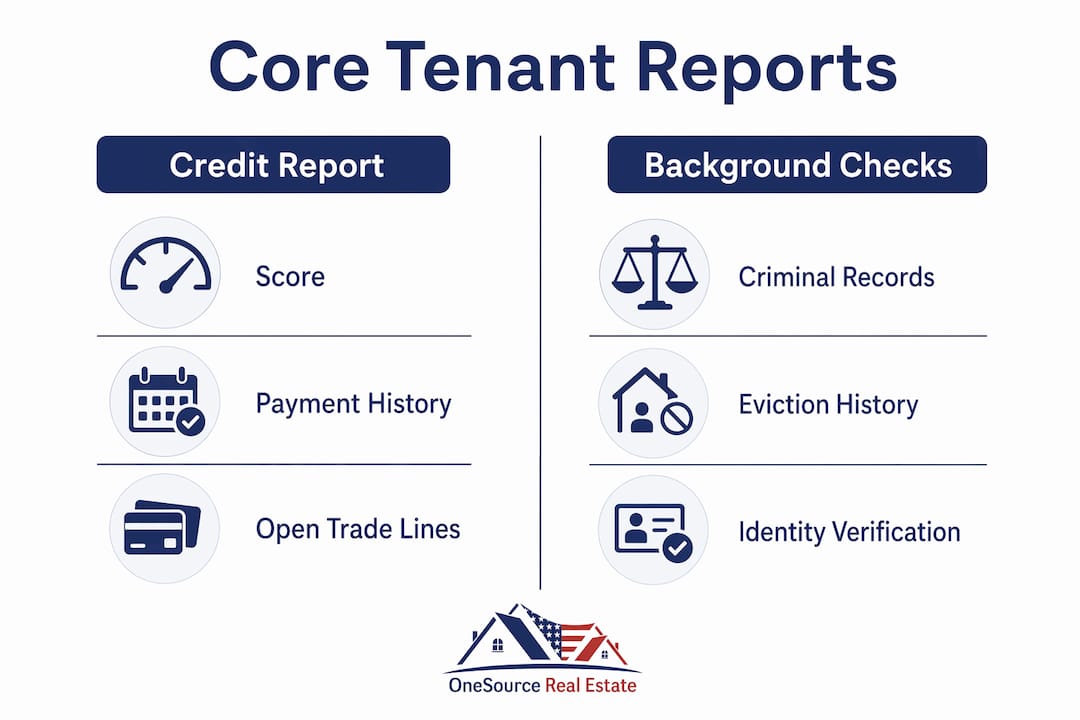
Nationwide criminal background check searches multi-jurisdictional indexes plus county-level records for felonies and misdemeanors across all 50 states. Depth matters here: a national index alone misses local filings.
Nationwide eviction report pulls court filings and judgments, including cases that were later dismissed. Even a dismissed eviction filing reveals a prior landlord-tenant dispute worth understanding.
Beyond the core three, common add-ons include identity verification, income verification (bank-verified or pay-stub review), sex offender registry, global watchlists, and rental history verification.
Pro Tip: Income verification and multi-tier eviction searches are the two add-ons that most reduce leasing risk. Automated income tools flag applicants who need manual validation, but they can miss irregular or self-employed income patterns, so always pair them with document review for non-W2 applicants.
| Report Type | What It Shows | Landlord Decision It Informs |
|---|---|---|
| Credit report | Score, payment history, debts, collections | Payment reliability and debt load |
| Criminal background | Felonies, misdemeanors, county records | Safety and liability risk |
| Eviction report | Court filings, judgments, dismissals | Prior landlord-tenant conflict history |
| Income verification | Bank-verified income or pay stubs | Rent-to-income ratio and payment capacity |
| Identity verification | Government ID match, SSN validation | Fraud prevention and report accuracy |
How does the tenant screening process actually work?
The workflow runs in five steps, and skipping any one of them creates compliance exposure.
- Send the application invite. Share a screening request link with the applicant via email or text. Platforms that offer tenant-facing consent links shorten this step considerably.
- Collect written consent. The applicant authorizes the background check in writing. Under the FCRA, you cannot pull a consumer report without a permissible purpose and documented authorization.
- Identity verification. The applicant confirms their identity, typically via government ID and Social Security number. This step prevents report mismatches and catches application fraud.
- Report delivery. Credit, criminal, and eviction reports generate after identity clears. Most automated reports return within minutes for national index matches; full multi-court eviction searches that require manual courthouse lookups can take longer.
- Decision and adverse action if needed. Review results, apply your written criteria consistently, and approve or deny. If you deny based on report findings, federal law requires an adverse action notice.
Before ordering any report, confirm you have:
- Signed written authorization from the applicant
- A completed rental application with full legal name, date of birth, and SSN
- A documented, written screening criteria policy you apply to every applicant
What red flags should you watch for in screening reports?
Not every negative item on a report carries equal weight. Knowing which flags to prioritize keeps your decisions defensible.
High-priority flags to take seriously:
- Evictions filed within the past three to five years, especially with a judgment
- Undisclosed judgments or collections that contradict what the applicant stated
- Violent felony convictions that directly affect property or resident safety
- Identity mismatches between the application and the verified ID
Conditional flags that need context, not automatic denial:
- Bankruptcies discharged more than four years ago with clean payment history since
- Past nonpayment resolved through settlement with no recent repeat
- Sealed or expunged records (which may not legally appear on reports in some states)
Many landlords use credit score bands (commonly 620–650 as a minimum), allow no more than one or two recent late payments, and set an eviction lookback window of three to five years. These are working guidelines, not legal requirements. Your written policy is what protects you.
Pro Tip: Document your screening criteria before you list the property, apply them identically to every applicant, and keep a log of every decision. Inconsistent application of criteria is one of the most common triggers for Fair Housing complaints.

Local county filings are where national databases most often miss records. An eviction filed in a small county court may never reach a national index, which is why multi-tier searches matter.
Who pays for screening, and what does it cost?
Pricing falls into three shapes in the U.S. market.
- Per-report fees: You pay per applicant screened. Good for landlords with one or two units who screen infrequently.
- Subscription or monthly plans: A flat monthly fee covers unlimited or bundled reports. Better for landlords managing five or more units with regular turnover.
- Managed service: Screening, compliance, placement, and eviction support are bundled into a property management contract. The highest upfront cost, but it offsets the time and legal risk of doing it yourself.
On who pays: landlords can absorb the fee or pass it to the applicant. Many states and cities restrict how much you can charge applicants, so check local rules before billing them. Passing the cost to applicants is common and legal in most U.S. markets, but it can reduce application volume for higher-priced rentals.
- Screen occasionally (1–2 units): Per-report pricing keeps costs low and avoids subscription overhead.
- Manage multiple units: A subscription or managed service saves time and reduces per-screen cost at volume.
- Want compliance handled for you: A managed service like OneSource Real Estate bundles reports, FCRA workflows, and eviction support into one package.
How accurate are screening reports, and where do they fall short?
National credit bureau data from TransUnion, Experian, and Equifax is generally reliable for credit history. Criminal and eviction databases are less consistent.
The biggest gap is county-level court filings. Many local unlawful detainer records never make it into national indexes, so a report showing "no evictions found" means no records were found in the jurisdictions searched, not that none exist.
| Data Source | Strength | Common Gap |
|---|---|---|
| National credit bureaus | Payment history, debts, score | Rarely misses; format varies by bureau |
| Multi-jurisdictional criminal index | Broad felony/misdemeanor coverage | May miss recent local filings |
| National eviction database | Consolidated court records | County-level filings often absent |
| Automated income verification | Fast bank-verified income check | Misses irregular or self-employed income |
False positives from identity-matching errors happen when two people share a similar name and date of birth. If a criminal record appears that the applicant disputes, request the full source record and verify the match against the applicant's confirmed identity documents before acting on it.
Screening platforms are decision-support tools. They surface risk signals; human review and a documented process are what turn those signals into defensible decisions.
FCRA and Fair Housing compliance: what landlords must do
The Fair Credit Reporting Act sets three non-negotiable obligations for landlords using consumer reports.
1. Consistent criteria. Apply the same written screening standards to every applicant. Varying your criteria by applicant is both an FCRA problem and a Fair Housing risk.
2. Proper use of consumer reports. Only use reports for a permissible purpose (evaluating a rental applicant) and only after obtaining written authorization.
3. Adverse action notice. If you deny an applicant, or offer materially different terms, based on information in a consumer report, you must send an adverse action notice. It must name the reporting agency, explain the applicant's right to dispute the report, and provide the agency's contact information.
Compliance checklist:
- Written screening criteria documented before listing
- Signed applicant authorization on file for every report pulled
- Adverse action notice sent within the required timeframe when applicable
- Records retained (application, authorization, report, decision) for at least two to five years
OneSource Real Estate builds these steps into its managed screening workflow. Adverse action templates, documented FCRA steps, identity and income verification, and follow-up dispute handling are part of the managed service, not add-ons you have to track separately. For Georgia landlords, Fair Housing compliance adds state-level protections on top of federal rules.
How do you handle errors or disputes in a screening report?
When an applicant disputes information in their report, the process runs through the reporting agency, not the landlord. Your role is to facilitate, not investigate.
Direct the applicant to the consumer reporting agency that produced the report. Under the FCRA, the agency must investigate the dispute within 30 days and correct or delete inaccurate information. If the disputed item is removed or corrected, you should reconsider the application using the updated report before finalizing a denial.
Keep a record of the dispute notification, the date you forwarded the applicant to the agency, and any updated report you received. This documentation protects you if the applicant later claims the denial was improper.
How to interpret screening results and make a sound rental decision
A screening report is not a pass/fail score. It is a profile you read against your written criteria.
Start with the credit report: look at payment history over the past 24 months, not just the score. A 620 score with consistent on-time payments for two years tells a different story than a 680 score with three recent 30-day lates.
Cross-reference the eviction report against what the applicant disclosed. An undisclosed filing is a bigger red flag than the filing itself. Then check the criminal report against your written safety criteria, and verify the identity match before acting on any adverse record.
When results are mixed, document your reasoning. "Applicant meets income and credit criteria; one eviction filing from 2019 with no judgment; approved based on written policy" is the kind of note that protects you in a Fair Housing inquiry.
Legal considerations beyond FCRA: Fair Housing Act and discrimination risk
The Fair Housing Act prohibits denying housing based on race, color, national origin, religion, sex, familial status, or disability. Screening criteria that appear neutral can still create disparate impact liability if they disproportionately exclude a protected class.
Blanket criminal history bans, for example, have drawn HUD scrutiny because of their disproportionate effect on certain protected groups. A better approach: evaluate criminal history based on the nature of the offense, how recent it was, and whether it poses a direct safety risk to residents or the property.
For landlords in Georgia, Fair Housing laws layer state protections on top of federal rules. Staying current on both requires either a compliance-aware property manager or regular legal review.
This article is general information, not legal advice. Confirm current rules with the FTC, CFPB, HUD, or a qualified attorney for your specific situation.
DIY screening platforms vs. full-service tenant screening providers
DIY platforms let landlords pull credit, criminal, and eviction reports directly, usually for a per-report or subscription fee. They work well for landlords who are comfortable reading reports, maintaining their own compliance documentation, and sending adverse action notices correctly.
Full-service providers, including managed property management firms, bundle the reports with compliance workflows, adverse action templates, and often lease drafting and eviction support. The cost is higher, but the time savings and reduced legal exposure are real, especially for landlords who own fewer than five units and do not screen frequently enough to stay sharp on FCRA requirements.
The honest trade-off: DIY is cheaper per screen and gives you direct control. Managed screening costs more but transfers the compliance burden to someone who handles it daily. For a single-unit landlord in Atlanta who screens once a year, a managed service often costs less than one legal consultation after a compliance misstep.
How to choose the right tenant screening service
Five criteria separate a solid screening service from one that creates more problems than it solves.
Report depth: Does it include county-level eviction searches, not just national indexes? Does the criminal check cover local municipalities?
Compliance tooling: Does the platform generate adverse action notices automatically? Does it store signed authorizations?
Income verification method: Bank-verified income is more reliable than self-reported figures. For applicants with irregular income, manual document review should be available.
Integration: If you use property management software or a full-service manager, the screening workflow should connect directly to your lease and rent collection process.
Support: When a report returns an ambiguous result or an applicant disputes a record, you need someone to call. Platforms with no live support leave you making compliance calls alone.
Key Takeaways
A complete tenant screening service for landlords requires credit, criminal, and eviction reports paired with documented FCRA-compliant criteria and adverse action procedures applied consistently to every applicant.
| Point | Details |
|---|---|
| Three core reports | Every screening must include credit, nationwide criminal, and nationwide eviction reports. |
| FCRA compliance is mandatory | Document consistent criteria, obtain written consent, and send adverse action notices when denying based on report findings. |
| County-level gaps are real | National databases miss local court filings; prioritize providers that include county-level eviction searches. |
| Who pays affects volume | Passing fees to applicants is legal in most U.S. markets but may reduce applications; check local rules first. |
| OneSource Real Estate | Offers managed tenant screening with integrated reports, FCRA workflows, and eviction support for Atlanta-area landlords. |
Why managed screening usually pays for itself
The conventional wisdom is that DIY screening saves money. For a landlord managing ten or more units with a dedicated system, that is probably true. For everyone else, the math is less obvious.
The real cost of a screening mistake is not the missed report fee. It is the eviction you file six months in, the legal fees, the lost rent, and the time. A single bad placement in Atlanta can easily run into several thousand dollars by the time you recover possession. Managed screening, with its built-in adverse action workflows and compliance documentation, removes the most common failure points: inconsistent criteria, missing notices, and reports that looked fine because the county-level search was never run.
Single-unit landlords benefit most from managed services because they screen infrequently and are least likely to stay current on FCRA requirements. Small portfolio owners (two to ten units) benefit from the time savings and the bundled eviction support. Large portfolios with dedicated staff can often run DIY platforms effectively, provided they invest in compliance training and documentation systems.
The one thing I would tell any landlord: write your screening criteria down before you list the property, not after you meet the first applicant. That single step eliminates most Fair Housing exposure and makes every subsequent decision faster and cleaner.
OneSource Real Estate handles tenant screening for Atlanta landlords
Placing the wrong tenant costs far more than a screening fee. OneSource Real Estate's managed tenant screening gives you credit, criminal, and eviction reports alongside documented FCRA workflows, adverse action templates, and eviction support, all handled by a team that does this daily for Atlanta-area landlords.
No piecing together reports from three different platforms. No wondering whether your adverse action notice covers what it needs to. OneSource Real Estate bundles the full tenant verification process into its property management service, so you get thorough screening and the compliance documentation to back every decision.
Request a sample tenant screening report or schedule a short consultation at listtosellatl.com.
Authoritative sources and further reading
- Fair Credit Reporting Act (FTC): The full text of the FCRA, including landlord obligations for consumer reports, adverse action requirements, and applicant rights.
- Using Consumer Reports: What Landlords Need to Know (FTC): Plain-language FTC guidance on FCRA compliance for landlords, including adverse action notice requirements.
- Background Checks and Renter Protections (CFPB): CFPB overview of how background checks work in rental housing, including data coverage gaps and applicant rights.
- Types of Tenant Screening Methods (EchoPM): A neutral primer on screening approaches for landlords evaluating their options.
FAQ
What does a tenant screening service for landlords include?
A complete service includes a credit report, nationwide criminal background check, and nationwide eviction report. Add-ons like income verification and identity checks are available through most providers.
How long does tenant screening take?
Most automated reports return within minutes to the same business day after the applicant completes authorization. Manual courthouse searches for eviction records can extend that timeline.
What is an adverse action notice and when is it required?
An adverse action notice is a written notice you must send when denying an applicant based on a consumer report. It must name the reporting agency, explain the denial reason, and describe the applicant's right to dispute the report.
Can a landlord charge applicants for screening?
Yes, in most U.S. markets landlords can pass screening fees to applicants, but some states and cities cap the amount. Check your local rules before billing applicants.
How does OneSource Real Estate handle tenant screening?
OneSource Real Estate provides managed tenant screening for Atlanta-area landlords, including credit, criminal, and eviction reports, FCRA-compliant workflows, adverse action templates, and eviction support as part of its full-service property management offering.