
TL;DR:
- Section 8 is a federal housing assistance program that provides rent subsidies paid directly to private landlords for eligible tenants. It requires landlords to comply with specific standards, pass inspections, and communicate regularly with local PHAs to ensure continuous subsidy payments. Proper screening, compliance, and proactive management help landlords maximize reliable, government-backed income.
Section 8 is a federal housing assistance program that pays rent subsidies directly to private landlords on behalf of eligible low-income tenants. Formally called the Housing Choice Voucher Program, it serves over 2.3 million households nationwide, making it the largest federal rental assistance program in the United States. For real estate professionals and investors, understanding how this program works is the difference between leaving stable, government-backed income on the table and building a reliable rental portfolio. This guide covers agent roles, landlord compliance, tenant screening, and property management best practices for 2026.
How do real estate agents support Section 8 housing?
A real estate agent working with Section 8 housing plays a specific and often misunderstood role. Agents can assist landlords and tenants by locating suitable properties, marketing Section 8 rental listings, and explaining program requirements. What agents cannot do is force a landlord to accept a Housing Choice Voucher. That decision rests entirely with the property owner, unless local law says otherwise.

Source-of-income discrimination laws change this calculus in certain states and cities. Some jurisdictions prohibit landlords from refusing tenants solely because they hold a voucher. Agents practicing in Atlanta and surrounding areas need to know Georgia's current rules on this point before advising clients. Staying current with local Public Housing Agency (PHA) processes is equally critical, since each of the approximately 2,300 PHAs nationwide operates under its own timelines, paperwork requirements, and inspection schedules.
Effective agents use several strategies to work with reluctant landlords:
- Explain the payment guarantee. The PHA pays its portion of rent directly to the landlord, reducing the risk of missed payments.
- Clarify the screening rights. Landlords retain full rights to screen tenants using standard criteria.
- Walk through the inspection process. Many landlords fear inspections. Agents who explain HUD's Housing Quality Standards (HQS) upfront reduce that anxiety.
- Connect landlords with PHA contacts. A direct introduction to the local PHA builds confidence faster than any brochure.
- Highlight vacancy reduction. Voucher holders tend to stay longer because moving requires requalification, which reduces landlord turnover costs.
Pro Tip: Build a working relationship with your local PHA's landlord liaison. That contact speeds up approvals, resolves inspection disputes, and gives you a competitive edge when placing voucher tenants.
What are the landlord compliance requirements for Section 8?
Landlord participation in Section 8 is not passive. It requires a formal partnership with the local PHA and ongoing adherence to federal standards. Getting this right from the start protects your rental income.
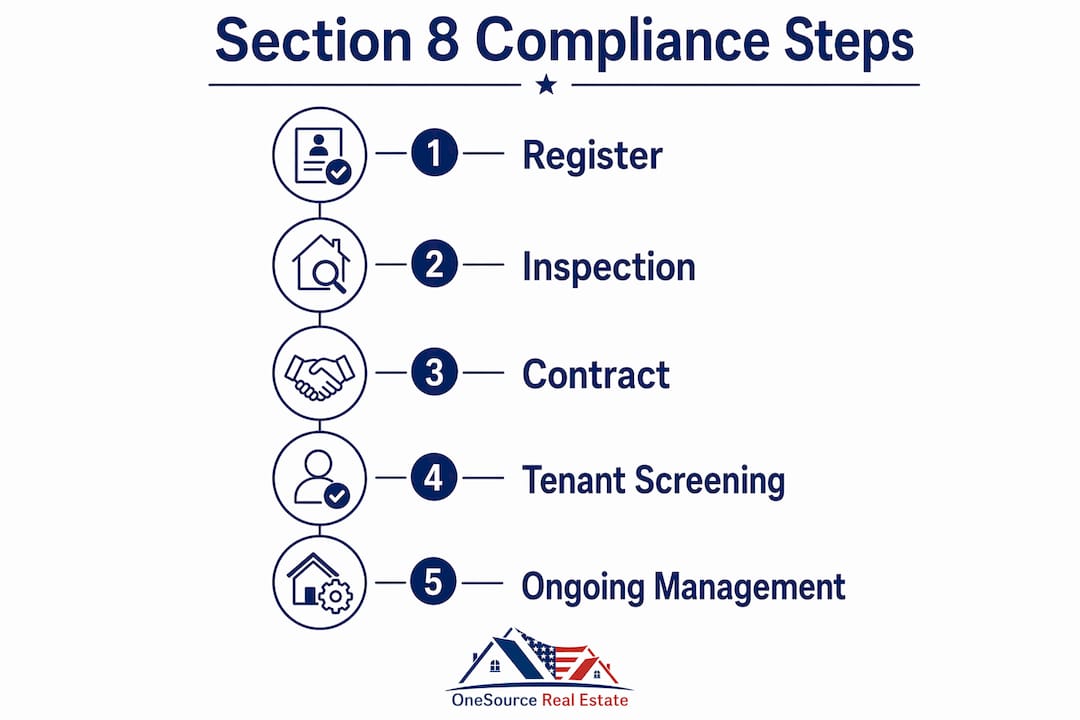
The compliance process follows a clear sequence:
- Register with the local PHA. Submit your property and ownership documentation to begin the approval process.
- Pass the initial HQS or NSPIRE inspection. HUD's Housing Quality Standards cover structural safety, utilities, sanitation, and habitability. The newer NSPIRE standard, which HUD has been phasing in, places greater emphasis on health hazards. The property must pass before any tenant moves in.
- Sign the Housing Assistance Payment (HAP) contract. This contract is signed only between the landlord and the PHA, not the tenant. It defines the subsidy amount, payment terms, and landlord obligations.
- Execute the lease with the tenant. The lease must include HUD's required tenancy addendum, which adds specific provisions around tenant rights and landlord conduct.
- Submit banking information to the PHA. Submitting banking details early prevents delays in receiving direct deposit payments after the lease is signed.
- Pass annual inspections. The PHA inspects the property every year. Failing an inspection triggers a payment suspension until repairs are completed.
- Follow proper rent increase procedures. No rent increases are permitted during the initial lease term. After that, landlords must submit a written request to the PHA and receive approval before raising rent.
Eviction rules also apply differently under Section 8. Landlords must follow standard state eviction procedures and notify the PHA simultaneously. Evicting a tenant without notifying the PHA can jeopardize the HAP contract.
Pro Tip: Never wait until move-in day to submit your banking information. PHAs process direct deposit setups on their own schedule. Submit everything the day you sign the HAP contract.
The HAP contract binds the landlord and PHA but excludes the tenant entirely. This means rent disputes and subsidy issues are resolved between the landlord and PHA, not through the lease. Understanding that separation prevents a lot of confusion during tenancy.
How should agents and landlords screen Section 8 tenants?
Tenant screening for Section 8 must follow the same standards applied to any private-market applicant. Screen Section 8 tenants identically to other renters, using credit checks, rental history verification, and background checks where permitted by local law. Applying stricter standards to voucher holders specifically violates the Fair Housing Act.
The voucher itself tells you nothing about the tenant's reliability. It confirms eligibility for assistance, not character or payment habits. Evaluate each applicant on the same criteria you use for every other rental.
Key screening criteria to apply consistently:
- Credit history. Look for patterns of debt management, not just a score. A thin credit file is different from a file full of collections.
- Rental history. Contact previous landlords directly. Ask about payment timeliness, property condition at move-out, and lease compliance.
- Background check. Follow your local jurisdiction's rules on criminal history screening. Some cities restrict what you can consider and when.
- Income verification. Voucher holders typically pay about 30%) of their adjusted monthly income toward rent. Verify that the tenant's personal income portion is stable and documented.
- References. Personal and professional references add context that credit reports miss.
The tenant's voucher amount is set by the PHA based on local payment standards. If your asking rent exceeds the payment standard, the tenant pays the difference. That gap affects affordability, so confirm the voucher amount before proceeding with an application.
For investors managing Section 8 properties in Decatur, GA or nearby Atlanta suburbs, consistent screening documentation protects you in any fair housing audit.
What are the best practices for managing Section 8 rental properties?
Ongoing management of a Section 8 property requires more structure than a standard rental. The PHA monitors compliance continuously, and payment interruptions happen fast when standards slip.
Maintaining HQS compliance year-round
Failure to maintain HUD's Housing Quality Standards results in suspension or termination of HAP payments. That is not a warning. It is the rule. Proactive maintenance prevents the scenario where a failed annual inspection cuts off your income mid-month.
Schedule a self-inspection 60 days before the PHA's annual visit. Walk the property using HUD's HQS checklist, which covers smoke detectors, HVAC function, plumbing, window condition, and structural integrity. Fix anything that would fail before the official inspector arrives.
Managing rent adjustments and lease renewals
Rent increases require advance written notice to the PHA, typically 60 days before the lease renewal date. The PHA evaluates the request against local payment standards and comparable rents. Requests that exceed the payment standard are often denied or partially approved, so price your increases realistically.
Document every communication with the PHA in writing. Email is preferable to phone calls because it creates a record. If a dispute arises over an inspection finding or a rent increase denial, written documentation is your only defense.
Handling payment timing and subsidy delays
| Situation | Recommended action |
|---|---|
| HAP payment not received by the 5th | Contact PHA landlord services immediately with your HAP contract number |
| Failed inspection finding | Complete repairs within the PHA's stated timeframe and request reinspection in writing |
| Tenant moves out mid-month | Notify PHA within 24 hours to stop subsidy and avoid overpayment clawback |
| Rent increase request denied | Request a written explanation and resubmit with comparable market data |
Pro Tip: Set up a separate bank account for Section 8 subsidy deposits. This makes tax reporting cleaner and immediately flags any payment discrepancy.
For landlords managing multiple units, rent collection services that integrate with PHA payment schedules reduce administrative errors and keep your records audit-ready.
Key Takeaways
Successful Section 8 participation requires strict compliance with HUD standards, equal tenant screening, and consistent PHA communication to protect subsidy income.
| Point | Details |
|---|---|
| Agent role is facilitation | Agents market properties and guide landlords but cannot compel voucher acceptance. |
| HAP contract is landlord-PHA only | The tenant is not a party to the HAP contract, separating subsidy and lease obligations. |
| Screen all tenants equally | Applying stricter standards to voucher holders violates the Fair Housing Act. |
| HQS compliance protects income | Failed inspections suspend HAP payments immediately, so proactive maintenance is non-negotiable. |
| Submit banking info early | Early direct deposit setup with the PHA prevents payment delays after lease signing. |
What I've learned working Section 8 deals in Atlanta
The biggest mistake I see landlords make is treating Section 8 as a last resort. They come to it reluctantly, after a vacancy drags on, and they enter the program with low expectations. That mindset creates problems. Landlords who approach Section 8 as a deliberate investment strategy, not a fallback, consistently outperform those who stumble into it.
The PHA relationship is everything. I have seen landlords with identical properties get completely different outcomes based solely on how well they communicate with their local housing authority. The landlords who call proactively, submit paperwork early, and show up to inspections prepared get faster approvals and fewer payment delays. The ones who treat the PHA as an adversary fight every step.
Tenant screening is where I see the most legal risk. Investors sometimes apply informal extra scrutiny to voucher holders that they would never apply to a market-rate applicant. That is a Fair Housing Act violation waiting to happen. The equal treatment standard is not optional, and it is not a technicality. Apply your criteria uniformly and document everything.
The income stability argument for Section 8 is real. A significant portion of the rent comes directly from the federal government. That portion does not bounce. For investors building long-term rental income in the Atlanta market, that reliability is worth the compliance overhead.
— Matt
OneSource Real Estate and Section 8 property management
Managing a Section 8 rental property involves PHA contracts, annual inspections, rent adjustment timelines, and tenant compliance, all running simultaneously. For investors who want the income without the administrative load, professional property management makes the difference.

OneSource Real Estate provides full-service property management for residential rental properties across Atlanta and surrounding areas, including properties participating in the Housing Choice Voucher Program. The team handles PHA communication, inspection preparation, lease compliance, and tenant relations so landlords receive their subsidy income without the paperwork burden. If you own or are considering a Section 8 rental in the Atlanta metro area, OneSource Real Estate has the local expertise to keep it running correctly.
FAQ
What does a real estate agent do for Section 8 housing?
A real estate agent helps landlords find and market Section 8 rental listings and guides tenants in locating properties accepting Section 8 vouchers. Agents cannot require landlords to accept vouchers unless local source-of-income discrimination laws apply.
How do landlords qualify to rent to Section 8 tenants?
Landlords register with their local PHA, pass an initial HQS or NSPIRE property inspection, and sign a Housing Assistance Payment contract before any voucher tenant moves in.
Can landlords screen Section 8 tenants the same way as other renters?
Yes. Landlords must apply identical screening criteria to all applicants. Stricter standards applied specifically to voucher holders violate the Fair Housing Act.
How much rent does a Section 8 tenant pay directly?
Voucher holders typically pay about 30% of their adjusted income) toward rent, with the PHA covering the remainder up to the local payment standard.
What happens if a Section 8 property fails an inspection?
The PHA suspends HAP payments until the landlord completes required repairs and passes a reinspection. Proactive maintenance before the annual inspection prevents this outcome.