
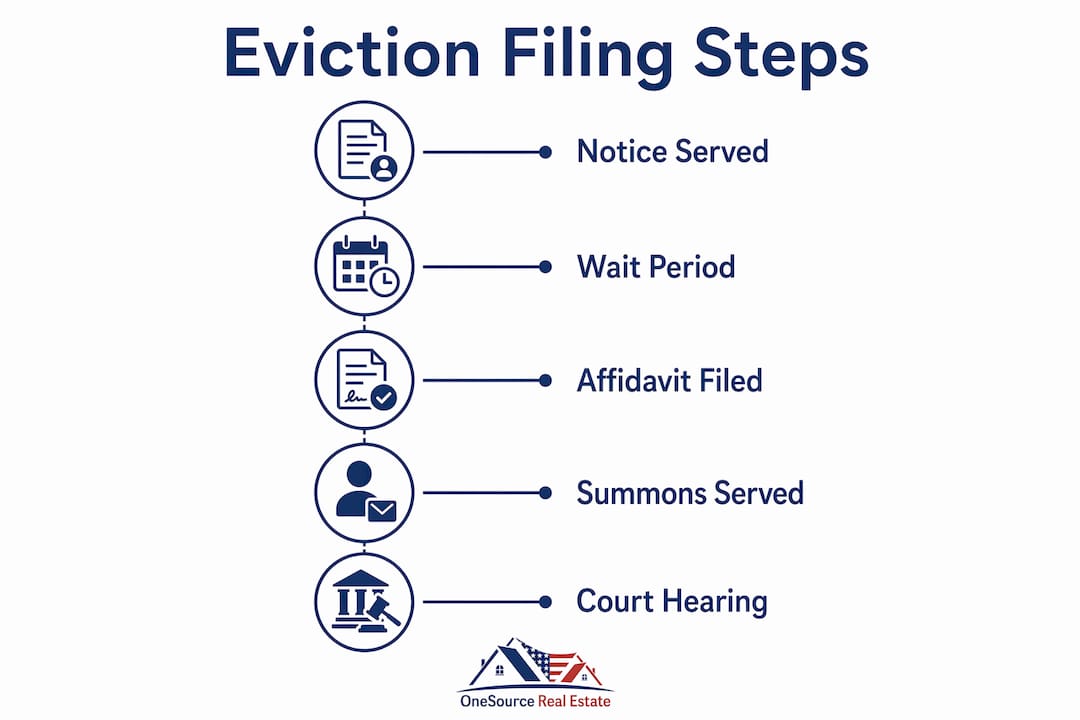
Filing an eviction notice in Georgia means submitting a dispossessory affidavit to your local magistrate court. That single document kicks off the entire legal process. Before you file, you must give the tenant proper written notice, and after you file, the court serves the tenant and sets a response deadline. Here is what the process looks like at a glance:
- Give written notice first. For non-payment of rent, Georgia law requires at least a 3-business-day written notice to pay or vacate before you can file anything.
- File the dispossessory affidavit at the magistrate court in the county where the rental property sits, signed under oath before a deputy clerk or notary.
- The court serves the tenant. The sheriff or a process server delivers the summons using personal delivery, delivery to a competent adult resident, or "tack and mail" if no one is home.
- The tenant has 7 days to answer, excluding weekends and legal holidays. No answer means you can seek a default judgment.
- A writ of possession is the final enforcement order. Once issued, the tenant has 7 days to vacate before the sheriff steps in.
Self-help eviction tactics, including changing the locks or cutting off utilities, are illegal under Georgia law. Every step runs through the court.
What are the legal grounds for eviction in Georgia?
You cannot file a dispossessory without a lawful reason. Georgia courts will dismiss a case that lacks a valid legal basis, so identifying your grounds before you draft anything is the right starting point.
Under O.C.G.A. § 44-7, the most common grounds are:
- Non-payment of rent or fees. The tenant failed to pay rent or other charges due under the lease.
- Lease violation. The tenant breached a specific lease term, such as unauthorized pets, subletting without permission, or property damage.
- Holdover tenancy. The lease expired and the tenant remains without a new agreement or your consent.
- Illegal activity. Criminal conduct on the premises can support eviction, though documentation requirements are strict.
Read your lease before you do anything else. The Georgia Landlord-Tenant Handbook makes this point plainly: the landlord must comply with whatever notice and termination procedures the lease spells out. If your lease requires a 30-day written notice for a lease violation, skipping that step gives the tenant grounds to challenge the filing. Even when the law sets a minimum, your lease may require more.
One thing Georgia courts will not accept: evicting a tenant simply because you want the property back with no legal basis. Grounds must be real, documented, and provable.
How do you serve the required notice before filing?
The written notice is not a formality. For non-payment cases, Georgia law requires you to give the tenant at least a 3-business-day written notice to pay the overdue amount or vacate before you can file a dispossessory. Skip this step and the court will likely dismiss your case.
What the notice must include:
- The tenant's name and the property address
- The exact amount owed, broken down clearly
- The deadline to pay or vacate (at least 3 business days from service)
- Your name and contact information as the landlord
How to serve it:
- By lease terms. If your lease specifies a notice method, use it.
- Posting on the door. Place the notice in a sealed envelope and attach it to the main entry door of the unit.
- Personal delivery. Hand it directly to the tenant.
Keep a written record of when and how you served the notice. Date it, note the method, and if possible take a photo of the posted envelope. That record becomes evidence if the tenant later claims they never received notice. For lease violations other than non-payment, the demand for possession does not need to be in writing under Georgia law, but a written, dated demand is always stronger in court than an oral one.
How do you file the dispossessory affidavit with the magistrate court?
Once the notice period passes and the tenant has not paid or left, you can file. The dispossessory affidavit is the formal legal document that starts the eviction lawsuit, and accuracy here is not optional.

Where to file: The magistrate court in the county where the rental property is located. Some counties allow online filing; check your county's magistrate court website or call the clerk's office to confirm. Georgia Courts maintains a court locator to help you find the right office.
What the affidavit must include:
- Your full legal name as the landlord
- The tenant's full legal name (get this right; errors here can invalidate service)
- The property address
- The specific reason for eviction
- Confirmation that you demanded possession and the tenant refused
- Confirmation that you provided the 3-business-day notice, if the reason is non-payment
- The total amount of unpaid rent or fees owed, if you are claiming money damages
In many Georgia counties, you do not need to produce a written lease to file, but the tenant's name and property address must be exact. If you are claiming unpaid rent, state the amount clearly. You can attach a copy of the lease or payment records to support the claim.
Signing the affidavit: You must sign under oath before a deputy clerk at the courthouse or before a notary public. This is not a step you can skip or do informally. An unsworn affidavit will be rejected.
Filing fees: Expect to pay around $54 to file, plus approximately $35 per defendant for the sheriff to serve the summons. Additional fees apply if there are unnamed occupants or multiple defendants. Fees vary by county, so confirm the exact amount with the clerk before you show up.
How does the court serve the tenant with the eviction summons?
After you file, the court takes over the service process. You do not serve the tenant yourself. The sheriff, a deputy, or a lawful constable delivers the dispossessory summons and affidavit to the tenant using one of three approved methods:
- Personal delivery. The sheriff hands the documents directly to the tenant.
- Delivery to a competent adult resident. If the tenant is not home but another adult who lives there is present, the sheriff can serve that person.
- Tack and mail. If no one is home, the sheriff posts a copy of the summons and affidavit on the door and mails a copy by first-class mail to the tenant's last known address on the same day. The postmark date must match the posting date; a mismatch gives the tenant grounds to challenge service.
Tack and mail is the most common method in practice. One important limitation: if the dispossessory was served by tack and mail and the tenant does not file an answer, the court can order the tenant to vacate but cannot award you a money judgment for unpaid rent. If the tenant does file an answer after tack and mail service, the court can then award money damages.
The date of actual service starts the tenant's response period. Make sure you note that date.
Pro Tip: Ask the clerk's office for a copy of the return of service once the sheriff completes delivery. That document is your proof that service happened correctly, and you will want it in hand before any hearing.
What happens when the tenant files an answer?
Tenants have 7 days from the date of actual service to respond, either in writing or orally to the clerk. If the seventh day falls on a Saturday, Sunday, or legal holiday, the deadline extends to the next business day.
What each outcome means for you:
- No answer filed. You can request a default writ of possession. The court can order the tenant to vacate without a hearing.
- Answer filed. The eviction pauses. The court schedules a hearing, typically within 7 days of the answer. Both you and the tenant present evidence and arguments.
- Answer filed with a tender defense. The tenant may claim they offered to pay all rent and fees owed plus court costs. If the court finds the offer was valid and you refused it, the tenant may be allowed to stay. This defense is available to a tenant only once in any 12-month period.
Prepare for the hearing as if the tenant will answer. Bring your lease, all payment records, copies of the notices you served, the affidavit, and any photos or written communications relevant to the case. If the case cannot be resolved within two weeks of service, the court may require the tenant to pay ongoing rent into the court registry while the case is pending. Failure to make those payments results in eviction.
How do you enforce a writ of possession after winning?
Winning the court judgment is not the same as getting your property back. The writ of possession is a separate document, and you must request it from the court after a favorable ruling.
Once the court issues the writ:
- The tenant has 7 days to vacate voluntarily.
- If the tenant does not leave within those 7 days, the sheriff returns to physically remove them and their belongings.
- You cannot remove the tenant yourself, change the locks while they are still inside, or dispose of their property without following the legal process.
The writ of possession is what gives the sheriff legal authority to act. Without it, even a court judgment does not let you physically remove anyone. Request the writ promptly after the ruling; delays on your end extend the time before you regain possession.
If the tenant leaves belongings behind after removal, Georgia law governs how you handle abandoned property. Do not throw anything away immediately without checking the applicable rules in your county.
What are the timelines, costs, and practical tips for Georgia evictions?
The full eviction process in Georgia typically takes several weeks from first notice to physical removal, depending on whether the tenant answers and whether a hearing is needed. Here is a summary of the key deadlines:
| Stage | Deadline |
|---|---|
| Written notice (non-payment) | At least 3 business days before filing |
| Tenant's answer deadline | 7 days from actual service (extended for weekends/holidays) |
| Hearing after tenant answers | Usually within 7 days of the answer |
| Tenant vacates after writ | 7 days from writ issuance |
Costs to budget for:
- Filing fee: approximately $54
- Sheriff service fee: approximately $35 per defendant
- Additional fees for multiple or unnamed occupants vary by county
Practical tips that save landlords real headaches:
- Do not accept partial rent after filing. Once you file the dispossessory, accepting any partial payment can legally halt the eviction and give the tenant a defense. If the tenant offers money, consult an attorney before accepting anything.
- Verify county-specific procedures. Some counties have unique forms or local filing rules. Call the magistrate clerk's office before you go. A quick phone call can prevent a wasted trip and a rejected filing.
- Check for online filing options. A growing number of Georgia magistrate courts allow landlords to file dispossessory affidavits online. Your county's court website is the fastest way to find out.
- Track your rent collection records carefully from day one. Clean documentation of every payment and every missed payment is your strongest evidence at any hearing.
For landlords managing properties under a Georgia Realtors lease, the lease terms on notice and termination govern your first steps, so read that section carefully before you draft any demand.
What mistakes do landlords make when filing eviction notices in Georgia?
Most failed evictions trace back to one of a handful of preventable errors. Knowing them ahead of time is the difference between a clean case and a dismissal.
Affidavit errors and missing notarization. The dispossessory affidavit must be signed under oath before a deputy clerk or notary. An unsigned or unsworn affidavit gets rejected at the counter. Beyond the signature, errors in the affidavit such as a misspelled tenant name, wrong property address, or incorrect dollar amount can delay your case or get it dismissed entirely. Double-check every field before you sign.
Accepting partial rent after filing. This one catches landlords off guard. Once the dispossessory is filed, accepting even a partial payment from the tenant can legally stop the eviction. The tenant gains a defense, and you may have to start over. If the tenant hands you money after filing, do not accept it without legal advice.
Skipping or botching the pre-filing notice. Serving the 3-business-day notice incorrectly, or not keeping proof that you served it, gives the tenant an easy path to challenge the case. Always document the method, date, and delivery of every notice you send.
Ignoring local court rules. Georgia has 159 counties, and magistrate courts are not uniform. Some require specific local forms. Others have particular filing windows or fee structures. What works in DeKalb County may not work in Paulding County. Confirm the local rules with the clerk before you file.
Attempting self-help eviction. Changing locks, removing the tenant's belongings, or shutting off utilities to force a tenant out exposes you to civil liability. Georgia courts take this seriously, and a tenant who can prove self-help tactics were used against them has grounds to sue.
Pro Tip: Set a calendar reminder to review the Georgia Landlord-Tenant Handbook at least once a year. Georgia eviction law does get updated, and a procedure that was correct last year may have changed. Staying current costs you nothing; getting blindsided in court costs you the case.
Key Takeaways
Filing an eviction in Georgia requires a dispossessory affidavit filed with the magistrate court, preceded by proper written notice and followed by legal service, a tenant response window, and a writ of possession to enforce the judgment.
| Point | Details |
|---|---|
| Pre-filing notice | Serve a written 3-business-day notice to pay or vacate before filing for non-payment. |
| Dispossessory affidavit | File at the magistrate court in the property's county; sign under oath before a clerk or notary. |
| Filing costs | Expect approximately $54 to file plus approximately $35 per defendant for sheriff service. |
| Tenant response window | Tenants have 7 days from actual service to answer; no answer allows a default judgment. |
| Writ of possession | Request separately after a favorable ruling; tenant has 7 days to vacate before sheriff enforces removal. |
FAQ
How much does it cost to file an eviction notice in Georgia?
Filing a dispossessory affidavit costs approximately $54 at the magistrate court, plus approximately $35 per defendant for the sheriff to serve the summons. Additional fees apply for multiple defendants or unnamed occupants, and exact amounts vary by county.
How do I get someone out of my house in Georgia?
You must file a dispossessory affidavit with the magistrate court in the county where the property is located, after first giving proper written notice. Once the court rules in your favor, request a writ of possession; the tenant then has 7 days to leave before the sheriff enforces removal.
Can you get evicted in Georgia without going to court?
No. Georgia law requires a landlord to obtain a court order before removing a tenant. Self-help tactics like changing locks or removing belongings are illegal, and a landlord who skips the court process faces civil liability.
How quickly can you evict someone in Georgia?
The timeline depends on whether the tenant files an answer. If no answer is filed within 7 days of service, you can seek a default judgment quickly. If the tenant answers, a hearing is typically scheduled within 7 days of that answer, and the full process from first notice to physical removal usually takes several weeks.
Managing the eviction process correctly takes time, documentation, and a clear understanding of Georgia law. If you would rather hand that burden to professionals, OneSource Real Estate provides full-service property management for Atlanta-area landlords, including eviction support, lease compliance, and tenant placement.