When a tenant breaks the lease, a Georgia landlord should document the violation, send a written notice that names the lease clause and what fixes the problem, and file a dispossessory case in magistrate court only if the tenant does not comply. Georgia sets no statutory cure period for ordinary lease violations, so your lease and your paper trail do most of the work. You can never change the locks or remove belongings yourself.
This guide walks through the process in order, with the Georgia rules that matter at each step.
TL;DR
- Document first: date, time, lease clause, photos, witnesses and every message with the tenant.
- For a non-monetary violation, Georgia has no minimum notice or cure period, so send a written notice with a clear fix and a calendar deadline anyway.
- Unpaid rent follows a separate track with its own written notice, and a tenant may have a one-time right to pay and stop the case.
- If the tenant does not comply, you file a dispossessory affidavit. The tenant has 7 days to answer after being served.
- Self-help (lock changes, removing belongings, cutting utilities) is illegal, even when the tenant is clearly in breach.
Table of Contents
- What counts as a lease violation
- Step 1: Build the file before you send anything
- Step 2: Send a written notice of noncompliance
- Unpaid rent is a different track
- Step 3: Handle the tenant's response
- Step 4: File a dispossessory case
- Step 5: Writ of possession
- What you must never do
- Enforcement habits that prevent repeat violations
- Our perspective
- How we can help
- FAQ
- Sources
What counts as a lease violation
A lease violation is any act or failure that goes against the terms of the lease. The Georgia Landlord-Tenant Handbook, published by the state's Department of Community Affairs, treats the lease as the controlling document, so the clauses you wrote decide what you can enforce.
Common violations include:
- Nonpayment of rent or other charges
- Noise and nuisance complaints
- Unauthorized pets or extra occupants
- Smoking in a non-smoking unit
- Subletting without permission
- Unapproved alterations
- Property damage
- Parking violations
Not every breach deserves the same response. A late fee dispute, a loud party and unauthorized occupants sit at very different points on the scale. Decide early whether you want the tenant to correct the problem or you want possession, because that choice shapes the wording of your notice.
Step 1: Build the file before you send anything
The landlord who wins is usually the one with the cleanest records. The American Association of Landlords recommends assembling the signed lease and addenda, rent ledger, written communications, photos or videos, neighbor complaints, repair requests and prior warnings before serving notice. That file matters most if the tenant later claims retaliation or discrimination.
For each incident, write down:
- The date and time, and what you or a witness observed
- The exact lease clause, word for word
- Timestamped photos or video
- Names and contact details of witnesses
- Every written message, and the tenant's response or silence
- The rent ledger and payment history, if money is involved
Keep the tone of your own messages factual. Texts written in anger tend to read badly when a judge sees them.
Step 2: Send a written notice of noncompliance
Georgia does not require a cure period for a regular lease violation. Nolo's Georgia guide explains that the three-day notice rule does not apply when a tenant violates the lease, and that a landlord can give as much or as little notice as they choose before filing under O.C.G.A. § 44-7-50(a). Your lease may still promise a cure period, and if it does, you must honor it.
Even where the law does not demand it, a clear written notice protects you. It shows the tenant knew what was wrong, how to fix it and what happens next. A strong notice includes:
- The names of the tenant and landlord and the property address
- The lease section violated
- The facts: what happened and when
- The exact action that cures the problem
- A deadline written as a calendar date, not "within a few days"
- The consequence if the tenant does not comply
Sample wording
Section 12 of your lease dated [date] prohibits pets without written approval. On [date] we observed a dog at the property. To cure this violation, remove the animal from the property by [calendar date] and confirm in writing. If the violation continues after that date, we may demand possession and pursue remedies available under Georgia law.
Adapt it to your lease and have your attorney review the final template.
Delivery matters as much as content
Use more than one method so you have independent proof of delivery: hand delivery with a signed acknowledgment, certified mail with return receipt, posting plus mailing, and email only if the lease authorizes it. Texting a notice or sliding it under a door without any record gives you little to show a judge.
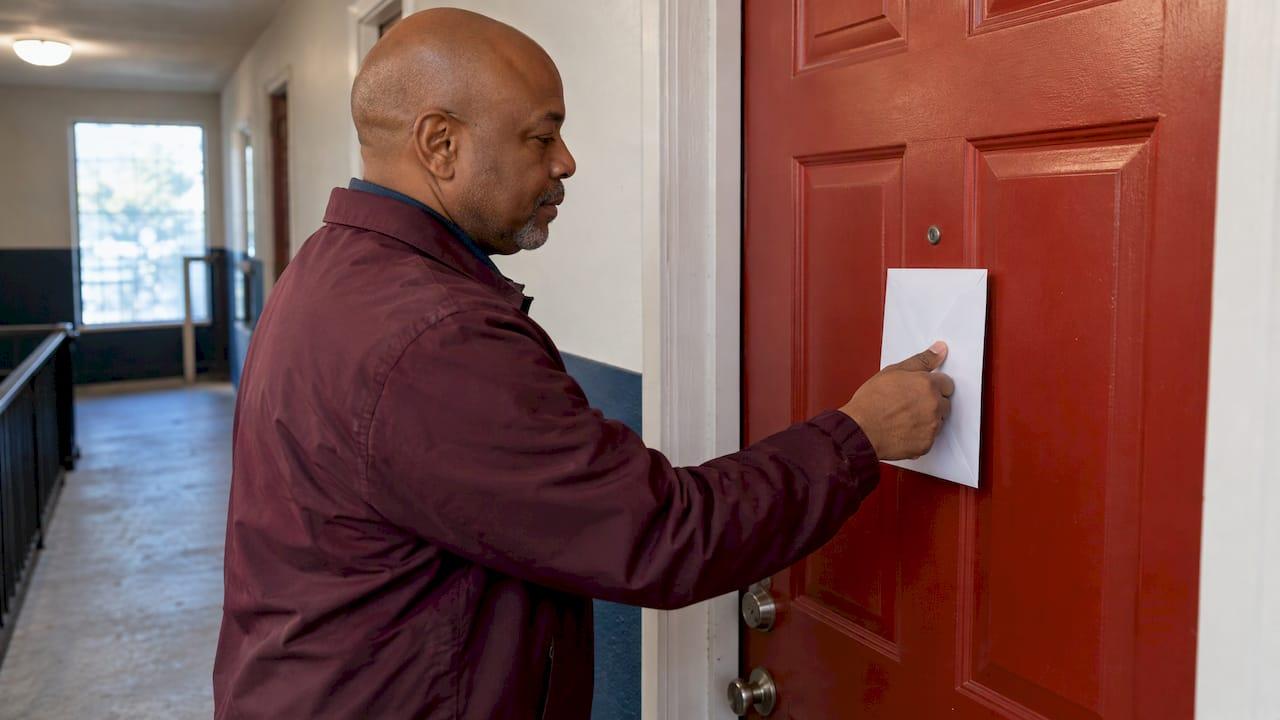
When you demand possession, Georgia law adds a requirement: the demand must be posted conspicuously on the door in a sealed envelope, along with any delivery method your rental agreement specifies. Our guide to notice to vacate in Georgia covers templates and statutes in detail.
Unpaid rent is a different track
Most of what you read online about a "three-day notice" concerns unpaid rent, not other violations. A rent default has its own written pay-or-vacate notice before you can file, and a separate tender defense in court (more on that below). Keep the two tracks apart in your files and your notices: a notice that mixes a rent demand with a pet violation invites confusion. For the filing sequence on rent cases, see how to file an eviction notice in Georgia.
Step 3: Handle the tenant's response
There are three outcomes after your notice goes out.
The tenant fixes the problem
Verify it yourself. Visit or inspect, photograph the result and get the tenant's confirmation in writing wherever possible. Then add a short note to the file closing the matter. If the same violation returns, your record of the first one shows a pattern.
If the violation is serious or repeated, a cure does not oblige you to renew. Georgia nonrenewal and month-to-month rules have their own notice periods, covered in our guides on nonrenewal notices and month-to-month tenancies.
The tenant disputes it
A disagreement does not stop you from proceeding, but be ready for the defenses a tenant can raise at a hearing. These include constructive eviction, failure to follow the statutory rules, and breach of the implied warranty of habitability, as summarized in the Georgia Courts' eviction policy report. Your documentation is your answer to each of them.
Retaliation is the claim landlords most often overlook. Under O.C.G.A. § 44-7-24, a tenant who reported a life, health, safety or habitability concern and then faces a landlord action within three months can establish a prima facie retaliation case. Remedies include a civil penalty of one month's rent plus $500 and court costs. If the tenant recently made a repair request, make sure your notice rests on a violation you can prove independently.

The tenant does nothing
This is where you move to a dispossessory case.
Step 4: File a dispossessory case
Georgia does not use the word "eviction" in the way many states do. The court process is called dispossessory. According to the Georgia Courts' policy report, the sequence runs like this:
- You make a demand for possession and, for nonpayment, give the required notice.
- You file a dispossessory affidavit under oath in the magistrate court of the county where the property sits.
- The sheriff or constable serves the summons and affidavit on the tenant.
- The tenant has 7 days from service to answer.
- With no answer, the court issues a writ of possession by default. With an answer, it sets a hearing where you must prove every element.
The Decatur Magistrate Court explains that service can be personal, by leaving the papers with a person over 18 at the residence, or, after attempting personal service, by tacking a copy to the door and mailing another. The same court notes that it offers free mediation on the day of the hearing. If the parties cannot agree, both sides present evidence to the judge.
Bring the full file to the hearing: lease, notice, proof of delivery, photos, ledger and communications. Organize them in date order.
The tender defense for rent cases
If the case is about unpaid rent, the tenant has a powerful option. Under O.C.G.A. § 44-7-52, a tenant who tenders all rent allegedly owed plus the cost of the dispossessory warrant within seven days of being served has a complete defense. A landlord must accept that tender from an individual tenant only once in any 12-month period. The Georgia handbook describes the same rule. This applies to money owed, not to other violations, so a pet or occupancy breach has no statutory pay-and-stay option.
Step 5: Writ of possession
After a judgment in your favor or a default, the court issues a writ of possession. The sheriff or constable, not you, executes it and sets the tenant out. Timing and application details are in our Georgia writ of possession guide. Do not schedule movers or re-list the unit until the writ has actually been executed.
What you must never do
Georgia prohibits self-help against a residential tenant under O.C.G.A. § 44-7-55. The state handbook says the only lawful ways to remove a tenant are the tenant's consent or a court order. That holds even when the tenant has plainly broken the lease. A landlord who changes locks, removes belongings or blocks access risks criminal charges and civil liability, including punitive damages for trespass to the tenant's property. The handbook also says a landlord may not knowingly and willfully suspend utilities until after the judge's final decision.
It also notes that Georgia has no government agency that can step in and force either side to act. Your lease, your records and the court are the whole system.
If a tenant has left and abandoned belongings, a different set of rules applies. See our abandoned property playbook.

Enforcement habits that prevent repeat violations
Most lease problems are cheaper to prevent than to litigate. These habits work for landlords of any size:
- Screen carefully and set expectations at move-in. Walk the tenant through the lease clauses that cause the most trouble: pets, occupants, parking, noise. Our tenant move-in process guide lays out the steps.
- Respond to the first incident. A tolerated violation is hard to enforce later. A short dated email after the first complaint keeps the record intact.
- Enforce consistently. Treating similar tenants differently invites discrimination claims.
- Keep every conversation in writing. If something is said by phone, send a follow-up summary.
- Calendar your lease dates. Renewals, rent increases and nonrenewals have their own notice rules, including those in our rent increase notice guide.
Our perspective
Most landlords who call us about a lease violation have the same problem: they know what happened, but they can't prove it on paper. The tenant knows it too.
We run our management around that reality. Every violation gets documented the day it is reported, every notice is tied to a specific lease clause, and every delivery leaves a record. We keep rent ledgers, communications and inspection photos in one place so a file is ready when it is needed.
Georgia gives landlords wide latitude on lease violations, and that latitude cuts both ways. With no statutory cure period, a sloppy process loses cases that a careful one would win. For owners with one or several rentals in Atlanta and the surrounding area, we think the better answer is a full-service management team that handles screening, lease drafting, enforcement and court coordination consistently, so you are not learning dispossessory procedure for the first time at a hearing.
That is the work we built our team around: clear communication, transparent pricing and a process you can read in advance.
Matt
How we can help
If you would rather not run notices, deadlines and court filings yourself, our property management service covers tenant screening, placement, rent collection, financial reporting, maintenance coordination, legal compliance, eviction support, lease drafting and renewal. Monthly management is 10% per month, with a one-off $250 onboarding fee and a $500 one-off lease renewal fee. The optional Owner Benefit Package (OBP™) is $40 per month per unit.

If you are weighing how to structure your rental portfolio or want a second opinion on a problem tenancy, our investment consulting sessions are a 30-minute call at $300 or a 60-minute deep dive at $500.
FAQ
How much notice does Georgia require for a lease violation?
For ordinary lease violations, Georgia sets no minimum notice or cure period. As Nolo explains, the three-day notice rule does not apply to them. Your lease may set its own cure period, so check it first, and put your demand in writing with a calendar deadline.
Can I evict a tenant immediately for a violation?
No. You can demand possession, but only a court order can remove the tenant. Georgia prohibits self-help under O.C.G.A. § 44-7-55, as the state handbook states. Once the tenant is served with a dispossessory summons, they have 7 days to answer.
What should a notice of noncompliance include?
Include the parties, the property, the specific lease section, the facts, the exact cure, a calendar-date deadline and the consequence of not complying. Deliver it by more than one method, such as hand delivery with a signed acknowledgment plus certified mail, so you hold several records of delivery.
What if the tenant pays the rent owed after I file?
In a nonpayment case, a tenant who tenders all rent owed plus the dispossessory warrant costs within seven days of being served has a complete defense under O.C.G.A. § 44-7-52. A landlord must accept that tender only once in any 12-month period.
Can a tenant claim retaliation?
Yes. If a tenant raised a life, health, safety or habitability concern and you took action within three months, Georgia law allows a prima facie retaliation case. Documented, independent grounds for your notice are your best protection.
Sources
- Georgia Landlord-Tenant Handbook (Georgia DCA)
- Georgia Courts eviction policy report (PMAP 8900)
- Dispossessory, Decatur Magistrate Court
- O.C.G.A. § 44-7-52, FindLaw
- O.C.G.A. § 44-7-24, Justia
- Georgia eviction process, Nolo
- How to evict a tenant, American Association of Landlords