
In Georgia, you can only regain possession of your rental property through a court-issued writ of possession — and that writ comes only after you win a dispossessory judgment. No judgment, no writ. No writ, no lawful lockout. Here is the short version of what must happen before law enforcement can remove a tenant:
- Win the dispossessory judgment in magistrate court
- Wait out the appeal window (typically seven days after judgment under OCGA §44-7-55)
- Apply for and schedule execution of the writ with the clerk and local sheriff
Before you file anything, call the clerk's office to confirm the current form name and any local filing fee. County practice varies more than most landlords expect.
Key takeaways
A Georgia landlord cannot execute a lawful lockout without a court-issued writ of possession — the judgment alone authorizes nothing, and every step from filing to execution is governed by OCGA §44-7-55.
| Point | Details |
|---|---|
| Judgment is required first | No writ can be issued without a favorable dispossessory judgment from magistrate court. |
| Seven-day wait is mandatory | The writ cannot be executed until seven days after judgment; premature filing will be rejected. |
| 30-day execution deadline | Apply for execution within 30 days of writ issuance or you must start the writ process over. |
| Self-help is illegal | Changing locks or removing property without an executed writ exposes landlords to wrongful-eviction liability. |
| OneSource Real Estate | Handles the full dispossessory workflow for Atlanta-area landlords, including sheriff coordination and on-site execution. |
Table of Contents
- What Georgia law actually says about writs of possession
- How to obtain a writ of possession in Georgia, step by step
- Key timelines and deadlines to track
- How execution works and what happens to tenant property
- Can an eviction be stopped after a writ is issued?
- Common fees, forms, and where to file in Georgia
- Common landlord mistakes that create liability
- How a professional property manager handles writs and evictions
- What the writ process reveals about landlord risk
- OneSource Real Estate handles the writ process so you do not have to
- Sources
- FAQ
What Georgia law actually says about writs of possession
OCGA §44-7-55 is the controlling statute. Its plain-language meaning for landlords breaks down into four practical rules:
What that means in practice:
- Seven-day wait. Even after you win, the writ cannot be executed until seven days have passed from the date of judgment. Filing the application before that window closes will get it rejected.
- Removal authority. The executing officer (sheriff, deputy, or marshal) is authorized to remove both the tenant and their belongings. You do not need a separate court order for the property.
- Abandoned property. Once removed, the tenant's personal property is legally treated as abandoned under §44-7-55(c). The landlord is not a bailee and owes no duty of care to the tenant regarding those items.
- 30-day execution deadline. The application for execution must generally be filed within 30 days of the writ's issuance. Miss that window and you need a new writ, which means additional fees and scheduling delays.
- Off-duty officer option. HB 1203 (2024) amended Article 3 to let landlords hire a certified off-duty peace officer if local law enforcement cannot execute the writ within 14 days of the request. The sheriff retains oversight and must receive five days' written advance notice of the planned execution date.
How to obtain a writ of possession in Georgia, step by step
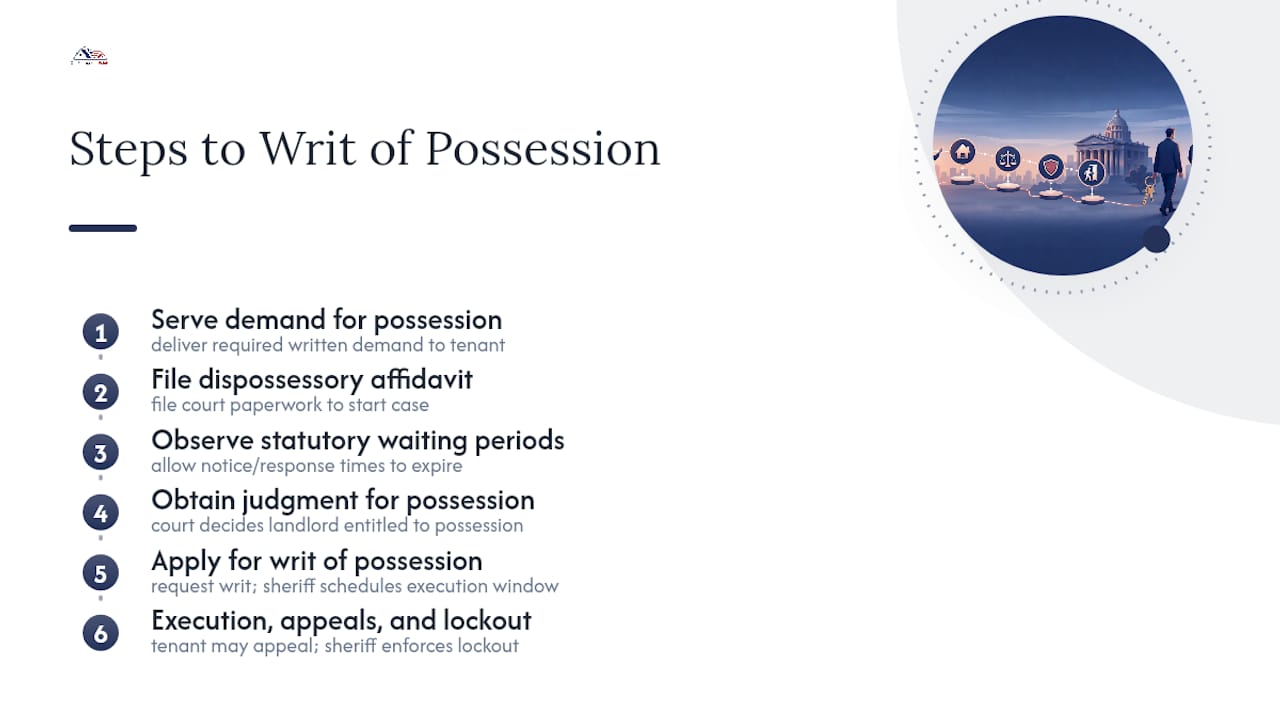
The process runs in a fixed sequence. Skipping or reordering any step is the fastest way to get your case dismissed.
Before you file
Document your demand for possession. Georgia courts treat this as a threshold requirement. A written demand sent by certified mail (with the return receipt) or hand-delivered with a witness is the standard. Fulton County Magistrate Court and other county pages flag missing demand documentation as a common dismissal point. Review your lease documentation to confirm the notice terms required under your specific agreement.

Filing the dispossessory affidavit
File a Dispossessory Affidavit (sometimes called a Dispossessory Complaint) at your county's magistrate court. The affidavit states the grounds for eviction: nonpayment of rent, lease violation, holdover tenancy, or other statutory basis. The court then serves the tenant.
Tenants have seven days from service to file a written answer. If no answer is filed, you may request a default judgment on the eighth day. If the tenant answers, the court schedules a hearing.
After judgment: applying for the writ
Once judgment enters in your favor, wait the seven-day statutory period, then file the Application for Writ of Possession with the clerk. Bring:
- A copy of the signed judgment with the case number
- Proof of service on the tenant
- The completed Application for Writ of Possession (get the current version from your county clerk)
- Payment for the court filing fee and the sheriff's execution fee
- Your contact information and the property address for the sheriff's scheduling office
After the clerk issues the writ, deliver it to the sheriff's civil division and pay the execution fee. The sheriff schedules the lockout date. See the eviction notice filing guide for a fuller breakdown of the pre-filing steps.
Key timelines and deadlines to track
Missing a single deadline can force you to restart the entire process.
| Milestone | Typical timeframe |
|---|---|
| Tenant answer period after service | 7 days |
| Default judgment request (if no answer) | More than 7 days after service |
| Earliest writ application after judgment | More than 7 days after service |
| Deadline to apply for execution | Within 30 days of writ issuance |
| Off-duty officer trigger (if sheriff cannot act) | 14 days after landlord's request |
| Advance notice to sheriff for off-duty officer | 5 days before planned execution |
Deadline alert: The 30-day execution window is the most commonly missed deadline in Georgia dispossessory cases. Courts generally require a new writ application — with new fees — if you miss it, per OCGA §44-7-55.
Sheriff scheduling backlogs vary significantly by county. In metro Atlanta counties, landlords often wait one to three weeks between writ issuance and the actual lockout date. Call the sheriff's civil division the same day you deliver the writ to get a realistic execution date, and calendar the 30-day deadline from writ issuance immediately. If the sheriff cannot act within 14 days of your request, HB 1203 gives you the off-duty officer option.
How execution works and what happens to tenant property
On execution day, the sheriff or deputy follows a standard sequence. LegalClarity's practice guide notes that officers typically post a 24-hour notice before returning to physically remove the tenant and their belongings.
- Notice posting. The officer posts a final notice at the property, giving the tenant a short window to vacate voluntarily.
- Return and removal. If the tenant has not left, the officer returns and physically removes the tenant and their property from the premises.
- Lockout. The officer authorizes the landlord to change the locks. Many counties require the landlord or a representative to be present with a locksmith on execution day. Confirm this with your sheriff's office in advance.
- Property treatment. Under §44-7-55(c), removed property is legally abandoned. The landlord is not a bailee and has no legal duty to store or return it.
Even with that statutory protection, photograph and inventory everything removed. A timestamped photo record takes about 20 minutes and can defeat a wrongful-conduct claim that might otherwise cost thousands to defend. For landlords considering selling after an eviction, the tenant removal playbook covers property-clearing protocols in more detail.
Can an eviction be stopped after a writ is issued?
Yes, and it happens more often than landlords expect. Here are the main scenarios:
Tenant appeal. A tenant can appeal the dispossessory judgment, which typically stays execution pending the appeal outcome. The appeal must be filed within the statutory window (generally 30 days of judgment, though the tenant may need to post a supersedeas bond). If an appeal is filed, notify the sheriff immediately to pause scheduling.
Motion to stay. A tenant can file a motion to stay execution, which a judge may grant for cause. These are less common but can delay execution by days or weeks.
Tenant payment. In nonpayment cases, a tenant who pays all past-due rent, fees, and court costs before the writ is executed may be able to halt the eviction. The court decides whether to accept payment and dismiss the action.
Landlord checklist when a last-minute tenant action arrives:
- Contact the clerk immediately to confirm whether execution is paused
- Notify the sheriff's civil division to hold the scheduled lockout
- Preserve all judgment paperwork and the writ itself
- Consult an attorney if the tenant files a motion or appeal you did not anticipate
- If you believe the stay or appeal is improper, ask the court for an expedited hearing
Common fees, forms, and where to file in Georgia
Forms and fees are set at the county level, so what applies in Fulton differs from what you will find in Liberty or Gwinnett.
Common forms:
- Dispossessory Affidavit — filed at the magistrate court clerk's office to initiate the action
- Application for Writ of Possession — filed after judgment to request the writ
- Sheriff execution request — submitted to the sheriff's civil division with the writ
Where to get them: Download current versions from your county magistrate court's website. Fulton County Magistrate Court and Liberty County both publish dispossessory forms and procedural guidance online.
Typical fees landlords pay:
- Court filing fee for the dispossessory affidavit (varies by county)
- Application fee for the writ of possession (Liberty County lists a $25 application fee as an example)
- Sheriff's execution fee (varies; call the civil division for the current amount)
Pro tip: Call the clerk before you go. Form versions change, fees are updated, and showing up with an outdated form wastes a trip and delays your case.
Common landlord mistakes that create liability
The most expensive errors in Georgia dispossessory cases are not legal complexity — they are procedural shortcuts.
- Changing locks without a writ. A judgment alone does not authorize a lockout. Acting before the writ is issued and executed is illegal self-help under Georgia law and can expose you to damages.
- Shutting off utilities. Cutting power, water, or heat to force a tenant out is a separate legal violation, regardless of where you are in the eviction process.
- Mishandling tenant property before execution. Removing or disposing of a tenant's belongings before the writ is executed creates wrongful-conduct liability. The abandoned-property protection under §44-7-55(c) applies only after lawful execution.
- Missing the 30-day execution window. As noted above, a lapsed writ means a new application, new fees, and a fresh scheduling wait.
- Poor demand documentation. Fulton County Magistrate Court specifically flags missing or defective demand-for-possession proof as a frequent dismissal trigger.
Pro Tip: Build an evidence file from day one: save the original lease, every written communication with the tenant, the demand letter with proof of delivery, and all court filings in a single folder. Courts accept organized documentation; they cannot work with scattered texts and verbal recollections.
How a professional property manager handles writs and evictions
For landlords managing one or two properties, the dispossessory process is manageable but time-consuming. For anyone with a larger portfolio or properties spread across multiple Atlanta-area counties, the coordination overhead compounds fast.
A professional property manager typically handles:
- Documentation intake — lease review, demand letter drafting, and proof-of-delivery confirmation before any filing
- Court filing — submitting the Dispossessory Affidavit and tracking the tenant answer period
- Post-judgment coordination — filing the Application for Writ of Possession and delivering it to the sheriff's civil division
- Sheriff scheduling — following up with the civil division to confirm the execution date and calendar the 30-day deadline
- On-site execution presence — meeting the officer with a licensed locksmith, photographing the property, and securing the unit
- Post-eviction property handling — inventorying removed items and documenting the unit's condition
When to consider delegating: if you have never filed a dispossessory before, if your property is in a county with a known sheriff backlog, or if the tenant has already filed one appeal, the risk of a procedural error outweighs the cost of professional help. Local managers with established relationships at the magistrate court and sheriff's office move faster than landlords navigating those offices for the first time. For a look at how property management in Decatur handles eviction logistics locally, that guide covers the workflow in detail.
What the writ process reveals about landlord risk
Most landlords who run into trouble with writs of possession are not cutting corners on purpose. They simply do not know that a judgment and a writ are two separate things with two separate timelines. That gap in understanding is where the liability lives.
The seven-day wait feels arbitrary until you realize it exists to give the tenant a final opportunity to appeal. Skip it and you have not just made a procedural error — you have handed the tenant a wrongful-eviction claim. The same logic applies to the 30-day execution window. Courts do not grant extensions out of sympathy; they grant them when you file an affidavit showing good cause. "I forgot" is not good cause.
What actually protects landlords long-term is treating the writ process as a documentation exercise, not just a legal one. Every step — demand letter, affidavit, judgment, writ application, execution date, property inventory — should generate a paper record. That record is what makes a wrongful-conduct claim collapse before it reaches a hearing.
OneSource Real Estate handles the writ process so you do not have to
Eviction logistics in Georgia are manageable on paper and genuinely stressful in practice. OneSource Real Estate's full-service property management covers the entire dispossessory workflow for Atlanta-area landlords: demand letter drafting, court filing, post-judgment writ applications, sheriff coordination, on-site execution presence, and post-eviction property securing. You get local contacts at the magistrate courts and sheriff's civil divisions that most individual landlords spend weeks trying to reach.

If you are weighing whether to handle a writ yourself or bring in a manager, the honest answer is this: one missed deadline or one improperly handled piece of tenant property can cost more than a year of management fees. Contact OneSource Real Estate to discuss your property and get a clear picture of what full-service eviction support looks like for your situation.
Sources
- Landlord-Tenant (Dispossessory) | Fulton County Magistrate Court, GA
- Dispossessory | Liberty County, GA
- HB 1203 (signed legislation, 2024) — amendments to Article 3 of Chapter 7 of Title 44 (dispossessory proceedings)
- How do you get a writ of possession? | LegalClarity
Call your county magistrate court clerk to confirm current form versions and fee amounts before filing. Forms are updated periodically and the version on an older printout may not be accepted.
This article is general information, not a substitute for advice from a qualified lawyer. Consult a qualified legal professional about your own circumstances before acting on anything here.
FAQ
How long does a writ of possession take in Georgia?
From the date of judgment, expect a minimum of seven days before the writ can be executed, plus the time for the clerk to issue it and the sheriff to schedule the lockout. In metro Atlanta counties, total time from judgment to execution typically runs two to four weeks, depending on sheriff backlog.
Can an eviction be stopped after a writ of possession is issued?
Yes. A tenant can file an appeal or a motion to stay, which may pause execution. In nonpayment cases, a tenant who pays all amounts owed before execution may also halt the eviction. Notify the sheriff immediately if any last-minute legal action is filed.
What happens after a writ of possession is executed in Georgia?
The sheriff removes the tenant and their belongings, the landlord changes the locks, and the property is secured. Under OCGA §44-7-55(c), any personal property removed is legally treated as abandoned and the landlord has no duty to store or return it.

Can a tenant still pay after a writ of possession is issued?
In nonpayment cases, yes — but only before the writ is physically executed. Once the sheriff carries out the lockout, the eviction is complete. Whether the court accepts payment and dismisses the action before that point is at the judge's discretion.