
What are squatters rights in Georgia?
Georgia squatters rights do not grant unauthorized occupants any immediate claim to your property. Squatting is illegal from the moment it begins. The only legal mechanism that could eventually transfer ownership to an occupant is adverse possession, and Georgia sets a very high bar for it.
Under O.C.G.A. §§ 44-5-163 and 44-5-164, a squatter must satisfy five elements simultaneously for the entire statutory period:
- Actual possession: Physical use of the land consistent with its character
- Open and notorious: Visible occupation a reasonable owner would notice
- Exclusive: No shared use with the true owner or the public
- Hostile: Without the owner's permission at any point
- Continuous: Uninterrupted for the full period
The time requirement depends on title status. Without any written evidence of title, the clock runs for a long statutory period under O.C.G.A. § 44-5-163. With color of title (a defective but written instrument), the period drops to 7 years under O.C.G.A. § 44-5-164. If you ever give a squatter permission to be on your property, the hostile element fails and the clock resets entirely.
The 2024 Georgia Squatter Reform Act added a faster removal path and made unlawful squatting a criminal offense, shifting the legal landscape firmly in favor of property owners.

Table of Contents
- How to legally remove squatters from your Georgia property
- Understanding Georgia's adverse possession elements in depth
- What the 2024 Georgia Squatter Reform Act actually changed
- Best practices to protect your property from squatter claims
- What rights and responsibilities do squatters have under Georgia law?
- How squatters and tenants differ under Georgia law
- Notice requirements before eviction in Georgia
- Legal remedies beyond eviction for property owners
- How a squatter would establish an adverse possession claim
- Common defenses squatters raise against eviction
- Key Takeaways
- FAQ
How to legally remove squatters from your Georgia property
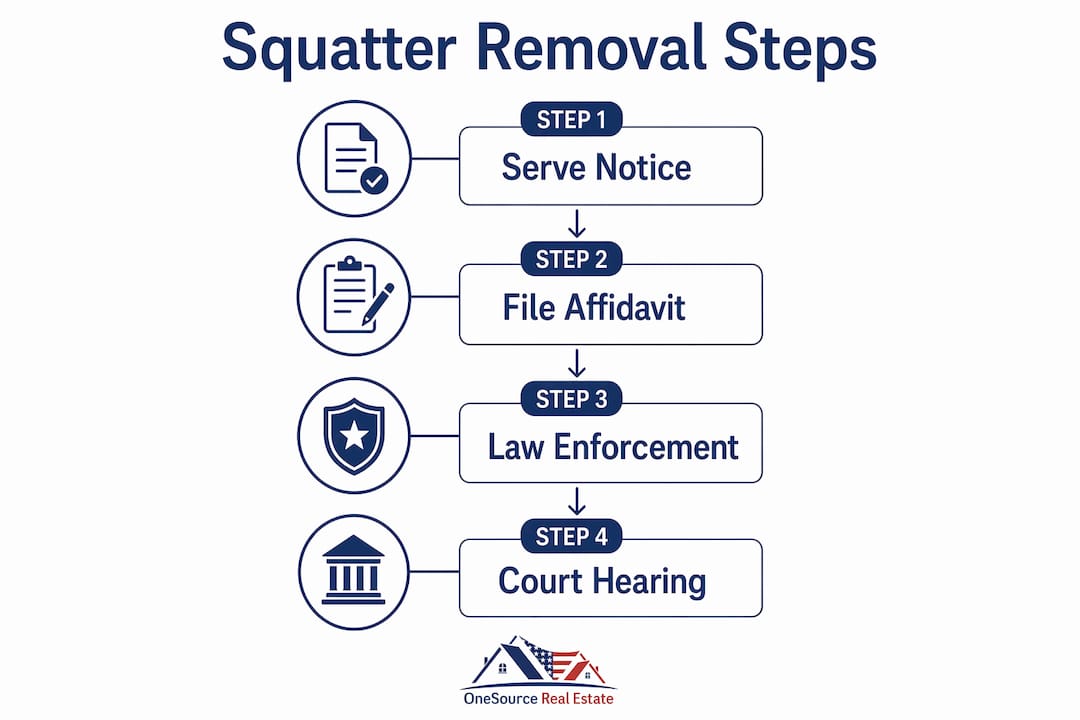
Georgia law gives you two primary tools, and the right one depends on whether a landlord-tenant relationship exists.
For true squatters with no legal connection to the property:
- File a sworn property affidavit in magistrate court under O.C.G.A. § 44-11-30, stating you are the lawful owner and the occupant has no legal right to be there
- The sheriff, deputy, constable, marshal, or any officer certified by the Georgia Peace Officer Standards and Training Council must exhibit the affidavit to the occupant at least three days before removal
- If the occupant files no counter-affidavit within those three business days, the officer removes them and a writ of possession is issued
- If a counter-affidavit is filed, a magistrate court hearing must be set within a short statutory period.
For occupants with a prior tenancy relationship:
- Serve a written demand to vacate
- File a dispossessory affidavit in magistrate court under O.C.G.A. §§ 44-7-50 through 44-7-59
- The occupant has 7 days to file a written answer; a hearing follows
What you cannot do: Changing locks, cutting utilities, or removing belongings without a court order are illegal self-help evictions in Georgia. Doing so exposes you to civil lawsuits and potential criminal charges, regardless of how clear-cut the squatter situation appears.
Pro Tip: Keep dated written records of every notice, communication, and visit to your property. A single documented interaction showing you acknowledged the occupant's presence, or granting any form of permission, can interrupt an adverse possession clock that has been running for years.
Understanding Georgia's adverse possession elements in depth
Georgia's adverse possession statute, O.C.G.A. § 44-5-161, requires that possession be public, continuous, exclusive, uninterrupted, and peaceable, accompanied by a claim of right, and not originating in fraud. Each element must hold for the entire prescriptive period, not just at the start.
Color of title makes a real difference. A deed with a flawed legal description or a gap in the chain of title still qualifies as color of title, cutting the required period from 20 years to 7 years. It also defines the boundaries of what can be claimed, so a squatter with color of title cannot claim more land than the defective instrument describes.
Georgia courts also allow "tacking," where successive occupants in privity with each other can combine their possession periods to reach the required total. A squatter who took over from a prior unauthorized occupant they had a direct relationship with could potentially count both periods.
The hostile element is the most vulnerable point in any adverse possession claim. Under O.C.G.A. § 44-5-161(b), permissive possession cannot form the foundation of a prescriptive title claim until the possessor makes an adverse claim and gives actual notice to the owner. One clear, documented grant of permission resets everything.
The "30-day squatter's rights" idea that circulates online has no basis in Georgia law. No one acquires any ownership interest after 30 days. The minimum is 7 years with color of title, and that requires satisfying all five elements without interruption.
What the 2024 Georgia Squatter Reform Act actually changed
Georgia's legislature passed HB 1017 in April 2024, effective April 24, 2024. The Act addressed a specific problem: law enforcement often refused to remove squatters who appeared to be residing in a property, leaving owners stuck in a slow eviction process that required a landlord-tenant relationship that did not exist.
Key changes under the Act:
- New criminal offense: O.C.G.A. § 16-7-21.1 makes unlawful squatting a misdemeanor. Upon conviction, penalties include a fine, up to 12 months in jail, or both under Code Section 17-10-3.
- Citation and 3-day window: Law enforcement issues a citation; the occupant has a short statutory period to produce a properly executed lease, rental agreement, or proof of rental payments
- No documentation, immediate arrest: Failure to produce documentation within the statutory period subjects the occupant to arrest
- Expanded officer authority: The Act amended O.C.G.A. § 44-11-30 to allow police, marshals, and all officers certified by the Georgia Peace Officer Standards and Training Council to serve affidavits and remove squatters, not just county sheriffs
- Magistrate court jurisdiction: Hearings for counter-affidavit situations must be held within 7 days in magistrate court, replacing the prior requirement for a jury trial in state or superior court
- Monetary damages: Courts may award the property owner fair market rent for the entire duration of the squatter's occupancy
One practical caveat: implementation varies by county. Law enforcement agencies are still developing uniform procedures, and not every magistrate court is scheduling hearings within the 7-day window consistently statewide.
Best practices to protect your property from squatter claims
Prevention is far cheaper than removal. Georgia property management in Decatur and across the metro area consistently shows that documented, proactive ownership habits stop adverse possession claims before they start.
- Inspect vacant properties regularly and document each visit with dated photos
- Post "No Trespassing" signs and keep records showing the property is actively monitored
- Use written leases for every occupant, even informal arrangements, and keep signed copies on file; a residential lease creates the legal paper trail that distinguishes tenants from squatters
- Send written notices any time you discover unauthorized use, and send them via certified mail so you have proof of delivery
- Never give informal verbal permission to anyone occupying your property without a lease; document any authorized use in writing immediately
- Act fast: The moment you discover a squatter, file the affidavit under O.C.G.A. § 44-11-30 rather than waiting to see if they leave on their own
- Hire professional property management for vacant or rental properties; a management company monitors occupancy, handles notices, and coordinates with law enforcement when needed
Self-help removal attempts, no matter how justified they feel, can void your legal position and expose you to liability. Georgia courts treat unauthorized lock changes and utility shutoffs as serious violations.
What rights and responsibilities do squatters have under Georgia law?
Squatters in Georgia have no ownership rights from unauthorized occupancy alone. They do, however, retain basic due process protections. Under the affidavit process, they have three business days to produce documentation before removal or arrest. If they file a counter-affidavit, they are entitled to a court hearing within 7 days. Courts will not remove someone without following the statutory process, even when ownership is clear.
A squatter's responsibility is straightforward: vacate immediately or produce legal documentation. Producing a fraudulent lease or fabricated rental agreement triggers additional criminal exposure under O.C.G.A. §§ 16-9-1 and 16-9-2, plus an additional fine based on the property's fair market monthly rental rate.
How squatters and tenants differ under Georgia law
The distinction matters enormously for which removal process applies. A tenant has a legal agreement, written or verbal, authorizing occupancy. A squatter has no such authorization at all.
The Georgia Squatter Reform Act tools apply only to true squatters. If any landlord-tenant relationship exists, even an informal month-to-month arrangement, the owner must use the dispossessory process under O.C.G.A. §§ 44-7-50 through 44-7-59. Attempting to use the faster affidavit process on a tenant can result in dismissal and potential liability. Courts look at the substance of the arrangement, not just what the parties call it.
Notice requirements before eviction in Georgia
For tenants, Georgia law requires a written demand to vacate before filing a dispossessory affidavit. The demand must state the reason for removal (nonpayment, lease violation, holdover, etc.) and give the tenant a reasonable opportunity to respond. After filing, the court serves a summons and the tenant has 7 days to file a written answer.
For squatters under the affidavit process, the officer must exhibit the owner's affidavit to the occupant at least three days before removal. This three-day notice is built into the O.C.G.A. § 44-11-30 procedure itself.
Legal remedies beyond eviction for property owners
Eviction or affidavit removal gets the person out. Georgia law also gives you financial remedies:
- Fair market rent damages: Under the 2024 Act, courts can award the full fair market rental value for the entire period of unauthorized occupancy
- Civil trespass lawsuit: A property owner can pursue a civil claim for damages caused by the squatter's occupation, including property damage and costs incurred
- Criminal prosecution referral: Under O.C.G.A. § 44-11-33, the court and plaintiff may present the final order to law enforcement for investigation or prosecution of the squatter
Working with a full-service property management team gives you access to legal compliance support and documentation practices that strengthen any civil claim.
How a squatter would establish an adverse possession claim
For a squatter to have any realistic adverse possession claim in Georgia, they would need to:
- Occupy the property physically and consistently, in a manner visible to any reasonable observer
- Exclude the true owner and the public from the land
- Never receive permission from the owner at any point during the entire period
- Maintain possession without interruption for 20 years (or 7 years with color of title)
- Assert a claim of right, meaning an honest belief they have a right to the property
The 2024 Act makes this even harder in practice. A property owner who files an affidavit under O.C.G.A. § 44-11-30 interrupts possession and resets the adverse possession clock, since the occupant can no longer claim uninterrupted, hostile possession after a formal legal challenge.
Common defenses squatters raise against eviction
Squatters facing removal in Georgia typically raise one of these arguments:
- Claiming a tenancy relationship: Producing a lease (genuine or fraudulent) to trigger the landlord-tenant eviction process instead of the faster affidavit removal
- Counter-affidavit filing: Asserting a good-faith legal right to possession, which forces a magistrate court hearing within 7 days
- Permissive possession: Arguing the owner gave permission, which would defeat the hostile element but also means they were never a squatter in the legal sense
- Disability protections: Georgia law protects minors and mentally incompetent individuals from losing property through adverse possession until the disability is removed
None of these defenses are automatic wins. Courts scrutinize documentation carefully, and fraudulent lease production carries its own criminal penalties under Georgia law.
Key Takeaways
Georgia squatters rights require a minimum of 7 or 20 years of uninterrupted adverse possession before any ownership claim is possible, and the 2024 Georgia Squatter Reform Act gives property owners a faster affidavit-based removal path.
| Point | Details |
|---|---|
| Adverse possession minimums | 20 years without color of title; 7 years with color of title under O.C.G.A. §§ 44-5-163 and 44-5-164. |
| 2024 Reform Act | HB 1017 made unlawful squatting a misdemeanor and created a 3-business-day affidavit removal process. |
| Self-help evictions are illegal | Changing locks or cutting utilities without a court order exposes owners to civil and criminal liability. |
| Permission resets the clock | Any documented grant of permission breaks the hostile element and restarts the adverse possession period. |
| Squatters vs. tenants | The affidavit process applies only to true squatters; tenants require the dispossessory process under O.C.G.A. §§ 44-7-50 through 44-7-59. |
FAQ
How long does a squatter have to stay before claiming rights in Georgia?
A squatter must maintain uninterrupted adverse possession for either 7 years with color of title or 20 years without it. The "30-day squatter's rights" claim is a myth with no basis in Georgia law.
What does the 2024 Georgia Squatter Reform Act do for property owners?
HB 1017, effective April 24, 2024, made unlawful squatting a misdemeanor under O.C.G.A. § 16-7-21.1, created a magistrate-court affidavit process allowing removal within 3 business days, and expanded which officers can serve affidavits and remove occupants.
Can I change the locks to remove a squatter in Georgia?
No. Self-help evictions, including lock changes and utility shutoffs, are illegal in Georgia regardless of the occupant's status. Use the affidavit process under O.C.G.A. § 44-11-30 for squatters or the dispossessory process for tenants.
What is the difference between a squatter and a trespasser in Georgia?
A trespasser enters briefly without permission; a squatter resides on the property without authorization. Under the 2024 Act, unlawful squatting is now a criminal offense treated similarly to criminal trespass, allowing law enforcement to issue citations and make arrests.
Does giving someone permission to stay on my property affect adverse possession?
Yes, directly. Permission breaks the hostile element required for adverse possession under O.C.G.A. § 44-5-161(b), and the prescriptive clock resets. Always document any authorized use in writing.