
In Georgia, the notice you need depends on why you're ending the tenancy. For nonpayment of rent, O.C.G.A. § 44-7-50 requires a written notice giving a short deadline to pay or vacate before a landlord can file a dispossessory affidavit. To terminate a month-to-month tenancy at will with no fault, O.C.G.A. § 44-7-7 requires the landlord to give at least 60 days' written notice; a tenant needs only 30 days.
Immediate next steps:
- Landlords: Serve the correct written notice, document delivery with a witness or certified mail, and wait out the statutory period before filing at your county magistrate court.
- Tenants who received a notice: Read it carefully for the type and deadline, pay any arrears within 3 business days if it's a pay-or-quit notice, and preserve the original document.
- Both parties: Gather every piece of written evidence now. Courts expect documentation, not memory.
One rule applies to everyone: Georgia law prohibits self-help removals. Changing locks, removing belongings, or cutting utilities without a court-ordered writ of possession is illegal. The only lawful path to removing a tenant is through the dispossessory process.
Key Takeaways
Georgia's notice-to-vacate rules are statute-specific: landlords must give 3 business days for nonpayment under O.C.G.A. § 44-7-50 and 60 days to end a tenancy at will under O.C.G.A. § 44-7-7, and both landlords and tenants must document every step to protect their position in court.
| Point | Details |
|---|---|
| Nonpayment notice period | Landlords must give 3 business days to pay or vacate before filing a dispossessory under O.C.G.A. § 44-7-50. |
| Tenancy-at-will termination | Landlords need 60 days' written notice; tenants need 30 days under O.C.G.A. § 44-7-7. |
| Tenant answer deadline | Tenants have 7 days from dispossessory service to file a written answer, excluding weekends and holidays. |
| Written demand for possession | A documented demand for possession is required before filing; oral demands frequently lead to dismissal. |
| OneSource Real Estate | Handles notice drafting, service documentation, and eviction coordination for Atlanta-area landlords. |
This article is general information, not a substitute for advice from a qualified lawyer. Consult a qualified legal professional about your own circumstances before acting on anything here.
Table of Contents
- What types of notice to vacate in Georgia apply to your situation?
- What to include in a Georgia notice to vacate: a checklist and sample wording
- How to serve a notice properly in Georgia so courts will accept it
- Step-by-step: what happens after a notice expires
- Tenant rights in Georgia and common defenses to a dispossessory
- Practical best practices landlords should follow to avoid procedural errors
- Where to get valid Georgia notice templates and how to adapt them safely
- Official statutes, court forms, and legal-aid links for Georgia notices
- How notice requirements differ by tenancy type
- Do holidays and weekends affect Georgia notice deadlines?
- What tenants can do when a landlord skips proper notice
- A landlord's perspective on why documentation is the real protection
- OneSource Real Estate handles notices and eviction support for Atlanta landlords
- Sources
- FAQ
What types of notice to vacate in Georgia apply to your situation?
Georgia uses several distinct notice types, and serving the wrong one wastes time and can get your dispossessory dismissed.
When each notice applies:
- Pay-or-quit notice: Tenant is behind on rent. Landlord delivers written notice giving 3 business days to pay the full amount owed or vacate. This is the right to cure Georgia law gives tenants before court action begins.
- Demand for possession: Tenant has violated a lease term (other than nonpayment) or the lease has expired and the tenant is holding over. A written demand for possession is required before filing a dispossessory. Declaring a default verbally is not enough.
- 60-day landlord notice: No lease violation. Landlord simply wants to end a month-to-month arrangement. Must be written and delivered at least 60 days before the desired termination date.
- 30-day tenant notice: Tenant wants to end a month-to-month tenancy. Written notice to the landlord at least 30 days out.
- Fixed-term lease expiration: The lease ends on its own terms. No statutory notice is required to end the term itself, though a demand for possession is still needed if the tenant refuses to leave after expiration.
What to include in a Georgia notice to vacate: a checklist and sample wording
A notice that's missing key elements can be thrown out before the case even starts. Georgia courts look for specific information, and vague or conditional language is one of the most common reasons a dispossessory gets dismissed early.
Required and recommended elements:
- Full legal name(s) of all occupants named in the lease
- Full street address of the rental property, including unit number
- Date the notice is delivered
- Specific calendar date by which the tenant must vacate or pay (not "within 3 days" — write the actual date)
- Clear statement of the reason: nonpayment, lease violation, or termination of tenancy
- Exact dollar amount owed, if it's a pay-or-quit notice
- Statement that possession is demanded after the deadline passes
- Landlord or authorized agent's name and signature
Sample wording for a 3-business-day pay-or-quit notice:
Notice to Pay Rent or Vacate
To: [Tenant Full Name(s)], residing at [Full Property Address], [City], Georgia [ZIP].
You are hereby notified that you owe unpaid rent in the amount of $[Amount] for the rental period of [dates]. You have three (3) business days from the date of this notice — no later than [specific calendar date] — to pay the full amount owed or vacate the premises. If you fail to pay or vacate by that date, legal proceedings will be initiated to recover possession of the property and all amounts owed.
[Landlord/Agent Name], [Date], [Signature]
Sample wording for a 60-day termination notice:
Notice of Termination of Tenancy at Will
To: [Tenant Full Name(s)], residing at [Full Property Address], [City], Georgia [ZIP].
You are hereby notified that your month-to-month tenancy is terminated effective [specific calendar date, at least 60 days from delivery]. You are required to vacate and surrender the premises on or before that date. This notice is provided pursuant to O.C.G.A. § 44-7-7.
[Landlord/Agent Name], [Date], [Signature]
Phrasing mistakes that invalidate a notice:
- Writing "within 3 days" without a specific calendar date
- Using conditional language like "if you do not pay, we may pursue action"
- Forgetting to demand possession after the deadline
- Listing the wrong tenant name or wrong property address
- Omitting the amount owed on a pay-or-quit notice
Pro Tip: Always write the specific calendar deadline on the face of the notice. A notice that says "3 days from delivery" without naming the date gives a tenant room to argue when the clock started.
How to serve a notice properly in Georgia so courts will accept it
Serving a notice correctly is just as important as writing it correctly. A perfectly worded notice served improperly can be challenged and dismissed.
Georgia recognizes several accepted methods for serving a notice to vacate:
- Personal hand-delivery: Hand the notice directly to the tenant. This is the strongest method and leaves the least room for dispute.
- Delivery to a competent adult at the property: If the tenant is not home, you may leave the notice with another adult who lives there.
- Tack and mail ("tack-and-mail"): Post the notice on the front door of the property and mail a copy to the tenant by first-class mail on the same day. Long County Sheriff's Office guidance confirms this method is used when personal service is not possible.
- Certified mail: Acceptable for some notice types; keep the return receipt as proof.
There is an important distinction between serving an initial notice to vacate and serving a dispossessory summons. The summons is served by the county sheriff or marshal, not the landlord. When personal service fails on a summons, the sheriff uses tack-and-mail: posting the summons on the door and mailing a copy the same day. This matters because tack-and-mail service on a dispossessory summons may limit the landlord to possession remedies only. If you want a money judgment for unpaid rent, personal service is worth pursuing.
Pro Tip: Document every service attempt. Take a timestamped photo of a posted notice, keep the certified mail tracking number and return receipt, and have a witness sign a brief affidavit confirming hand-delivery. Courts want proof, and "I handed it to them" is not enough.
Step-by-step: what happens after a notice expires
Once the notice period runs out and the tenant has not paid, cured the violation, or vacated, the landlord's next move is the dispossessory process through the county magistrate court.
The dispossessory sequence:
- File a dispossessory affidavit at the county magistrate court where the property is located. The affidavit states the grounds (nonpayment, holdover, etc.) and requests possession and any money owed. Filing fees vary by county; check your local magistrate court's website for current amounts.
- Court issues a summons. The magistrate court issues a summons to the tenant, served by the county sheriff or marshal.
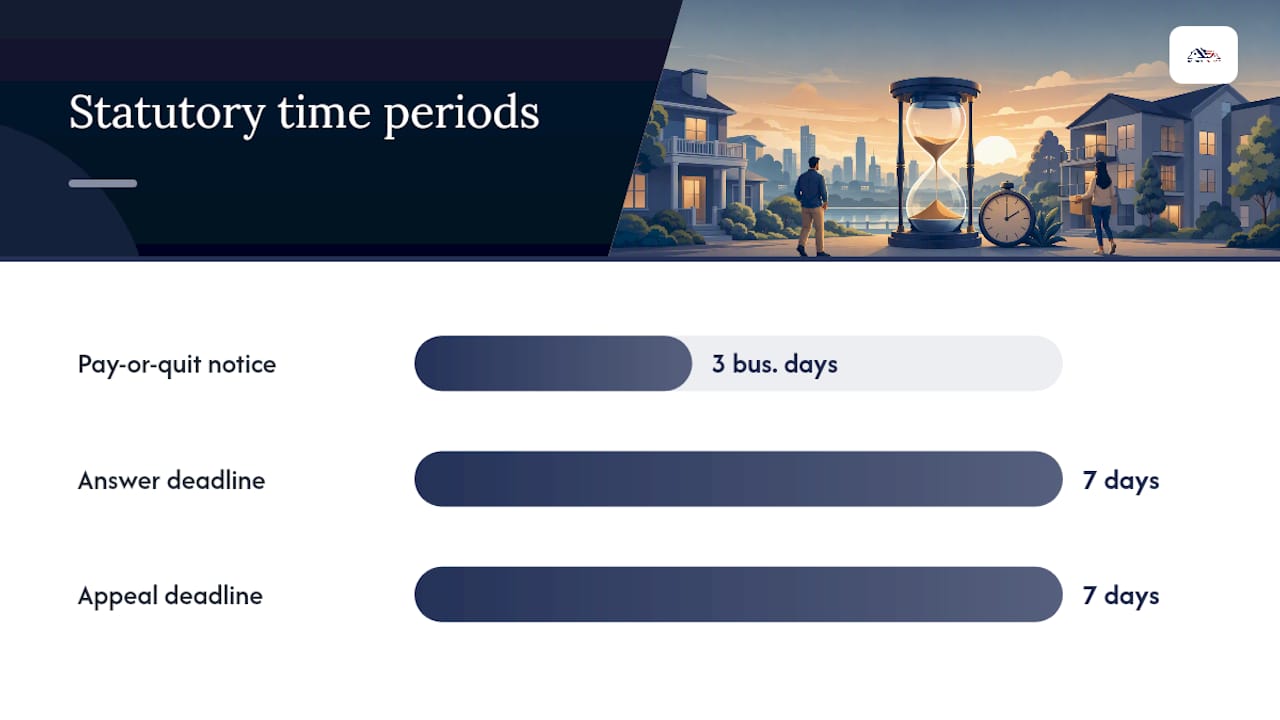
- Tenant has 7 days to answer. From the date of service, the tenant has 7 calendar days (excluding weekends and holidays) to file a written answer. If no answer is filed, the landlord may request a default judgment.
- Hearing is scheduled. If the tenant answers, the court schedules a hearing. Typical time from filing to hearing ranges from a few days to a few weeks depending on the county's docket.
- Judgment issued. The magistrate judge hears both sides and issues a judgment for possession, money, or both.
- Writ of possession. If the landlord wins and the tenant still does not leave, the court issues a writ of possession. The sheriff then executes the writ, physically removing the tenant and their belongings.
- Appeal window. Either party may appeal the magistrate court's decision to the superior court within 7 days of the judgment.
| Statutory Clock | Time Period |
|---|---|
| Notice to pay or quit (nonpayment) | 3 business days |
| Tenant's deadline to answer dispossessory | 7 days from service |
| Appeal deadline after judgment | 7 days |
For step-by-step filing instructions, this eviction filing guide covers the dispossessory affidavit process in detail.
Tenant rights in Georgia and common defenses to a dispossessory
Receiving a Georgia eviction notice does not mean the case is over. Tenants have real legal options, and procedural mistakes by landlords are common enough that they're worth knowing.
Common defenses tenants raise:
- Improper service: The notice was not delivered by an accepted method, or the summons was not properly served.
- Defective notice: Wrong tenant name, wrong property address, missing dollar amount on a pay-or-quit notice, or no specific calendar deadline.
- Landlord failed to demand possession: A written demand for possession is a required step. Courts frequently dismiss dispossessory filings where the landlord declared a default but never made an affirmative written demand.
- Rent was paid: Tenant has proof of payment that the landlord did not credit.
- Retaliatory or discriminatory notice: The notice was served in retaliation for a complaint about habitability, or it targets a protected class under Georgia fair housing laws.
- Breach of warranty of habitability: The property has serious unaddressed defects that affect the tenant's right to quiet enjoyment.
- Landlord accepted rent after serving notice: Accepting rent after serving a notice to vacate can waive the notice entirely.
What tenants should do immediately:
- Preserve the original notice and any payment receipts.
- File a written answer within 7 days of receiving the dispossessory summons. Georgia Legal Aid's downloadable dispossessory answer form walks through the process step by step.
- Contact Georgia Legal Aid for free guidance and representation resources.
- Gather all evidence: lease agreement, payment records, text messages, and photos of the property's condition.
Missing the 7-day answer deadline is one of the most damaging mistakes a tenant can make. A default judgment hands the landlord possession without a hearing.
Practical best practices landlords should follow to avoid procedural errors
Most dispossessory cases that get dismissed do not fail on the merits. They fail because the landlord skipped a procedural step or made a documentation error that a tenant's attorney spotted immediately.
Pre-filing checklist:
- Confirm you are using the correct notice type and the correct statutory period for your situation.
- Serve the notice by an accepted method and document it with a photo, witness, or certified mail receipt.
- Do not accept any rent payment after serving a pay-or-quit notice. Accepting even a partial payment can waive the notice and reset the clock.
- Issue a written demand for possession after the notice period expires. Oral demands are legally risky; courts want a paper trail.
- Wait the full statutory period before filing. Filing one day early can get the case dismissed.
Red flags that get cases dismissed:
- Notice with a vague deadline ("within 3 days") instead of a specific calendar date.
- No documented proof of service.
- Accepting rent after the notice was served.
- Relying on an oral demand for possession instead of a written one.
- Filing a dispossessory affidavit before the notice period has fully expired.
When a case involves significant unpaid rent, a commercial tenant, or a tenant who has filed prior answers, consulting a Georgia landlord-tenant attorney before filing is worth the cost. Bring your lease, the notice, proof of service, and any payment records to that consultation.
Pro Tip: Good tenant screening reduces the likelihood of reaching the eviction stage at all. Verifying income, rental history, and references before signing a lease is far cheaper than a dispossessory proceeding.
Where to get valid Georgia notice templates and how to adapt them safely
The internet is full of generic notice templates that were not written for Georgia law. Using one of them is a gamble.
Trustworthy template sources:
- Georgia Legal Aid (georgialegalaid.org): Free, state-specific forms and instructions written for Georgia courts. This is the first place both landlords and tenants should look.
- Georgia Courts self-help center (georgiacourts.gov): Official court forms and procedural guides for dispossessory proceedings.
- County magistrate court websites: Many counties post their own fillable dispossessory affidavit and answer forms. Always use the form for the specific county where the property is located.
- Georgia-licensed attorneys and property managers: Forms reviewed by someone who practices in Georgia courts carry more weight than anything downloaded from a national template site.
Customization rules:
- Always replace every placeholder with specific, accurate information: full legal names, exact property address, precise calendar dates.
- Never modify the statutory language in a form. If a form cites O.C.G.A. § 44-7-50, leave that citation intact.
- Add your signature and the date of delivery on the face of the notice, not just in a cover letter.
- If the form has a "reason for termination" field, be specific. "Nonpayment of rent" is better than "lease violation."
Quick checklist to test a template before use:
- Does it name all occupants?
- Does it state a specific calendar deadline?
- Does it state the exact amount owed (for pay-or-quit)?
- Does it demand possession after the deadline?
- Does it cite the correct statute?
- Is it signed and dated?
If any of those answers is no, fix the template before serving it.
Official statutes, court forms, and legal-aid links for Georgia notices
These are the primary sources for Georgia notice and dispossessory procedures. Each one is free and authoritative.
- O.C.G.A. § 44-7-50 (Justia): Full statutory text for the demand for possession and the 3-business-day pay-or-quit notice.
- O.C.G.A. § 44-7-7 (Justia): Full statutory text for tenancy-at-will termination notice periods (60 days for landlords, 30 days for tenants).
- Georgia Courts Landlord/Tenant Self-Help: Official court guidance on the dispossessory process, service rules, and tenant answer deadlines.
- Georgia Legal Aid — Evictions: Plain-language explanation of the eviction process, tenant rights, and links to downloadable forms.
- Georgia Legal Aid — Dispossessory Answer Form (PDF): Fillable form tenants can use to respond within the 7-day window.
- County magistrate court websites: Search "[your county] magistrate court Georgia" for county-specific dispossessory affidavit forms and current filing fees. Always use the county where the rental property sits, not where the landlord lives.
How notice requirements differ by tenancy type
The type of tenancy determines which notice applies, and the distinction between a tenancy at will and a fixed-term lease is the most consequential one in Georgia landlord-tenant law.
A tenancy at will is a month-to-month arrangement with no fixed end date. Either party can end it, but the statutory notice periods under O.C.G.A. § 44-7-7 apply: 60 days for the landlord, 30 days for the tenant. These periods cannot be shortened by agreement in most residential situations.
A fixed-term lease (typically 12 months) ends automatically on the expiration date written in the lease. No notice is required to end the term itself. However, if the tenant stays past the expiration date without a new agreement, they become a holdover tenant. At that point, the landlord must serve a written demand for possession before filing a dispossessory. The lease's own notice provisions may also apply, so read the lease carefully before acting.
Commercial leases operate under different rules. Georgia courts generally enforce whatever notice period the commercial lease specifies, and the statutory residential minimums in O.C.G.A. § 44-7-7 do not automatically apply. A commercial landlord should follow the lease's exact language and consult an attorney before serving notice. For a deeper look at how lease clauses interact with notice requirements, the Georgia Realtors residential lease guide covers common provisions in detail.
Do holidays and weekends affect Georgia notice deadlines?
Yes, and this is a detail that trips up landlords more often than you'd expect.
For the 3-business-day pay-or-quit notice under O.C.G.A. § 44-7-50, the count is business days, not calendar days. Saturdays, Sundays, and state and federal holidays do not count. If you serve a notice on a Thursday and Friday is a state holiday, the 3-business-day period does not expire until the following Wednesday.
For the 7-day answer deadline after a dispossessory summons is served, Georgia courts generally exclude weekends and holidays from the count as well. The Georgia Courts self-help guidance confirms this exclusion for the tenant answer period.
For the 60-day and 30-day tenancy-at-will notices, the count is calendar days, not business days. Weekends and holidays are included. Serve these notices with enough lead time to account for any delivery delays, particularly if you are using certified mail.
The practical rule: when in doubt, give more time than the minimum. Filing a dispossessory one day before the notice period legally expires is one of the most common reasons cases get dismissed.
What tenants can do when a landlord skips proper notice
A landlord who fails to serve a proper notice before filing a dispossessory has handed the tenant a procedural defense. Georgia courts take notice requirements seriously, and a defective or missing notice is grounds to dismiss the dispossessory affidavit outright.
If you are a tenant and you believe the notice you received was defective or was never served at all, here is what you can do:
Raise the defect in your written answer. File your answer within 7 days of receiving the dispossessory summons and state specifically that the notice was improper, missing, or not served correctly. The court will not raise this issue for you; you must assert it.
Document the defect. If the notice has a wrong name, wrong address, missing dollar amount, or no specific calendar date, keep the original and note the error in your answer. If you were never served at all, state that clearly and describe how you first learned of the dispossessory.
Seek legal aid. Georgia Legal Aid provides free guidance and representation resources for tenants facing eviction. A defective notice is exactly the kind of procedural issue a legal aid attorney can use to delay or dismiss a case.
If a landlord attempts a self-help removal (changing locks, removing belongings, or cutting utilities) without a court order, that is a separate legal violation. A tenant in that situation should document everything, contact law enforcement, and consult an attorney immediately.
A landlord's perspective on why documentation is the real protection
Most landlords who lose a dispossessory case did not lose on the facts. They lost because they could not prove what they did and when they did it.
At OneSource Real Estate, the approach to notices and eviction support starts with documentation before the notice is even drafted. Every notice goes out with a written record of service: a timestamped photo, a certified mail tracking number, or a witness affidavit. When a tenant disputes service, that record is what keeps the case alive.

The written demand for possession is the step most self-managing landlords skip. They assume that serving the notice and waiting out the period is enough. It is not. As practitioners at Arnall Golden Gregory have noted, declaring a default without a documented, affirmative demand for possession frequently leaves a dispossessory vulnerable to dismissal. OneSource Real Estate treats the demand for possession as a separate, required document, not an afterthought.
When a case reaches the point where legal counsel is needed, having a clean file makes the attorney's job faster and cheaper. The landlord who walks into a consultation with a signed notice, a proof of service, a written demand for possession, and a payment ledger is in a fundamentally different position than the one who walks in with a memory and a text message.
OneSource Real Estate handles notices and eviction support for Atlanta landlords
Serving a legally valid notice to vacate in Georgia requires the right form, the right timing, the right service method, and the right documentation. One missed step can reset the entire process.

OneSource Real Estate manages the full notice and eviction support process for residential landlords in Atlanta and surrounding areas. That means drafting and serving notices that comply with O.C.G.A. § 44-7-50 and § 44-7-7, documenting service in a format courts accept, issuing written demands for possession, and coordinating with eviction counsel when a dispossessory is necessary. Landlords who work with OneSource Real Estate avoid the procedural errors that dismiss cases and delay possession by weeks.
If you own rental property in the Atlanta area and want professional management that handles notices, tenant screening, rent collection, and legal compliance from day one, contact OneSource Real Estate to discuss a management agreement.
Sources
- Georgia Code § 44-7-50 - Demand for possession; notice to vacate or pay
- What should I know about evictions? | Georgia Legal Aid
- Landlord/Tenant – Georgia Courts
- When declaring a default isn't enough: the importance of a demand for possession — Arnall Golden Gregory LLP
- Georgia Code § 44-7-7 (2024) - Tenancy at will - Notice required for termination :: Justia
- Georgia Code § 44-7-50 (2024) - Demand for possession; notice to vacate or pay :: Justia
- Evictions | Long County GA Sheriff's Office
FAQ
How much notice does a Georgia landlord have to give a tenant to move out?
It depends on the reason. For nonpayment of rent, the landlord must give 3 business days under O.C.G.A. § 44-7-50. To end a month-to-month tenancy at will without cause, the landlord must give at least 60 days' written notice under O.C.G.A. § 44-7-7.
Can you write your own notice to vacate in Georgia?
Yes. Georgia does not require a court-issued form for the initial notice to vacate. The notice must include the tenant's full name, the property address, a specific calendar deadline, the reason for the notice, and the landlord's signature. Using a template from Georgia Legal Aid or a Georgia-licensed attorney reduces the risk of a defective notice.
What is the difference between a notice to vacate and an eviction in Georgia?
A notice to vacate is the written demand served on the tenant before any court action. An eviction, called a dispossessory in Georgia, is the court proceeding that follows if the tenant does not comply. The notice is a prerequisite; the dispossessory is the legal remedy.
Can a Georgia landlord evict a tenant without going to court?
No. Georgia law prohibits self-help evictions. A landlord cannot remove a tenant by changing locks, removing belongings, or cutting utilities without a court-ordered writ of possession. The dispossessory process through the county magistrate court is the only lawful method.