
In Georgia, a month-to-month tenancy is treated as a tenancy at will. A tenant gives 30 days' notice to end it, while a landlord must give 60 days under O.C.G.A. § 44-7-7. Even with proper notice, a landlord still needs a court-ordered dispossessory to remove a tenant who refuses to leave. Tenants served with an eviction filing generally have 7 days to answer.
TL;DR:
- Landlords must give 60 days' written notice to terminate a month-to-month tenancy, while tenants only need to provide 30 days' notice, starting from receipt.
- Existing lease terms, such as rent and pet policies, typically carry over when a fixed lease becomes a tenancy at will, with only notice rules changing.
- Proper notice must be delivered via a documented method like certified mail or hand delivery and include specific details to prevent disputes.
- Evictions require a court-ordered dispossessory process, with tenants having 7 days to respond and physical removal only performed by law enforcement on a court-warrant.
- Informal or inconsistent notices, such as texts or lack of documentation, significantly increase the risk of legal complications in Georgia landlord-tenant matters.
Table of Contents
- What Counts as a Month-to-Month Tenancy Georgia Landlords Recognize
- How Much Notice You Actually Need to End It
- Lease Disclosures and Terms Every Month-to-Month Agreement Should Nail Down
- What Happens if Notice Isn't Enough: Eviction Basics in Georgia
- How to Write and Serve a Valid Notice (With Templates)
- A Local Checklist for Georgia Landlords and Tenants
- Why Getting the Paperwork Right Matters More Than People Think
- Let OneSource Real Estate Handle the Notice, the Deposit, and the Paperwork
- Where These Rules Come From
- Sources
- FAQ
What Counts as a Month-to-Month Tenancy Georgia Landlords Recognize
Georgia law calls this arrangement a "tenancy at will," and it forms in two common ways. Either the parties never signed a fixed-term lease and rent is simply paid month to month, or a written lease expired and the landlord kept accepting rent without a renewal. Both scenarios fall under Georgia Code §§ 44-7-6 and 44-7-7.
The important wrinkle: when a fixed lease lapses into a tenancy at will, the old lease terms don't vanish. Rent amount, pet rules, and maintenance obligations usually carry forward by default. Only the termination rules change, since a tenancy at will follows the statutory 60/30 notice framework instead of whatever end date the original lease named. If you're not sure whether your agreement quietly converted, our breakdown of Georgia lease renewal laws walks through exactly when that switch happens.
How Much Notice You Actually Need to End It
The math is simple but the timing trips people up constantly. A landlord must give 60 days' written notice to terminate; a tenant only needs to give 30 days' written notice, per O.C.G.A. § 44-7-7. Neither period has to line up with your rent due date. Georgia Legal Aid confirms tenants generally owe that full 30 days regardless of where it falls in the billing cycle, and landlords can sue for rent if the notice comes in short.
Georgia counts these days from the date notice is received, not sent, and courts typically don't prorate the final period. If you hand over notice on the 10th of the month, you owe (or are owed) rent through the corresponding date in the following period, not just through month's end, based on practical guidance on Georgia's counting rules.
A valid notice should include:
- The full address of the rental unit
- A clear statement of intent to terminate and the exact move-out date
- The date the notice is delivered
- Signatures from whoever is giving notice
To avoid disputes, follow these steps:
- Calculate your termination date by counting forward 30 or 60 days from delivery, not from when you wrote it.
- Deliver the notice through a method you can prove (certified mail, hand delivery with a witness).
- Keep a dated copy for your own records.
If a tenant stays past the notice period without a new agreement, the landlord's only lawful path forward is a dispossessory filing, not changing the locks.
Pro Tip: Send notice right after you pay rent, not right before the next due date. It gives you a cleaner buffer and avoids accidentally owing a full extra rent period because you miscounted the 30 or 60 days.
Lease Disclosures and Terms Every Month-to-Month Agreement Should Nail Down
Even an informal month-to-month arrangement benefits from a few things in writing: the landlord's name and contact address, the rent due date, late fee terms, and who handles which repairs. For any property built before 1978, federal rules require a lead-based paint disclosure, detailed in the EPA's lead disclosure fact sheet and echoed in HUD's own disclosure guidance.
Georgia's Safe at Home Act reshaped security deposit handling, and the numbers matter:
- Security deposits are capped, and landlords must give an itemized statement of any deductions.
- Deposits must generally be returned within a set window after move-out, or the landlord risks paying penalties on top of the deposit itself, per Georgia tenant protections under the Safe at Home Act.
- Rent increases on a tenancy at will typically require the same notice period as termination since the landlord is effectively ending the old terms and offering new ones.
Our guide to Georgia security deposit law breaks down the return timeline and penalty structure in more depth, and the Georgia Realtors residential lease guide covers the broader disclosure checklist landlords use when drafting agreements.
What Happens if Notice Isn't Enough: Eviction Basics in Georgia
Proper notice ends the tenancy legally, but it doesn't physically remove anyone. If a tenant stays past their termination date, the landlord's only lawful option is a dispossessory action filed in magistrate court. Here's roughly how that plays out:
- The landlord files a dispossessory warrant, which the court serves on the tenant.
- The tenant has 7 days to file a written answer with the court.
- If no answer is filed, the landlord can request a default judgment.
- If the tenant answers, the court schedules a hearing, often within a couple of weeks.
- If the landlord wins, the court issues a writ of possession, executed by a sheriff or marshal, not the landlord.
That last step matters more than most people realize. Georgia law is explicit that self-help evictions, changing locks, removing belongings, or shutting off utilities, are illegal. Only a sheriff or marshal acting on a writ of possession can lawfully remove a tenant, according to county eviction guidance.
Tenants also keep protections under the DCA's landlord-tenant handbook, including a right to habitable housing and, under the Safe at Home Act, a short pre-eviction notice window for nonpayment before a landlord can even file. If you've been served:
- File your answer within 7 days, no exceptions.
- Contact Georgia Legal Aid or a local legal aid clinic immediately.
- Save every text, email, and receipt related to rent and repairs.
For the fuller mechanics of filing or responding to a case, see our step-by-step eviction filing guide for Georgia.
How to Write and Serve a Valid Notice (With Templates)
Getting the paperwork right avoids most disputes before they start. Follow these steps:
- Confirm your notice period (30 days for tenants, 60 for landlords) and calculate the exact termination date from the delivery date, not the date you draft it.
- Write the notice with the property address, both parties' names, the termination date, and a signature line.
- Choose a delivery method you can document: certified mail with return receipt, hand delivery with a witness, or email only if your lease specifically allows it.
- Keep a signed copy for your own file the day you send it.
Tenant Notice to Vacate Template "I, [tenant name], am providing 30 days' written notice that I will vacate the property at [address] on or before [date]. This notice is delivered on [date of delivery]. Signed, [tenant signature]."
Landlord Notice to Terminate Template "This letter serves as 60 days' written notice that your tenancy at [address] will terminate on [date]. Please vacate the premises and return all keys by that date. Delivered on [date]. Signed, [landlord signature]."
After sending, confirm the other party received it, keep a copy of any delivery receipt, and start planning your move or your next tenant placement immediately. Our notice to vacate templates and step-by-step checklist has fillable versions of both letters if you want a head start.
A Local Checklist for Georgia Landlords and Tenants
Landlords across Atlanta, Marietta, and Alpharetta run into the same handful of mistakes: notices sent by text instead of a documented method, deposits returned late without an itemized list, and eviction filings started before the mandatory pre-eviction notice window closes. A quick checklist helps:
- Landlords: photograph unit condition before move-in, handle deposits by the book, and never attempt removal without a sheriff or marshal present.
- Tenants: document move-in condition with photos, put every repair request in writing, and keep copies of anything you serve or receive.
- Both: when a dispute escalates past a polite conversation, involve legal counsel or Georgia Legal Aid before it becomes a court matter.
Pro Tip: Time your notice to land right after a rent payment posts. It keeps your 60 or 30 day count clean and avoids the common Atlanta-area mistake of owing an extra half month because the notice landed mid-cycle.
Why Getting the Paperwork Right Matters More Than People Think
Most landlord-tenant disputes in Georgia don't come from bad intentions. They come from a notice sent on the wrong day, a deposit returned without an itemized list, or a landlord who assumed a text message counted as written notice. The statute is unforgiving about form even when everyone involved is acting in good faith.
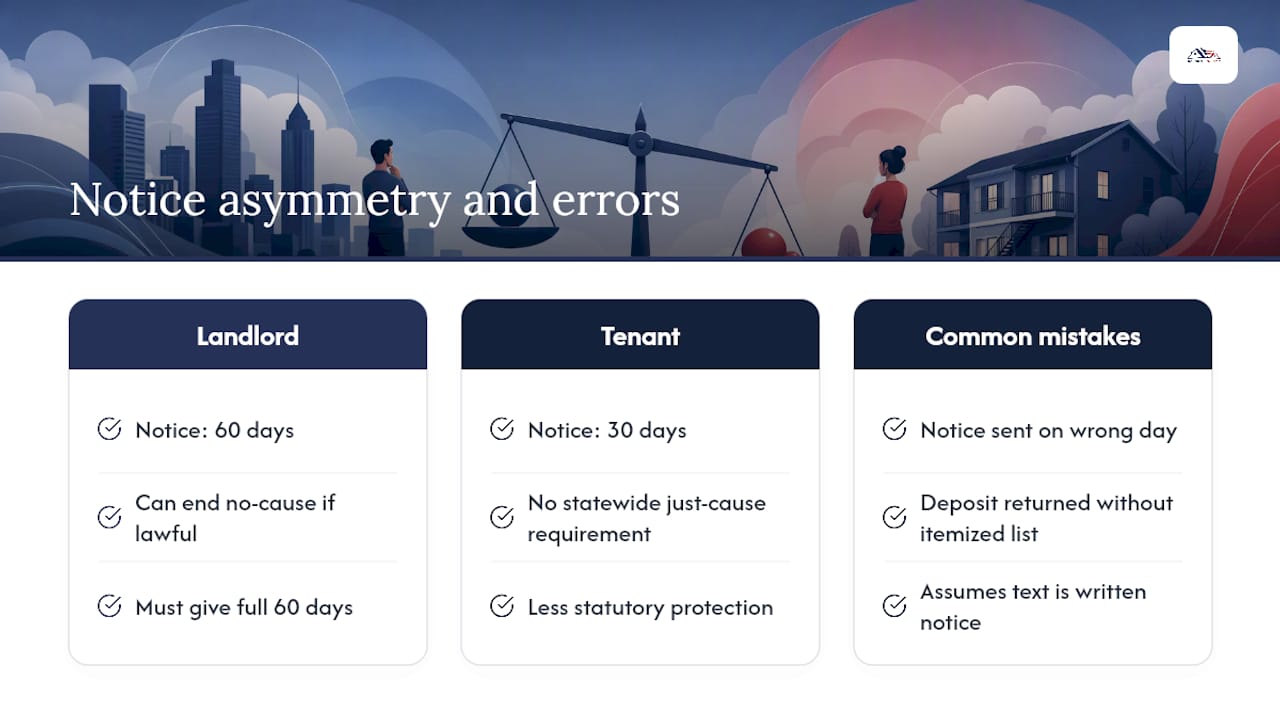
What surprises people most is how little protection Georgia gives tenants against a no-cause termination. There's no statewide just-cause requirement, so a landlord can end a tenancy at will for almost any lawful reason as long as the full 60 days is given. That asymmetry, 60 days for landlords, 30 for tenants, isn't an accident. It reflects how much harder it is for a household to find new housing than for a landlord to find a new tenant.
If you take one thing from this: put everything in writing, count your notice days from receipt, and never assume a lease "just ends" cleanly without a document trail. Templates help. So does knowing when to call in help instead of guessing.
— Matt
Let OneSource Real Estate Handle the Notice, the Deposit, and the Paperwork
If you own rental property in the Atlanta area, the hardest part of a month-to-month tenancy usually isn't understanding the law, it's executing it correctly every single time. OneSource Real Estate is the alternative to handling notices, deposit returns, and eviction coordination yourself: full-service property management that keeps your notices timed correctly, your deposits compliant with the Safe at Home Act, and your paperwork ready if a dispossessory ever becomes necessary.

Monthly management is charged as a percentage of collected rent, with additional onboarding and lease renewal fees. If you'd rather talk through your specific situation first, a 30-minute consulting call covers lease drafting, notice timing, and eviction strategy for $300. Visit the property management page to see current service details and get started before your next notice deadline sneaks up on you.
Where These Rules Come From
- Georgia Code § 44-7-7: the statute governing notice periods for tenancy at will.
- Georgia Landlord-Tenant Handbook (DCA): the state's official overview of leases, repairs, and eviction.
- Georgia Legal Aid: tenant-focused guidance on breaking a rental agreement.
This article is general information, not a substitute for advice from a qualified lawyer. Consult a qualified legal professional about your own circumstances before acting on anything here.
Sources
- Georgia Code § 44-7-7 - Tenancy at will - Notice required for termination
- Georgia Landlord-Tenant Handbook (DCA)
- Can I Break My Rental Agreement? — Georgia Legal Aid
- Long County Sheriff — Eviction / Self-help eviction guidance
- EPA lead disclosure rule fact sheet
FAQ
What are the requirements for a month-to-month lease agreement in Georgia?
Georgia doesn't require a written lease for a tenancy at will, but the arrangement must still follow the statutory notice rules: 60 days from the landlord, 30 days from the tenant, under O.C.G.A. § 44-7-7. Any written agreement should still cover rent amount, due date, and repair responsibilities to avoid disputes.
What are the new rent laws in Georgia for 2026?
Georgia's Safe at Home Act introduced a warranty of habitability, capped security deposits, and a short pre-eviction notice window for nonpayment before a landlord can file, according to a summary of the Safe at Home Act. Landlords must also provide an itemized statement when returning or withholding a deposit.
Why would a landlord want to do month to month?
Month-to-month tenancies give landlords flexibility to adjust rent, change tenants, or sell the property without waiting out a fixed lease term. The tradeoff is that landlords still owe tenants a full 60 days' notice to end the arrangement, per O.C.G.A. § 44-7-7. Property managers like OneSource Real Estate often recommend month-to-month terms for owners weighing a near-term sale.
How long does a landlord have to evict you in Georgia?
There's no fixed statutory timeline; it depends on how fast the tenant answers and how quickly the court schedules a hearing. After a dispossessory is filed, tenants have 7 days to answer, and cases typically resolve within a few weeks if uncontested, per the Georgia Landlord-Tenant Handbook. Only a sheriff or marshal can physically remove a tenant once a writ of possession issues.