
Georgia law does not require landlords to offer renewals for fixed-term leases, and rent is not capped anywhere in the state. What controls the process is your tenancy type: fixed-term leases run on whatever the contract says, while tenancy-at-will arrangements trigger O.C.G.A. § 44-7-7's 60-day landlord notice and 30-day tenant notice. Read your lease closely and start renewal conversations early, because Georgia gives you very little statutory protection to fall back on.
TL;DR:
- Landlords can raise rent at renewal with no cap, and increases of 10% or more are common in market areas like Atlanta; tenants should compare with similar units to assess fairness.
- Failure to send renewal notices early almost always leads to automatic month-to-month tenancy at will, which requires 60-day landlord and 30-day tenant notices to terminate or change terms.
- Lease automatic renewal clauses can extend a lease beyond the original term if tenants forget notice deadlines, often locking them into unanticipated rent increases.
- A lease's end does not automatically mean the tenant leaves; it can renew, be extended, terminate, or convert to a tenancy-at-will based on contract language and actions taken afterward.
- Georgia law does not require a landlord to give notice for fixed-term lease renewal or termination unless stated in the lease, making proactive communication essential for both parties.
Table of Contents
- What Happens When a Georgia Lease Ends?
- When Does Georgia's 60/30 Notice Rule Apply?
- Can a Georgia Landlord Raise Rent at Renewal?
- How Do You Request or Negotiate a Lease Renewal?
- What If the Landlord Won't Renew Your Lease?
- Special Circumstances That Change the Rules
- A Practitioner's Checklist for Renewal Season
- How Are Security Deposits Handled at Renewal or Termination?
- What Happens With Roommates or Multiple Tenants at Renewal?
- Renewal Pitfalls I See Most Often in Georgia Leases
- How OneSource Real Estate Handles Renewals for You
- Where to Verify Georgia's Lease Renewal Rules
- Sources
- FAQ
What Happens When a Georgia Lease Ends?
A lease ending doesn't automatically mean the tenant leaves or the rent changes. Four things can happen, and which one applies depends entirely on what the lease says and what the parties do next.
The lease can renew under its own terms, get extended by mutual agreement, terminate outright with the tenant moving out, or slide into a tenancy-at-will if the tenant stays and the landlord keeps accepting rent. That last option catches a surprising number of people off guard. Georgia's landlord-tenant handbook is blunt about it: once a landlord cashes a rent check after the lease term expires without a new signed agreement, the arrangement typically becomes a month-to-month tenancy at will, whether either side meant for that to happen or not.
Automatic renewal clauses cause their own headaches. Plenty of Georgia leases include language that renews the term automatically unless someone gives notice by a certain date, sometimes with the rent quietly resetting to "market rate" or jumping by a fixed percentage. Tenants who forget the notice deadline can find themselves locked into another 12 months at a rent they never agreed to pay. Landlords who don't track these dates lose the chance to renegotiate before a below-market lease rolls over again.
A few outcomes worth knowing before your term ends:
- Renewal: A new lease term begins, usually with updated rent and dates, signed by both parties.
- Extension: The existing lease continues on the same terms for a defined additional period.
- Termination: The lease ends and the tenant vacates by the stated date.
- Tenancy-at-will: No new lease is signed, but the tenant stays and the landlord keeps taking rent, converting the arrangement to a month-to-month tenancy governed by § 44-7-7.
Georgia Legal Aid puts it plainly: if the lease requires written notice to renew, the tenant has to send it. If the lease is silent on renewal altogether, the landlord can treat the term as expired and pursue possession once it ends. Neither side gets to assume good faith will fill in the gaps the contract left open.
When Does Georgia's 60/30 Notice Rule Apply?
The notice period you owe, or are owed, depends almost entirely on whether you're in a fixed-term lease or a tenancy-at-will.
- Tenancy-at-will (month-to-month): O.C.G.A. § 44-7-7 requires the landlord to give 60 days' notice to terminate or change terms, and the tenant owes 30 days' notice to end the tenancy.
- Fixed-term leases: Georgia sets no statutory notice requirement for renewing or ending a fixed-term lease. Whatever your contract says about notice deadlines is what governs, full stop.
- Silent leases: If a fixed-term lease says nothing about renewal notice, the landlord isn't legally obligated to warn you before the term simply expires.
That third point trips up a lot of tenants who assume some baseline notice always applies. It doesn't. The 60/30 rule is specific to tenancy-at-will situations, not a general Georgia standard for every lease.
Given how little the statute requires, timing is really about self-protection rather than legal obligation. Starting renewal conversations 60 to 90 days before your lease ends gives both sides room to negotiate, arrange financing or new housing, and avoid a rushed decision. Landlords who wait until 30 days out often lose good tenants who've already signed somewhere else, and tenants who wait that long may find the unit already re-listed.
Whatever you send, document it. Email with a read receipt, certified mail, or a dated letter delivered in person and acknowledged in writing all hold up better than a verbal conversation if a dispute ever lands in court. OneSource Real Estate treats written, timestamped notice as standard practice on every managed property precisely because oral agreements are nearly impossible to prove months later.

Can a Georgia Landlord Raise Rent at Renewal?
Yes, and there's no ceiling on how much. O.C.G.A. § 44-7-19 prohibits every county and city in Georgia from regulating residential rent amounts, so there is no rent-control cap anywhere in the state, unlike jurisdictions such as New York or California.
That doesn't mean a landlord can change the rent whenever they feel like it. During a fixed-term lease, rent stays exactly where the contract set it unless the lease itself includes an escalation clause allowing adjustments. Once a tenancy becomes month-to-month, the landlord can raise rent, but must deliver that change using the same 60-day notice required under § 44-7-7 for terminating the tenancy, since a rent increase on a tenancy-at-will is legally treated as a change in terms.
The uncapped reality: Georgia's lack of rent control means renewal increases of 10%, 20%, or more are legal on their face, and market conditions in metro Atlanta have pushed plenty of landlords to raise rent aggressively at renewal.
A few guardrails still apply:
- An increase can't target a tenant in retaliation for a complaint, a repair request, or a fair housing claim filed within a legally relevant window before the increase.
- An increase or refusal to renew can't be applied in a way that disproportionately affects tenants based on race, disability, familial status, or another protected class under the Fair Housing Act.
- Landlords should keep records showing a rent increase reflects market comparables, not a pattern tied to a tenant's protected characteristics or recent complaints.
Pro Tip: If you're a tenant facing a steep renewal increase, ask for comparable rents on similar units nearby. If the number is wildly out of line with the market, that's useful leverage in negotiation, even though Georgia gives you no legal cap to point to.
How Do You Request or Negotiate a Lease Renewal?
Getting a renewal you're happy with usually comes down to timing and paperwork, not luck.
- Send written notice early. Whether you're the tenant asking about renewal or the landlord making an offer, put it in writing 60 to 90 days before the lease ends. Include the proposed start and end dates, the new rent amount, and the term length.
- Specify the term clearly. A one-year renewal and a month-to-month rollover carry very different notice obligations later. Say which one you're proposing.
- Negotiate trade-offs, not just numbers. A tenant willing to sign a two-year term instead of one often has real leverage to ask for a smaller rent increase or a rent freeze. Landlords benefit from locking in occupancy and avoiding turnover costs, which run higher than most people assume once you factor in vacancy days, cleaning, and re-marketing.
- Get signatures before you rely on the deal. A verbal "yes, that works" is not a contract. As soon as a renewal offer is signed by both parties, it becomes a new binding agreement, and a landlord generally can't unilaterally change terms afterward without the tenant's written consent.
- Keep copies of everything. Save the original notice, any counteroffers, and the final signed document. If a disagreement surfaces down the line, dated paperwork settles it faster than memory ever will.
Pro Tip: Landlords who quote the new rent and term in the same message they send the renewal offer close the loop faster than those who negotiate over multiple back-and-forth calls. A clear written offer often gets a quicker yes.
What If the Landlord Won't Renew Your Lease?
A landlord can decline to renew a fixed-term lease for almost any reason, or no reason at all, as long as the refusal doesn't cross into illegal territory.
Refusing to renew becomes a legal problem when it targets a protected class under the Fair Housing Act, or when it functions as retaliation against a tenant who recently filed a habitability complaint, requested repairs, or exercised another legal right. Courts and fair housing agencies look at timing and pattern here: a non-renewal that lands right after a tenant complains to a housing authority looks very different from one tied to a documented history of late payments or lease violations.
If you believe a refusal or renewal terms cross a legal line:
- Document every communication, including dates, names, and exact wording of any offer or refusal.
- Contact GeorgiaLegalAid.org or ConsumerEd Georgia for free guidance on your specific situation, since neither agency can force a landlord to renew but both can help you understand your options.
- Consider a consultation with a landlord-tenant attorney if the dollar amounts or discrimination concerns are significant.
- Start planning a move-out timeline in parallel, since Georgia courts won't pause an eviction simply because a dispute is pending.
Georgia's consumer protection office has confirmed there's no state agency that can force a resolution in a private lease dispute. Once a lease genuinely expires and the tenant hasn't left, the landlord's remedy is a dispossessory action through the local magistrate court, which is Georgia's formal eviction process.
Special Circumstances That Change the Rules
A handful of situations override the standard renewal and termination framework, and both tenants and landlords should know when they apply.
- Military service members get early-termination protections under the federal Servicemembers Civil Relief Act, plus Georgia-specific provisions the DCA handbook covers, typically tied to permanent change of station orders or deployment beyond a certain distance from the leased unit.
- Domestic violence survivors can qualify for early lease termination in Georgia with proper documentation, such as a protective order or police report, without the usual penalties for breaking a lease early.
- Early-termination clauses written into the lease itself usually require a specific notice period and a termination fee, often equal to one or two months' rent, and tenants remain on the hook for that fee even if they vacate early.
- Property sales generally don't cancel an existing lease. A new owner typically inherits the lease and its terms, including any renewal rights the previous landlord agreed to.
A Practitioner's Checklist for Renewal Season
Most renewal disputes come down to missed deadlines and unclear paperwork, not disagreements over the actual terms. OneSource Real Estate builds every managed lease around avoiding both.
For tenants: Confirm your tenancy type, mark your notice deadline on a calendar 90 days out, request renewal terms in writing, and keep every email and letter.
For landlords: Send renewal offers or non-renewal notices at least 60 days before term end, document delivery, and never rely on a verbal rent increase.
| Party | Key action | Timing |
|---|---|---|
| Tenant | Send written intent to renew or vacate | 60-90 days before lease end |
| Landlord | Send renewal offer or non-renewal notice | 60+ days before lease end |
| Both | Sign new lease or renewal addendum | Before old term expires |
| Landlord | Deliver rent increase notice (month-to-month) | 60 days per § 44-7-7 |
A renewal offer template needs, at minimum, the proposed rent, the new term dates, any changed clauses, and a signature line for both parties. A tenant's renewal request needs the same basic elements plus a clear statement of intent to stay.
How Are Security Deposits Handled at Renewal or Termination?
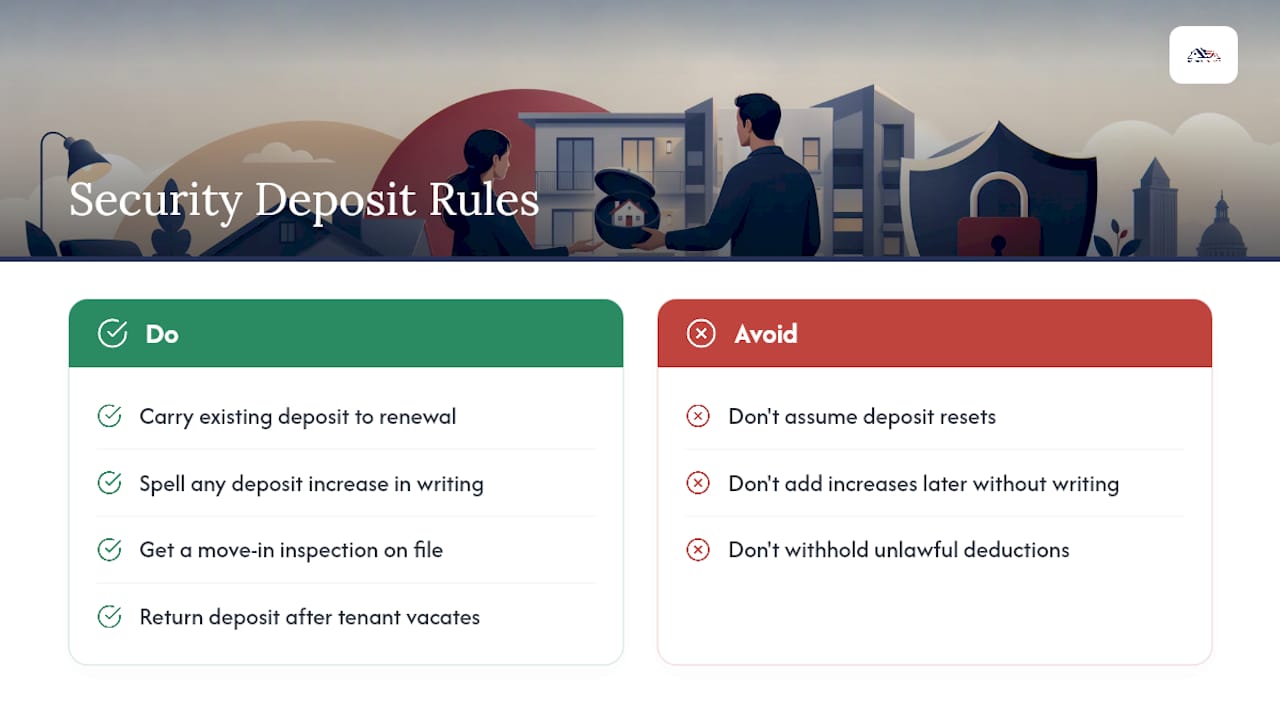
A security deposit tied to an expiring lease doesn't automatically reset when a new lease begins. If the tenant signs a renewal with the same landlord and stays in the same unit, most Georgia leases simply carry the existing deposit forward under the new agreement, with no new deposit collected unless the lease specifically calls for a top-up.
Where it gets more complicated is when the rent increases significantly at renewal. Some landlords use that moment to also raise the deposit amount, which is legal in Georgia since there's no statutory cap on residential security deposits tied to rent. Any deposit increase should be spelled out in writing as part of the renewal terms, not assumed or added later.
If the tenancy terminates instead of renewing, standard move-out rules apply: the landlord has to return the deposit, minus any lawful deductions for damage beyond normal wear and tear, within a set window after the tenant vacates. That process, along with what counts as a legitimate deduction, is covered in detail in Georgia's security deposit law. The short version for renewal purposes: get a move-in inspection on file before the new term starts if the deposit is carrying forward, because that documentation is what protects both sides when the next lease eventually ends too.
What Happens With Roommates or Multiple Tenants at Renewal?
When more than one tenant is named on a lease, renewal decisions get more complicated because Georgia treats co-tenants as jointly and severally liable, meaning each tenant is individually responsible for the full lease obligations, not just their share.
That matters at renewal time because a landlord typically needs agreement, or at least notice, from all named tenants before issuing a new lease, especially if the roommate lineup is changing. If one roommate wants to renew and another wants to leave, the departing tenant should still provide written notice of intent to vacate, and the remaining tenant will likely need to either qualify to hold the lease solo or bring in a replacement roommate the landlord approves.
Landlords managing shared-tenant renewals should send the renewal offer to every named tenant, not just whoever happens to communicate most, since notice to one co-tenant doesn't automatically bind the others. If the lease converts to tenancy-at-will because rent kept getting accepted after the term ended, the 60-day landlord notice and 30-day tenant notice under § 44-7-7 still applies, but practically speaking, all co-tenants should be looped in on that notice to avoid confusion about who's actually terminating.
The cleanest approach for roommate situations is a written agreement, signed by everyone involved, spelling out exactly who's renewing, who's leaving, and how the security deposit gets split or reassigned if a replacement tenant joins the new lease.
Renewal Pitfalls I See Most Often in Georgia Leases
The single biggest mistake I see isn't a legal violation. It's silence. Tenants let auto-renewal deadlines slide by without reading the fine print, and landlords wait until three weeks before a lease ends to even think about the next tenant. By then, both sides are negotiating from a position of panic instead of leverage.
The second pattern is landlords assuming Georgia's lack of rent control means any increase will fly unchallenged. It usually does, legally speaking, but a tenant who gets blindsided by a 25% jump at renewal is a tenant who leaves, and turnover costs almost always exceed what that increase would have earned in a single year.
Clear contract language and early outreach fix most of this. When a lease spells out the renewal process, the notice deadline, and how rent adjustments work, there's very little room left for dispute. That's really the whole argument for professional property management: someone is actually watching the calendar and sending the notice on day 60, not day 30.
— Matt
How OneSource Real Estate Handles Renewals for You
Chasing down notice deadlines, drafting renewal offers, and making sure every increase is documented correctly takes real time, and getting even one date wrong can cost a landlord a good tenant or an entire month of vacancy. OneSource Real Estate handles that work for property owners across Atlanta and the surrounding Georgia metro, including Marietta, Alpharetta, Johns Creek, Powder Springs, and Austell.
That includes drafting renewal offers with the correct rent, term, and signature lines; sending required notices on the statutory timeline so nothing lapses into an unintended tenancy-at-will; managing tenant communications throughout negotiation; collecting rent and reconciling deposits; and running compliance checks so increases and non-renewals stay on the right side of fair housing law. If you own rental property in the area and want renewals handled without tracking every deadline yourself, visit OneSource Real Estate's property management page to see how the service works and request a quote.
Where to Verify Georgia's Lease Renewal Rules
Anyone dealing with a contested renewal or termination should go straight to primary sources rather than relying on secondhand summaries.
- O.C.G.A. § 44-7-7 sets the 60/30 notice rule for tenancy-at-will arrangements.
- O.C.G.A. § 44-7-19 bans local rent regulation statewide.
- The Georgia Landlord-Tenant Handbook from the Department of Community Affairs covers renewal, extension, and special circumstances in plain language.
- Georgialegalaid offers free guidance on renewal and termination questions.
- ConsumerEd Georgia answers common landlord-tenant questions, though it can't intervene in private disputes.
For anything involving real money at stake, a discriminatory refusal, or a contract dispute headed toward court, contacting GeorgiaLegalAid or a local attorney beats guessing.
Sources
- How much notice must landlord give tenant before raising rent? | ConsumerEd Georgia (Ask Ed)
- O.C.G.A. § 44-7-19 — Limits on local regulation of rent (Official Code of Georgia Annotated)
- Georgia landlord-tenant handbook | Georgia Department of Community Affairs (DCA)
- What should I know about ending or renewing a lease? | Georgia Legal Aid
- Fair Housing Act overview | U.S. Department of Justice Civil Rights Division
FAQ
How much notice does a landlord have to give if not renewing a lease in Georgia?
For a fixed-term lease, Georgia requires no statutory notice if the lease itself doesn't specify one, so the lease simply expires on its stated end date. For a tenancy-at-will, the landlord must give 60 days' notice under § 44-7-7.
What are the key changes to Georgia's landlord-tenant law in 2026?
Georgia's core renewal and notice framework under § 44-7-7 and § 44-7-19 remains unchanged; the DCA handbook is the best place to confirm current guidance before assuming any statute has shifted.
How soon can a landlord make you renew your lease?
A landlord can't force a renewal at all. They can only offer new terms and set a deadline for the tenant to accept; if the tenant doesn't sign, the lease ends on schedule and the tenant is expected to vacate.
How to break a lease without penalty in Georgia?
Georgia allows penalty-free early termination mainly under specific protections, such as SCRA provisions for military service members and documented domestic violence situations, or when a lease includes its own early-termination clause with defined terms.
What happens if a tenant doesn't respond to a renewal offer?
If the tenant never signs and the term ends, the landlord can treat the lease as expired and pursue possession; if the tenant stays and rent keeps getting accepted, the arrangement generally converts to a tenancy-at-will under § 44-7-7.