
A solid screening process comes down to six things: written criteria you hand to every applicant, income verification at a multiple of the monthly rent, a credit check, an eviction history check, an individualized criminal-record review (not a blanket ban), and full FCRA compliance from consent through adverse action. The U.S. Department of Housing and Urban Development (HUD) adds one more requirement most landlords overlook: your criteria must be applied the same way to every applicant, every time, or you create Fair Housing liability. OneSource Real Estate builds each of these steps into its tenant placement workflow so nothing gets skipped.
Your immediate next steps:
- Draft and date your written screening criteria before you accept a single application
- Collect signed written consent before ordering any consumer report
- Order credit, eviction, and criminal background reports from an FCRA-compliant consumer reporting agency (CRA)
- Compare each applicant's file against your written criteria, document your reasoning
- Send a pre-adverse action notice (with the report and Summary of Rights) if you are leaning toward denial, then wait at least 5 business days before finalizing
- Issue a formal adverse action notice if you deny, naming the CRA and the applicant's dispute rights
The FCRA's standard lookback for most consumer-report items is several years, though bankruptcies can appear for a longer period. Georgia landlords should also note that state law under O.C.G.A. § 10-1-393 layers additional consent and disclosure requirements on top of the federal baseline.
Table of Contents
- What are the legal and policy requirements every landlord must follow?
- What tenant screening criteria should your written policy actually include?
- How do you verify what applicants tell you?
- How should you handle red flags without auto-rejecting applicants?
- Copy-and-paste: a tenant screening policy template you can use today
- How OneSource Real Estate screens tenants in practice
- Key Takeaways
- Why consistent screening matters more than strict screening
- OneSource Real Estate handles tenant screening so you don't have to
- Useful sources for landlords
- FAQ
What are the legal and policy requirements every landlord must follow?
Written, consistently applied screening criteria are not optional. They are the foundation that makes every other part of the process defensible. If your criteria live only in your head, you cannot prove you applied them the same way to the applicant you approved and the one you denied.
HUD Fair Housing rules on criminal records
HUD's guidance is unambiguous: blanket bans on applicants with any criminal record can violate the Fair Housing Act through disparate impact, even when the policy looks neutral on its face. What HUD requires instead is an individualized assessment that weighs the nature of the offense, how long ago it occurred, and whether it is actually relevant to the safety of the property or other residents.
The only automatic exclusion HUD recognizes as lawful is for applicants who have been convicted of manufacturing or distributing methamphetamine on federally assisted property.
Compliance reminders:
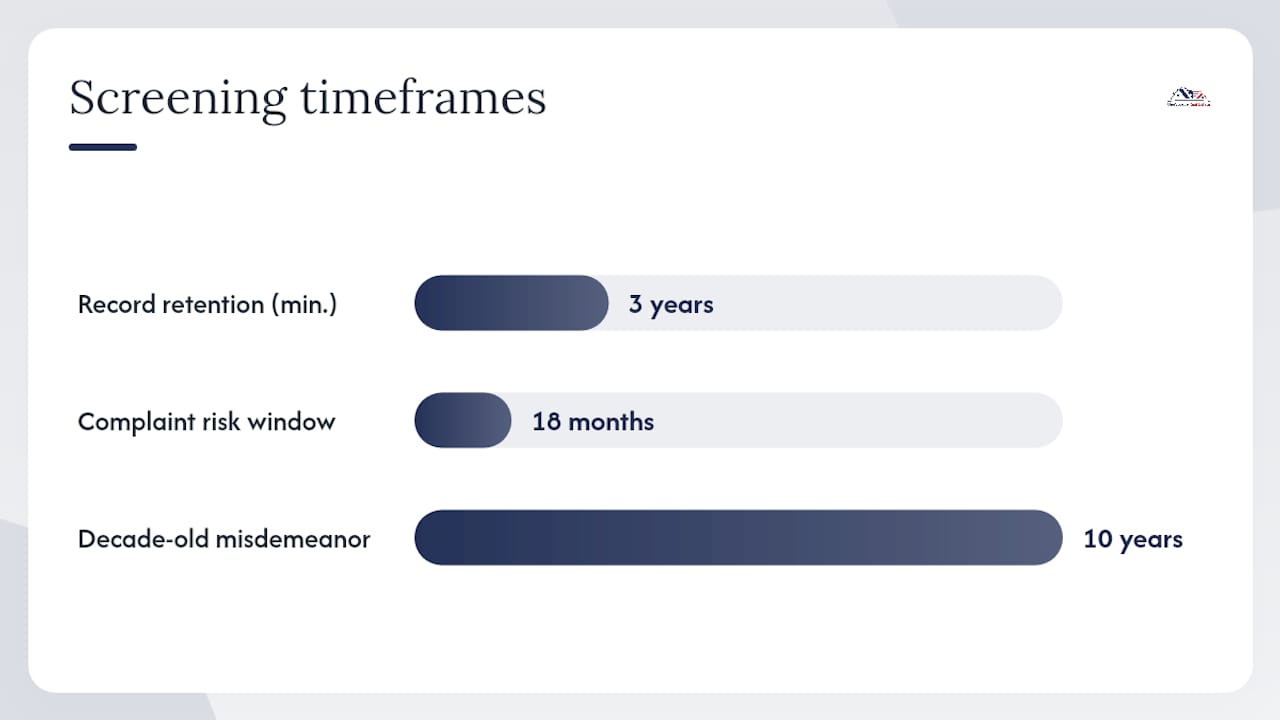
- Retain all applications, consent forms, reports, and decision notes for at least 3 years (longer is safer)
- Document why each decision was made, not just what the decision was
- Avoid criteria that are not predictive of tenancy risk (e.g., a decade-old misdemeanor unrelated to property or people)
- Apply every threshold identically regardless of the applicant's protected class
Pro Tip: Create a one-page decision log for each applicant: date received, reports ordered, criteria compared, outcome, and the specific reason. If a Fair Housing complaint arrives 18 months later, that log is your defense.
Georgia landlords screening applicants under O.C.G.A. § 10-1-393 must also provide written disclosure of the screening fee, whether it is refundable, and the applicant's right to dispute inaccurate information.
What tenant screening criteria should your written policy actually include?
The categories below are what experienced landlords and property managers check on every application. Build your written policy around these, set your own thresholds within the ranges shown, and apply them without exception.
Screening criteria at a glance
| Criterion | What to request | Example threshold | Notes |
|---|---|---|---|
| Income | Pay stubs (2–3 months), W-2, tax returns, or benefit award letters | Gross income ≥ 2.5–3× monthly rent | Accept SSDI, vouchers, and other lawful income sources |
| Credit | Full credit report from FCRA-compliant CRA | Minimum score guidance: 580 (example) | HPD guidance allows 12 months of on-time rent as an alternative |
| Eviction history | Tenant court / eviction registry search | No unpaid judgments within 3–5 years | Evaluate context: dismissed cases differ from money judgments |
| Criminal history | National criminal background check | Individualized review required; no blanket ban | Per HUD guidance |
| Rental history | 2–3 prior landlord references | Positive references; no pattern of lease violations | Call references; do not rely on written letters alone |
| Identity | Government-issued photo ID | Must match application name and DOB | Cross-check with SSN fragment on report |
| FCRA lookback | Consumer report | 7-year standard for most items | Bankruptcies may appear up to 10 years |
These thresholds are examples of common market practice, not legal requirements. Consult counsel to set thresholds appropriate for your market and property type.
Nontraditional income and vouchers
HUD's research guidance is clear that screening criteria should reflect actual tenancy risk, not just the form income takes. An applicant receiving Social Security Disability Insurance (SSDI) or a Section 8 housing choice voucher can demonstrate the same ability to pay rent as a W-2 employee. Refusing to consider those income sources as a matter of policy creates Fair Housing exposure in many jurisdictions.
For applicants with no traditional credit history, the HPD/HDC Tenant Selection Criteria offers a practical model: accept 12 consecutive months of documented, on-time rent payments as an alternative to a credit check. That approach is increasingly common in municipal housing programs and is worth building into your policy as an option.
"Screening criteria that are not predictive of whether an applicant will be a successful tenant — and that have a discriminatory effect — violate the Fair Housing Act, regardless of intent." — HUD Fair Housing Guidance, 2024
For Georgia landlords navigating Section 8 voucher acceptance, the practical steps are the same: verify the voucher amount, confirm the unit passes HQS inspection, and apply your income and rental-history criteria consistently.
How do you verify what applicants tell you?
Verification is where screening either holds up or falls apart. A policy is only as good as the documents and calls behind it.
Step-by-step verification workflow
- Collect the signed application and written FCRA consent form
- Order credit, eviction/tenant-court, and criminal background reports from an FCRA-compliant CRA
- Request income documents: 2–3 months of pay stubs, most recent W-2, or two years of tax returns for self-employed applicants
- For voucher holders, contact the housing authority to confirm voucher validity and amount
- Call each prior landlord directly using a number you find independently, not one the applicant provides
- Match the applicant's name, date of birth, and SSN fragment across the application, ID, and all reports
- Document every step, date every contact, and save copies of all documents
Fees and disclosure
Georgia law allows landlords to charge a reasonable screening fee. TurboTenant's Georgia application guidance notes that common market fees run roughly $30–$75 per applicant. Whatever you charge, disclose the exact amount in writing before the applicant pays it, state whether it is refundable, and explain what it covers. A simple policy statement works:
"Applicants will be charged a screening fee of $[amount] to cover the cost of credit and background reports. This fee is [refundable/non-refundable] and will be collected at the time of application."
If a report comes back with information the applicant disputes, follow the FCRA dispute process: direct the applicant to the CRA, pause your decision timeline, and do not finalize a denial based on information under active dispute.
Pro Tip: When matching criminal court records, always confirm date of birth AND a partial SSN AND a prior address before treating a record as a match. Name-only matching produces false positives that can expose you to discrimination claims, as HUD has specifically warned.
How should you handle red flags without auto-rejecting applicants?
Not every negative item in a file is a disqualifier. The landlords who make the best placement decisions treat red flags as data points, not verdicts.
Common red flags and how to read them:
- Criminal record: — requires individualized review per HUD guidance
How to conduct an individualized criminal-record review
- Identify the specific offense, conviction date, and sentence
- Assess the nature and severity (violent vs. non-violent, property-related vs. unrelated)
- Consider recency: a conviction from 15 years ago carries different weight than one from 8 months ago
- Look for evidence of rehabilitation: steady employment, completed programs, stable housing history since
- Evaluate relevance to tenancy: does this offense create a genuine, documented risk to property or residents?
- Document your reasoning in writing before making the decision
Fair Chance Housing resources provide model policies and worked examples for landlords building individualized review processes. The goal is not to ignore criminal history but to make a decision you can defend with specific, documented reasoning rather than a blanket rule.
Pro Tip: Write one paragraph explaining why you approved or denied each applicant with a red flag. "Denied due to criminal record" is not defensible. "Denied due to conviction for [offense type] within the past [X] years, which presents a direct risk to [specific concern], after individualized review of nature, recency, and rehabilitation evidence" is.
Application timeline targets
| Stage | Target turnaround |
|---|---|
| Application received | Day 0–1 |
| Consent collected and reports ordered | Day 1 |
| Reports returned | Day 1–3 |
| Phone verifications completed | Day 1–3 |
| Pre-adverse notice sent (if applicable) | Day 3–4 |
| Waiting period | 5 business days |
| Final decision issued | Day 5–7 |
Most complete screenings resolve within 5–7 business days when applicants submit complete documents upfront. Delays almost always trace back to missing income documents or unreachable prior landlords.
Required language to include on your application form:
- Written consent statement for consumer reports (FCRA-required)
- Screening fee amount and refund policy
- Equal Housing Opportunity statement
- Notice that written screening criteria are available upon request
Reasonable accommodation requests
If an applicant requests a modification to your screening process as a reasonable accommodation for a disability (for example, requesting that you accept a different form of income verification), you are generally required to engage in an interactive process and consider the request. Document the request, your response, and your reasoning. Georgia Fair Housing laws mirror the federal standard on this point.
A typical screening cycle from application to decision runs within about one to two weeks when all documents arrive on time.
Copy-and-paste: a tenant screening policy template you can use today
Screening policy header (fill in your details)
[Property Owner / Management Company Name] Tenant Selection Plan Effective Date: [MM/DD/YYYY] Property Address(es): [List properties covered]
Purpose: This policy establishes the criteria used to evaluate all rental applicants. Criteria are applied consistently to every applicant regardless of race, color, national origin, religion, sex, familial status, disability, or any other protected class under applicable law.
Required documents checklist
- Completed rental application (all fields)
- Government-issued photo ID
- 2–3 months of pay stubs (or equivalent income documentation)
- Most recent W-2 or 2 years of tax returns (self-employed)
- Voucher documentation (if applicable)
- Signed FCRA consent form
FCRA disclosure placeholders
- Consent language: "By signing below, I authorize [Landlord Name] to obtain consumer reports including credit, eviction, and criminal background reports for the purpose of evaluating my rental application."
- Pre-adverse notice: "We have received information from [CRA Name] that may affect our decision. A copy of the report and your FCRA Summary of Rights is enclosed. You have [5] business days to dispute any inaccuracies."
- Adverse action notice: "Your application has been denied based in whole or in part on information obtained from [CRA Name, address, phone]. You have the right to a free copy of your report within 60 days and to dispute its accuracy."
Pro Tip: Per TDHCA guidance and HUD expectations, your written criteria must include an effective date and be updated whenever thresholds change. Save each version with its date — regulators and courts look for documented consistency over time.
To create a downloadable PDF version: paste this template into Google Docs, adjust your thresholds, and use File → Download → PDF. Store one copy in your property file and one in a cloud folder organized by property address.
How OneSource Real Estate screens tenants in practice
OneSource Real Estate runs every tenant placement through a single, documented workflow: application received, FCRA-compliant reports ordered, individualized review against written criteria, and placement with a signed lease.
The firm's process, step by step:
- Using consumer reports: What landlords need to know
- Guidance on Application of the Fair Housing Act to the Screening of Applicants for Rental Housing
- Georgia Tenant Screening Laws: Complete Landlord Guide (2026)
- HPD/HDC Tenant Selection Criteria Revised 4/1/2025
- Georgia Rental Application (2026) — Send Digital Forms for Free
- huduser.gov
- Tenant Selection Criteria (TDHCA)
- Fair Chance Housing
For applicants with housing vouchers, OneSource coordinates directly with the housing authority to confirm voucher validity and unit eligibility. For reasonable accommodation requests, the team documents the request and response before making any decision. When a report comes back with a potential criminal record, the file goes through the individualized review process: offense type, date, relevance, and any rehabilitation documentation.
Pro Tip: OneSource stores all application files, reports, consent forms, and decision notes in a property-specific digital folder retained for a minimum of 3 years. If you manage your own properties, mirror this structure: one folder per applicant, organized by property address and application date.
Landlords who want to see how this process works in detail can review the tenant screening service guide on the OneSource blog, or explore the full property management services overview.
Key Takeaways
Effective tenant screening requires written criteria applied consistently to every applicant, full FCRA compliance from consent through adverse action, and individualized criminal-record review rather than blanket bans.
| Point | Details |
|---|---|
| Written criteria are mandatory | Document your thresholds, date the policy, and give a copy to every applicant before screening. |
| FCRA requires three steps | Obtain written consent, send a pre-adverse notice with the report, then issue a formal adverse action notice if you deny. |
| Income standard | Most landlords require gross income of 2.5–3× monthly rent; accept lawful income sources including SSDI and housing vouchers. |
| Criminal records need individual review | Blanket bans violate the Fair Housing Act; assess nature, recency, and relevance for each record. |
| FCRA lookback is 7 years | Most consumer-report items fall off after 7 years; bankruptcies may appear for up to 10 years. |
| OneSource Real Estate | Handles FCRA-compliant screening, individualized review, and tenant placement for Atlanta-area landlords. |
Why consistent screening matters more than strict screening
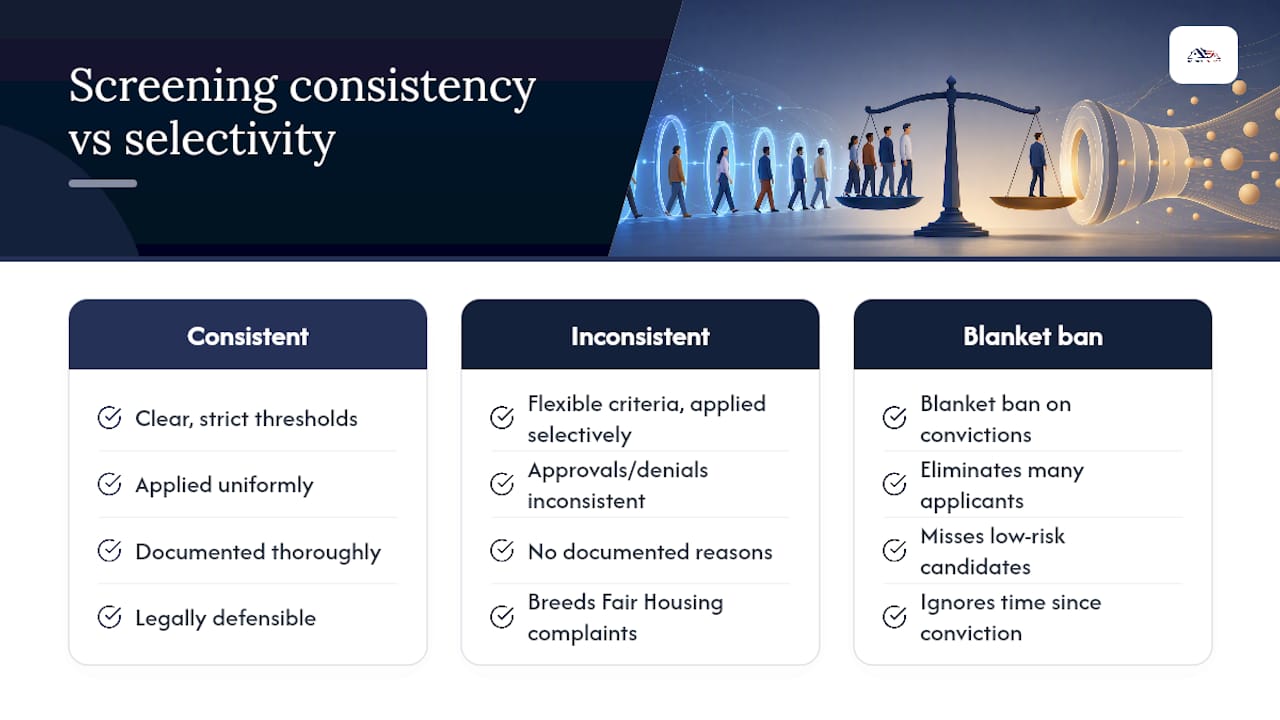
The landlords who get into trouble are rarely the ones with tough standards. They are the ones with inconsistent standards — approving one applicant with a 580 credit score and denying another with the same score, with no documented reason for the difference. That gap is where Fair Housing complaints are born.
Strict criteria, applied consistently and documented thoroughly, are legally defensible. Flexible criteria applied selectively are not. The distinction sounds obvious until you are in month three of a tenancy that is going sideways and you cannot remember exactly why you approved this particular applicant over the one you turned away.
There is also a practical argument for individualized criminal-record review that goes beyond compliance. A blanket ban on any criminal history eliminates a large pool of applicants, many of whom would be excellent tenants. The research on recidivism shows that time since conviction is one of the strongest predictors of future behavior. An applicant with a 12-year-old non-violent conviction and a clean rental history since is a very different risk profile than someone with a recent offense. Treating them identically is not just legally risky; it is a poor screening decision.
The checklist in this article is designed to give landlords both: clear, defensible thresholds and the flexibility to make individualized decisions where the facts warrant it. The documentation requirement is what makes that flexibility safe.
OneSource Real Estate handles tenant screening so you don't have to
Pulling FCRA-compliant reports, drafting a written screening policy, conducting individualized criminal-record reviews, coordinating with housing authorities on vouchers, and sending legally correct adverse action notices — that is a full afternoon of work per applicant, done wrong often enough to create real liability.
OneSource Real Estate manages the entire tenant screening and placement process for Atlanta-area landlords: FCRA-compliant consumer reports, written policy drafting, income verification, prior landlord calls, individualized review, lease execution, and move-in coordination. Landlords who hand this process to OneSource get faster occupancy, documented compliance, and a placement they can stand behind. The property management service covers screening as part of a full management contract, or as a standalone tenant procurement engagement. Contact OneSource through the website to discuss which option fits your portfolio.
Useful sources for landlords
The sources below are the primary references used in this article. Each one is worth bookmarking.
Federal guidance:
- FTC: Using Consumer Reports — What Landlords Need to Know: the definitive plain-language guide to FCRA compliance for landlords, covering consent, pre-adverse, and adverse action steps
- HUD Fair Housing Screening Guidance (2024): HUD's official position on criminal-record screening, disparate impact, and individualized assessment requirements
- HUD PDR Edge: Alternative Income and Screening Criteria: research-backed guidance on accepting nontraditional income sources and avoiding criteria that are not predictive of tenancy risk
Program-level examples and templates:
- NYC HPD/HDC Tenant Selection Criteria (revised 4/1/2025): concrete example thresholds, alternative credit verification, and program-level policy structure
- TDHCA Tenant Selection Criteria: state regulator expectations for written criteria, effective dates, and uniform application
- Fair Chance Housing: model policies and worked examples for individualized criminal-record review
Georgia-specific:
- Georgia Tenant Screening Laws: Complete Landlord Guide: covers O.C.G.A. § 10-1-393, consent requirements, 7-year lookback, and fee disclosure rules
- TurboTenant: Georgia Rental Application: digital application templates and common fee ranges for Georgia landlords
This article is general information, not legal advice. Screening rules vary by state, city, and property type. Consult a licensed attorney or your local housing authority to confirm that your written criteria comply with current law before you use them.
FAQ
What income-to-rent ratio should landlords require?
Most landlords require gross monthly income of 2.5–3× the monthly rent. Apply the same ratio to every applicant and accept all lawful income sources, including SSDI and housing vouchers.
What FCRA steps are required when denying a rental applicant?
You must obtain written consent before pulling a consumer report, send a pre-adverse action notice with a copy of the report and the FCRA Summary of Rights if you are leaning toward denial, wait at least 5 business days, then issue a formal adverse action notice naming the CRA if you finalize the denial.
Can a landlord automatically reject applicants with a criminal record?
No. HUD guidance requires an individualized assessment of each criminal record, weighing the nature, recency, and relevance of the offense. Blanket bans can violate the Fair Housing Act through disparate impact.
What tenant screening criteria does Georgia require landlords to follow?
Georgia landlords must comply with federal FCRA requirements plus state rules under O.C.G.A. § 10-1-393, which include written consent and disclosure, a 7-year common lookback for most consumer-report items, and written disclosure of the screening fee and whether it is refundable.
How does OneSource Real Estate handle tenant screening for landlords?
OneSource Real Estate manages the full screening workflow: FCRA-compliant consumer reports, written policy application, income verification, prior landlord calls, individualized criminal-record review, and lease execution, as part of its property management service for Atlanta-area landlords.