
Federal law bans any application question that reveals a protected characteristic; race, national origin, religion, sex, disability, and familial status are all off the table. What you can ask about is narrower than most landlords assume: income, rental history, identity for screening, and consent to run a background check. Two moves cut most of the legal risk here. First, use the same standardized application for every applicant. Second, get a signed authorization before pulling any consumer report, and put your screening criteria in writing.
TL;DR:
- Asking about birthplace, native language, marital status, or children directly or indirectly can lead to discrimination claims under federal law and additional local protections.
- Landlords should only request information related to ability to pay rent and lease compliance, such as income, rental history, and employment details, with standardized questions for all applicants.
- Criminal record screening must be individualized, focusing on convictions rather than arrests, and should consider offense severity, timing, and relevance to safety concerns.
- Every applicant must sign a consent form before screening reports are accessed, with formal pre-adverse and adverse action notices, and all records kept securely for at least one year.
- Consistency in applying screening criteria and regularly updating application forms in response to legal changes reduce discrimination risks and avoid costly legal and reputational damages.
Table of Contents
- Rental Application Questions That Are Legal Under the Fair Housing Act
- What Information Can You Legally Request From an Applicant?
- Criminal History Screening: Where the Legal Line Actually Sits
- Asking About Occupants and Handling Accommodation Requests
- The FCRA Screening Workflow: Consent, Reports, and Denial Steps
- Writing a Denial Letter That Actually Protects You
- A Practitioner's Checklist for Your Next Application Form
- Updating Your Application as Laws Change
- Handling Sensitive Applicant Information Responsibly
- What It Actually Costs to Get This Wrong
- Why Most Landlords Overcomplicate This
- Build a Compliant Screening Process Without Building It Alone
- Sources
- FAQ
Rental Application Questions That Are Legal Under the Fair Housing Act
The Fair Housing Act protects seven classes: race, color, religion, national origin, sex, familial status, and disability. Any application field that directly or indirectly reveals one of those is a liability, even when you never intended it that way. HUD's 2024 screening guidance makes the point sharply: you can be liable for a discriminatory screening policy even when a third-party vendor ran the actual check.
The obvious violations are easy to spot once you know the list:
- "What's your race or ethnicity?" or anything requesting a photo before approval
- "What religion do you practice?" or questions about religious observance and holidays
- "Where were you born?" or "Is English your first language?"
- "Are you married, single, or divorced?"
- "Do you have kids, or are you planning to?"
- "Do you have a disability?" or "What medications do you take?"
The riskier violations are the ones that sound neutral but function as proxies. Asking about birthplace or "native language" is really asking about national origin. Asking marital status is often a backdoor into familial status. Questions that ask, directly or in code, whether an applicant is pregnant or intends to have children fall into the same trap, and HUD's guidance treats these proxy questions as evidence of discrimination just as seriously as the blunt versions. Even how you word a rental listing can create the same exposure; the wrong phrasing in a listing description can trigger the same complaint as an illegal application question would.
Here's the part landlords miss: the federal list is a floor, not a ceiling. Many states and cities add protections HUD doesn't require, covering source of income, sexual orientation, gender identity, or age. Georgia's own fair housing rules layer on top of federal law, and jurisdictions like New York City go further still, publishing specific examples of prohibited inquiries landlords can be cited for using. Check your local ordinance before you finalize any application form. What's legal in one county can be a fair housing complaint two counties over.
What Information Can You Legally Request From an Applicant?
A useful test for any field on your form: does it measure ability to pay rent, or willingness to follow the lease? If the answer is no, cut the question. Here's what passes that test.
- Identity verification. Legal name, date of birth, and Social Security number or ITIN for running a credit and background check. Collect this only for screening purposes, store it securely, and never ask for it before you've explained why you need it.
- Income and employment. Total verifiable monthly income, current employer, and employer contact information. Acceptable proof includes recent pay stubs, bank statements, or tax returns for self-employed applicants. A common standard is requiring income above the rent amount, applied the same way to every applicant.
- Rental history. Previous addresses, prior landlord contact information, rent amount paid, and eviction history pulled from public records. Ask the same three or four questions of every past landlord so your process stays consistent and defensible.
- References. Names and contact information for personal or professional references, with a short list of factual, repeatable questions rather than open-ended character assessments.
- Occupancy and parking. Number of people who will live in the unit and number of vehicles, tied to a neutral occupancy standard you apply uniformly, not to who those occupants are.
Every one of these fields answers a business question. None of them require you to know anything about who someone is beyond their ability to pay and their track record as a tenant.
Criminal History Screening: Where the Legal Line Actually Sits
Arrests without a conviction are generally off-limits as a basis for denial. An arrest isn't proof of anything, and using one as a screening criterion is a common way landlords accidentally trigger a discrimination claim. Convictions are different, but only when you handle them carefully. A growing number of cities and states have "ban the box" rules that restrict when you can ask about criminal history at all, sometimes barring the question until after a conditional offer.
The safer approach is an individualized assessment rather than a blanket rule. That means looking at:
- The nature and severity of the offense
- How much time has passed since it occurred
- Whether the offense actually relates to a safety concern for other residents or property
- Whether the record has been sealed or expunged, which generally makes it off-limits
A policy that says "no applicant with any conviction, ever" is exactly the kind of blanket rule that invites a disparate-impact claim, because it screens out people at wildly different rates across racial groups without actually measuring risk. Apply your criteria the same way for every applicant and write down how you evaluated each one.
Pro Tip: Build your criminal history rubric before you ever see an application, not while you're staring at one. Deciding your standards in the moment, applicant by applicant, is how inconsistent enforcement creeps in.
When your local ordinance conflicts with your instinct on a specific case, defer to the local rule and loop in an attorney rather than guessing.
Asking About Occupants and Handling Accommodation Requests
You can ask how many people will occupy the unit. You cannot ask their ages, whether they're the applicant's children, or anything else that reveals familial status. Tie your occupancy limit to a neutral standard, like square footage or number of bedrooms, applied the same way regardless of who's asking.
Disability works the same way in reverse: you cannot ask whether an applicant has one. If someone requests an accommodation, such as a modified unit or an assigned parking space, you can request limited documentation confirming the accommodation is needed, but nothing about the diagnosis itself.
Service animals get special handling entirely separate from your regular pet policy:
- Accept a service animal or emotional support animal request without asking about the nature of the underlying disability
- Don't charge a pet fee or deposit for a documented service or support animal
- Document the request and your response, the same way you would any other accommodation
If your form doesn't clearly separate pets from service animals, fix that before your next tenant. A detailed pet policy framework makes the distinction concrete and gives you language that holds up if a request is challenged.
The FCRA Screening Workflow: Consent, Reports, and Denial Steps
Running a background or credit check isn't optional paperwork, it's a legal process with specific steps under the Fair Credit Reporting Act, and skipping one exposes you regardless of how solid your underlying decision was.
- Get signed authorization first. Every adult applicant, screened individually with their own signature, must authorize the credit, criminal, and eviction check before you pull anything. Shared or unsigned applications create an FCRA problem even when the eventual decision is completely defensible.
- Send a pre-adverse action notice. Before you deny someone based on something in a consumer report, give them a copy of that report and a summary of their rights. This step exists specifically so applicants can catch and dispute an error before it costs them housing.
- Send the adverse action notice. If you deny the application, the notice has to name the reporting agency you used, state the specific reason for denial, and explain the applicant's right to dispute the information.
- Keep records. Retain the signed authorization, the report itself, and documentation of the standard you applied. The CFPB is explicit that applicants have the right to dispute report information used against them, and your records are what protect you if that dispute turns into a complaint.
Landlords who skip the pre-adverse step most often do it out of a sense that the denial is obviously justified. It isn't a matter of justification. It's a procedural requirement that exists independent of whether your decision was right.
Writing a Denial Letter That Actually Protects You
A vague denial ("Your application was not approved") is the single easiest thing to fix and one of the most common mistakes on this list. Specificity is what protects you, not vagueness.
A defensible denial letter states the exact standard the applicant failed, the specific number or fact that triggered it (a credit score, an eviction record, a conviction), and which reporting agency supplied that information along with the date it was pulled. If someone failed on multiple fronts, list every one and attach the supporting documentation for each.
- State the standard, not a summary ("Minimum credit score is 620; applicant's score was 580")
- Name the report source and date it was run
- Attach or reference the specific supporting record
- Keep a copy in your file indefinitely, not just until the unit is filled
Publishing your screening criteria publicly, on your website or in your listing, does something most landlords don't expect: it reduces disputes before they start, because applicants can self-select out before they apply. HUD's guidance treats this kind of transparency as a meaningful risk-reduction step, not just good customer service.
A Practitioner's Checklist for Your Next Application Form
After reviewing hundreds of applications across the Atlanta market, the same handful of fields cause the same handful of problems every time. Here's the shortlist worth keeping next to your application template.
Keep on the form: legal name, date of birth or SSN/ITIN for screening, current and past addresses, employer and income verification, prior landlord contact, occupancy count, vehicle count, and a signature line for screening authorization.
Remove from the form: anything about marital status, children, birthplace, native language, religion, race, disability, or health.
Consent language to include (have an attorney review before use): "I authorize [Landlord/Property Manager] to obtain a consumer report, including credit history, criminal history, and rental history, for the purpose of evaluating this rental application. I understand I will be notified before any adverse action is taken based on this report."
A standardized screening checklist applied to every applicant, not adjusted case by case, is the single strongest defense against a discrimination claim. That consistency, more than any specific question you ask or skip, is what determines whether your process holds up under scrutiny.
Pro Tip: Print your screening criteria and tape it to the inside of your application binder. If you can't recite your own income and credit standards from memory, you're not applying them consistently, even if you think you are.
Updating Your Application as Laws Change
Fair housing law isn't static, and the questions that were fine to ask five years ago aren't automatically fine now. Source-of-income protections, for instance, have expanded steadily at the state and local level, meaning a question about how an applicant pays rent (voucher versus wage income) that used to be neutral is now a protected inquiry in a growing number of jurisdictions.
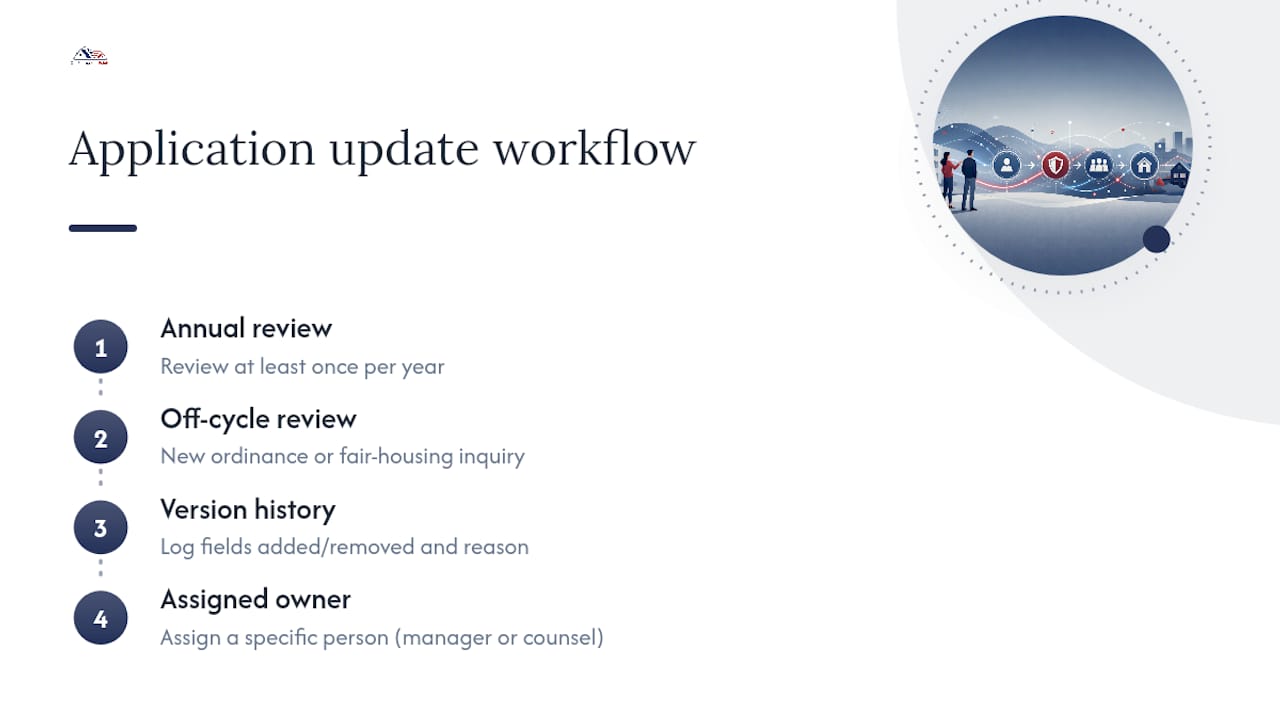
Review your application at least once a year, and immediately after any change to local housing ordinances you become aware of. Two triggers should prompt an off-cycle review regardless of timing: a new state or city ordinance affecting rental screening, and any complaint or inquiry from a fair housing agency, even one that doesn't result in a finding against you.
Keep a version history of your application form. If a question ever comes under scrutiny, being able to show exactly when a field was added or removed, and why, is far stronger than trying to reconstruct your reasoning after the fact. Assign someone specific, whether that's you, a property manager, or legal counsel, to own this review rather than letting it happen "eventually." Forms that don't get revisited tend to accumulate outdated fields nobody remembers adding, and those legacy fields are exactly what a fair housing investigator will flag first.
Handling Sensitive Applicant Information Responsibly
Once you've collected Social Security numbers, income documents, and background reports, you've created a liability that has nothing to do with fair housing law and everything to do with basic data security.
Store applications in a locked system, physical or digital, that only people directly involved in screening decisions can access. Don't email SSNs or bank statements as plain attachments if you can avoid it; use a secured portal or encrypted document exchange instead. Limit copies. Every duplicate you make is another point of exposure if something goes wrong.
Set a retention policy and stick to it. Keep denied applicants' records long enough to defend a potential dispute (most guidance points toward at least a year, sometimes longer depending on your jurisdiction), then securely destroy them rather than letting old applications pile up indefinitely. Shred physical documents; don't just delete digital files, actually wipe them.
Train anyone else involved in leasing, on-site managers, leasing agents, family members helping with a small portfolio, on the same rules you follow. A data breach or a fair housing complaint doesn't care whether the person who mishandled information understood the stakes.
What It Actually Costs to Get This Wrong
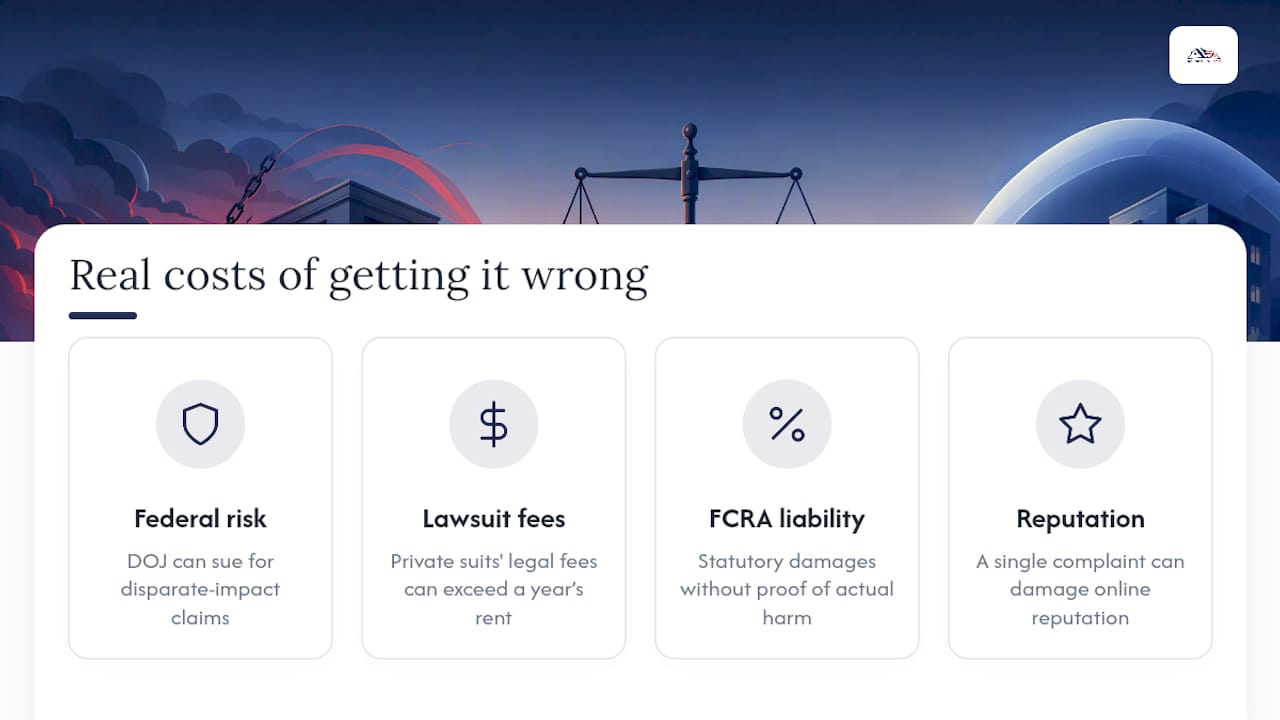
The exposure here is bigger than a single denied applicant complaining. The Fair Housing Act allows for federal enforcement action, and the Department of Justice can pursue landlords whose screening practices produce a discriminatory pattern, even without proof of intentional bias. Disparate-impact claims don't require you to have meant any harm. They require only that your policy produced an unequal outcome across a protected class.
Beyond federal exposure, most states allow private lawsuits, and legal fees alone can dwarf whatever a unit would have earned in a year of rent. Add in state or local fair housing agency complaints, which can trigger investigations independent of any lawsuit, and the practical cost of one bad application question multiplies quickly. FCRA violations carry their own separate liability, including statutory damages that don't require the applicant to prove actual financial harm.
The reputational cost is real too, even for small landlords. A single formal complaint, even one that gets resolved quietly, can follow a property management operation in ways that are hard to undo once tenants start comparing notes online. The fix is almost always cheaper than the failure: a standardized, reviewed application form costs a few hours of attention. A discrimination complaint costs a lot more than that, in money and in time you don't get back.
Why Most Landlords Overcomplicate This
Most advice on this topic treats every screening decision as a legal minefield, and that framing does landlords a disservice. The actual rule is simple: measure ability to pay and willingness to follow the lease, and nothing else. Landlords get into trouble not because the law is confusing, but because they ask questions out of habit or curiosity that have nothing to do with either of those two things.
The bigger blind spot isn't the obviously illegal question, most people know not to ask about religion. It's the proxy question that feels conversational: asking where someone's from, commenting on a name, asking if kids will be "loud." Those slip through because they don't feel like screening questions. They feel like small talk. Treat them the same way you'd treat a direct question about race, because a fair housing investigator will.
If there's one place to focus first, it's consistency over cleverness. A mediocre application form applied identically to everyone beats a sophisticated one applied selectively. Write your criteria down, use the same form every time, and get the authorization signature before you pull a single report. That's most of the legal risk, handled.
— Matt
Build a Compliant Screening Process Without Building It Alone
Every fair housing rule and FCRA step covered here is manageable on paper and easy to get wrong in practice, especially across multiple units or a growing portfolio. We handle the full screening workflow for landlords including standardized applications, signed screening authorizations, documented criteria applied the same way to every applicant, and recordkeeping that helps protect against disputes.
Property management services also cover what happens after screening, including rent collection, lease renewals, and eviction support when a tenancy doesn't work out. If you'd rather have a system running in the background than reread federal guidance every time a new applicant applies, consider getting in touch through the property management page to explore tenant screening or full management support options for your properties.
This article is general information, not a substitute for advice from a qualified lawyer. Consult a qualified legal professional about your own circumstances before acting on anything here.
Sources
- Guidance on the Application of the Fair Housing Act to the Screening of Applicants for Rental Housing (HUD, 2024)
- What should I do if my rental application is denied because of a tenant screening report? (CFPB)
- Fair Housing Act overview (HUD)
- Fair Housing Act overview (U.S. Department of Justice)
FAQ
What questions can't be asked on a rental application?
Any question that reveals race, color, religion, national origin, sex, familial status, or disability status is illegal under the Fair Housing Act, including proxy questions about birthplace, native language, marital status, or whether an applicant has or plans to have children.
What can landlords legally ask for on an application?
Landlords can request legal name, date of birth, Social Security number or ITIN for screening, income and employment verification, rental history, references, and number of occupants, all tied to ability to pay or lease compliance.
What are red flags on a rental application?
Common red flags include unverifiable income, inconsistent rental history, an eviction record, or references that decline to confirm basic facts, but every red flag must be applied through the same written standard for every applicant to avoid a discrimination claim.
What questions do landlords typically ask on a rental application?
Standard rental applications ask for identity information, current and past addresses, employer and income details, references, and consent to run a credit, criminal, and eviction check, which requires a signed authorization under the Fair Credit Reporting Act.
Can a landlord ask if I have children?
No. Asking directly about children, or asking questions designed to reveal the same information, violates familial status protections under the Fair Housing Act; a landlord can only ask the total number of people who will occupy the unit.