
Copy this, adjust the numbers, and publish it: "Sun-filled 2BR/1BA, $1,650/mo, in-unit laundry, off-street parking, pets welcome (breed restrictions apply), available March 1. Two blocks from the Beltline. Schedule a showing today." That single sentence conveys price, layout, a key amenity, pet policy, and a move-in date, which helps attract qualified applicants rather than casual browsers.
Before you write anything else, run through this: rent and fees stated in dollars, beds/baths and square footage, pet and parking policy, utilities included or excluded, move-in date, and one line guiding the reader on how to take the next step. Skip any of those and you'll spend your first week fielding the same three questions by text instead of collecting applications.
- Rent, deposit, and any recurring fees spelled out in numbers
- Beds, baths, square footage, and lease term
- Pet policy and parking, stated plainly
- One standout feature that isn't generic ("renovated kitchen," not "cozy")
- Move-in date and a direct call to action
Publish the listing, then commit to replying to inquiries within 24 hours. Speed matters more than most landlords expect, and slow responses are one of the fastest ways to lose a good tenant to a competing unit.
Key Takeaways
A rental listing fills fastest when it front-loads price, layout, pet and parking policy, and a clear call to action within the first two sentences.
| Point | Details |
|---|---|
| Lead with filters, not adjectives | State price, beds/baths, pets, and parking before any descriptive language. |
| Use a 4 to 5 sentence formula | Hook, specs, features, neighborhood, then rules and a CTA, no longer. |
| Disclose all fees upfront | State total monthly cost including add-on fees to filter out low-intent inquiries. |
| Stay Fair Housing compliant | Avoid protected-class language and include an Equal Housing Opportunity statement. |
| Respond within 24 hours | Fast replies shorten vacancy length more reliably than longer descriptions. |
| Get professional help if needed | OneSource Real Estate writes, formats, and posts listings across platforms for owners who want it done for them. |
This article is general information, not a substitute for advice from a qualified lawyer. Consult a qualified legal professional about your own circumstances before acting on anything here.
Table of Contents
- What Are the Non-Negotiable Fields in a Rental Listing Description?
- What Is a Good Headline for a Rental Property Listing?
- What's the Best Structure for a Rental Property Description?
- Ready-to-Use Rental Listing Templates by Property Type
- What Are the Fair Housing Rules for Rental Ads?
- What Listing Mistakes Cost Landlords Qualified Applicants?
- How Should Photos Pair With Your Listing Copy?
- Do Transparent Fees Actually Attract Better Applicants?
- How I Think About Writing a Listing That Actually Works
- Need Help Getting Your Listing Filled Faster?
- Sources
- FAQ
What Are the Non-Negotiable Fields in a Rental Listing Description?
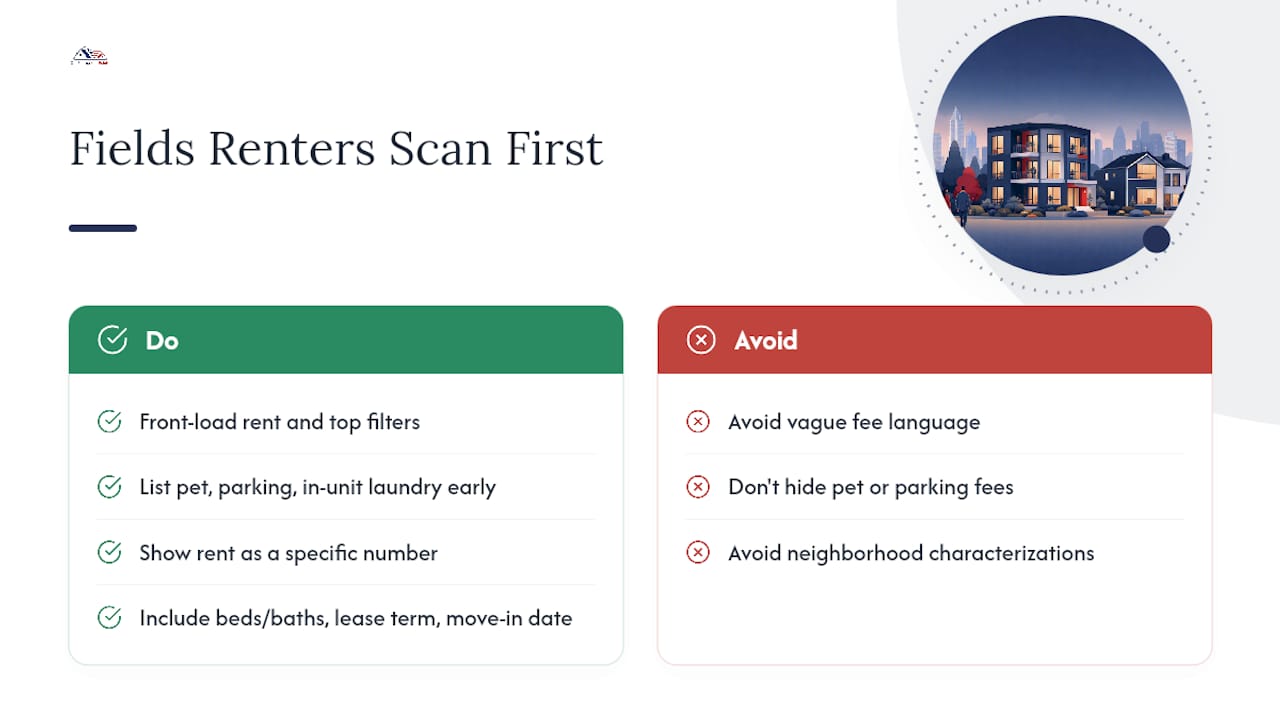
Every listing needs seven pieces of information before it goes anywhere near Zillow or Craigslist, and the order you present them in isn't random. Renters scan for deal-breakers first, so bury the wrong detail and you'll get inquiries from people who'll drop out the moment they learn there's a $75 monthly pet fee you didn't mention.
Start with rent, written as a specific number, not a range. "$1,800/mo" filters better than "$1,700 to $1,900 depending on unit." If there are recurring fees, a pet rent, a parking fee, a utility flat rate, format them as a single line: "Rent $1,800 + $50 pet fee + water/trash included." That one line does more filtering work than three paragraphs of prose.
Next comes the hard data: beds, baths, square footage, lease term, and move-in date. Then pet policy and parking, stated without hedging ("Two pets max, $300 non-refundable pet fee, breed restrictions apply" beats "pets considered"). List utilities included and excluded explicitly, along with any application fee or deposit amount, since vague fee language is one of the fastest ways to lose a serious applicant's trust. For neighborhood facts, stick to distances, transit lines, and named landmarks rather than characterizations of who lives there. "Half a mile from the Marta Chamblee station" is safe and useful. Commentary on the neighborhood's residents is not, and it's a genuine Fair Housing risk.
Pro Tip: Renters filter on pet policy, parking, and in-unit laundry before anything else. Put those three details in the headline or the first sentence, because most people skim, and units that do not disclose this information upfront risk losing interest from tenants who skim listings. This mirrors TenantCloud's advice to front-load the details renters actually filter on.
What Is a Good Headline for a Rental Property Listing?
A good headline follows a formula: location + price + beds/baths + one standout amenity. "Midtown 1BR, $1,450, in-unit W/D, walk to the Beltline" tells a renter everything they need to click in under ten words. Apartments backs this up: leading with beds/baths, price, and a standout benefit improves click-through because it helps renters filter listings before they even open them.
Different platforms give you different room to work with:
- Zillow and Apartments.com allow longer headlines, so you can fit two amenities: "Renovated 2BR/2BA near Buckhead, $2,100, pool + gated parking."
- Facebook Marketplace truncates aggressively on mobile, so front-load price and beds/baths in the first six words.
- Craigslist rewards specificity over cleverness. Skip the wordplay and state the facts.
A few dos and don'ts worth memorizing:
- Do lead with what renters filter on: price, beds/baths, pets, parking.
- Don't use vague adjectives like "amazing" or "must-see" with nothing behind them.
- Don't mention preferred tenant types, families, professionals, students, ever.
- Do keep it under 70 characters where the platform allows longer copy elsewhere.
Try these as starting points: "Marietta 3BR ranch, $2,300, fenced yard + 2-car garage" or "Downtown studio, $1,100, all utilities included, no deposit."
What's the Best Structure for a Rental Property Description?
The description that consistently performs best runs four to six sentences, built in this order: hook, specs, top two or three features, neighborhood context, then rules and a call to action. That's it. Padding beyond that length doesn't add conversions, it just adds scrolling.
- Hook (1 sentence): the single best feature, stated plainly. "Renovated kitchen with quartz counters and a gas range."
- Specs (1 sentence): rent, beds/baths, square footage, lease term.
- Features (1 to 2 sentences): in-unit laundry, parking, storage, pet policy.
- Neighborhood (1 sentence): distance to transit, a named landmark, a commute detail.
- Rules and CTA (1 sentence): deposit, application requirements, and what to do next.
For length, Zillow rewards 200 to 300 words because its algorithm favors completeness. Craigslist and Facebook perform better shorter, 100 to 150 words, because mobile readers bounce fast. Use bullet points for amenities lists, never ALL CAPS for emphasis (it reads as shouting and gets flagged by spam filters on some platforms), and skip bold text inside the description body itself.
Pro Tip: Match your CTA to your actual goal. If you want more showings, write "Schedule a tour today." If you're trying to fill applications faster, write "Apply online, approval in 24 to 48 hours." Guides on structured formatting, including Landlord Studio's rental listing framework, point to the same short hook plus detail sentences plus CTA pattern as the one that earns qualified leads.
Ready-to-Use Rental Listing Templates by Property Type
Here's a fill-in-the-blank template you can adapt to almost anything: "[Standout feature] [property type] in [neighborhood], $[rent]/mo. [Beds]BR/[Baths]BA, [sq ft] sq ft, [lease term]. Features include [amenity 1], [amenity 2], and [amenity 3]. [Pet/parking policy]. [Distance] from [landmark/transit]. Available [date]. [CTA]."
Applied to a studio: "Bright studio near Midtown, $1,150/mo. 450 sq ft, 12-month lease. In-unit AC, updated bathroom, on-site laundry. No pets. Steps from the Marta station. Available now. Apply online today."
Applied to a family home: "Spacious 4BR/2.5BA ranch in Johns Creek, $2,650/mo. 2,200 sq ft, fenced backyard, 2-car garage. Top-rated school district. Pets negotiable. Available June 1. Schedule a tour this week."
Platform length varies: aim for roughly 300 words on Zillow, 150 on Apartments.com, and 120 on Facebook, trimming neighborhood detail first when you need to cut.
"No dishwasher, but the pantry is full-size and the utility bill runs lower without one." That's how you handle a genuine drawback: name it once, then pivot to something concrete instead of pretending it isn't there.
A one-bedroom near a hospital or university works for shift workers and students, so lead with commute time. A pet-friendly duplex should lead with the yard and fencing, since that's what pet owners search for first. A short-term furnished rental should lead with move-in readiness: "Fully furnished, move-in ready, flexible 3-month lease available."
What Are the Fair Housing Rules for Rental Ads?
The Fair Housing Act prohibits advertising language that expresses a preference, limitation, or discrimination based on race, color, religion, sex, disability, familial status, or national origin, and every listing should carry an Equal Housing Opportunity statement to signal compliance. That rules out phrases like "perfect for young professionals," "no kids," or "near the church," even when the intent behind them feels harmless.
Neutral alternatives exist for almost every phrase landlords are tempted to use. Instead of "great for families," write "4 bedrooms, fenced yard." Instead of "ideal for singles," write "compact 1BR layout." The specifics do the work the coded language was trying to do, without the legal exposure.
Photos matter too. The National Fair Housing Alliance recommends using diverse, representative imagery rather than photos that could be read as signaling who belongs in a space. Digital ad targeting carries its own risk: HUD's 2024 guidance warns that audience-targeting tools on ad platforms can function as proxies for protected characteristics, so avoid narrowing your Facebook or Instagram ad audience by age, family status, or similar filters.
Run this checklist before you hit publish: no protected-class language anywhere in the copy, an Equal Housing Opportunity statement included, photos that don't imply exclusion, and no demographic-based ad targeting settings turned on.
Georgia landlords should also check state-specific fair housing protections, which layer on top of federal rules in a few areas.
What Listing Mistakes Cost Landlords Qualified Applicants?
Vague descriptors like "cozy" or "charming" read as code for small and dated, and specific renters skip past them. Rewrite "cozy 1BR" as "efficient 1BR, 600 sq ft, smart storage throughout." The second version tells the reader something true.
Hidden fees and "call for price" listings lose serious applicants before they ever inquire, since most renters filter by exact rent and won't call to find out what you're hiding. State every fee upfront instead.
- Vague language → replace with quantified specifics (sq ft, distance, exact fees)
- "Call for price" → replace with a stated rent figure
- Photos in random order → lead with your best, most true-to-life room
- Missing pet/parking fields → state them even when the answer is "no"
Pro Tip: Response time affects vacancy length more than almost anything else in your control. A listing that replies within an hour fills faster than an identical listing that takes three days, simply because serious renters move on to whoever answers first.
How Should Photos Pair With Your Listing Copy?
Lead with your best, most representative room as the thumbnail, usually the living room or a renovated kitchen, since that's the image that decides whether someone clicks at all.
Capture a full shot list: living room, kitchen, each bedroom, bathroom, laundry area, and parking or exterior. Reference specific photos in your copy when it helps ("see updated kitchen, photo 3") and write simple alt text for every image, both for accessibility and because search engines index it. A line like "bright kitchen with white cabinets and gas range" serves visually impaired readers and SEO at the same time.
- Best/most accurate room first, always
- Full shot list: living, kitchen, bed, bath, laundry, parking
- Simple, descriptive alt text on every photo
Do Transparent Fees Actually Attract Better Applicants?
Listings built on a tested structure, headline, hook, specs, amenities, CTA, paired with platform-appropriate length, can see meaningful lifts in inquiry volume; one industry guide cites lifts as high as 30% when landlords template and test their listings. Fee transparency is part of that structure, not separate from it.
Try this line: "Total monthly cost: $1,850 (rent + water + trash, no hidden fees)." It's one sentence, and it filters out anyone who can't afford the unit before they waste your time with a showing request.
- State total monthly cost, not just base rent
- List what's included in that number
- Let the number do the filtering for you
How I Think About Writing a Listing That Actually Works
Most listings fail for a boring reason: they describe the property instead of answering the four questions every renter has already typed into a search filter. Price, layout, pets, parking. Get those right in the first two sentences and the rest of the copy is just supporting detail.
I've reviewed listings that read like real estate poetry and sat vacant for six weeks, next to plain, specific ones that filled in days. The specific ones win because renters aren't shopping for adjectives. If you'd rather hand this off entirely, our property management team writes and places these listings for owners across the Atlanta area every week.
Need Help Getting Your Listing Filled Faster?
Writing a compliant, high-converting listing takes real time, and every day it sits half-finished is a day of lost rent. OneSource Real Estate writes the copy, formats it for each platform, and posts it for you, so you're not toggling between Zillow's character limits and Facebook's photo cropping at 11 p.m.
Our tenant procurement service handles the listing description, photo sequencing, and platform posting, then manages inquiries so you're only talking to pre-qualified applicants. Owners who use this service typically see faster placement and fewer weeks of vacancy than self-managed listings, because a dedicated team is watching response time the way the earlier pro tip described. If you want a second set of eyes on a listing you've already drafted, or you'd rather skip the writing entirely, request help with your property management and we'll take it from there. For landlords who want to pair a well-written listing with paid distribution, a service like AdPropix's tenant finder ads can extend reach beyond organic platform traffic.
Sources
- HUD — FHEO Guidance on Advertising through Digital Platforms (2024)
- National Fair Housing Alliance — Responsible Advertising
- TenantCloud — How to Advertise an Apartment for Rent: 8 Tactics
- Apartments
FAQ
What is a good headline for a rental property listing?
A good headline combines location, price, beds/baths, and one standout amenity, such as "Midtown 1BR, $1,450, in-unit W/D, walk to the Beltline."
What is the 2% rule for rentals?
The 2% rule is an investment screening guideline suggesting monthly rent should equal roughly 2% of a property's purchase price, used to gauge cash flow potential rather than to write listing copy.
How do I write a home listing description?
Follow a four to six sentence structure: a hook highlighting the best feature, specs (rent, beds/baths, square footage), two or three key amenities, a neighborhood detail, and a closing call to action.
What do I put for property description?
Include rent and fees, beds/baths and square footage, pet and parking policy, utilities included, move-in date, and one distinguishing feature, all stated specifically rather than in vague terms.
Who can help me write and post my rental listing?
OneSource Real Estate offers listing copy, photo formatting, and platform posting as part of its property management and tenant placement services for owners in the Atlanta area.