
Rent guarantee insurance pays you the rent your tenant owes after they default, subject to a waiting period and a monthly cap, typically for up to 12 months or until you recover possession. If your rental income covers a mortgage payment, if you own a high-rent unit, or if your state's eviction timeline runs three to six months, this coverage is worth serious consideration. That said, it is a cash-flow backstop, not a substitute for thorough tenant screening. The landlords who get the most value from rent guarantee insurance are the ones who screen carefully first, then buy the policy as a financial safety net for the scenario they hope never happens.
Table of Contents
- How does rent guarantee insurance actually work?
- What does rent guarantee insurance typically cover?
- How much does rent guarantee insurance cost?
- What rent guarantee insurance does not cover
- How does rent guarantee insurance compare to other options?
- Pre-purchase checklist: what to verify before you buy
- Key Takeaways
- What most landlords get wrong about rent guarantee insurance
- OneSource Real Estate protects your rental income from the ground up
- Useful sources for U.S. landlords
- FAQ
How does rent guarantee insurance actually work?
The policy sits dormant until your tenant misses rent. At that point, a waiting period begins, commonly around 30 days of arrears, before the insurer starts paying. Once triggered, the insurer pays a monthly benefit up to a stated cap for a fixed claim period. Coverage typically runs up to a year or until you regain possession of the property, whichever comes first.
The claim trigger and payment flow
Most policies follow this sequence:
- Tenant misses a payment. You document it immediately in your rent ledger.
- You notify the insurer within the required window (often 30 days of the missed payment).
- You submit evidence: signed lease, referencing packet, rent ledger, and any written correspondence with the tenant.
- The insurer reviews the file and begins monthly benefit payments once the waiting period is satisfied.
- You pursue eviction through your state's court process. The insurer continues paying while the legal process runs.
One mechanic landlords often overlook: insurer subrogation. After the insurer pays your claim, they may pursue the defaulting tenant directly to recover what they paid out. The tenant remains legally liable for the unpaid rent and associated legal costs. This is not a forgiveness arrangement for the tenant.
Pro Tip: Start your referencing and claims documentation folder the day the lease is signed, not the day rent goes missing. Most denied claims trace back to missing or incomplete paperwork from the move-in period.
What does rent guarantee insurance typically cover?
Core coverage is straightforward: the insurer reimburses your missed rent payments up to a monthly cap. Beyond that, the value of a policy often comes down to what it bundles.
| Coverage Item | Typical Inclusion | Notes |
|---|---|---|
| Missed rent payments | Standard | Monthly cap applies; verify the dollar limit |
| Legal expenses / eviction costs | Common add-on or bundle | Covers attorney fees, court filing costs |
| Void / vacancy payments | Less common | Short turnover gap after eviction |
| Rent above the policy cap | Excluded | You absorb the difference |
| Pre-existing arrears | Excluded | Policy must start before default occurs |
| Referencing failures | Excluded | No referencing = no valid claim |
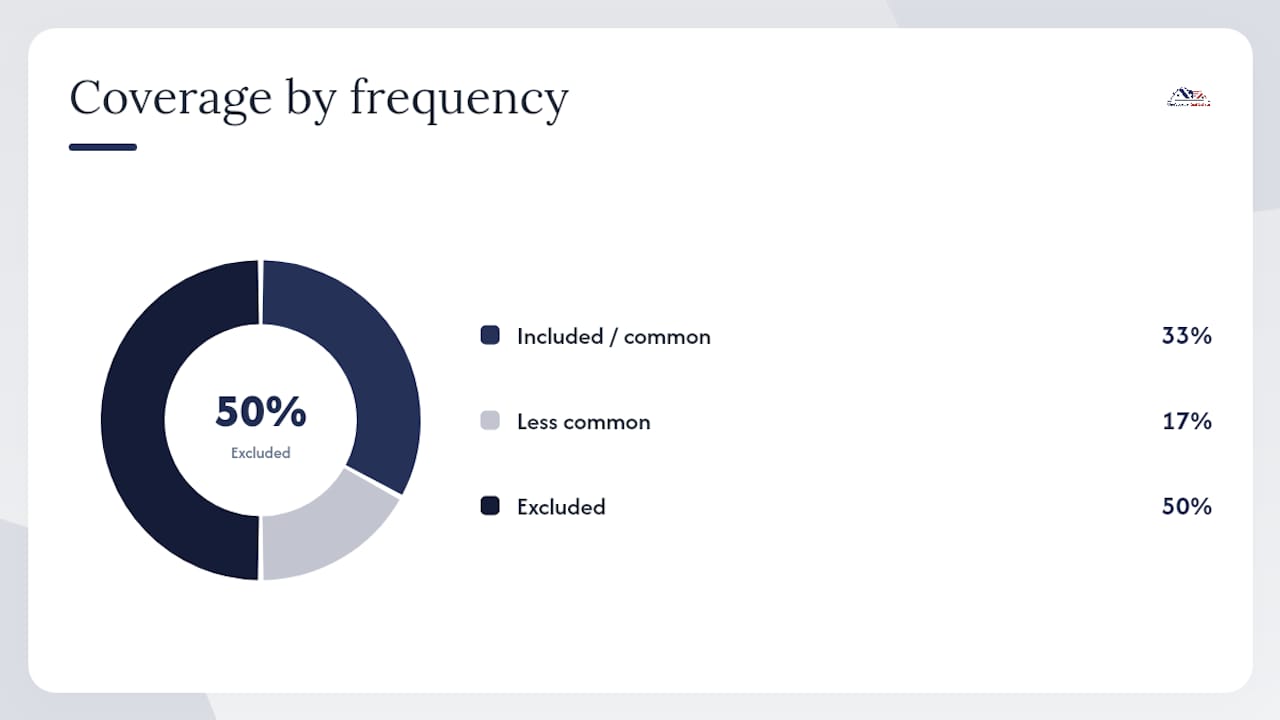
Rent default insurance policies commonly bundle rent reimbursement with legal-expense cover, which pays attorney fees and court costs during eviction. That bundling matters more than it looks on paper: eviction in some U.S. states can run $3,000–$5,000 in legal fees alone, and a policy that absorbs those costs changes the math considerably.
Standard landlord insurance does not cover tenant nonpayment. A landlord policy from a carrier like Travelers covers physical damage to the structure and liability claims. Loss of rent in a standard landlord policy only pays when a covered peril, such as a fire or flood, makes the unit uninhabitable. Tenant default is a separate risk requiring a separate product.
How much does rent guarantee insurance cost?
Premiums vary enough that a single number is misleading, but the structure is consistent. Insurers price coverage based on a handful of factors: the monthly rent amount, the property's location and local vacancy risk, the tenant's credit profile, the length of the waiting period, and whether legal-expense cover is included.
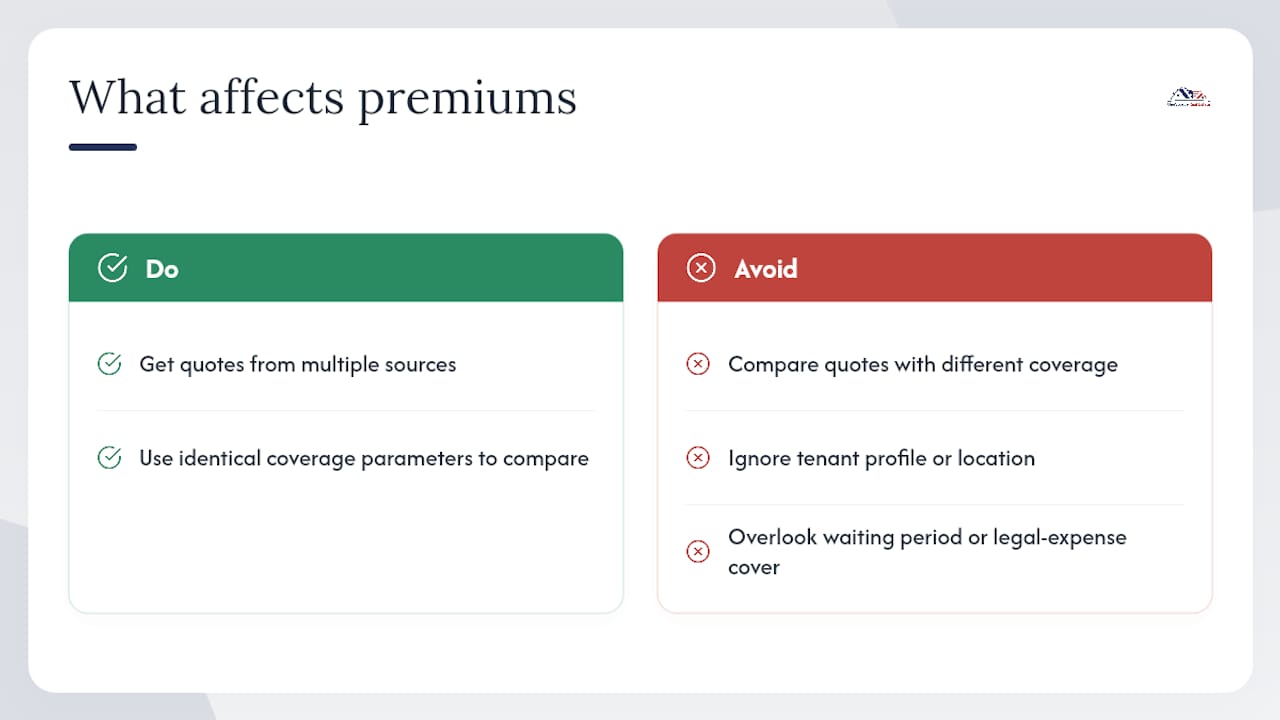
Two premium models are common. The first is a flat annual fee, which works well for lower-rent properties where a percentage model would produce a very small premium. The second is a percentage of annual rent, which scales with the exposure the insurer is taking on. Published benchmarks from landlord-focused guides show that premiums vary meaningfully by market, tenant profile, and coverage scope, so the most useful thing you can do is get quotes from multiple sources with the same coverage parameters.
The waiting period is a real pricing lever. A 30-day waiting period costs more than a 60-day one because the insurer absorbs risk sooner. Some policies structure the deductible as one month's rent rather than a dollar amount, which effectively means you absorb the first missed payment and the insurer covers the rest. For a $2,000/month unit, that is a $2,000 deductible.
Legal-expense add-ons push premiums higher, but given eviction costs in markets like Atlanta, the added premium often pays for itself in a single claim.
What rent guarantee insurance does not cover
The exclusions are where policies diverge most, and where landlords get surprised.
Read your policy's exclusions before you buy, not after you file. The most common reason a claim is denied is not that the tenant paid. It is that the landlord failed to complete referencing, missed a notification deadline, or had arrears that predated the policy start date. A policy that looks comprehensive on the summary sheet can be nearly uncollectable if the underwriting conditions were not met at inception.
Common exclusions across most policies:
- Arrears that existed before the policy start date
- Tenancies where proper referencing was not completed or documented
- Tenants who voluntarily vacate (as opposed to being evicted)
- Rent amounts above the policy's monthly cap
- Landlord failure to serve correct legal notices or follow statutory eviction procedures
- Certain tenant types not approved at underwriting
The financial math also deserves scrutiny. Premiums, waiting periods, monthly caps, and aggregate limits all reduce your net recovery. If your monthly rent is $1,800 and the policy cap is $1,500, you are absorbing $300 per month out of pocket. Over a six-month claim, that is $1,800 in unrecovered rent before you factor in the premium you paid.
How does rent guarantee insurance compare to other options?
Three products get confused regularly. They are not interchangeable.
- Rent guarantee insurance (RGI): An indemnity insurance policy. Trigger is tenant nonpayment. The landlord retains full property control. The insurer pays up to the policy cap after the waiting period. This is a discrete product sold by specialized insurers or as an add-on through property managers.
The right comparison depends on what you are trying to solve. If you want to keep managing your property yourself and just want a financial backstop for default, RGI is the product. If you want to remove yourself from day-to-day management and want predictable income, a full-service property management arrangement with an owner-protection package may deliver more value.
Pre-purchase checklist: what to verify before you buy
Before signing any rent guarantee policy, work through this list.
Documents to preserve from day one:
- Signed lease with all addenda
- Full referencing packet: credit report, government ID, income verification, employer contact
- Rent ledger (digital, timestamped)
- All written tenant correspondence (email or text)
- Maintenance and repair logs
Policy clauses to verify:
- Waiting period length and how it is calculated
- Monthly benefit cap and aggregate (total) payout cap
- Maximum claim duration in months
- Whether legal-expense cover is included or an add-on
- Subrogation terms and what cooperation is required
- Referencing window: how recently referencing must have been completed
Questions to ask the insurer before buying:
- How quickly do you pay after a complete claim submission?
- What specific evidence do you require to open a claim?
- Do you accept referencing completed by a third-party screening service?
- Is this policy available in my state, and are there state-specific coverage limits?
- What happens if the eviction process takes longer than the policy's maximum claim period?
Pro Tip: Ask the insurer for a sample claim scenario in writing before you buy. A reputable insurer will walk you through a hypothetical payout calculation. If they cannot or will not, that tells you something.
Key Takeaways
Rent guarantee insurance is most valuable when your cash flow depends on rental income and your state's eviction timeline is long enough to create a meaningful financial gap.
| Point | Details |
|---|---|
| Core function | Pays missed rent after a waiting period, typically up to 12 months or until possession is recovered. |
| Screening comes first | RGI is a backstop; thorough tenant referencing is still the primary defense against default. |
| Exclusions matter most | Claims are most often denied for referencing failures or missed notification deadlines, not tenant behavior. |
| Legal-expense bundling | Adding eviction cost coverage changes the financial math significantly in states with long court timelines. |
| OneSource Real Estate | Offers full property management with tenant screening, rent collection, eviction support, and optional owner-protection packages in Atlanta and surrounding areas. |
What most landlords get wrong about rent guarantee insurance
The conventional wisdom treats rent guarantee insurance as a product you buy and forget. That framing is how landlords end up with denied claims.
The policy is only as good as the documentation behind it. An insurer is not going to pay a claim because you say your tenant stopped paying. They are going to pay because you can prove the tenancy was properly underwritten, the lease was correctly executed, and you followed the claim notification process to the letter. The landlords who collect on these policies are the ones who treated the referencing and documentation requirements as non-negotiable from day one, not as paperwork to get through.
There is also a real question about whether standalone RGI is the right tool for every landlord. If you are managing a property remotely, dealing with a complex tenant situation, or navigating a state with a long eviction timeline, the operational coordination required to keep a claim valid is substantial. A property manager who handles tenant screening, lease execution, rent collection, and eviction coordination does not just reduce your workload. They also reduce the documentation gaps that kill claims. The insurance is more valuable when the management infrastructure behind it is solid.
OneSource Real Estate protects your rental income from the ground up
Managing rent default risk is not just about having the right insurance policy. It is about having the right systems in place before a tenant ever misses a payment.

OneSource Real Estate handles the full management stack for Atlanta-area landlords: tenant screening and referencing, lease drafting, rent collection, maintenance coordination, eviction support, and optional owner-protection packages. That means the documentation insurers require for a valid claim is built into the management process from day one, not assembled in a panic after rent goes missing. For landlords who want operational support alongside financial protection, that combination is more reliable than a standalone policy managed in isolation.
If you are evaluating your options for rental income protection in Atlanta and surrounding areas, request a property management consultation to see how a managed approach compares to buying coverage on your own.
Useful sources for U.S. landlords
This article covers general information about rent guarantee insurance in the U.S. context. Tax treatment of premiums and claim payouts, state eviction timelines, and specific policy terms vary. Consult a licensed insurance professional and a tax advisor for guidance specific to your situation.
- Understanding Rent Guarantee Insurance: Protect Your Rental Income
- Rent guarantee insurance | Buildium
- How Rent Default Insurance Protects Your Rental Income - SingleKey
- The landlord's guide to rent guarantee insurance - Stessa
- Landlord insurance for rental properties - Travelers
FAQ
What is rent guarantee insurance?
Rent guarantee insurance is an indemnity policy that reimburses landlords for lost rent when a tenant defaults, typically paying monthly benefits up to a stated cap for up to 12 months or until the landlord recovers possession.
What are the main drawbacks of rent guarantee insurance?
Claims are frequently denied due to incomplete tenant referencing, missed notification deadlines, or pre-existing arrears. Monthly caps, waiting periods, and aggregate limits also reduce net recovery compared to the full rent owed.
How much does rent guarantee insurance cost?
Premiums vary by monthly rent amount, location, tenant profile, waiting period length, and whether legal-expense cover is included. Get quotes from multiple sources using identical coverage parameters to compare accurately.
How long does rent guarantee coverage last?
Most policies cover missed rent for up to 12 months or until the landlord regains possession of the property, whichever comes first. The exact duration depends on the policy's stated maximum claim period.
Does standard landlord insurance cover tenant nonpayment?
No. Standard landlord insurance covers physical damage to the structure and liability claims. Loss-of-rent coverage in a landlord policy only pays when a covered peril makes the unit uninhabitable, not when a tenant simply stops paying.