
Yes: if a rental home was built before 1978, federal law requires the landlord to provide a Lead Warning Statement, any known lead paint records, and the EPA pamphlet "Protect Your Family From Lead in Your Home" before a tenant signs the lease. That is the whole test. Age of the building triggers the duty, not whether anyone suspects lead is actually present.
Landlords do not have to test for lead or remove it. The federal rule is about disclosing what you already know, not chasing down what you don't.
Three things to do before any lease gets signed:
- Attach a signed Lead Warning Statement to the lease itself.
- Hand the tenant a copy of the EPA pamphlet, in the same language as the lease.
- Get the tenant's signature acknowledging receipt, and keep that record.
Pro Tip: Do this even for tenants renewing a lease on a unit they've lived in for years, as explained in this landlord's guide to lease renewals. A gap in your disclosure paperwork is a gap regardless of how long someone has already lived there.
Key Takeaways
Federal law requires landlords renting most pre-1978 housing to disclose known lead hazards, provide the EPA pamphlet, and attach a signed Lead Warning Statement before lease signature, with no testing obligation attached.
| Point | Details |
|---|---|
| Federal trigger | Any rental unit built before 1978 falls under Title X's disclosure rule, regardless of renovations. |
| Four required items | Known hazard disclosure, available records, the EPA pamphlet, and a signed Lead Warning Statement. |
| No testing duty | Landlords disclose what they already know; the rule does not require inspection or abatement. |
| Retention window | Keep signed acknowledgments for three years as proof of compliance. |
| Managed compliance | OneSource Real Estate builds disclosure paperwork into its lease preparation for managed rental owners. |
Table of Contents
- What the Federal Lead Paint Disclosure Rule Requires for Rentals
- Where to Find the Lead Warning Statement and Sample Disclosure Forms
- When Lead Disclosure Rules Don't Apply
- A Landlord's Step-by-Step Compliance Checklist
- How OneSource Real Estate Helps Landlords Stay Compliant
- Why the Testing Myth Won't Die
- Get Lease Compliance Handled by OneSource Real Estate
- Sources
- FAQ
What the Federal Lead Paint Disclosure Rule Requires for Rentals
The obligation comes from the Residential Lead-Based Paint Hazard Reduction Act of 1992, known as Title X, and its implementing rule, Section 1018. It covers most private, public, and federally assisted housing built before 1978, and it applies whether you own one rental house or a portfolio of forty units.
Before the lease is signed, you owe the tenant four things:
- Disclosure of any lead-based paint or hazards you actually know about.
- Copies of any existing records or reports on lead paint in the unit.
- The EPA-approved pamphlet on lead hazards.
- A signed Lead Warning Statement attached to or built into the lease.
If your lease is written in a language other than English, the disclosure and warning statement have to match that language. You cannot hand a Spanish-speaking tenant an English-only lease and an English-only lead disclosure and call it compliant.
Retention matters as much as delivery. Keep every signed acknowledgment for a period of time from the start of the tenancy, since that is the window regulators and courts look at if a dispute surfaces. 24 C.F.R. part 35 spells out this record requirement alongside the required language for the warning statement itself.
Skipping this isn't a paperwork technicality. Violations can trigger civil and criminal penalties, and tenants can pursue private damages, sometimes tripled under Title X, when a landlord failed to disclose known hazards before move-in.
Where to Find the Lead Warning Statement and Sample Disclosure Forms
The Lead Warning Statement is the specific paragraph confirming the landlord's knowledge status: it states whether lead-based paint or hazards are known to exist, lists any reports the landlord has, and includes a line for the tenant and any real estate agent to acknowledge receipt of the pamphlet and records.
EPA publishes a ready-to-use version. The sample Lead-Based Paint Disclosure form (LESR) contains the exact acknowledgment language regulators expect, and the EPA pamphlet itself is available directly from the agency's lead information page, including versions in languages other than English.
You have a few practical options for using it:
- Attach the EPA sample form as a signed exhibit to the lease.
- Fold the Lead Warning Statement language directly into your lease template as its own clause.
- Use a state-specific version where your state requires additional language beyond the federal minimum.
Printable form services like eForms also host fillable versions of the disclosure packet, useful if you want something ready to sign without building your own template. Whichever route you choose, document the delivery date and get a dated signature. A form sitting in your files unsigned proves nothing.
When Lead Disclosure Rules Don't Apply
A few rental situations fall outside the federal requirement entirely. Short-term leases of 100 days or fewer are exempt, which covers most vacation and corporate housing arrangements. Certain housing for elderly or disabled residents, where no children under six are expected to live, also has different treatment under the rule.
A unit that has been certified lead-free by a state-certified inspector is out of scope too, but only if you keep that certificate on file and can produce it. Beyond these carve-outs, some states and cities layer stricter lead rules on top of the federal baseline, including mandatory testing in certain older housing stock. Federal law is the floor, not the ceiling, so check your local code before assuming you're exempt.
A Landlord's Step-by-Step Compliance Checklist
Work through these steps in order, every time you sign a new tenant into pre-1978 housing:
- Confirm the property's age. Pull the county property record to verify the construction date. If it was built before 1978, the rule applies regardless of renovations since.
- Gather what you already have. Collect any prior inspection reports, paint records, or abatement paperwork, and get a copy of the EPA pamphlet ready to hand over.
- Draft the Lead Warning Statement. Attach the EPA sample language or build the clause into your lease, matching the lease's language.
- Deliver, sign, and file. Provide the documents in person or electronically with documented consent, obtain a signed acknowledgment, and store it for three years alongside your other lease records.
If a tenant asks about testing on their own, you're not obligated to arrange or pay for it, but document the request and your response in writing. That paper trail protects you if a dispute comes up later, even though the federal rule places no testing duty on you as the landlord.
How OneSource Real Estate Helps Landlords Stay Compliant
Individual landlords juggling this alongside rent collection and maintenance calls often let disclosure paperwork slip. OneSource Real Estate builds it into standard lease preparation for the owners it manages for:
- Preparing compliant lease attachments with the Lead Warning Statement already drafted.
- Distributing the EPA pamphlet to every prospective tenant before signature.
- Collecting and storing signed tenant acknowledgments as part of the lease file.
- Retaining disclosure records for the full compliance window, not just until move-in.
Why the Testing Myth Won't Die
Every landlord forum has someone insisting they need to hire an inspector before renting out an older duplex. They don't, and that misunderstanding costs people money they didn't need to spend and, worse, sometimes convinces landlords disclosure is optional if they simply skip testing altogether. It isn't. The federal rule asks for honesty about what you know, not a hunt for what you don't.

What conventional advice gets wrong is treating this as a one-time task bolted onto move-in. The stronger practice treats disclosure like security deposit handling or fair housing compliance: something you rebuild into every lease renewal, not just the first signature. A landlord who disclosed properly in 2022 and then let a tenant renew three times without touching the file again has a weaker paper trail than one who resigns the acknowledgment each cycle.
If I had to prioritize one thing for a landlord reading this with five units and no property manager, it's record retention. The disclosure itself is simple. Proving you delivered it three years later, when a tenant or an inspector asks, is where most landlords actually fail.
Get Lease Compliance Handled by OneSource Real Estate
Assembling a compliant disclosure packet is one more task on top of screening, rent collection, and maintenance calls, and it's the kind of paperwork that gets skipped when things get busy. OneSource Real Estate's property management services build lead disclosure directly into lease preparation for owners in Atlanta and the surrounding area, so the Lead Warning Statement, the EPA pamphlet, and the signed acknowledgment are already handled before a tenant moves in.
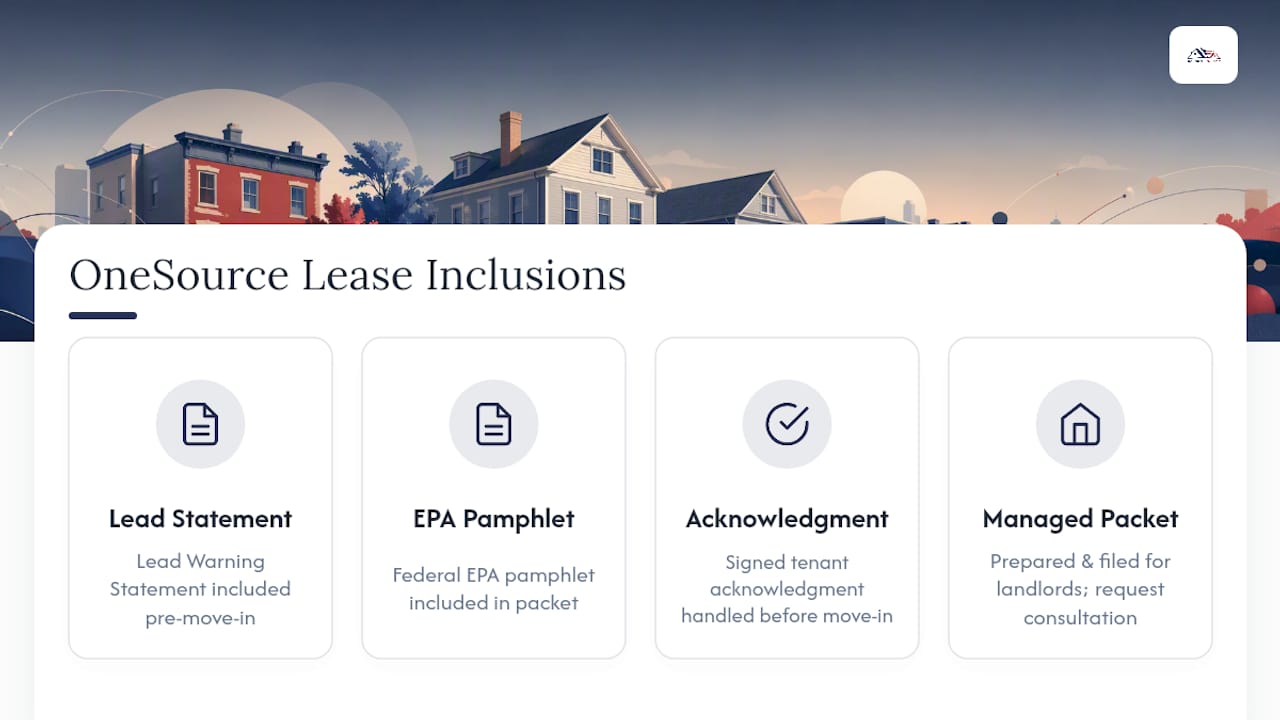
That matters most for landlords managing rentals from a distance or juggling several properties at once, where a missed signature on one unit is easy to lose track of. If you'd rather have a licensed team prepare and file this paperwork for every lease, reach out to OneSource Real Estate for a property management consultation and see what a fully managed lease packet looks like for your rental.
Sources
- Lead-Based Paint Disclosure Rule (Section 1018 of Title X) | US EPA
- 24 C.F.R. part 35 — Lead-Based Paint Activities
FAQ
Does lead paint disclosure apply to rentals?
Yes. Federal law requires disclosure for most rental housing built before 1978, regardless of whether the landlord owns one unit or a large portfolio.
Where can I find an official lead paint disclosure form for a rental?
The EPA publishes a sample Lead-Based Paint Disclosure form (LESR) that landlords can attach directly to a lease; some states also publish their own versions, so check your state housing agency if one exists.
Is a lead paint disclosure always required?
Not always. Housing built in 1978 or later, leases of 100 days or fewer, and units certified lead-free by a state-certified inspector generally fall outside the federal requirement.
Do landlords have to test for lead?
No. The federal disclosure rule requires landlords to share what they already know about lead hazards; it does not require testing, inspection, or abatement.
How long must landlords keep signed lead disclosure records?
Three years from the start of the tenancy, which covers most windows regulators or courts would look at in a dispute.