
There's no dollar amount or percentage cap on late rent fees written into Georgia law. What controls whether a fee sticks is the lease itself, whether the amount is a reasonable estimate of the landlord's actual costs, and two hard statutory rules: a $30-or-5% cap on returned-check fees and a three-business-day written notice before any dispossessory filing. Georgia's landlord-tenant statutes and the Georgia Landlord-Tenant Handbook set the framework that OneSource Real Estate uses when drafting compliant leases for Atlanta-area rentals.
TL;DR:
- Georgia law does not set a maximum cap on late rent fees; enforceability depends on whether the fee is a reasonable estimate of actual costs.
- Courts generally accept a flat fee of around $50 to $75 or approximately 5% of rent as reasonable, but fees must not resemble penalties or punitive measures.
- Landlords must provide a three-business-day written notice before filing for eviction, itemizing all charges, including late fees and bounced check fees.
- Late fees can be applied immediately after the due date unless the lease states a specific grace period; most landlords include a 3 to 5 day window.
- For bounced checks, Georgia law fixes a statutory fee of at least $30 or 5% of the check amount, whichever is greater, regardless of lease language.
Table of Contents
- Does Georgia Law Cap Late Rent Fees?
- How Courts Decide If a Late Fee Clause Holds Up
- When Does a Late Fee Actually Kick In?
- The Three-Business-Day Notice Georgia Landlords Can't Skip
- Worked Examples: How to Calculate a Defensible Late Fee
- Writing a Late Fee Clause That Actually Holds Up
- What Tenants Can Do About an Unfair or Undisclosed Fee
- OneSource Real Estate's Approach to Late-Fee Policy for Atlanta Landlords
- Let OneSource Real Estate Handle Your Rent Collection Compliance
- What Georgia Landlords and Tenants Get Wrong About Late Fees
- Sources
- FAQ
Does Georgia Law Cap Late Rent Fees?
No. Georgia's landlord-tenant statutes never mention a maximum late fee, and no chapter of the state code sets a percentage ceiling the way some states do. That surprises a lot of people who assume every state has some version of a "5% rule." Georgia doesn't.
Instead, enforceability comes down to ordinary contract law. Under O.C.G.A. §13-6-7, a fee written into a lease as "liquidated damages" for a breach (paying rent late counts) has to represent a genuine, reasonable estimate of the harm the landlord actually suffers. If a court decides the number looks more like a penalty designed to punish the tenant than compensation for real administrative cost, the clause can be thrown out entirely, not just reduced.
The DCA Landlord-Tenant Handbook reinforces this by telling landlords to spell out several things directly in the lease:
- The rent due date and any grace period
- The exact late fee amount or formula
- The returned-check fee
- How and when fees get assessed
One rule sits completely outside this reasonableness test: dishonored checks. Georgia law fixes that fee at $30 or 5% of the check amount, whichever is greater, regardless of what the lease says.
How Courts Decide If a Late Fee Clause Holds Up
Georgia courts apply a straightforward liquidated-damages test. The fee has to approximate what the landlord actually loses from a late payment. That means the extra time spent on collections calls, the administrative cost of sending notices, sometimes a small allowance for delayed cash flow. It does not mean whatever number felt fair when the lease was drafted.
Clauses that get struck down tend to share a pattern:
- Flat penalties disconnected from any real cost (a $200 charge on a $900 rent payment)
- Daily compounding fees with no ceiling, which can balloon into amounts far exceeding the rent itself
- Fees explicitly labeled as "punishment" or tied to the tenant's number of prior late payments rather than the landlord's cost
Clauses that tend to survive scrutiny stay proportionate and are stated as a single flat charge or a modest percentage, generally in the range of $50 to $75 flat, or around 5% of monthly rent. Neither number is a legal ceiling. Both reflect what courts have historically treated as defensible.
Pro Tip: Write the fee as a one-time flat charge per missed due date rather than a daily accrual. A single defensible number is far easier to justify in court than an escalating formula a judge has to untangle.
When Does a Late Fee Actually Kick In?
Georgia has no statutory grace period. None. If the lease doesn't build one in, rent is technically late the day after the due date, and a fee could apply immediately, assuming the lease authorizes it.
That said, most experienced landlords voluntarily include a short window anyway:
- A 3 to 5 day grace period is the most common practice across Georgia leases, giving tenants a buffer for bank delays or paycheck timing without giving up the right to charge a fee.
- No grace period at all is legal but tends to generate more disputes, since tenants often assume some cushion exists even when the lease never says so.
- A stated, specific grace window in the lease ("rent is late if not received by the 5th of the month") removes ambiguity entirely and is what the DCA handbook recommends over silence.
The Three-Business-Day Notice Georgia Landlords Can't Skip
Before a landlord can file a dispossessory action over unpaid rent or fees, HB 404, the Safe at Home Act, requires a written notice giving the tenant three business days to pay or move out. This applies to leases entered into or renewed on or after July 1, 2024, so many older, unrenewed leases may still fall under prior practice until they come up for renewal.
The notice has specific delivery requirements:
- It must be delivered by hand, first-class mail, or another method the lease specifically authorizes
- If mailed or posted, it generally needs to go in a sealed envelope addressed to the tenant
- It should itemize exactly what's owed: base rent, late fees, and any other charges, broken out separately rather than lumped into one number
That itemization matters beyond procedure. If a dispute ends up in front of a magistrate, a clear, dated notice breaking out the fee amount gives the landlord a paper trail and gives the tenant something concrete to dispute if the math is wrong. Vague notices that just say "amount owed: $1,400" invite challenges.
Worked Examples: How to Calculate a Defensible Late Fee
Numbers make this concrete. Take a $1,000-a-month unit with a five-day grace period. A flat $50 late fee is generally defensible because it corresponds to real costs: staff time preparing and sending a notice, a follow-up call, updating the ledger. That's roughly 5% of rent, landing right in the range industry guidance treats as reasonable, though again, it's a practice norm, not a legal ceiling.
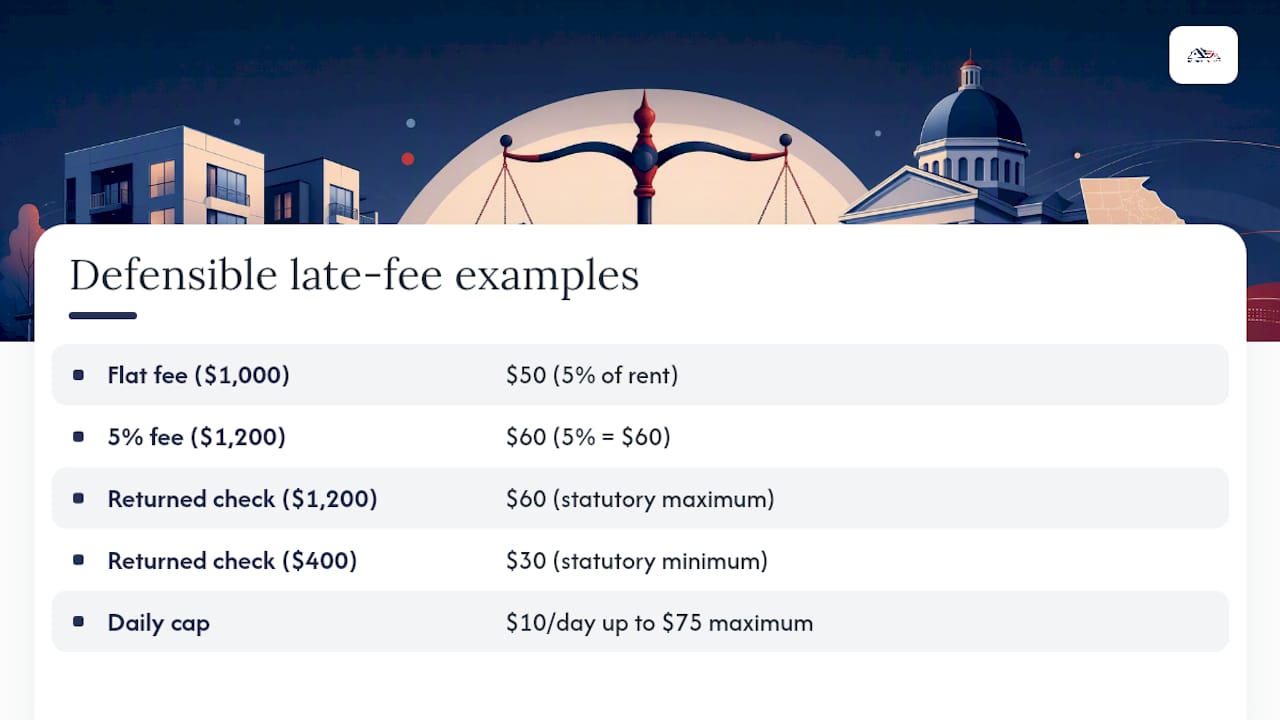
Now scale it. On a $1,200 rent payment, a 5% fee works out to $60 (1,200 × 0.05 = 60). That's the math a landlord should show if a tenant ever asks how the number was reached.
Returned checks work differently because the formula is fixed by statute, not by the lease. On a $1,200 check, 5% comes to $60, which exceeds the $30 floor, so $60 is the legal maximum. On a smaller $400 rent check, 5% is only $20, so the $30 statutory minimum takes over and $30 becomes the fee.
Where landlords get into trouble is daily compounding. A capped alternative, say $10 per day up to a $75 maximum, keeps the same incentive structure without the runaway math a judge might reject outright.
Writing a Late Fee Clause That Actually Holds Up
A clause worth defending in court covers five things clearly, without stacking ambiguous language on top of each other. Here's a sample structure landlords can adapt:
Before finalizing any lease, check for these items:
- Exact due date and grace period spelled out, not implied
- Late fee stated as a flat number or clear formula, never "at landlord's discretion"
- Returned-check fee referencing the statutory cap
- Whether fees count as "additional rent" (this affects what can be pursued in eviction)
- Accepted notice delivery methods matching what HB 404 requires
Clarity here isn't just good practice. It's the difference between a fee a court upholds and one it strikes as unenforceable. For broader lease language beyond fees, a Georgia Association of Realtors-based lease template is a solid starting framework.
What Tenants Can Do About an Unfair or Undisclosed Fee
Tenants aren't without options when a fee looks wrong. The most common defenses, according to Georgia Legal Aid, are that the lease never mentioned a late fee at all, that the amount functions as a penalty rather than a reasonable estimate of cost, that the landlord skipped the required notice, or that the landlord has a pattern of accepting late payments without ever charging the fee, which can amount to waiver.
If a fee looks disputable, take these steps in order:
- Request an itemized breakdown in writing showing exactly how the charge was calculated.
- Keep every payment receipt and text or email related to rent timing.
- Contact Georgia DCA or a local legal aid office if the landlord won't provide documentation or the amount seems clearly punitive.
Pro Tip: If an eviction case is already filed, pay the full disputed amount into the court registry rather than withholding it. Tendering less than the full amount can undercut your legal defenses even when your underlying argument about the fee is correct.
OneSource Real Estate's Approach to Late-Fee Policy for Atlanta Landlords
OneSource Real Estate builds late-fee clauses around the same principle courts apply: the fee has to trace back to a real, recordable cost. For property owners across Atlanta, Marietta, Alpharetta, and Johns Creek, that means a flat fee, a documented grace period, and a notice process that satisfies HB 404 before any dispossessory step is even considered.

Operationally, that looks like automated rent reminders before the due date, timestamped delivery records for every notice, and a ledger that ties each fee to a specific administrative task. Landlords who adopt this kind of rent collection workflow walk into a dispute with a paper trail already built, rather than scrambling to reconstruct one after the fact.
Let OneSource Real Estate Handle Your Rent Collection Compliance
Drafting a late fee clause that survives a courtroom is one thing. Enforcing it consistently across a portfolio of units, month after month, is a different job entirely. OneSource Real Estate's property management services handle both: compliant lease drafting, automated rent collection, itemized notice delivery, and eviction support when a case genuinely needs to go that far.

For Atlanta-area landlords tired of chasing down late payments or worrying whether a fee clause will hold up if challenged, OneSource Real Estate manages the entire cycle, from lease language to the three-business-day notice HB 404 requires. Reach out through the property management page to get a rent-roll review and see where your current lease language stands.
What Georgia Landlords and Tenants Get Wrong About Late Fees
Most disputes over late rent fees in Georgia don't come from bad faith. They come from vague leases. A landlord writes "reasonable late fees may apply" instead of a number, then wonders why a magistrate won't enforce it. A tenant assumes a five-day grace period exists because their last apartment had one, then gets blindsided when this lease has none.
The conventional wisdom treats Georgia's lack of a statutory cap as landlord-friendly. In practice, it cuts the other way. States with a hard percentage cap give landlords a clear number to hit. Georgia gives them a standard, reasonableness, that a judge interprets case by case. That ambiguity punishes sloppy drafting more than it rewards aggressive fee-setting. A landlord charging $35 with a specific formula written into the lease is on firmer ground than one charging $200 with no explanation at all, even though $35 is the smaller number.
The three-business-day notice under HB 404 changes the calculus further. It's not just a procedural speed bump. It forces landlords to itemize exactly what they're claiming before they can even get to court, which means sloppy fee math gets exposed earlier and more often. That's a net win for both sides: tenants get an honest accounting, and landlords who've done the work correctly get a faster, cleaner path through the dispossessory process.
— Matt
Sources
- Georgia Legislature — bill information and statute text
- Georgia Landlord-Tenant Handbook (DCA)
- Observed
FAQ
How much can a landlord charge for late fees in Georgia?
There's no legal maximum.
How many days late can you be on rent in Georgia before a fee applies?
Georgia sets no statutory grace period, so a fee can apply the day after the due date unless the lease specifies otherwise. Most landlords build in a 3 to 5 day grace window voluntarily.
What's the longest you can be late on rent before eviction starts?
There's no fixed number of days in the statute itself, but before filing a dispossessory for unpaid rent, landlords must give a three-business-day written notice to pay or vacate under HB 404 for leases entered or renewed on or after July 1, 2024.
What's the maximum fee for a returned or bounced rent check in Georgia?
This statutory cap applies regardless of what the lease says about general late fees.