
If you have an emotional support animal (ESA) in Georgia, the Fair Housing Act (FHA) is your primary legal protection, and the single most important thing you can do right now is submit a dated written reasonable-accommodation request to your landlord. Georgia has no separate state ESA statute, but Georgia's Fair Housing Law (O.C.G.A. § 8-3-200 et seq.) mirrors federal FHA protections and is enforced at the state level by the Georgia Commission on Equal Opportunity (GCEO). That means the federal rules and Georgia rules work in parallel for housing.
Here is what to do immediately if you need an ESA accommodation:
- Submit a dated written request to your landlord or property manager asking to keep your ESA despite any "no pets" policy.
- Include a letter from a licensed mental health professional only if your landlord asks for one.
- Keep copies of every communication, including emails, texts, and certified mail receipts.
- If your request is denied, ask for the denial in writing and file a complaint with HUD or the GCEO.
One important 2026 update: HUD narrowed its enforcement focus toward trained animals performing specific work or tasks. Untrained ESAs still carry FHA housing protections under the statute itself, but the practical enforcement landscape shifted. This guide covers what that means for Georgia residents and what steps protect your rights most effectively.
Table of Contents
- Which laws govern emotional support animal rights in Georgia?
- When can a Georgia landlord lawfully deny an ESA request?
- How to request an ESA accommodation in Georgia
- ESA letters: who can sign them, are online letters valid, and how to spot fraud
- Fees, deposits, and damages: what Georgia landlords can and cannot charge
- ESA versus service animals: public access, ADA limits, and why the difference matters
- Travel and flying from Georgia with an ESA: current rules and practical steps
- What animals qualify as ESAs in Georgia and rules about multiple ESAs
- If your ESA request is denied: enforcement paths and next steps in Georgia
- How Georgia landlords and property managers typically handle ESA requests
- Key Takeaways
- Why clear ESA procedures protect everyone involved
- Primary sources and further reading
- FAQ
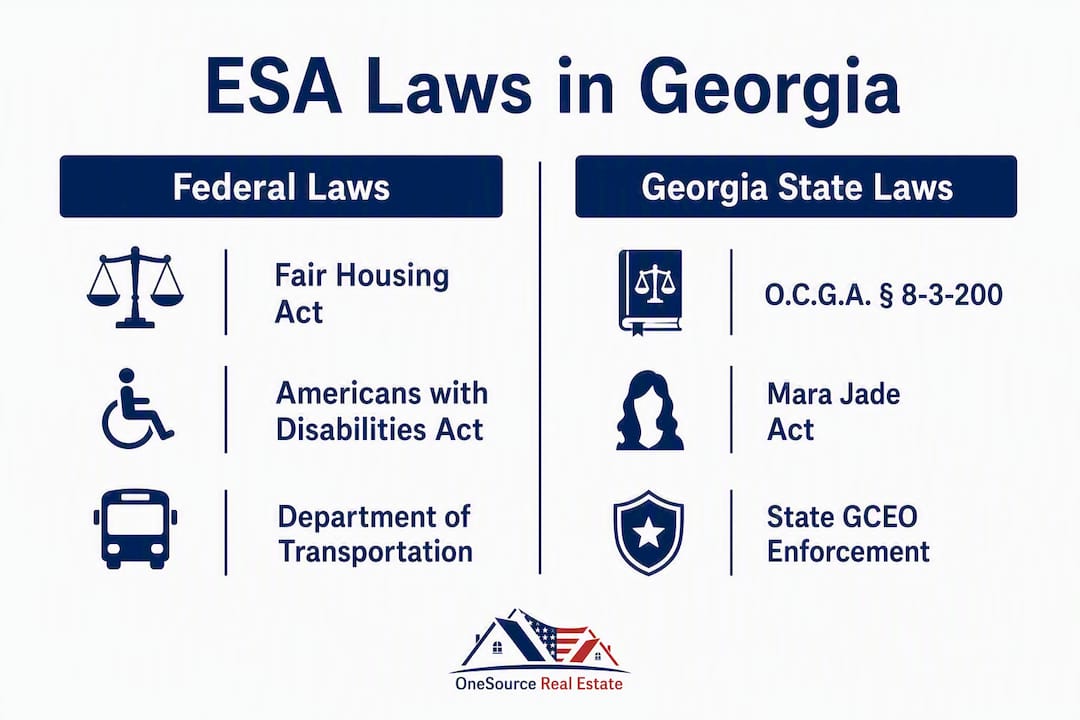
Which laws govern emotional support animal rights in Georgia?
The federal Fair Housing Act (42 U.S.C. §§ 3601–3619) is the foundation. It requires housing providers to make reasonable accommodations for people with disabilities, including allowing assistance animals even when a property has a "no pets" policy. Georgia's parallel fair-housing statute (O.C.G.A. § 8-3-200 et seq.) substantially mirrors those protections and gives the GCEO authority to investigate and enforce violations at the state level.
HUD's guidance documents, particularly its FHEO notices, define how landlords should evaluate accommodation requests and what documentation they may request. The 2026 enforcement update shifted HUD's active enforcement priority toward trained animals, but the FHA statute itself still covers untrained ESAs in housing. That distinction matters: the law on the books has not changed; what changed is where HUD directs its investigative resources.
"An assistance, or emotional support animal, is an animal companion that offers some type of benefit to an individual with some form of disability. The animal is intended to provide companionship and support that will help alleviate at least one aspect of the disability." — Georgia ADA/Reasonable Modifications Guidance
The Americans with Disabilities Act (ADA) is a separate law with a narrower scope. Under the ADA, only trained service animals (dogs, and in limited cases miniature horses) have guaranteed public-access rights. The ADA explicitly excludes emotional support animals from that definition because they do not perform specific trained tasks. So an ESA's legal home is housing law, not public-access law.
For air travel, the U.S. Department of Transportation (DOT) finalized rules that allow airlines to treat ESAs as pets rather than service animals. Most major carriers no longer provide in-cabin ESA accommodations. Psychiatric service dogs that are individually trained to perform tasks may still qualify under DOT rules, but that is a different category.

When can a Georgia landlord lawfully deny an ESA request?
Denials are allowed only in narrow, fact-specific situations. The FHA creates a strong presumption in favor of accommodation, and a landlord who denies a request carries the burden of justifying it.
"Under the FHA, housing providers must allow an ESA as a reasonable accommodation even with 'no pets' policies unless the animal poses a direct threat to health or safety of others that cannot be eliminated or reduced to an acceptable level, or the request creates an undue financial or administrative burden." — ADA National Network
Lawful grounds for denial include:
- Direct threat: The specific animal poses a documented, individualized threat to the health or safety of others that cannot be mitigated through reasonable measures.
- Undue financial or administrative burden: Accommodation would impose costs or operational demands that are genuinely disproportionate given the housing provider's size and resources.
- FHA coverage exceptions: Owner-occupied buildings with four or fewer units where the owner lives on-site; single-family homes sold or rented without a broker under specific conditions; certain private clubs and religious organizations.
- Fundamental alteration: The accommodation would change the essential nature of the housing program.
If a landlord denies your request, they must explain the reason in writing. You can then respond, offer alternatives (a behavior management plan, additional cleaning commitment, or references from a prior landlord), and document that response. Courts and HUD investigators look at whether the landlord engaged in an interactive process in good faith.
Pro Tip: Before escalating to a complaint, send a written follow-up offering a specific mitigation measure. That letter becomes evidence of good faith and often resolves the dispute faster than a formal complaint.
How to request an ESA accommodation in Georgia
Submit a dated written request. That act triggers your FHA protections and starts the clock on the landlord's obligation to respond. Here is a step-by-step checklist:
- Date your request. Include today's date at the top of the letter or email.
- Identify yourself and your unit. Full name, address, and unit number.
- State the accommodation clearly. "I am requesting permission to keep an emotional support animal in my unit despite the property's no-pets policy."
- Include a brief functional statement. You do not need to disclose a diagnosis. A sentence like "I have a disability-related need for an assistance animal that helps alleviate symptoms of my condition" is sufficient.
- Offer documentation if asked. Note that you can provide a letter from a licensed mental health professional upon request.
- Request a written response. Ask the landlord to confirm receipt and provide a written decision within a reasonable timeframe.
- Send by email and certified mail. Email creates a timestamp; certified mail creates a delivery record. Keep both.
- Log all follow-up. Note dates, times, and summaries of any verbal conversations.
Tenant guidance consistently shows that many denials stem from procedural gaps, not from a genuine lack of legal rights. A clear, complete written request resolves a large share of disputes before they escalate.

ESA letters: who can sign them, are online letters valid, and how to spot fraud
A letter from a licensed mental health professional who has personal clinical knowledge of you is the reliable standard. Landlords may request documentation when your disability and need are not obvious, but they cannot demand your full medical records or a specific diagnosis.
HUD's guidance specifies that the clinician should have personal knowledge of your condition. A synchronous evaluation, whether in-person, by video, or by phone, generally satisfies that standard. A questionnaire-only service with no real clinical interaction does not.
Who can sign an ESA letter:
- Licensed psychologists (PhD, PsyD)
- Psychiatrists (MD or DO)
- Licensed clinical social workers (LCSW)
- Licensed professional counselors (LPC)
- Licensed marriage and family therapists (LMFT)
What a valid letter should include:
- Clinician's full name, license type, license number, and state of licensure
- Clinician's contact information
- Date of evaluation
- A functional statement connecting the animal to symptom mitigation
- The accommodation being requested
- No requirement to disclose a specific diagnosis
Red flags for fraudulent letters:
- Instant approval with a one-question form and no clinical interaction
- Generic templates with no clinician contact information
- Websites that "guarantee" landlord acceptance
- No license number or verifiable clinician identity
Pro Tip: Before submitting your letter, verify the clinician's license on the Georgia Secretary of State's professional licensing portal. A landlord who checks and finds an unlicensed signer can lawfully request additional documentation.
Fees, deposits, and damages: what Georgia landlords can and cannot charge
HUD's guidance is direct: housing providers may not require a person with a disability to pay a pet fee, pet deposit, or pet rent as a condition of keeping an approved assistance animal. That prohibition applies to ESAs and service animals alike.
What landlords can do is hold tenants responsible for actual, documented property damage caused by the animal. That is a meaningful distinction. A flat monthly "pet fee" charged regardless of damage is unlawful. A charge to repair a scratched hardwood floor after move-out, backed by photos and receipts, is lawful.
The 2026 HUD enforcement update adds a layer of nuance for untrained ESAs. Because HUD's active enforcement focus shifted toward trained animals, landlords who dispute an untrained ESA accommodation may face less immediate federal pressure, though the FHA statute still applies. Tenants with untrained ESAs should document their accommodation request and supporting letter especially carefully.
Practical steps to protect yourself financially:
- Photograph every room at move-in and move-out, with timestamps.
- Get a written move-in condition checklist signed by both parties.
- Keep receipts for any cleaning or repairs you make during tenancy.
- If a landlord claims animal damage, request an itemized written statement with supporting documentation.
- Review Georgia's security deposit rules to understand how damage claims must be handled and what notice landlords must provide.
ESA versus service animals: public access, ADA limits, and why the difference matters
Service animals have public-access rights under the ADA. ESAs do not. That is the clearest way to state it, and getting this wrong leads to real conflicts.
Under the ADA, a service animal is a dog (or miniature horse in limited cases) individually trained to perform a specific task directly related to a person's disability. An ESA provides comfort through its presence, which is valuable, but it is not a trained task. That distinction is why the ADA excludes ESAs from public-access protections.
Where ESAs have no guaranteed access:
- Restaurants and retail stores
- Hotels and motels (unless the property voluntarily allows them)
- Most workplaces (ADA focuses on task-trained service animals)
- Campus common areas (though campus housing may be covered under FHA)
- Public transportation (beyond what individual providers voluntarily allow)
Psychiatric service dogs (PSDs) occupy a different category. If a dog is individually trained to perform a specific task related to a psychiatric disability, such as interrupting a panic attack or reminding a handler to take medication, it qualifies as a service animal under the ADA and carries full public-access rights. The animal's training, not the handler's diagnosis, determines the category.
For housing, the FHA applies regardless of whether the animal is trained. That is the key asymmetry: housing protections are broader, public-access protections are narrower.
Travel and flying from Georgia with an ESA: current rules and practical steps
Most airlines no longer provide in-cabin ESA accommodations. The DOT's final rule, effective in 2021, allowed airlines to treat ESAs as pets rather than service animals, and virtually every major carrier followed suit. If you are flying out of Hartsfield-Jackson Atlanta International Airport or any Georgia airport, assume your ESA will be treated as a pet unless you have confirmed otherwise with your specific airline.
Before you book:
- Check the airline's current animal policy on its website, not a third-party summary.
- Confirm whether your animal qualifies as a carry-on pet, checked pet, or cargo-only animal based on size and species.
- Ask about fees, carrier dimensions, and health certificate requirements.
- If your animal is a trained psychiatric service dog, review the airline's service animal documentation form (most require advance submission, often 48 hours before departure).
- Arrive early. Additional screening for service animal documentation is common at major hubs.
At the airport:
- Carry your documentation in a clearly labeled folder.
- Be prepared to answer the two ADA-permitted questions for service animals: Is the animal required because of a disability? What work or task has the animal been trained to perform?
- For ESAs traveling as pets, have your carrier, health certificate, and payment ready at check-in.
Atlanta's Hartsfield-Jackson is one of the busiest airports in the world, and gate agents handle dozens of animal-related questions daily. A calm, organized approach with documentation ready reduces friction significantly.
What animals qualify as ESAs in Georgia and rules about multiple ESAs
Common household animals, primarily dogs and cats, are the default for assistance-animal accommodation requests. HUD guidance treats them as generally acceptable without extensive justification, provided the disability-related need is documented.
Unusual species prompt a more searching inquiry. HUD's framework asks whether the specific animal is necessary for the person's disability-related need and whether it poses any direct threat or fundamental alteration concern. Large farm animals, primates, and reptiles face much higher scrutiny, and landlords may lawfully request more detailed documentation for those requests.
What to expect for common versus uncommon animals:
- Dogs and cats: standard documentation process; rarely questioned on species grounds alone.
- Small birds, rabbits, hamsters, guinea pigs: generally accepted with standard documentation.
- Exotic or large animals: expect requests for additional documentation explaining why that specific species is necessary.
- Multiple ESAs: allowed when reasonable and not an undue burden, but each animal's necessity should be addressed in the supporting letter.
Multiple ESA requests are evaluated on the facts. A landlord can ask why multiple animals are needed and whether the number creates a burden given the property's size or structure. The supporting clinician letter should address each animal's role in the tenant's treatment or symptom management. Offering a behavior plan or references from a prior landlord strengthens a multi-animal request considerably.
If your ESA request is denied: enforcement paths and next steps in Georgia
Ask for the denial in writing first. That document is the foundation of any complaint or legal action, and a landlord who refuses to provide a written reason is itself a red flag worth noting in your records.
Step-by-step enforcement path:
- Request written denial. Ask the landlord to state the specific reason in writing.
- Gather your documentation. Collect your original request, ESA letter, all correspondence, and any lease provisions cited by the landlord.
- File a HUD complaint. Use the HUD online complaint form at hud.gov. HUD accepts complaints online, by phone, and by mail.
- Contact the GCEO. The Georgia Commission on Equal Opportunity handles state fair-housing complaints and can investigate independently of HUD.
- Consult a fair-housing attorney or legal aid. Georgia Legal Services Program and Atlanta Legal Aid Society offer free or low-cost consultations for housing matters.
- Act before an eviction notice. Georgia eviction proceedings move quickly through magistrate and superior courts. Getting legal counsel before a dispossessory action is filed gives you far more options than responding after the fact.
Timeline reality: HUD investigations can take months. State GCEO proceedings vary. If your housing is at immediate risk, a fair-housing attorney can seek emergency relief in court faster than an administrative complaint resolves. Start both tracks simultaneously if the situation is urgent.
Tenant advocacy resources can help you organize documentation and understand your options before you file.
How Georgia landlords and property managers typically handle ESA requests
Property managers following best practices run a formal reasonable-accommodation workflow. Understanding that process helps you anticipate what to expect and how to speed things along.
Typical property manager steps:
- Intake. Receive the written accommodation request and log it with a date stamp.
- Initial review. Determine whether the disability and need are obvious or whether documentation is needed.
- Documentation request (if needed). Send a written request for a clinician letter; specify what information is needed without demanding a diagnosis.
- Legal review. For unusual animals, multiple ESAs, or complex situations, consult legal counsel before responding.
- Written decision. Issue a written approval or denial with the specific basis stated.
- Document the accommodation. Note the approved animal in the lease file and any agreed conditions.
The typical review window varies depending on how quickly documentation arrives and whether legal review is needed. Delays most often occur when the clinician is out of state, the animal species is unusual, or the initial request is incomplete.
Pro Tip: Submit a complete, organized packet on day one: your dated written request, the clinician letter, and a brief note offering to discuss any concerns. Property managers who receive a clean packet move faster because they have nothing to chase down.
OneSource Real Estate's property management team follows this structured workflow for all accommodation requests across its Atlanta-area portfolio, which means tenants and owners both get a documented, defensible process. For landlords who want a professionally managed approach to ESA compliance and full-service property management, that consistency reduces legal exposure on both sides.
Key Takeaways
Georgia ESA housing rights rest on the federal Fair Housing Act and the parallel state statute, and a dated written accommodation request is the single most important step any tenant can take.
| Point | Details |
|---|---|
| FHA governs Georgia ESA housing | Georgia's O.C.G.A. § 8-3-200 et seq. mirrors the FHA; no separate state ESA statute exists. |
| Written request triggers protections | Submit a dated written reasonable-accommodation request and keep proof of delivery. |
| No pet fees for approved ESAs | Landlords cannot charge pet rent or deposits for assistance animals, but tenants pay for actual damage. |
| Legitimate ESA letters require real clinical contact | A licensed clinician with personal knowledge of you must sign; questionnaire-only online services are weak evidence. |
| Denials are narrow but must be documented | If denied, get the reason in writing and file with HUD or GCEO promptly to preserve housing. |
Why clear ESA procedures protect everyone involved
Clear, consistent ESA accommodation procedures benefit landlords and tenants equally, and the cases that end in court almost always started with a process failure, not a genuine legal dispute.
When a tenant submits a complete, well-documented request and a property manager responds in writing within a reasonable window, the interaction is usually resolved without conflict. The tenant keeps housing stability. The owner avoids fair-housing liability. The documentation protects both parties if the situation is ever reviewed by HUD or a court.
What gets overlooked is the cost of ambiguity. A landlord who ignores a written request, or a tenant who submits a vague verbal ask and then escalates immediately, creates a dispute that neither party needed. Georgia eviction proceedings move fast, and fair-housing investigations take time. The gap between those two timelines is where tenants lose housing they had a legal right to keep.
The 2026 HUD enforcement shift toward trained animals does not eliminate ESA housing rights. It does mean that tenants with untrained ESAs should be especially careful about documentation quality and that landlords who rely on the enforcement shift to deny valid requests are still exposed to FHA liability. The statute has not changed. Only the enforcement priority has.
Good documentation, timely communication, and a willingness to engage in good faith resolve the vast majority of ESA accommodation requests in Georgia before they become legal problems.
Primary sources and further reading
Every rule discussed in this article can be verified through these primary sources. When preparing a complaint or legal action, go directly to the source rather than relying on summaries.
| Source | What it provides |
|---|---|
| HUD Fair Housing Act Overview | Overview of FHA protections and covered housing types |
| HUD Assistance Animals Guidance | HUD's specific guidance on ESAs, documentation standards, and fee rules |
| Georgia Fair Housing Law (O.C.G.A. § 8-3-200 et seq.) | State statute text and GCEO enforcement information |
| Georgia ADA/Service Animal Guidance | State-level ADA guidance distinguishing service animals from ESAs |
| ADA National Network | Plain-language explanation of ADA service animal rules and FHA housing protections |
| Georgia Commission on Equal Opportunity (GCEO) | State fair-housing complaint filing and agency contact information |
- To file a federal housing discrimination complaint: — Visit hud.gov and use the online Fair Housing complaint portal.
- For ADA service animal rules: — The U.S. Department of Justice publishes plain-language guidance at ada.gov.
This article provides general information about federal and Georgia fair-housing law. It is not legal advice. Consult a licensed attorney or contact the GCEO or HUD directly to address your specific situation.
FAQ
Can a landlord deny an emotional support animal in Georgia?
Yes, but only in narrow circumstances: if the specific animal poses a direct, documented threat to health or safety that cannot be mitigated, if the accommodation creates an undue financial or administrative burden, or if the property falls under a specific FHA exemption (such as a small owner-occupied building). A blanket "no pets" policy alone is not a lawful basis for denial.
What qualifies a dog for emotional support status in Georgia?
Any dog (or other common household animal) can serve as an ESA if a licensed mental health professional with personal clinical knowledge of you documents a disability-related need for the animal. The animal does not need specialized training, unlike a service dog under the ADA.
Can I sue my landlord for denying my emotional support animal?
Yes. If a landlord unlawfully refuses a reasonable accommodation, you can file a complaint with HUD or the GCEO, and you can pursue a private lawsuit under the FHA. Remedies can include injunctive relief, actual damages, and attorney's fees. Consult a fair-housing attorney before filing to assess your specific facts.
What is the Mara Jade Act in Georgia?
Georgia's HB, signed in 2026 and known as the Mara Jade Act, updated the state code to standardize references to "service dogs" (replacing earlier "assistance and guide dog" language), added criminal penalties for interfering with or harming a service dog, and made conforming changes across multiple state statutes. It addresses service dogs specifically and does not alter ESA housing protections under the FHA or O.C.G.A. § 8-3-200 et seq.
Do online ESA letters work with Georgia landlords?
An online letter can be valid if it was issued by a licensed mental health professional who conducted a real, synchronous clinical evaluation of you, whether by video or phone. Letters generated through questionnaire-only platforms with no genuine clinical interaction are weak evidence under HUD's reliability standard and may be rejected by a landlord or dismissed in a complaint proceeding.