
A strong vendor network pairs licensed, insured contractors with continuous compliance monitoring and measurable performance data, so every dispatch is safe, documented, and fast. That means credentialing at intake, automated tracking of insurance and license expirations, and audits that turn vendor history into hard numbers. Build it, verify it, govern it, then measure it. Skip any one step and the whole system leaks liability.
TL;DR:
- Regular audits and performance data tracking are essential to identify vendor cost drift, response times, and quality issues before they become major problems.
- Automated compliance monitoring, including reminders and system integrations, reduces liability risks associated with expired licenses and insurance lapses.
- Building a diverse vendor pool, including minority-, woman-, and veteran-owned businesses, enhances network resilience without lowering credentialing standards.
- Detailed onboarding, including scope, response time SLAs, and documented contracts, ensures vendors understand expectations and reduces disputes.
- Continuous lifecycle compliance, with automated status updates and document verification, prevents noncompliant vendors from being dispatched or invoicing improperly.
Table of Contents
- What Makes a Vendor Network Property Management System Work?
- How Do You Source and Build a Reliable Vendor Bench?
- What Belongs on a Vendor Credentialing Checklist?
- What Should Vendor Onboarding and Contracts Include?
- How Do You Keep Vendor Compliance Current After Onboarding?
- How Do You Audit Vendor Performance and Which KPIs Matter?
- How Should You Handle Vendor Disputes and Escalations?
- Which Tools and Integrations Support Vendor Governance?
- Risk Management Strategies for Vendor Networks
- How Do You Control Vendor Costs Without Cutting Corners?
- What Technology Trends Are Changing Vendor Network Management?
- How Do You Build Vendor Diversity Into Your Network?
- What Legal and Regulatory Issues Go Beyond Credentialing?
- Publisher Perspective: How OneSource Real Estate Applies These Standards
- A Property Manager's Quick Vendor Playbook
- Let OneSource Real Estate Handle Your Vendor Network
- Sources
- FAQ
What Makes a Vendor Network Property Management System Work?
A working vendor network property management system rests on a handful of nonnegotiables: credentialing requirements, risk tiers, service level agreements, standardized scopes of work, rate cards, and a direct line into whatever property management system runs your operation.
Each piece solves a specific problem. Credentialing keeps uninsured or unlicensed labor off your properties. Risk tiers let you demand more paperwork from a roofer than from a lawn crew, since the liability exposure isn't the same. SLAs set response-time expectations before an emergency call comes in, not during one. Standardized scopes of work stop the "I thought that was included" argument that eats into margins on every invoice dispute.
Pro Tip: Tier vendors by risk and trade before you write a single onboarding form. A plumber working inside occupied units needs deeper vetting than a vendor who only handles exterior landscaping, and treating them identically either overburdens low-risk vendors or under-protects you on high-risk ones.
How Do You Source and Build a Reliable Vendor Bench?
Sourcing vendors is less about finding names and more about finding names you can actually trust with a key. Referrals from other property managers tend to produce the highest-quality leads because someone has already vetted the work firsthand, though the pool stays small and slow to grow. Trade associations widen that pool and add a layer of professional accountability, but membership doesn't guarantee availability when you need someone Tuesday morning.
Vendor marketplaces and portals solve the speed problem. Platforms built specifically for property management vendors can supply licensed, insured, background-checked pros with compliance and pricing already built in, which shortens the vetting cycle considerably. Vendor-matching services also connect managers with pre-screened, regionally vetted maintenance pros through their own screening pipelines, which helps when a portfolio spans several ZIP codes and you can't personally vouch for every trade.
Before adding anyone to the bench, ask about:
- Real service area, not just a listed address.
- Current availability and typical response window.
- Two or three references from active property management clients.
- Sample pricing on common jobs, not just a general rate sheet.
For urgent gaps, line up a temp-dispatch partner or a cross-portfolio contractor in advance. Scrambling during a burst pipe is how corners get cut.
What Belongs on a Vendor Credentialing Checklist?
Credentialing is where most vendor networks either earn trust or quietly accumulate risk. Run every new vendor through the same gate, in the same order, every time:
- Collect a completed W-9 and confirm the EIN or SSN matches the business name on file.
- Require a current Certificate of Insurance with an Additional Insured endorsement naming the property manager and owner as primary and noncontributory.
- Verify the active trade license through the relevant state or local licensing board, not just a photo of a card.
- Confirm workers' compensation coverage for any vendor with employees on-site.
- Run a background check appropriate to the risk tier, especially for vendors entering occupied units.
- Document an agreed scope of work before the first dispatch, even for routine trades.
Set minimum documentation gates by risk tier: a landscaper might clear with insurance and a W-9, while an electrician or plumber should clear every item on the list before a work order goes out. During genuine emergencies, a documented temporary hold with a named approver, an expiration date, and an approved backup vendor is the right compromise. What isn't acceptable is quietly waiving requirements and hoping no one asks later. Automated insurance tracking and Additional Insured endorsements measurably cut liability exposure precisely because they close that gap before it opens.
What Should Vendor Onboarding and Contracts Include?
Onboarding is where good intentions either become enforceable terms or stay a handshake. A solid vendor contract spells out scope of work, guaranteed response times, warranty length on labor and parts, indemnification language, invoicing and payment terms, and the insurance endorsements already discussed. Vague language here is where disputes start.
A practical onboarding packet includes:
- Verification of every credential before the vendor is marked "approved" in your system.
- A named escalation contact on both sides, not a general office line.
- Property-specific orientation covering access protocols, gate codes, and tenant communication rules.
- Sample SLA terms: 24-hour response for non-emergency work, 2 to 4 hours for emergencies, and a defined rework window if the job doesn't pass inspection.
One workable template requires the COI, W-9, three local references, and a sample invoice before a vendor ever gets moved to approved status. Skipping that last step is how invoicing surprises show up three months in.
How Do You Keep Vendor Compliance Current After Onboarding?
Credentialing at intake only protects you on day one. Insurance lapses, licenses expire, and a vendor who was compliant in January can be running bare by June without anyone noticing until a claim happens. Vendor compliance works better as ongoing lifecycle governance than as a one-time checklist item, because continuous monitoring is what actually keeps a noncompliant vendor from getting dispatched.

The practical mechanics: automated reminders 30 and 60 days before an expiration, a temporary hold status that blocks new dispatches the moment a document lapses, and vendor status levels (active, on hold, suspended) visible to anyone scheduling work. The strongest setups tie that status directly into purchase orders and payment systems, so an expired COI blocks the invoice, not just the work order.
Reserve manual review for edge cases, like a vendor mid-renewal with proof of an active application, and document every exception with a name, a reason, and an end date. Undocumented exceptions are exactly what compliance monitoring exists to prevent.
How Do You Audit Vendor Performance and Which KPIs Matter?
Systematic vendor audits run at least once a year, with data-backed performance reporting cutting procurement costs that would otherwise go unnoticed on a job-by-job basis. Pair that annual portfolio audit with quarterly spot checks on your highest-volume trades.
- Pull the last twelve months of work orders per vendor and check on-time arrival against promised windows.
- Calculate first-trip resolution rate: how often a job closes without a return visit.
- Track the rework or go-back rate, since repeat visits on the same issue signal a training or quality problem.
- Compare invoice amounts against the agreed rate card to catch drift.
- Weigh owner cost-per-job against comparable vendors in the same trade.
- Review tenant satisfaction feedback tied to that vendor's visits.
Use the results. Retrain vendors with fixable gaps, place chronic underperformers on probation with a defined improvement window, renegotiate rates where the data supports it, and remove vendors who don't improve.
How Should You Handle Vendor Disputes and Escalations?
Most vendor disputes trace back to undocumented expectations. Require photo verification before and after every job, keep communication logs in one system rather than scattered texts, and give resident-facing staff a simple script for reporting problems.
When a job goes wrong, follow a clear order: written notice of the issue, a defined cure period, warranty-based resolution if the work was covered, and a replacement vendor if the cure period passes without a fix. Balance that accountability with incentives. Vendor scorecards, preferred status for top performers, and first-call priority on new work orders keep good vendors engaged instead of just compliant.
Which Tools and Integrations Support Vendor Governance?
Paper checklists don't scale past a handful of properties. The tool categories that matter are credentialing platforms, maintenance dispatch and work-order systems, e-bidding platforms, and accounting or accounts-payable connectors.
- Credentialing platforms can verify COIs, run background checks, screen against exclusion lists, and collect W-9s, often configurable by owner or property.
- Vendor management platforms that integrate with your PMS and accounting system stop payments to noncompliant vendors automatically and keep an auditable record of every bid and award.
- E-bidding tools make apples-to-apples cost comparisons possible instead of relying on memory or scattered emails.
Before selecting anything, confirm it exports reporting data, keeps an audit trail, and gives vendors a self-service portal to update their own documents. That last point alone cuts a surprising share of your team's administrative load.
Risk Management Strategies for Vendor Networks
Every vendor relationship carries three layers of risk: liability exposure, service failure, and financial exposure. Managing all three starts with the insurance and licensing controls already covered, but risk management goes further than credentialing.
Diversify your bench within each trade so a single vendor's failure, whether that's a lapsed license or a sudden closure, doesn't leave you without coverage in a critical category. Two or three vetted plumbers beat one "great" plumber who becomes a single point of failure the day he retires or gets overbooked.
Build indemnification and hold-harmless clauses into every contract, not just the high-risk trades, since even a landscaping mishap can trigger a liability claim on the property owner. Require primary and noncontributory language on Additional Insured endorsements specifically, because a standard endorsement without that language can still leave your policy responding first.
Document everything. Photo evidence before and after a job, signed scopes of work, and a paper trail on every change order matter far more during a dispute than anyone realizes until they need it. Insurance carriers and attorneys both look for documentation gaps first.
Finally, plan for vendor concentration risk at the portfolio level. If one contractor handles 70% of your HVAC calls across a multifamily portfolio, a single bad season for that vendor becomes your operational crisis, not just theirs. Spread volume deliberately, even when one vendor is clearly your favorite.
How Do You Control Vendor Costs Without Cutting Corners?
Cost control in vendor management isn't about squeezing the lowest possible rate out of every trade. It's about knowing what a fair rate looks like and catching drift before it compounds across a portfolio.
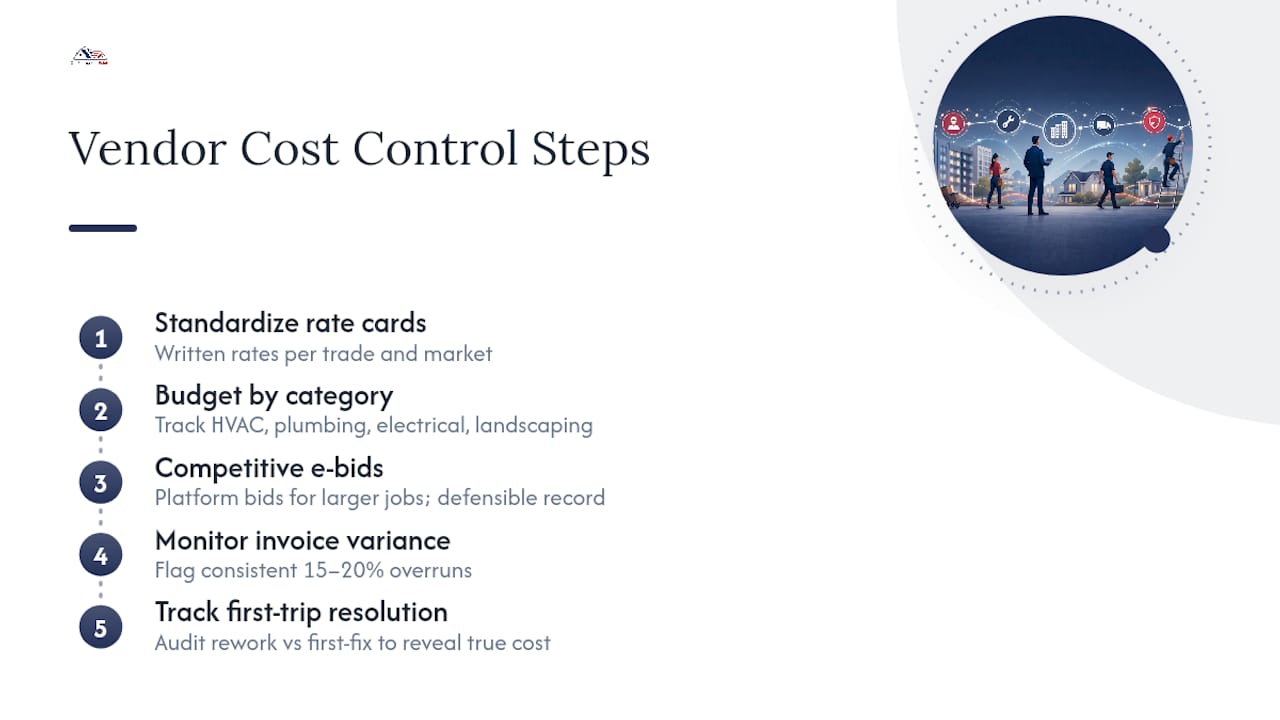
Start with standardized rate cards per trade and market, agreed to in writing during onboarding. Without a rate card, every invoice becomes a negotiation, and negotiations favor whoever has more time and less oversight, which is rarely the property manager.
Budget vendor spend by category, not just as a lump maintenance line. Separate HVAC, plumbing, electrical, general handyman, and landscaping into their own tracked categories so you can spot a trade that's quietly eating more of the budget than its share of work orders justifies.
Use competitive bidding for larger jobs, even within an established vendor bench. An e-bidding process, run through a platform rather than informal phone calls, keeps pricing honest and gives owners a defensible record if they ever question a cost.
Watch invoice variance closely. A vendor whose invoices consistently run 15 to 20% over the quoted estimate on similar jobs isn't necessarily dishonest, but the pattern deserves a conversation before it becomes an expectation. Tie a portion of each vendor's continued work volume to staying within agreed pricing, which gives good-faith cost control some real teeth.
And don't confuse cheap with cost-effective. A vendor with a lower hourly rate but a high rework rate often costs more per completed job than a pricier vendor who fixes it right the first time. First-trip resolution data, tracked during your regular audits, is what exposes that gap.
What Technology Trends Are Changing Vendor Network Management?
Vendor management has shifted from spreadsheets and manila folders to platforms that treat compliance as a live status rather than a filing task. Automated document tracking is the clearest example: instead of someone manually checking expiration dates once a quarter, the system flags a lapsing COI weeks in advance and can block dispatch automatically the moment it expires.
AI-assisted vendor matching is emerging as a way to route work orders to the right vendor based on trade, location, availability, and past performance data, rather than whoever happens to answer the phone first. It's not replacing human judgment on complex jobs, but it's cutting the time spent manually searching a vendor list for who's actually free.
Mobile-first vendor portals let contractors upload updated insurance documents, submit invoices, and confirm job completion with photos directly from a job site, which removes a huge amount of back-and-office paperwork. E-bidding tools, mentioned earlier for cost control, are also becoming more integrated with credentialing platforms, so a bid can't even be submitted by a vendor whose documentation has lapsed.
The bigger trend underneath all of this is integration. The most useful systems no longer treat credentialing, dispatch, and accounting as separate tools that someone has to reconcile manually. They're built so that vendor status flows automatically into every workflow that touches that vendor, which is exactly what prevents a noncompliant contractor from slipping through a gap between systems.
How Do You Build Vendor Diversity Into Your Network?
A vendor network limited to the same three or four names in every trade eventually becomes fragile, and it also misses a broader talent pool worth tapping deliberately. Actively recruiting minority-owned, woman-owned, and veteran-owned businesses widens your bench while giving property owners a genuine story to tell about where their maintenance dollars go.
Practical steps make this more than a stated goal. Local chambers of commerce and trade-specific diversity certification programs, such as those tracking minority business enterprise or women business enterprise status, are a real recruiting channel, not just a compliance checkbox. Include diverse vendors in every competitive bid for larger jobs rather than defaulting to the established roster out of habit.
Track diversity metrics the same way you track performance KPIs: what percentage of vendor spend goes to certified diverse businesses, and is that percentage growing or stagnant year over year. Numbers you don't measure tend not to improve.
None of this means lowering credentialing standards. A diverse vendor still clears the same insurance, licensing, and background-check gates as every other vendor on the bench. The goal is a wider, more resilient pool of qualified vendors, not a parallel set of rules.
What Legal and Regulatory Issues Go Beyond Credentialing?
Credentialing covers insurance and licensing, but vendor relationships carry other legal exposure worth planning for directly. Worker classification is a big one: if a vendor's workers function more like employees than independent contractors, that misclassification risk can land on the property manager as much as the vendor, depending on the contract structure and local labor law.
Payment documentation matters here too. Vendors paid as independent contractors typically require accurate 1099 reporting at year-end, and sloppy W-9 collection during onboarding turns into a scramble come tax season.
Local fair housing and accessibility rules can also touch vendor work directly, particularly for repairs tied to accommodation requests, where the vendor's timeline and communication with the tenant matter as much as the repair itself. Data privacy is worth a mention as well: vendors often gain access to units and, sometimes, tenant contact information, so contracts should specify how that information gets handled and stored.
None of this replaces legal counsel review of your standard vendor contract template, especially across a multi-state portfolio where labor and licensing rules shift by jurisdiction.
Publisher Perspective: How OneSource Real Estate Applies These Standards
OneSource Real Estate runs vendor onboarding around the same core gate covered above: COI verification with proper endorsements, active license confirmation, and a documented scope of work before any dispatch. That structure exists because the alternative, chasing paperwork after a job is already underway, is how liability gaps and invoice disputes start. Standardized SLA templates and rate cards keep expectations consistent across the full property management portfolios OneSource manages for owners across the Atlanta area.
A Property Manager's Quick Vendor Playbook
If you're starting from scratch, work through this in order: inventory your current bench, close the highest-risk credential gaps first, set expiration reminders and dispatch holds, run one focused audit this quarter, publish written SLAs and rate cards, then schedule recurring scorecard reviews. The most common misstep is skipping the audit step because it feels less urgent than active work orders. It isn't.
— Matt
Let OneSource Real Estate Handle Your Vendor Network
Building and policing a compliant vendor bench is a full-time job on top of the one you already have. OneSource Real Estate already runs that system daily across its managed portfolios: credentialing, COI tracking, SLA enforcement, and vendor performance reviews, without you having to chase a single license renewal yourself.

That's the practical difference for owners weighing a full property management arrangement against managing vendors solo. Instead of building spreadsheets and setting your own reminder system, you get a team that has already solved these compliance and coordination problems across dozens of properties in the Atlanta area. If you own rental property and want vendor coordination, tenant screening, and maintenance handled without the administrative load, request a property management consultation through OneSource Real Estate's property management page and find out what a fully managed vendor network looks like for your portfolio.
Sources
- The ultimate property management vendor guide: How to build, audit, and manage a reliable network — Buildium
- Vendor Compliance Explained: A Complete Guide for Property Managers — VendorAccess
- Vendor Network for Property Managers | Lula
FAQ
What Is a Vendor Network in Property Management?
A vendor network is the group of licensed, insured contractors and service providers a property manager credentials, contracts, and dispatches for maintenance and repairs, governed by ongoing compliance checks rather than a one-time approval.
What Does a Vendor Manager Typically Earn?
Vendor manager salaries vary widely by market, portfolio size, and whether the role sits inside a property management company or a dedicated vendor platform; national salary aggregators are the most reliable source for current figures in your specific region.
Is There an Annual Fee for Vendor Compliance Platforms Like NetVendor?
Pricing for credentialing and compliance platforms generally depends on portfolio size and feature tier, and specific fee schedules aren't publicly standardized, so requesting a quote directly from the provider is the accurate path.
What Is the Highest-Paying Role in Property Management?
Senior roles overseeing large portfolios, such as regional or portfolio-level directors and asset managers, tend to command the highest compensation in property management, generally exceeding what site-level or single-property manager roles pay.
How Often Should Vendor Audits Happen?
Run quarterly spot checks on your highest-volume trades and a full annual portfolio audit at minimum, since systematic annual audits paired with performance reporting are what actually catch cost drift and underperformance before they compound.