
TL;DR:
- Property managers must issue 1099-MISC for rent remitted to owners and 1099-NEC for contractor services, based on payment dates. Collecting W-9 forms before payments ensures compliance and accurate reporting; thresholds change after 2025. Proper year-round recordkeeping reduces errors, penalties, and IRS scrutiny while simplifying January filings.
As a property manager, you issue Form 1099-MISC to property owners for gross rent remitted and Form 1099-NEC to independent contractors for services, whenever payments meet the IRS reporting threshold. The agency/pass-through rule is what makes managers the filer, not the tenant: once you collect rent on an owner's behalf, you are responsible for reporting it.
The threshold that applies depends on when the payment was made, not which year you file. Payments made in 2025 remain subject to the $600 floor. Under the One Big Beautiful Bill Act (OBBBA), payments made on or after January 1, 2026, are subject to a raised $2,000 threshold for many payment types. Get your W-9s collected before the first payment, reconcile gross rent before you report, and e-file when the IRS requires it.
- Owners: 1099-MISC, Box 1 (Rents), gross rent collected
- Independent contractors: 1099-NEC, Box 1 (Nonemployee Compensation)
- Attorneys: 1099-MISC, Box 10 (Gross proceeds)
- Threshold: $600 for payments made before 2026; $2,000 for payments made in 2026 and later under the OBBBA
- Action now: Collect W-9s at onboarding, reconcile gross rent, schedule e-file setup before January
Table of Contents
- What is your property management 1099 compliance checklist?
- Which payments go on 1099-NEC vs. 1099-MISC?
- How do you prepare, issue, and file 1099s as a property manager?
- What do you do when a TIN is missing or wrong?
- How do common property management scenarios map to 1099 reporting?
- How do you correct errors and avoid penalties?
- What are the year-round best practices for property managers?
- How OneSource Real Estate handles 1099s for Atlanta landlords
- Key Takeaways
- Why 1099 accuracy matters more than most landlords realize
- OneSource Real Estate's managed reporting takes the 1099 burden off your plate
- Useful sources for 1099 forms, instructions, and e-filing
- FAQ
What is your property management 1099 compliance checklist?
Getting this right is mostly a matter of knowing which payee gets which form, which threshold applies, and when each deadline hits. Here is the fast-reference version.
Payee categories and form mapping:
- Property owners receiving remitted rent: Form 1099-MISC, Box 1
- Independent contractors (handymen, landscapers, plumbers, cleaners): Form 1099-NEC, Box 1
- Attorneys paid for legal services: Form 1099-MISC, Box 10
- Corporations (C-corps and S-corps): generally exempt, with limited exceptions
- LLCs taxed as corporations: exempt; LLCs taxed as sole proprietors or partnerships still require a 1099
Thresholds by payment date:
- Payments made before 2026: the reporting threshold is $600 aggregate per payee per year
- Payments made in 2026 and later: reporting thresholds are higher, reflecting recent legislative changes
- Aggregation applies across all accounts you control, including both trust and operating accounts
Filing and furnishing deadlines:
The IRS instructions for Forms 1099-MISC and 1099-NEC set different deadlines depending on the form and filing method.
- 1099-NEC: Recipient copy and IRS filing are due by late January
- 1099-MISC: Recipient copy due by late January; IRS filing deadlines vary by filing method and may be later
- E-file requirement: The IRS requires electronic filing when you submit 10 or more information returns in a calendar year
Immediate actions:
- Collect a completed Form W-9 before making any payment to a new vendor or owner
- Flag all payees who are not C-corps or S-corps for potential 1099 reporting
- Register for a Transmitter Control Code (TCC) through the IRS FIRE system or Information Returns Intake System (IRIS) well before January
Which payments go on 1099-NEC vs. 1099-MISC?
The split is straightforward once you understand what each form was designed to capture.
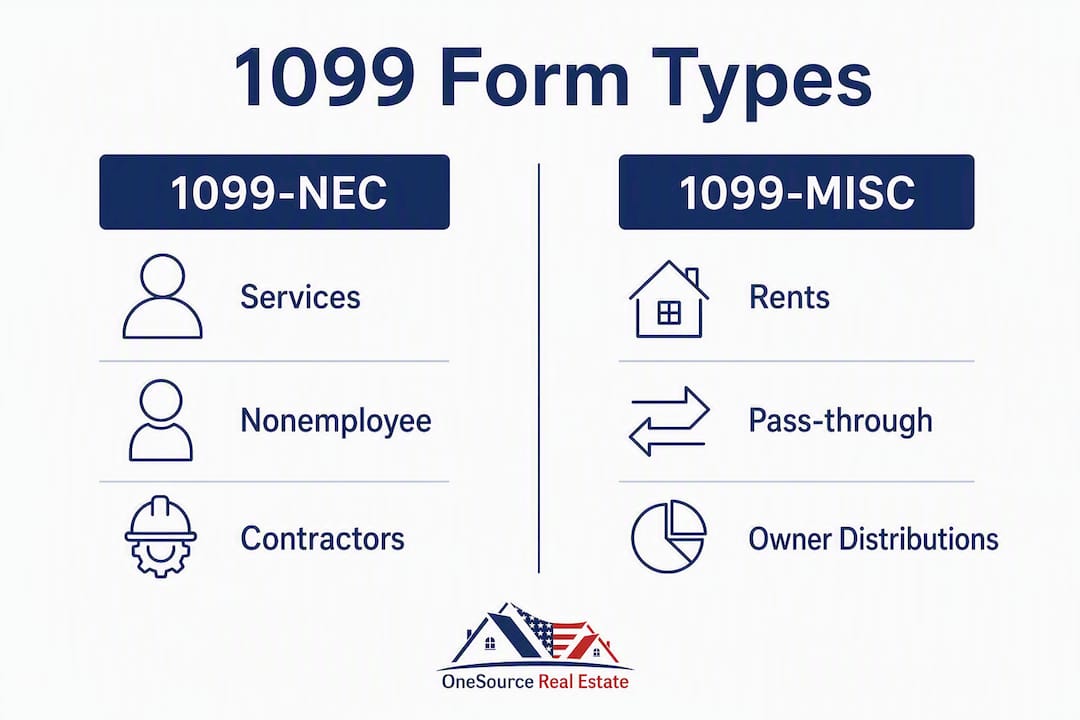
Form 1099-NEC covers services
1099-NEC reports nonemployee compensation paid to individuals or unincorporated businesses for services. In property management, that means any contractor you pay directly for work on a property or for the business: a handyman who bills $800 for repairs, a landscaper on a $1,200 annual contract, a freelance bookkeeper, or an unincorporated property inspector. The $600 threshold (for 2025 payments) applies to the aggregate paid to that person across the full calendar year, not per invoice.

Form 1099-MISC covers rents and pass-through distributions
Rent remitted to property owners goes in Box 1 of Form 1099-MISC. The IRS intermediary rule is explicit: tenants are relieved from issuing a 1099 to a property manager acting as agent, but the manager must issue a 1099-MISC to the owner when it pays rents of $600 or more (2025) or $2,000 or more (2026 and later). The amount reported is gross rent collected, not the net amount after your management fee.

| Payment type | Form | Box | Notes |
|---|---|---|---|
| Rent remitted to owner | 1099-MISC | Box 1 | Report gross rent, not net |
| Contractor/handyman services | 1099-NEC | Box 1 | Aggregate all payments to same payee |
| Attorney gross proceeds | 1099-MISC | Box 10 | Applies regardless of incorporation |
| Landscaper (unincorporated) | 1099-NEC | Box 1 | Sole proprietors and single-member LLCs |
| Plumber (incorporated S-corp) | Exempt | N/A | Verify tax classification on W-9 |
Common exemptions to know:
- Payments to C-corporations and S-corporations are generally exempt (except attorneys and medical providers)
- Payments processed through credit cards or third-party payment networks (PayPal, Venmo Business) are reported by the payment processor on Form 1099-K, not by you
- An LLC's reporting status depends entirely on how it is taxed: check Box 3 on the W-9
How do you prepare, issue, and file 1099s as a property manager?
Follow these steps from onboarding through final submission.
-
Verify TIN and name matches — Cross-check each payee's name and TIN against the W-9 on file. A mismatch triggers IRS notices and potential backup withholding obligations.
-
Furnish recipient copies by January 31. Both 1099-NEC and 1099-MISC recipient copies are due to payees by January 31, per the IRS filing instructions.
-
Set up TCC early. To e-file through the IRS FIRE system or IRIS, you need a Transmitter Control Code. Apply through the IRS IR Application for TCC well before January, since processing takes time.
Pro Tip: Run a mid-year 1099 readiness report in July. Catching a missing W-9 in July costs you one email. Catching it in January costs you a backup withholding headache.
What do you do when a TIN is missing or wrong?
W-9 collection is not a year-end task. It is a continuous compliance requirement, and the IRS is clear: if you make a payment without a valid TIN on file, you are technically required to apply backup withholding.
- Collect the W-9 before the first payment — The IRS W-9 instructions state that payers must request a TIN before making any reportable payment. Build this into your onboarding checklist for both owners and vendors.
The 24% backup withholding rate can surprise owners and vendors who have never encountered it. Explaining the requirement upfront, at onboarding, prevents disputes later.
How do common property management scenarios map to 1099 reporting?
Three scenarios cover most of what property managers encounter.
Scenario 1: Gross rent vs. net distribution to an owner
A manager collects $18,000 in gross rent from tenants over the year and remits $16,200 to the owner after deducting a 10% management fee. The 1099-MISC Box 1 amount is the full gross rent collected, not the net amount after fees. The owner reports the full $18,000 as rental income and separately deducts the $1,800 management fee as a rental expense. Reporting net rent is one of the most common errors in property management tax reporting, and it understates the owner's income in a way the IRS can catch through its matching programs.
Scenario 2: Aggregating contractor payments across months
A handyman receives $250 in March, $200 in July, and $400 in October from the same property manager, paid from different accounts. Total: $850. Because the aggregate payments exceed the applicable reporting threshold, the manager issues a 1099-NEC for the total amount. The key is tracking by payee, not by invoice or account.
Scenario 3: Incorporated vs. unincorporated vendor
A plumbing company organized as an S-corporation invoices $2,400 for repairs. No 1099 required. A sole-proprietor plumber invoices the same $2,400. A 1099-NEC is required. A single-member LLC that has not elected corporate tax treatment is treated as a sole proprietor for 1099 purposes. Always check Box 3 of the vendor's W-9 before deciding.
- Report gross rent, never net, in 1099-MISC Box 1
- Aggregate all payments to the same payee across all accounts before comparing to the threshold
- Corporate payees (C-corp, S-corp) are generally exempt; verify LLC tax classification on the W-9
- Payment date, not filing date, determines whether the $600 (for 2025 payments) or $2,000 (for 2026 and later payments) threshold applies
How do you correct errors and avoid penalties?
Mistakes happen. The IRS correction process is manageable when you act quickly.
-
Identify the error type. The IRS distinguishes between Type 1 errors (wrong dollar amount, wrong code, wrong checkbox) and Type 2 errors (wrong payee TIN or name). Each requires a slightly different correction approach.
-
File a corrected form. Check the "CORRECTED" box at the top of a new 1099 form. For Type 1 errors, file one corrected form with the right data. For Type 2 errors, file two forms: one to void the original (zero amount, "CORRECTED" checked) and one new form with the correct payee information.
-
Furnish a corrected copy to the recipient. Send the corrected form to the payee at the same time you file with the IRS.
-
Act before the penalty tiers escalate. The IRS penalty structure for incorrect or late information returns increases with time. Corrections made within 30 days of the due date carry the lowest penalty tier; corrections made after August 1 carry a higher rate; intentional disregard carries the highest penalty per form with no cap reduction.
The IRS Automated Underreporter (AUR) program matches 1099s against tax returns automatically. A mismatch does not just trigger a notice about the 1099 itself. It can open scrutiny of related deductions, QBI classification, and business expense claims. That is why a single incorrect 1099-MISC can become a much larger conversation with the IRS than the original error warrants.
Practical mitigation steps:
- Reconcile your 1099 totals against your accounting ledger before filing, not after
- Correct errors as soon as you discover them, even after the filing deadline
- When a notice arrives, respond within the stated timeframe and document every step
- Engage a CPA or tax professional when a CP2100 notice or AUR inquiry involves multiple payees or large dollar amounts
What are the year-round best practices for property managers?
The managers who have the easiest January are the ones who treat 1099 compliance as a year-round discipline, not a year-end scramble.
- W-9 before first payment, every time. No exceptions. Build it into your vendor and owner onboarding checklist so it happens automatically.
- Run quarterly 1099 readiness reviews. Pull a payee report each quarter, flag anyone approaching the threshold, and identify missing W-9s while there is still time to collect them.
- Consolidate payment records across trust and operating accounts. Many errors come from tracking only one account. Your 1099 totals must reflect every dollar paid to each payee, regardless of which account it came from.
- Use integrated property-management software. Platforms like AppFolio and Buildium track payments, store W-9 data, and generate 1099 drafts automatically, which cuts manual entry errors significantly.
- Apply for your TCC early. If you plan to e-file through the IRS FIRE system or IRIS, the TCC application process takes time. Start it in the fall, not in January.
- Retain W-9s, 1099s, and backup withholding records for at least four years. The IRS can assess penalties for information return failures within that window, and having documentation of good-faith compliance is your best defense.
Pro Tip: Set a calendar reminder for October 1 to audit your W-9 file. Any payee missing a form gets a request that month, giving you a full quarter to resolve it before year-end.
How OneSource Real Estate handles 1099s for Atlanta landlords
OneSource Real Estate's approach to property management services treats 1099 compliance as part of the core management workflow, not a separate year-end project.
The process starts at owner and vendor onboarding. Every new owner and every contractor receives a W-9 request before any payment is made or any work is authorized. Payment coding happens at the transaction level: each disbursement is tagged by payee type and payment category so that year-end aggregation is a report run, not a manual reconstruction.
Before January, OneSource reconciles trust-account receipts against operating disbursements for each managed property. The goal is confirming that 1099-MISC Box 1 reflects gross rent collected from tenants, not the net amount after management fees. That reconciliation step is what prevents the most common owner-reporting error in the industry.
- Collect W-9s at onboarding for all owners and vendors
- Tag every payment by payee and type at the transaction level
- Run a pre-January reconciliation of gross rent vs. net distributions
- Verify TIN and name matches before generating draft 1099s
- Furnish recipient copies by January 31; e-file with the IRS by the applicable deadline
Pro Tip: Owners who use an owner portal through their property management company can review their year-to-date rent collections at any time, which makes the January 1099 reconciliation a confirmation rather than a surprise.
Key Takeaways
Property managers must issue 1099-MISC to owners for gross rent remitted and 1099-NEC to independent contractors for services, with the applicable threshold determined by the payment date, not the filing year.
| Point | Details |
|---|---|
| Form assignment | 1099-MISC for rent to owners (Box 1, gross); 1099-NEC for contractor services (Box 1). |
| Threshold by payment date | $600 for payments made in 2025; $2,000 for payments made in 2026 and later under the OBBBA. |
| Recipient copy deadline | Both 1099-NEC and 1099-MISC recipient copies are due to payees by January 31. |
| W-9 and TIN compliance | Collect W-9s before the first payment; missing TINs trigger 24% backup withholding. |
| OneSource Real Estate | Handles W-9 collection, gross-rent reconciliation, and 1099 generation as part of full-service Atlanta property management. |
Why 1099 accuracy matters more than most landlords realize
Most landlords treat the 1099 as a paperwork formality. It is not. The IRS AUR program matches every 1099 you file against the recipient's tax return, and a mismatch does not stay contained to the 1099 itself. It can pull deductions, depreciation schedules, and QBI elections into the conversation.
The gross-vs.-net reporting error is the one I see cause the most downstream confusion. An owner who receives a 1099-MISC for $16,200 (net) instead of $18,000 (gross) will report lower rental income, claim a management fee deduction that does not reconcile with the 1099, and potentially trigger an AUR inquiry that neither the owner nor the manager anticipated. The fix is simple. The failure to apply it is surprisingly common.
The 2026 threshold change under the OBBBA raises the floor to $2,000 for many payments, but it does not eliminate the reporting obligation. Managers who assume the new threshold means less work will still need to track every payee carefully, because the payment date determines which threshold applies, and a vendor paid $1,800 in December 2025 and $300 in January 2026 is two separate reporting questions.
The most durable compliance habit is the simplest one: collect the W-9 before the first payment, every time, without exception. Everything else, the reconciliation, the form selection, the deadline tracking, gets easier when the foundational document is already in hand.
OneSource Real Estate's managed reporting takes the 1099 burden off your plate
Handling 1099 compliance correctly requires year-round bookkeeping discipline, accurate gross-rent reconciliation, and timely e-filing. For Atlanta-area landlords managing one property or a growing portfolio, that is a real operational load on top of everything else ownership demands.

OneSource Real Estate's full-service property management covers the entire 1099 workflow: W-9 collection at onboarding, payment coding throughout the year, gross-rent reconciliation before January, 1099 generation, and electronic filing by IRS deadlines. Owners receive clear year-end financial statements that match their 1099-MISC figures, which means fewer questions, fewer surprises, and a cleaner conversation with their CPA. Reduced audit exposure comes with the territory when your records are reconciled and your forms are filed correctly.
If you own rental property in Atlanta or the surrounding areas and want managed reporting handled for you, contact OneSource Real Estate to discuss a property management agreement.
Useful sources for 1099 forms, instructions, and e-filing
Keep these IRS resources bookmarked. They are the authoritative reference for every rule covered in this guide.
- About Form 1099-MISC (IRS): Official form page with filing requirements, thresholds, and box-by-box guidance
- About Form 1099-NEC (IRS): Official form page for nonemployee compensation reporting rules
- Instructions for Forms 1099-MISC and 1099-NEC (IRS PDF): Full instructions including deadlines, correction procedures, and penalty tables
When preparing to file or responding to an IRS notice, start with the instructions PDF and the relevant form page. Penalty tables and correction procedures are in the general instructions document.
FAQ
Do property management companies get a 1099?
Yes, if the property management company is not incorporated as a C-corp or S-corp and receives $600 or more (for 2025 payments), or $2,000 or more (for payments made in 2026 and later), in management fees, the property owner must issue a 1099-NEC to the manager. Verify the manager's tax classification on their W-9.
Should my property manager send me a 1099?
Yes. Under the IRS agency/pass-through rule, your property manager must issue you a Form 1099-MISC (Box 1) reporting the gross rent collected on your behalf when that amount meets the reporting threshold for the payment year ($600 for payments made in 2025; $2,000 for payments made in 2026 and later).
Do I need to file a 1099 for my rental property?
If you pay an unincorporated contractor $600 or more (for 2025 payments) or $2,000 or more (for payments made in 2026 and later) for services related to your rental property, you must file a 1099-NEC. If you use a property manager who collects rent on your behalf, the manager handles the 1099-MISC to you. OneSource Real Estate manages this entire workflow for Atlanta-area landlords.
Do I have to file my 1099 if I made less than $10,000?
The general reporting threshold is $600 for payments made in 2025, rising to $2,000 for payments made in 2026 and later under the OBBBA. Income below the reporting threshold is still reportable if it meets the applicable threshold, and recipients must still report all income on their tax return regardless of whether a 1099 was issued.