
Rent is due on the 1st, with a grace period through the 3rd; a flat or percentage late fee applies starting the 4th. Payments are accepted by check, money order, or online portal/ACH, with a returned-check fee of $35 to $50. Partial payments are refused unless covered by a signed arrangement, and unpaid rent moves to a written notice, then pay-or-quit, per local law. Confirm your state and city rules before enforcing any of it.
TL;DR:
- Late fees should reflect actual damages and be capped by local law, with California courts generally limiting enforceable fees to around 5–6 percent of rent.
- Partial payments are only enforceable if backed by a signed written agreement, as accepting unapproved partial payments can invalidate eviction notices in many jurisdictions.
- Confirm your state and city rules on late fees, notice periods, and eviction timelines annually, since laws such as Virginia’s extended nonpayment notice from 5 to 14 days can change enforcement.
- Route all rent payments through traceable channels like online portals or ACH transfers to maintain a clear audit trail and prevent disputes.
- Use a short, clear rent collection policy emphasizing consistency, which helps prevent disputes and reduces enforcement time, but always adapt it to your local legal environment.
Table of Contents
- Full Sample Rent Collection Policy Template
- How to Customize Each Clause Without Losing Enforcement Power
- What Legal Traps Should You Check Before Adopting This Template?
- Rolling Out the Policy Across Your Portfolio
- Clause Bank: Ready-to-Paste Rent Payment Rules
- What Rent Collection Templates Usually Get Wrong
- Why a Short, Enforceable Policy Is Your Best Defense
- When It Makes Sense to Hand Rent Collection to a Professional
- Sources
- FAQ
Full Sample Rent Collection Policy Template
Copy this structure into your lease or hand it out as a standalone addendum. Fill in the bracketed placeholders with your own numbers once you've checked local law.
Rent Collection Policy for [Property Name/Address]
Purpose: This policy establishes rent payment procedures and consequences for late or missed payments for all tenants at [property name or unit list].
Scope: Applies to all leases signed on or after [date], covering [unit numbers or "all units at this property"].
Due date and grace period: Rent is due on the [1st] of each month. A grace period runs through the [3rd/5th]; payments received after that date are considered late.
Accepted payment methods: Rent may be paid by [check, money order, online portal, ACH transfer] to [address or portal link]. Cash is not accepted.
Late fee: A late fee of [$50 flat / 5% of monthly rent] applies to any payment received after the grace period ends, added on the [4th/6th] of the month.
Returned payments: Any check or electronic payment returned for insufficient funds incurs a $[35 to $50] fee, and future payments must be made by certified funds or money order.
Partial payments: Partial payments are not accepted unless the landlord and tenant sign a written payment plan specifying amounts and dates.
Nonpayment escalation: A late notice is issued after [X] days of nonpayment. If rent remains unpaid, a pay-or-quit notice follows per state and local statute, and eviction proceedings may begin if payment is not received within the legal notice period.
Recordkeeping: All payments are logged in a tenant ledger and receipts are issued on request, per practices detailed in the Consumer Financial Protection Bureau's sample rental agreement.
- Attach this policy as a lease exhibit and have tenants initial it separately from the main signature page.
- Update dollar amounts and notice periods any time your local ordinance changes.
- Keep a signed copy in every tenant file, digital or paper.
How to Customize Each Clause Without Losing Enforcement Power
The words "due" and "late" aren't interchangeable in a courtroom. Rent is due on the date the lease says it's due; the grace period only delays when a late fee kicks in, not when the rent is legally owed. That distinction matters when you calculate notice timelines, since some jurisdictions count days from the original due date, not the end of the grace period.
Flat fees are simpler to enforce and easier for tenants to understand, but percentage fees scale with rent and can look fairer on paper. Either way, courts scrutinize whether the fee reflects real damages rather than a penalty. In California, judges have leaned toward capping enforceable late fees at roughly 5 to 6 percent of monthly rent, treating anything higher as an unenforceable penalty rather than a genuine damage estimate.
Partial payments are the clause landlords get wrong most often. Accepting even $200 toward a $1,500 balance can reset or void an active pay-or-quit notice in many states unless it's tied to a signed, dated payment agreement. Refuse it, or document it in writing and reissue your notice afterward.
- Require certified funds immediately after any returned check, not "next time."
- Route all payments through one traceable channel (portal, ACH, or mailed check) to build a clean audit trail.
- Label late fees, NSF charges, and legal costs as "additional rent" in the lease, which lets you include them in a single demand notice in jurisdictions that allow it.
Pro Tip: Never accept a partial payment in person without a signed agreement in hand first. A verbal "I'll pay you the rest Friday" is nearly impossible to prove and can cost you your eviction filing.
What Legal Traps Should You Check Before Adopting This Template?
Rent collection law is set state by state, sometimes city by city, and covers late fee caps, notice periods, and eviction timelines differently everywhere. A policy that's airtight in one state can be unenforceable two states over.
Notice periods shift more often than landlords expect. Virginia recently extended its nonpayment notice period from 5 days to 14 days, which means a template built on the old 5-day standard would violate current law the moment you tried to enforce it. Georgia landlords have their own late-fee precedents worth understanding before setting a dollar figure; a $50 flat fee has held up in Georgia courts in cases landlords have cited as a reasonable benchmark.
- Recheck your state's late-fee cap and notice period annually, since legislatures amend these rules more often than most landlords realize.
- Loop in a local attorney anytime you're managing a unit type you haven't handled before, like a HUD-subsidized property or a rent-controlled unit.
- Never copy commercial lease language into a residential template. Residential tenancies carry statutory tenant protections that commercial leases don't, and courts treat the two very differently.
- Federally assisted housing follows separate HUD procedures that override standard market-rate collection policies.
Rolling Out the Policy Across Your Portfolio
- Confirm your state and local rules on late fees, grace periods, and notice timelines before finalizing any dollar amount or deadline.
- Add the policy to your lease template and collect a signed acknowledgment at move-in or renewal, not as a verbal add-on.
- Set up a traceable payment channel, whether that's an online portal or ACH transfer, and automate rent reminders a few days before the due date.
- Train every staff member or property manager on the same enforcement standard so no tenant gets a quieter deal than another.
- Keep tenant ledgers current in real time rather than reconciling monthly, since gaps make disputes harder to resolve later.
- Review the whole policy quarterly and update it whenever a fee cap, notice period, or ordinance changes in your market.
A tenant screening process that filters for payment history reduces how often you'll need to lean on this policy in the first place.
Clause Bank: Ready-to-Paste Rent Payment Rules
- Due date: "Rent is due on the [1st] of each month, without demand." Use as the anchor clause; confirm your state doesn't require a specific due-date disclosure format.
- Grace period: "A grace period of [3] days applies before late fees accrue." Check whether your state defines a minimum grace period.
- Late fee: "A late fee of [$50 / 5%] applies to rent received after [date]." Verify your state's reasonableness standard first.
- NSF/returned check: "A $[40] fee applies to any returned payment; future rent must be paid by certified funds." Rarely regulated, but confirm local caps.
- Partial payment: "Partial payments are accepted only under a signed written agreement." Pair with a reissued notice if used after nonpayment begins.
- Payment method: "Rent must be paid via [portal/ACH/check] to [location]; cash is not accepted." Keeps every payment traceable.
- Pay-or-quit: "Failure to pay rent in full may result in a [X]-day notice to pay or vacate, per state law." Insert your jurisdiction's exact notice period.
What Rent Collection Templates Usually Get Wrong
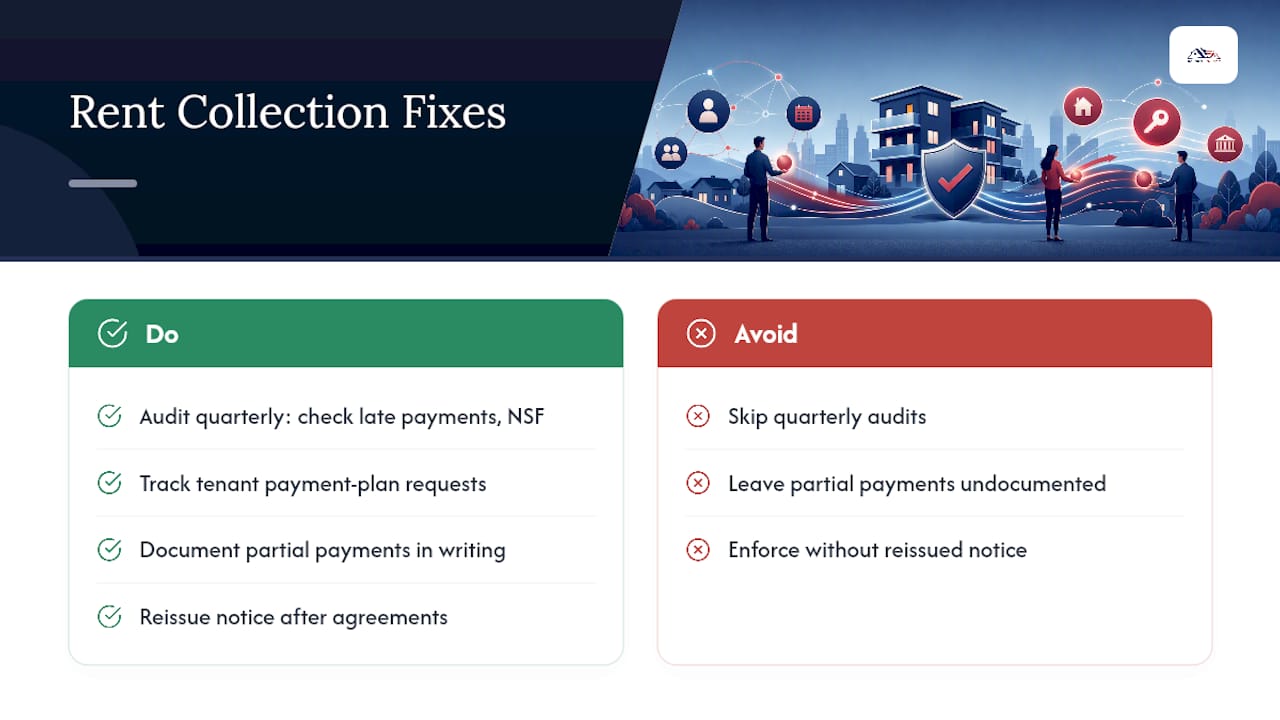
Generic templates skip the quarterly audit. Reviewing late payment rates, NSF frequency, and how often tenants request payment plans surfaces problems before they become eviction filings. Document every partial-payment arrangement in writing and reissue your notice afterward, since skipping that step can quietly void your legal standing. If enforcement is eating more hours than it should, outsourcing rent collection to a manager often pays for itself in recovered time and fewer missed fees.
Why a Short, Enforceable Policy Is Your Best Defense
Consistency beats cleverness here. A short, plainly worded policy enforced the same way every month prevents more disputes than any clause you could add. It also saves you hours you'd otherwise spend arguing exceptions. Adapt every template to your own state's law before you rely on it.
— Matt
When It Makes Sense to Hand Rent Collection to a Professional
Writing a policy is the easy part. Enforcing it at 10 PM on the 4th of the month, chasing a returned check, or filing a pay-or-quit notice correctly is where most self-managing landlords burn out. OneSource Real Estate handles rent collection, notices, and tenant communication as part of its Monthly Management service, priced at 10% per month, so you're not the one enforcing your own late-fee clause against a tenant you see at the mailbox.

If you're weighing whether to self-manage or delegate, a 30-Minute Consulting Call for $300 walks through your specific portfolio and flags where your current policy has gaps. Landlords who want tenants placed and screened before rent collection even becomes a question can use tenant placement services, and owners who want broader protection can add optional owner benefit packages typically offered by property management firms. If you're managing a handful of units around Atlanta and the paperwork is starting to outweigh the return, book a call and find out what handing it off actually looks like.
Sources
- Virginia extends residential nonpayment notice period from 5 days to 14 days
- California Civil Code 1671 & late fees — analysis
- Consumer
- Commercial vs residential distinction (UNC SOG materials)
FAQ
What Should a Rent Collection Policy Include?
A rent collection policy should state the due date, grace period, late fee amount and trigger, accepted payment methods, returned-check charges, and the escalation steps for nonpayment. It should also explain how partial payments are handled and how records are kept, following the structure in the CFPB's sample rental agreement.
How Much Can I Charge for a Late Rent Fee?
Late fee limits depend on your state; some jurisdictions require the fee to reasonably reflect actual damages rather than function as a penalty. California courts have leaned toward roughly 5 to 6 percent of monthly rent as a defensible benchmark, while other states set no explicit cap.
Can I Refuse a Partial Rent Payment?
Yes, and in most cases you should unless it's backed by a signed written agreement. Accepting partial rent without documentation can reset or invalidate an active pay-or-quit notice in many jurisdictions, delaying your ability to pursue eviction.
Does OneSource Real Estate Handle Rent Collection for Landlords?
Yes, rent collection is included in OneSource Real Estate's Monthly Management service, priced at 10% per month, along with tenant communication and late notice enforcement. Landlords who want a policy review first can book a 30-Minute Consulting Call for $300.
How Long Does a Pay-or-Quit Notice Take?
Notice periods vary by state and change over time; Virginia, for example, moved from a 5-day to a 14-day notice for residential nonpayment. Always confirm your current state and local requirement before issuing a notice, since using an outdated timeline can invalidate the filing.