
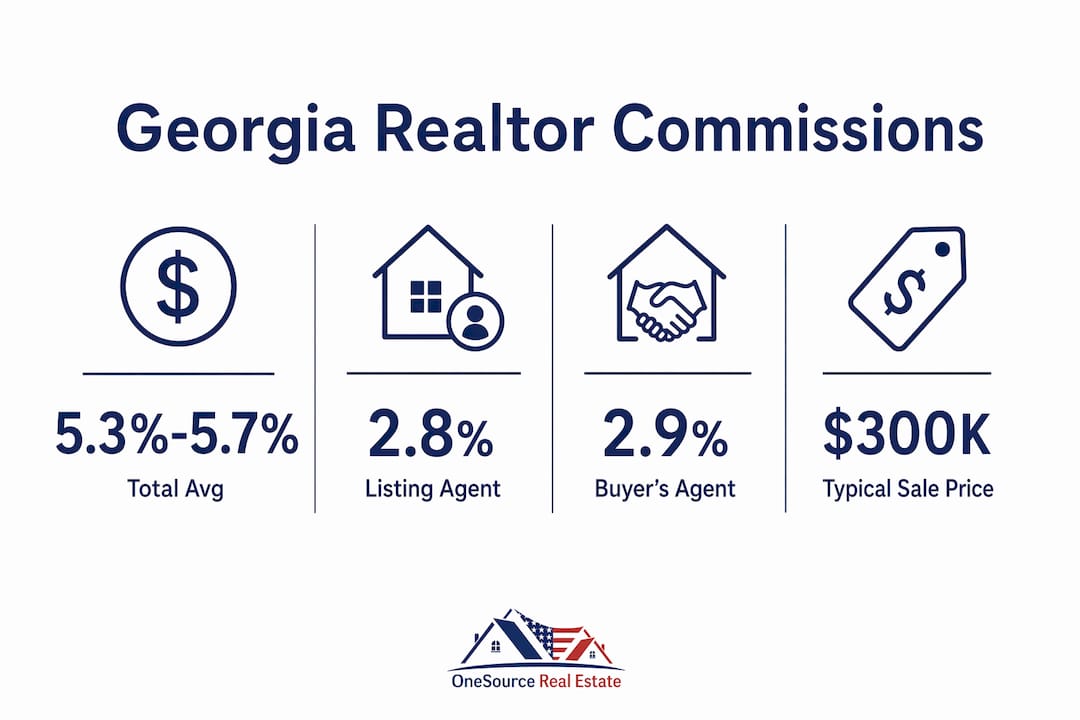
In Georgia, sellers typically pay a total realtor commission that varies around the mid 5% range of the sale price, split between the listing agent and the buyer's agent. On a median-priced Georgia home, that results in several thousand dollars in agent fees paid from closing proceeds. Both sides of the commission have always been negotiable, and since the August 2024 NAR settlement, that flexibility has expanded considerably.
Here's the quick breakdown:
- Total commission range: typically around the mid 5% range of the sale price
- Listing agent's share: generally close to half the total commission
- Buyer's agent share: generally close to half the total commission
- Who pays: sellers usually cover both sides from sale proceeds at closing
- Contractual reality: each party is technically responsible for their own agent's fee, but sellers almost always absorb both in practice
Pro Tip: Before signing a listing agreement, ask your agent to show you the exact commission percentage, how the buyer-agent share is structured, and whether it can be adjusted if the buyer brings no agent.
Table of Contents
- What does realtor commission in Georgia actually average in 2026?
- How realtor commission works in Georgia: agreements, timing, and the NAR settlement
- Who actually pays realtor fees in Georgia?
- How commission splits work: what the listing agent, buyer's agent, and their brokers each keep
- How to negotiate realtor fees in Georgia and actually lower your costs
- What OneSource Real Estate sees in Atlanta and Georgia markets
- How commercial real estate commissions differ from residential in Georgia
- Key Takeaways
- The commission conversation most sellers avoid
- OneSource Real Estate can help you keep more of your sale proceeds
- Useful sources and further reading
- FAQ
What does realtor commission in Georgia actually average in 2026?
Two widely cited 2026 surveys suggest the statewide average total commission is in the mid 5% range, with the listing and buyer's agent shares generally close to half each. A separate calculator suggests a slightly lower figure, also around the mid 5% range, with roughly equal splits. The spread between surveys reflects real variation: higher-priced markets and competitive listings often see different per-side percentages than rural or lower-value transactions.

Here's what typical commission percentages translate to in dollars at common price points, assuming roughly equal splits and total commission around the mid 5% range.
To calculate your own estimate:
- Take your expected sale price.
- Multiply by 0.055 (for 5.5%) or 0.057 (for 5.7%) to get total commission.
- Divide by 2 to get each agent's gross share.
- Subtract the broker's cut (commonly 30%) to see the agent's actual take-home.
Regional variance matters here. In Atlanta's intown neighborhoods, where prices run well above the state median, sellers sometimes negotiate tighter listing-side fees because the dollar amount is already substantial. In smaller markets like Valdosta or Dalton, the percentage often holds closer to the survey averages because deal volume is lower and agents have less flexibility.
How realtor commission works in Georgia: agreements, timing, and the NAR settlement
Commissions are set in writing before any work begins and paid from sale proceeds at closing. They do not come out of pocket on closing day; the title company or closing attorney deducts them from the seller's net proceeds and disburses them to the brokerages.

The Georgia Real Estate Commission oversees licensing and professional standards for agents and brokers statewide. The administrative rules under Chapter 520-1 govern brokerage relationships and how commission disclosures must be handled, including the written agreements that define each party's obligations.
Two documents control commission terms:
- Listing agreement: signed by the seller and listing broker; sets the total commission percentage and how much, if any, is offered to a cooperating buyer's agent
- Buyer representation agreement: signed by the buyer and their agent; specifies what the buyer's agent expects to earn and who is responsible for paying it
Since the August 2024 NAR settlement, buyer-agent compensation is no longer required to be offered through the MLS. Sellers can choose to offer nothing to a buyer's agent, offer a flat dollar amount, or offer a percentage. Buyers and their agents negotiate compensation separately, and buyers may be asked to cover their agent's fee directly if the seller declines.
Key clauses to look for in your agreements:
- The exact commission percentage and how it splits
- Whether the buyer-agent share is a fixed offer or negotiable
- Conditions under which the commission is owed (e.g., if the deal falls through)
- Dual agency disclosures if one agent represents both parties
Who actually pays realtor fees in Georgia?
Each client is contractually responsible for their own agent's fee. In practice, though, sellers almost always pay both sides from their sale proceeds. The reason is straightforward: most buyers are already stretched covering a down payment and closing costs. Requiring them to also write a check for their agent's commission at closing would knock a meaningful number of buyers out of contention for a given listing.
Sellers who want to reduce total commission expense have a few realistic options:
- Offer a lower buyer-side percentage (e.g., 2% instead of 2.75%) and accept that some buyer's agents may steer clients toward competing listings
- Use a tiered commission structure that rewards the listing agent with a higher percentage if the home sells above a target price
- Require buyers to pay their own agent post-NAR settlement, though this can reduce the buyer pool in price-sensitive markets
- Negotiate the listing-side fee directly with your agent, especially if you're also buying through the same brokerage
A few quick answers to common follow-ups:
Are sellers legally required to pay the buyer's agent? No. Since the NAR settlement, it's a negotiated term, not a requirement.
What if a buyer shows up without an agent? The seller keeps the buyer-side commission or negotiates it away entirely, which can meaningfully improve net proceeds.
Can a seller refuse to pay any commission? Yes, though a zero-commission listing is rare in practice and may limit MLS exposure depending on how the listing is structured.
How commission splits work: what the listing agent, buyer's agent, and their brokers each keep
The headline commission percentage is not what any individual agent takes home. It flows through two layers of splitting before anyone gets paid.
Here's how the math works on a $262,500 sale at a typical 5.3%–5.7% total commission:
- Total commission: $13,913–$14,963
- Listing agent's gross share (2.8%): $7,350
- Buyer's agent's gross share (2.9%): $7,612
- Listing agent's net after 70/30 broker split: $5,145
- Buyer's agent's net after 70/30 broker split: $5,328
That 70/30 broker split is a common example, though splits vary widely. A newer agent might keep only 50%–60% of their gross share; a top producer at a high-volume brokerage might negotiate 80%–90%.
| Sale Price | Total Commission (5.3%–5.7%) | Listing Agent Gross (2.8%) | Buyer's Agent Gross (2.9%) | Listing Agent Net (70%) | Buyer's Agent Net (70%) |
|---|---|---|---|---|---|
| $262,500 | $13,913–$14,963 | $7,350 | $7,612 | $5,145 | $5,328 |
The practical implication: when a seller negotiates the headline commission down by half a percent, the actual dollar reduction to each agent's take-home is smaller than it looks. A 0.5% reduction on a $262,500 sale saves the seller about $1,313 total, but each agent loses only about $459 after their broker split. That's worth knowing before you push hard on a cut that might cost you negotiating support at a critical moment.
How to negotiate realtor fees in Georgia and actually lower your costs
Yes, commissions are negotiable in Georgia. The NAR settlement made that clearer than ever. Here's how to do it without burning your agent relationship or costing yourself more than you save.
Practical tactics for sellers:
- Interview at least three agents and ask each one directly: "What's your commission, and what's flexible?"
- Offer a performance-based structure: a lower base if the home sells at list price, a bonus if it sells above
- If you're buying and selling simultaneously, ask the same agent to represent both transactions for a reduced combined rate
- In a strong seller's market, a lower buyer-side offer (say, 2%) carries less risk because buyer demand is high regardless
For buyers post-NAR settlement:
- Sign a buyer representation agreement that caps your agent's fee at a specific dollar amount or percentage
- Ask your agent to request seller concessions to cover their fee as part of the offer negotiation
- If the seller offers nothing to your agent, negotiate the purchase price down to offset what you'll owe
A simple script for sellers: "I'd like to discuss the commission structure before we sign. I'm considering a few agents, and I want to understand what flexibility exists on the listing-side fee and how you'd structure the buyer-agent offer."
Lower-fee alternatives and their real tradeoffs:
- Flat-fee listing services: pay a set fee (often a few hundred to a few thousand dollars) for MLS access only; you handle showings, negotiations, and paperwork yourself
- Limited-service brokers: offer partial support at a reduced commission; useful if you're experienced and the market is hot
- FSBO: no listing-side commission, but lower-fee models can reduce marketing reach and negotiation support, and most FSBO sellers still offer a buyer-agent fee to attract represented buyers
The tradeoff is real. A full-service real estate brokerage handles pricing strategy, marketing, contract review, and negotiation. Cutting that support to save 1% on commission can cost more in final sale price than the fee itself.
What OneSource Real Estate sees in Atlanta and Georgia markets
Based on listings and closings across Atlanta and surrounding counties, OneSource Real Estate consistently sees total commissions in the 5%–5.7% range, with meaningful variation by market segment. Intown Atlanta listings at higher price points often involve negotiated listing-side fees closer to 2.5%, while outlying markets in Henry County, Gwinnett, and Rockdale tend to hold near the statewide survey averages.
A few patterns OneSource sees regularly:
- Sellers in Decatur and East Atlanta often negotiate listing fees down to 2.5% when the home is priced above $400,000
- Buyers in Gwinnett and Rockdale counties frequently ask sellers to cover the full buyer-agent fee because buyer affordability is tighter at those price points
- Investors converting sales to rentals often work with OneSource on combined transaction and property management in Decatur arrangements, which can affect how commission and ongoing management fees are structured
OneSource structures commission discussions around one goal: maximizing the seller's net proceeds while keeping the listing competitive. That means being direct about what the buyer-side offer should be in a given submarket, not defaulting to a standard split that may not serve the seller's actual position.
Matt is a licensed real estate professional with OneSource Real Estate, serving Atlanta and surrounding Georgia markets.
How commercial real estate commissions differ from residential in Georgia
Commercial real estate commissions in Georgia follow a different set of norms than residential transactions. The headline difference: commercial rates are typically lower in percentage terms but higher in absolute dollars because the properties are worth more.
Residential transactions generally run 5%–6% total, split between two agents. Commercial deals typically range from 4%–6% for smaller properties, dropping to 1%–3% on large transactions above $5 million. The split structure also differs. Commercial agents often negotiate their compensation directly with the property owner or tenant rather than through an MLS offer, and dual representation (one agent handling both sides) is more common.
Commercial commissions are also more likely to be structured as flat fees or tiered rates based on deal size. A $2 million office building sale might carry a 4% commission on the first $1 million and 2% on the remainder. Lease transactions in commercial real estate are typically compensated differently from sales, often calculated as a percentage of total lease value over the lease term rather than a percentage of a sale price.
Licensing requirements are the same: Georgia requires a real estate license for commercial transactions, and the Georgia Real Estate Commission governs both residential and commercial practitioners. The practical difference is that commercial deals involve more negotiation of the fee structure itself, and buyers and tenants in commercial transactions are more likely to pay their own representation fees directly.
Key Takeaways
Georgia realtor commissions typically average between 5.3% and 5.7% of the sale price, with most surveys in 2026 reporting statewide total commission figures in this range. Sellers usually pay both sides at closing, and every component of that fee is negotiable—especially since the August 2024 NAR settlement.
| Point | Details |
|---|---|
| Typical total commission | Georgia averages a total commission in the 5.3%–5.7% range, with listing agent shares around 2.8% and buyer’s agent around 2.9%, split roughly evenly. |
| Who pays at closing | Sellers typically cover both agent fees from sale proceeds, though each party is contractually responsible for their own agent. |
| NAR settlement impact | Since August 2024, buyer-agent compensation is no longer required through the MLS and is fully negotiable. |
| Agent net vs. headline | After a common 70/30 broker split, each agent keeps about 70% of their gross share — a 5.5% headline means roughly $5,053 per agent on a $262,500 sale. |
| OneSource Real Estate | OneSource helps Atlanta-area sellers structure commission offers to maximize net proceeds while keeping listings competitive across Georgia markets. |
The commission conversation most sellers avoid
Most sellers treat the commission as a fixed cost and sign the listing agreement without asking a single question about the split. That's a mistake, and it's one I see repeatedly.
The NAR settlement changed the rules, but it didn't automatically change what agents ask for. Sellers who don't push back on the buyer-side offer are leaving money on the table in markets where buyer demand is strong enough to absorb a lower concession. And sellers who cut the listing-side fee without understanding what they're giving up often end up with less marketing, slower offers, and a final sale price that more than offsets the savings.
The fair approach, and what OneSource recommends, is a transparent conversation before the listing agreement is signed: here's the total fee, here's how it splits, here's what the buyer-side offer will be in this specific market, and here's what changes if we adjust any of those numbers. That conversation takes fifteen minutes and can save thousands.
OneSource Real Estate can help you keep more of your sale proceeds
Selling in Atlanta or the surrounding Georgia counties means navigating commission structures, buyer-agent offers, and post-NAR settlement paperwork that most sellers encounter only once or twice in a lifetime. OneSource Real Estate handles all of it, from pricing strategy and listing representation to commission negotiation and closing coordination.
OneSource works with sellers to structure buyer-agent offers that keep listings competitive without defaulting to the highest possible split. For investors and landlords, the same team that handles your sale can transition directly into property management services, covering tenant placement, rent collection, and maintenance coordination so you're not starting over with a new vendor after closing.
Ready to talk through what a fair commission structure looks like for your specific property and market? Contact OneSource Real Estate to get a straight answer before you sign anything.
Useful sources and further reading
- Georgia Real Estate Commission & Appraisers Board: The official state regulator for licensing, professional standards, and consumer inquiries about agent conduct and commission disclosures.
- GA Administrative Code, Chapter 520-1: The state rules governing brokerage relationships, disclosure requirements, and how commissions must be documented in written agreements.
- Georgia Real Estate Commission Calculator (2026): Provides statewide average commission data, per-side splits, and dollar-amount examples for multiple price points.
- Average Realtor Commission in Georgia, 2026 Update (Anytime Estimate): Survey-based averages with calculators and market-practice context for buyer-side fee decisions.
- Average Realtor Commission in Georgia, 2026 (Real Estate Witch): Corroborating survey data with price-tier examples and post-NAR settlement context.
- Who Pays Realtor Fees in Georgia? (HomeLight): Consumer-facing Q&A on seller vs. buyer payment responsibility and market practice.
FAQ
How much does a realtor make on a $300,000 Georgia home sale?
At a typical total commission rate in the mid 5% range, the gross fee splits approximately evenly per agent. After broker splits, the agent's take-home is a portion of that gross share.
Is 3% normal for a realtor in Georgia?
A 3% per-side commission (6% total) is typically above current Georgia averages, which generally fall slightly below that rate.
Can you negotiate realtor fees in Georgia?
Yes. Commissions are fully negotiable in Georgia, and the August 2024 NAR settlement reinforced that buyer-agent compensation is no longer a fixed MLS requirement. Sellers can offer less, structure tiered fees, or require buyers to cover their own agent directly.
Who pays the buyer's agent commission in Georgia?
Sellers typically pay the buyer's agent fee from sale proceeds to keep buyers from needing extra cash at closing, though post-NAR settlement, buyers can negotiate to cover their own agent's fee as part of the purchase terms.
Does Georgia require a written agreement before an agent can earn a commission?
Yes. Under Georgia brokerage relationship rules, commission terms must be set in a written listing or buyer representation agreement before the agent performs services. Verbal agreements are not enforceable for commission claims.