
What is a full-service real estate brokerage?
A full-service real estate brokerage manages every stage of a real estate transaction, from the first pricing conversation to the final signature at closing. Rather than handing you a login to an MLS portal and wishing you luck, these firms assign dedicated agents who handle marketing, negotiation, and closing on your behalf.
The distinction matters more than most people realize. Full-service firms maintain internal marketing teams, transaction coordinators, and legal oversight staff that limited-service agents typically lack. That infrastructure is what lets them absorb the complexity of a transaction so you don't have to.
Core characteristics of a full-service brokerage include:
- End-to-end transaction management covering listing through closing
- Professional marketing: photography, signage, digital campaigns, and open houses
- Offer review, contract negotiation, and legal compliance oversight
- Coordination with lenders, inspectors, appraisers, and title companies
- Post-closing support and, in many cases, ongoing property management
OneSource Real Estate is a clear example of this model in action. Operating in Atlanta and surrounding areas, OneSource Real Estate covers residential sales, buyer representation, and a full property management suite, keeping every piece of the transaction under one roof.
Table of Contents
- What full-service brokerages do for home sellers
- How full-service brokerages support home buyers
- Understanding commission fees and cost structure
- When a full-service brokerage is the right call
- How to find and hire the right full-service real estate broker
- Alternatives to full-service brokerages: what you give up
- How full-service property management fits into the brokerage model
- The full timeline from listing to closing
- Key questions to ask when evaluating a full-service real estate broker
- Red flags to watch for when choosing a full-service brokerage
- OneSource Real Estate covers the full picture for Atlanta buyers, sellers, and investors
- Key Takeaways
- FAQ
What full-service brokerages do for home sellers
Selling a home involves far more than putting a sign in the yard. A full-service brokerage builds a complete sales strategy around your property before it ever hits the market.
- Pricing strategy: Agents conduct a comparative market analysis to set a price that attracts buyers without leaving money on the table.
- Professional marketing: Homes listed with professional marketing tend to sell faster and at higher prices. That means high-resolution photography, four-color flyers, yard signage, and targeted digital campaigns.
- Staging guidance: Agents advise on furniture arrangement, decluttering, and minor repairs that improve buyer perception.
- Showings and open houses: The brokerage schedules, hosts, and follows up on every showing, so you're not fielding calls at 9 PM.
- Offer management: When offers arrive, your agent reviews each one, flags contingencies, and advises on counteroffers.
- Contract and closing coordination: From the accepted offer to the final walkthrough, the brokerage tracks every deadline, manages paperwork, and liaises with the title company.
The upfront investment in marketing and administrative infrastructure is exactly what justifies the commission. You're not paying for a listing; you're paying for a managed sales process.
How full-service brokerages support home buyers
Buyers often underestimate how much a full-service agent does on their side of the transaction. The work starts well before you tour a single home.
- Personalized property search: Your agent filters listings by your criteria, schedules viewings, and flags properties that match your goals before they get competitive.
- Financing guidance: Agents connect buyers with vetted lenders and walk through pre-approval requirements, helping you understand what you can realistically offer.
- Offer preparation: Writing a competitive offer means more than naming a price. Your agent structures contingencies, timelines, and escalation clauses to strengthen your position.
- Inspection and appraisal coordination: The brokerage schedules inspectors, reviews reports with you, and uses findings to negotiate repairs or price reductions.
- Negotiation: Buyer agents leverage market knowledge and negotiating skill to secure favorable terms, not just a lower number but better contingencies and closing timelines.
- Closing support: Your agent walks you through the closing disclosure, confirms wire instructions, and makes sure possession happens on schedule.
For first-time buyers especially, having someone who has done this hundreds of times is the difference between a smooth closing and a stressful one.

Understanding commission fees and cost structure
Full-service brokerage fees in the U.S. are commission-based, meaning you pay a percentage of the final sale price rather than a flat upfront fee. Commissions are negotiable and typically total around 5–6% of the sale price, split between the listing agent and the buyer's agent.
Sellers traditionally pay both sides of the commission at closing, though this has become a more active negotiation point following recent industry changes. The key is understanding what that percentage actually covers.
| Service Category | Full-Service Brokerage | Discount/Limited-Service |
|---|---|---|
| Professional photography | Included | Rarely included |
| MLS listing | Included | Included |
| Marketing campaigns | Included | Rarely included |
| Open houses | Included | Rarely included |
| Offer negotiation | Included | Limited or none |
| Transaction coordination | Included | Limited or none |
| Legal/contract oversight | Included | Minimal |
| Typical total commission | typically around 5–6% of the sale price in the U.S., paid by the seller and split between agents | varies widely |
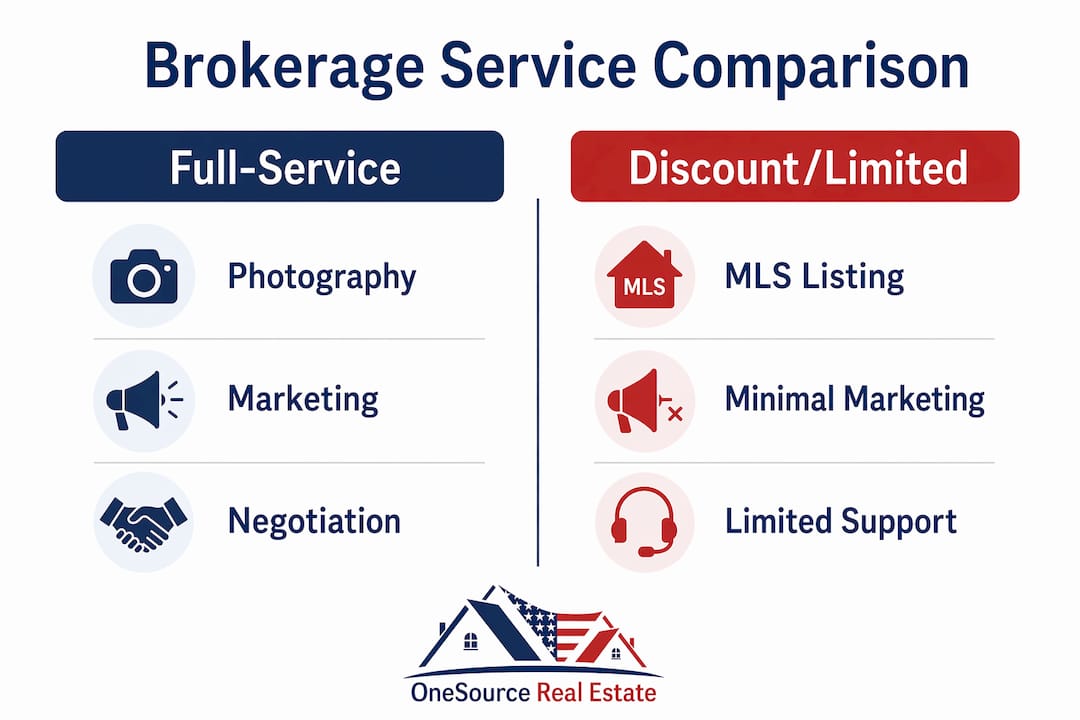
A discount brokerage charging 1–2% sounds appealing until you realize it often covers only the MLS listing with minimal transaction assistance or marketing. The upfront investment in marketing and infrastructure that full-service firms make is what drives better sale outcomes, and that cost is baked into the commission.
When a full-service brokerage is the right call
Not every transaction demands full-service support, but most benefit from it. A few situations where the value is clearest:
- Complex or fast-moving markets: In competitive markets like Atlanta, where multiple offers and tight timelines are common, having an experienced agent managing the process reduces the chance of a costly mistake.
- First-time buyers and sellers: If you've never navigated a real estate transaction, the legal and logistical complexity alone justifies professional oversight.
- Investors managing multiple properties: Full-service firms that include property management let investors scale without losing visibility into each asset.
- Relocation transactions: When you're buying or selling from a distance, you need someone local who can act on your behalf without constant check-ins.
- High-value or unique properties: Luxury or non-standard homes require targeted marketing and skilled negotiation that generic platforms can't replicate.
Full-service firms handle heavy transactional lifting that reduces client errors and delays, which matters most when the stakes are high.
Pro Tip: The commission you pay a full-service brokerage often costs less than a single negotiation mistake on a $400,000 home. A 1% pricing error on that transaction is $4,000 — more than the difference between full-service and discount fees.
How to find and hire the right full-service real estate broker
Credentials are a starting point, not a finish line. A licensed agent with a Realtor designation has met baseline standards, but what you really need is someone with deep knowledge of your specific market and a track record of results.
Start by asking for references from recent clients in your price range and neighborhood. Then evaluate:
- Local market experience: How many transactions has the agent closed in your target area in the past 12 months?
- Marketing approach: Ask to see examples of past listings. Are the photos professional? Is the digital presence strong?
- Communication style: Will you get updates proactively, or only when you ask? Responsiveness is one of the most common complaints buyers and sellers have about agents.
- Service scope: Does the brokerage handle everything in-house, or will parts of your transaction be outsourced to third parties?
- Fee transparency: A good broker explains the commission structure clearly and doesn't dodge questions about what's included.
Check online reviews, but read them critically. A pattern of complaints about communication or missed deadlines is more telling than a single negative review.
Alternatives to full-service brokerages: what you give up
Discount and limited-service brokerages exist on a spectrum. Understanding where they fall short helps you decide whether the savings are worth it.
Discount brokerages typically offer a reduced commission, often 1–2% for the listing side, but still provide some agent support. The trade-off is usually less marketing investment and lighter negotiation assistance.
Limited-service brokerages go further, offering only listing access via MLS with minimal transaction assistance or marketing. You handle showings, negotiations, and paperwork largely on your own.
- Discount models can work for experienced sellers in hot markets where homes sell quickly with minimal marketing.
- Limited-service models carry real risk for anyone unfamiliar with contracts, contingencies, or negotiation tactics.
- Neither model typically includes transaction coordination, legal oversight, or post-offer support at the level a full-service firm provides.
- For buyers, the impact is less direct since the seller usually pays both commissions, but a buyer's agent from a limited-service firm may provide less guidance through inspections and closing.
The savings are real. The question is whether the transaction complexity in your situation justifies accepting those trade-offs.
How full-service property management fits into the brokerage model
For investors and landlords, the brokerage relationship shouldn't end at closing. The most capable full-service firms extend their support into ongoing property management, which is where long-term returns are actually protected.
Integrated property management within a full-service brokerage covers:
- Tenant screening and placement: Background checks, credit reviews, income verification, and lease execution
- Rent collection and financial reporting: Automated collection, owner disbursements, and monthly statements
- Maintenance coordination: Vendor management, repair tracking, and emergency response
- Legal compliance: Lease drafting, renewal management, and eviction support when necessary
- Vacancy marketing: Listing vacant units, coordinating showings, and minimizing turnover gaps
The advantage of having this under one roof is continuity. When the same firm that sold you the property also manages it, there are no information gaps between the acquisition and the ongoing operation.
OneSource Real Estate offers exactly this model in Atlanta and surrounding areas. Their property management services cover tenant procurement, lease management, maintenance coordination, and optional owner protection packages, giving investors a single point of accountability across their portfolio. For landlords who want to stop fielding 11 PM maintenance calls, that kind of structure is the point.
The full timeline from listing to closing
Working with a full-service brokerage follows a predictable sequence, though the exact duration varies by market and transaction complexity. Here's what the process typically looks like:
Weeks 1–2: Preparation Your agent conducts a market analysis, recommends a list price, and coordinates any pre-listing repairs or staging. Professional photography is scheduled, and marketing materials are prepared.

Week 3: Launch The property goes live on the MLS and syndicated platforms. Digital campaigns launch, and the first open house is typically scheduled within the first weekend.
Weeks 3–5: Showings and offers Your agent manages showing requests, provides feedback after each visit, and monitors market response. In active markets, offers can arrive within days. Your agent reviews each offer, advises on terms, and manages counteroffers.
Week 5–6: Under contract Once an offer is accepted, the transaction coordinator takes over deadline management. Inspections are scheduled, the buyer's lender orders an appraisal, and any repair negotiations happen during this window.
Weeks 6–8: Closing preparation Title work is completed, the closing disclosure is reviewed, and final walkthroughs are scheduled. Your agent confirms all contingencies are satisfied and coordinates with the title company on closing logistics.
Closing day Documents are signed, funds are transferred, and keys change hands. A full-service brokerage stays available through this day and beyond for any post-closing questions.
The total timeline from listing to closing typically runs 45–75 days in most U.S. markets, though cash transactions and competitive offers can compress that significantly.
Key questions to ask when evaluating a full-service real estate broker
The interview process matters. These questions cut through the sales pitch and reveal what you're actually getting:
- How many transactions did you close in this market last year? Volume signals active market knowledge, not just a license.
- What does your marketing package include, specifically? Get a list. Photography, digital ads, open houses, and MLS syndication should all be named.
- Who handles my transaction if you're unavailable? Solo agents without backup create real risk during a time-sensitive closing.
- How do you communicate with clients, and how often? Weekly updates versus "call me if you need something" is a meaningful difference.
- Can you share references from clients in my price range? Past clients in similar transactions are the most reliable signal.
- What is your average days-on-market for listings in this area? Compare it to the local market average to gauge performance.
- How do you handle multiple offers? Their answer reveals negotiation philosophy and process discipline.
Beyond the questions, look at the brokerage's overall infrastructure. A firm with in-house transaction coordinators and a dedicated marketing team will consistently outperform a solo agent working from a home office, regardless of how personable the agent is.
Red flags to watch for when choosing a full-service brokerage
Most brokerages present well in an initial meeting. These warning signs are easier to spot once you know what to look for:
- Vague answers about marketing: If an agent can't tell you exactly what marketing they'll do and when, assume it's minimal.
- Pressure to sign quickly: A broker who rushes you into a listing agreement before you've asked your questions is prioritizing their timeline over yours.
- No references or evasive responses: Reluctance to connect you with past clients is a significant concern.
- Poor online presence: An agent whose own listings look unprofessional, with dark photos and thin descriptions, will market your property the same way.
- Unclear commission structure: Any hesitation to explain exactly what the commission covers, and who pays what, is a transparency problem.
- High turnover or solo operation: Brokerages with no support staff mean one person is handling everything. When that person is sick, traveling, or managing multiple closings, your transaction waits.
- No transaction coordinator: This role is what keeps deadlines from being missed. Its absence is a structural gap, not a minor detail.
One more thing worth checking: the brokerage's commission payment practices and how they handle disbursements. Disorganized back-office operations often signal broader process problems.
OneSource Real Estate covers the full picture for Atlanta buyers, sellers, and investors

If you're buying, selling, or managing investment property in Atlanta and the surrounding areas, OneSource Real Estate offers the kind of end-to-end support this article has been describing. Their residential sales team handles pricing strategy, professional marketing, offer negotiation, and closing coordination. Their buyer representation covers property search, financing guidance, and inspection support through to possession.
Where OneSource Real Estate stands apart from a typical sales-only brokerage is the integrated property management suite. Investors and landlords get tenant screening, rent collection, maintenance coordination, lease drafting, legal compliance, and eviction support, all managed by the same firm that helped them acquire the property. No handoff to a separate management company, no information gaps, no chasing down two different contacts when something goes wrong.
For anyone who has dealt with the fragmented experience of using one agent to buy and a separate company to manage, the difference is immediate. Contact OneSource Real Estate to discuss your buying, selling, or property management needs in the Atlanta market.
Key Takeaways
A full-service real estate brokerage manages every stage of a transaction, from pricing and marketing through negotiation and closing, reducing client risk and delivering better outcomes than limited alternatives.
| Point | Details |
|---|---|
| Full-service scope | Covers pricing, marketing, negotiation, legal oversight, and closing coordination end to end. |
| Commission structure | Total commissions typically run around 5–6% in the U.S., paid by the seller and split between agents. |
| Seller and buyer benefits | Sellers get professional marketing and managed offers; buyers get guided search, financing help, and negotiation support. |
| Property management integration | The strongest full-service firms extend into tenant screening, rent collection, maintenance, and legal compliance for investors. |
| OneSource Real Estate | Provides residential sales, buyer representation, and a full property management suite in Atlanta and surrounding areas. |
FAQ
What does full-service mean in real estate?
A full-service real estate brokerage manages the entire transaction process, including pricing, marketing, negotiation, legal compliance, and closing coordination, rather than offering only a basic MLS listing.
How much commission does a Realtor make on a $300,000 home?
At a typical commission of 5–6%, the total commission on a $300,000 home would amount to $15,000–$18,000, generally split between the listing agent and the buyer's agent.
What is the 7% rule in real estate?
The 7% rule is an informal investment guideline suggesting that a rental property should generate at least 7% of its purchase price in annual gross rent. Definitions vary, and it is not a universal industry standard.
What services do full-service brokerages offer beyond selling homes?
Many full-service brokerages, including OneSource Real Estate, also provide property management services covering tenant placement, rent collection, maintenance coordination, lease management, and legal compliance for investors and landlords.