
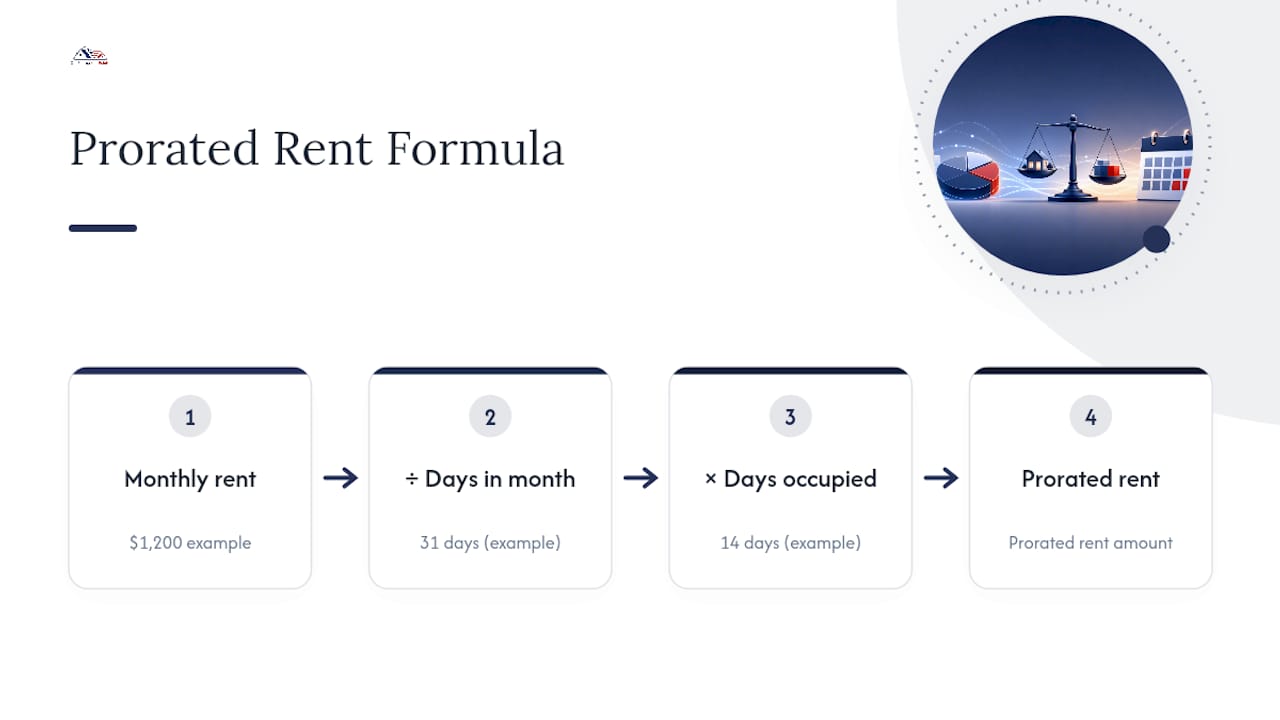
Prorated rent equals your monthly rent divided by the number of days in that month, multiplied by the number of days you actually occupy the unit. Say the rent is $1,200 and the tenant moves in on the 18th of a 31-day month. That's 14 days occupied: $1,200 ÷ 31 × 14 = prorated rent amount.
That's the daily-rate method, and it's the one most leases and courts default to. A less common alternative divides annual rent by 365 (or 366 in a leap year) instead of the days in that specific month. Whichever formula you use, name it in the lease so nobody has to guess later.
- Formula: Monthly rent ÷ days in month × days occupied
- Example: $1,200 ÷ 31 × 14 = prorated rent amount
- Alternative: Annualized method uses 365 or 366 as the divisor instead of the month's actual day count
Key Takeaways
Prorated rent is calculated by dividing monthly rent by the days in that month and multiplying by the days occupied, and consistency in method matters more than which one you pick.
| Point | Details |
|---|---|
| Use the daily-rate formula | Monthly rent ÷ days in month × days occupied gives the standard prorated total. |
| Pick one method and document it | Actual-days, 30-day, and annualized methods produce different totals, so name your choice in the lease. |
| Count days carefully | The move-in day counts as occupied; move-out counting should be spelled out to avoid disputes. |
| Round only the final total | Rounding the daily rate early compounds small errors into the final number. |
| Record the math on paper | Writing the formula and figures on the receipt resolves most tenant questions before they escalate. |
Table of Contents
- Using a Prorated Rent Calculation Tool
- How to Calculate Prorated Rent Using Actual Days in the Month
- Actual-Days vs. 30-Day vs. Annualized: Which Method to Use
- Worked Examples: Move-In and Move-Out Proration
- Recording Proration Policy in the Lease
- Handling Leap Years, Rent Changes, and Extra Fees
- Sources
- FAQ
Using a Prorated Rent Calculation Tool
Doing the math by hand takes thirty seconds, but a calculator removes the risk of a keystroke error on a number that ends up on a lease addendum. Tools like the Rentvine prorated rent calculator, the Zillow prorated rent calculator, and the TurboTenant prorated rent calculator all ask for the same basic inputs.
- Monthly rent amount
- The specific month (so the tool knows the day count)
- Move-in or move-out date
- Any upfront fees to add separately (deposits, pet fees, admin charges)
Enter the rent, pick the month or exact date range, choose your divisor method (actual-days, 30-day, or 365-day), then hit calculate. Before you copy the result anywhere official, check three things on the output: which divisor method it used, how it rounded the total, and the exact date range it billed. If the tool doesn't show its math, don't trust the number blindly. Run it twice with slightly different inputs to confirm it's consistent.
How to Calculate Prorated Rent Using Actual Days in the Month
This is the default method most landlords and property managers use, and it's the one to reach for when a lease doesn't specify otherwise.
- Confirm the monthly rent. Use the full contracted rent, not a discounted or promotional rate.
- Confirm the days in that specific calendar month. February has 28 (or 29 in a leap year), April has 30, and so on.
- Calculate the daily rate. Divide monthly rent by the days in that month.
- Count the billable days. For a move-in, the move-in day itself counts as day one. Move-out counting varies by policy, but charging through the actual move-out date is the common convention worth writing into the lease.
- Multiply the daily rate by days occupied. That gives you the raw prorated total.
- Round only the final total to the nearest cent. Rounding the daily rate first and then multiplying compounds small errors across the calculation.
Miscounting days, especially around move-out, is the single most frequent source of proration disputes. Spell out the counting convention in the lease and you cut that risk to almost zero.
Actual-Days vs. 30-Day vs. Annualized: Which Method to Use
Three proration methods show up across leases and property management software, and each converts monthly rent into a daily rate a little differently, according to Calculator Academy.
- Actual-days method: Monthly rent ÷ actual days in that month. Most precise, and the method some states default to when a lease says nothing.
- Banker's 30-day method: Monthly rent ÷ 30, regardless of the real month length. Simpler, but slightly overcharges in February and slightly undercharges in 31-day months.
- Annualized method: (Monthly rent × 12) ÷ 365, or ÷ 366 in a leap year. Common in commercial leasing because it smooths out month-to-month variance.
Run $1,200 rent for 14 days occupied through the actual-days method in a 31-day month and you get renter financial modelling for property investment prorated rent amount. Run the same 14 days through the 30-day method and you get $560.00, an $18 spread on one partial month. Pick one method, put it in the lease per DiscoveryMark's guide, and apply it every time.
Worked Examples: Move-In and Move-Out Proration
Move-in example. Rent is $1,500 for a 30-day April. Tenant moves in April 12, so they're billed from the 12th through the 30th, which is 19 days occupied.
- Daily rate: $1,500 ÷ 30 = $50.00
- Prorated total: $50.00 × 19 = $950.00
- Round the final figure only if the daily rate carries extra decimal places.
Move-out example. Same $1,500 rent, but now the tenant moves out August 9. August has 31 days, and the standard convention charges the 1st through the move-out date, which is 9 days.
- Daily rate: $1,500 ÷ 31 = $48.39 (rounded for display, not for the calculation itself)
- Prorated total: $48.39 × 9 = $435.48
Both totals should appear on the receipt or lease addendum alongside the date range charged, not just as a bare dollar figure.
Recording Proration Policy in the Lease
A prorated amount that shows up with no explanation invites a phone call. A prorated amount with the formula printed next to it rarely does. Sample clauses landlords can adapt:
- "Rent for a partial month will be prorated using the actual-days method: monthly rent divided by the number of days in that calendar month, multiplied by days occupied."
- "The move-in day counts as an occupied day; the move-out day is billed through the date keys are returned."
- "All prorated totals are rounded to the nearest cent after the final multiplication."
On the move-in or move-out record itself, note the method used, the actual numbers plugged into the formula, the date range covered, the final amount, and a tenant signature or initials acknowledging it. The HUD Fair Housing Act guidance and operational standards from NARPM both reinforce that clear, documented policies protect landlords and tenants alike. If the lease is silent on method, check your state's default rule before assuming actual-days applies everywhere.
Pro Tip: Keep the security deposit as a separate line item from the prorated rent total. Combining them on paperwork is a common cause of confusion during move-out disputes, as outlined in Georgia's security deposit rules.
Handling Leap Years, Rent Changes, and Extra Fees
- Leap years: If you use the annualized method, divide by 366 instead of 365, and say so in your policy per Calculator Academy's leap-year guidance.
- Mid-month rent increases: Prorate the old rate and new rate separately, then add the two totals together.
- Last-day move-ins: Charge exactly one day of rent using the daily rate for that month.
- Combined fees: List the security deposit and any move-in fees separately from the prorated rent figure, never bundled into one line.
Pro Tip: Round only the grand total to the nearest cent, and show that rounded math directly on the record so a tenant can verify it in ten seconds.
A property manager's note on documentation
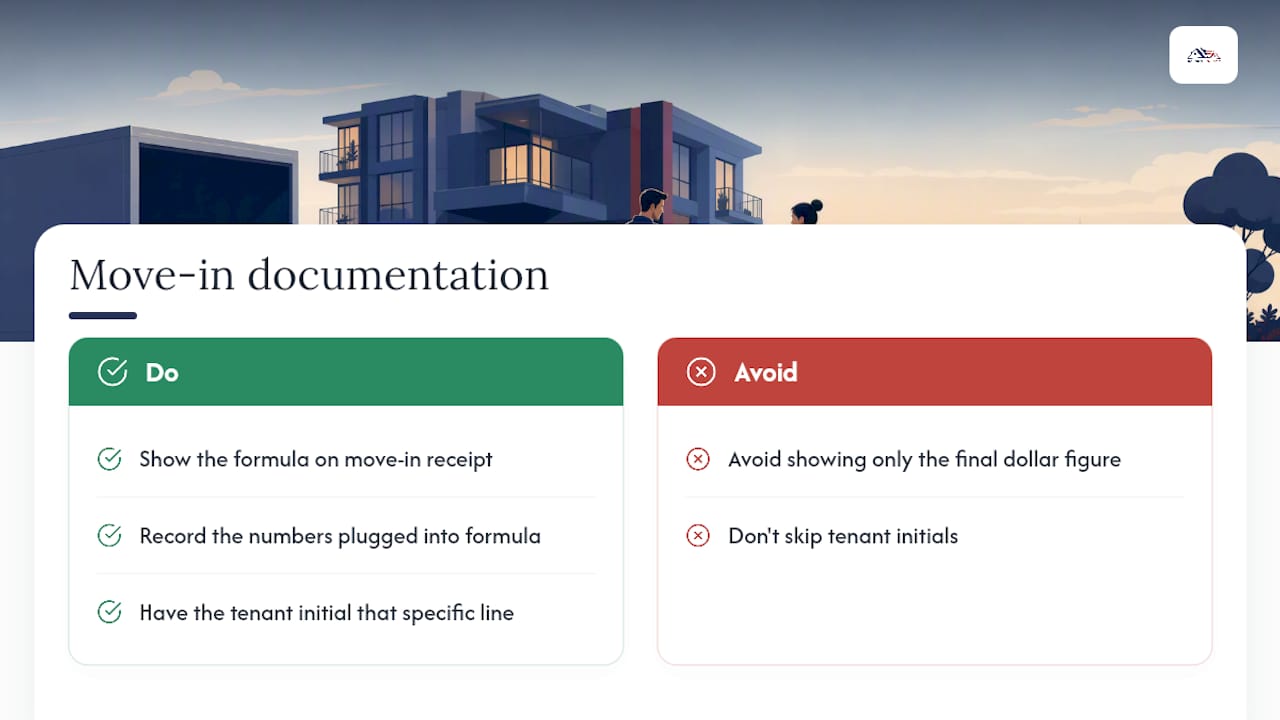
Showing the actual formula on the move-in receipt, not just the final dollar figure, is what stops most proration disputes before they start. A good habit: record the numbers plugged into the formula and have the tenant initial that specific line.
Sources
- Hud
- NARPM (National Association of Residential Property Managers)
- Prorated Rent Calculator - Calculator Academy
- How to Calculate Prorated Rent: The 3 Methods, Fully Worked (2026)
Landlords who'd rather hand off rent collection, proration math, and tenant billing entirely can see how OneSource Real Estate's property management services handle it for owners in the Atlanta area.
This article is general information, not a substitute for advice from a qualified financial advisor. Consult a qualified financial professional about your own circumstances before acting on anything here.
FAQ
How do you calculate prorated rent?
Divide the monthly rent by the number of days in that specific month, then multiply by the number of days the tenant actually occupies the unit. A $1,200 rent for 14 days in a 31-day month comes to prorated rent amount.
How do I calculate prorated rent when I move out?
Use the same daily-rate formula, but count days from the 1st of the month through the move-out date. Moving out on August 9 with $1,500 rent means 9 billable days at $48.39 per day, or $435.48.
What's the 30% rule for rent?
It has nothing to do with prorating a partial month's rent.
What does it mean if my rent is prorated?
It means you're only charged for the days you actually occupied the unit that month, rather than the full monthly amount, because you moved in or out partway through.