
TL;DR:
- You can purchase rental properties with little or no personal cash using methods like house hacking, seller financing, partnerships, tapping home equity, or bridge loans. Each approach shifts the cash burden elsewhere but still requires careful documentation, legal protections, and realistic cash flow analysis. Understanding these options helps investors leverage other people's capital while managing the risks associated with high leverage.
You can buy a rental property with little or no personal cash using one of five realistic routes: house hacking with an FHA or VA loan, seller financing or lease-option, partnerships using other people's money, tapping existing home equity, or a DSCR or hard-money bridge loan. Each route works, but none is a loophole. Every one of them shifts the cash burden somewhere else, and most still require you to cover closing costs, reserves, or negotiated fees unless you structure those into the deal.
Quick match by profile:
- First-time buyer with decent credit: House hack a duplex or triplex using an FHA loan (3.5% down) and let tenant rent cover most of the mortgage.
- Active-duty or veteran: VA loan on a multifamily up to four units, zero down, owner-occupied.
- Homeowner with equity: Pull a HELOC or cash-out refinance to fund the down payment on a separate investment property.
- Aspiring portfolio investor or LLC buyer: DSCR loan underwritten on the property's rental income, not your W-2, often paired with a private equity partner for reserves.
- Buyer targeting a motivated seller: Seller financing or a lease-option, where the seller sets the terms and the traditional bank stays out of it entirely.
One honest warning: creative financing amplifies both upside and downside. Higher leverage means a rent drop or vacancy period hits harder. Go in with conservative cash-flow projections and a written deal every time.
Table of Contents
- What are the realistic ways to buy a rental with no money?
- What do lenders actually require for these loan types?
- How do you actually close a no-money-down deal, step by step?
- What risks should you watch for in no-money-down deals?
- How does a no-money-down deal actually pencil out in 2026?
- Key Takeaways
- What experienced investors know that beginners often miss
- How OneSource Real Estate helps you close and manage your first rental
- Useful sources
- FAQ
What are the realistic ways to buy a rental with no money?
Every method below solves the same problem differently: replacing your personal cash with someone else's capital, a negotiated structure, or existing equity. Here is how each one actually works.

House hacking with FHA or VA financing
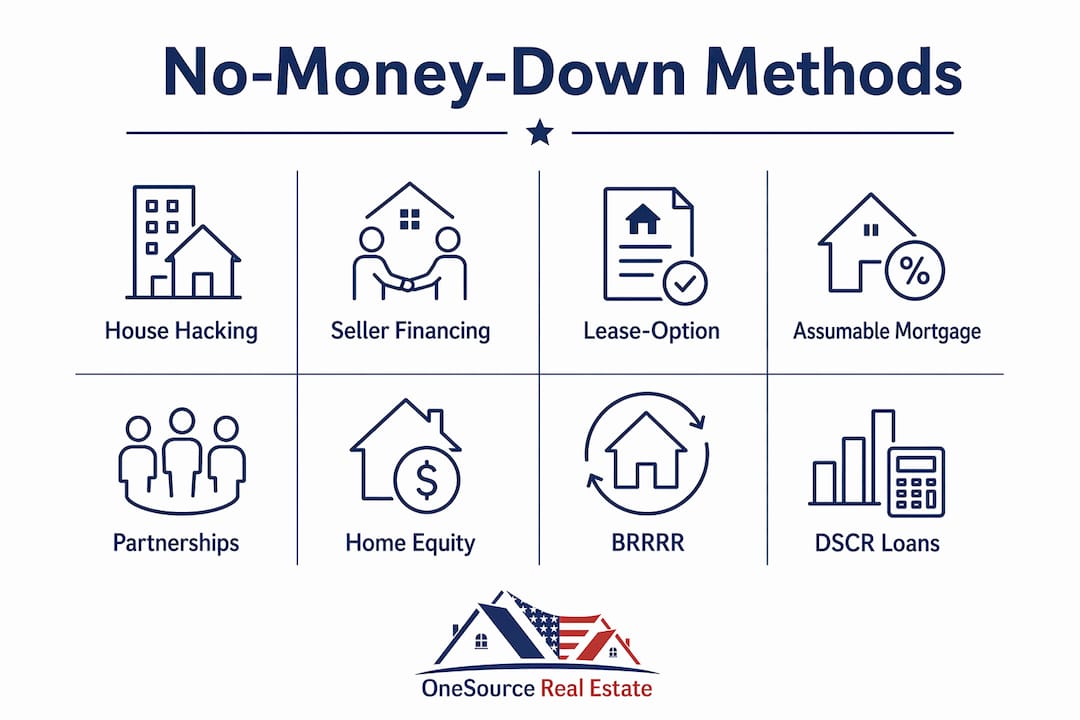
Buy a duplex, triplex, or fourplex, live in one unit, and rent the others. FHA loans allow this on properties up to four units with as little as 3.5% down, provided you occupy one unit as your primary residence. VA loans go further: eligible veterans and active-duty service members can buy the same multifamily property with zero down payment, no private mortgage insurance, and competitive rates.

Pros: Low entry cost, rental income offsets your mortgage from day one, and you build equity while living there. Cons: You share a building with tenants, and FHA/VA owner-occupancy rules require you to live there, typically for at least one year.
Seller financing
The seller acts as the bank. You negotiate a purchase price, interest rate, amortization schedule, and balloon payment directly with the owner, and you make monthly payments to them instead of a lender. Seller-finance terms are flexible enough to eliminate a traditional down payment entirely, though sellers often charge a higher interest rate to compensate for the risk.
Best for: Buyers with thin credit files or investors targeting free-and-clear properties where the seller has no mortgage to satisfy. Watch for: Balloon payments (often 5–7 years out) that require refinancing or a lump-sum payoff.
Lease-option (rent-to-own)
You pay a nonrefundable option fee, typically 1–3% of the purchase price, and lock in the right to buy the property at a set price within an agreed period. A portion of each monthly rent payment may credit toward the purchase price. This defers the full cash requirement until you exercise the option or refinance.
Best for: Buyers who need time to build credit or savings before qualifying for a mortgage. Limit: You cannot generate rental income from the property while you occupy it under the lease.
Assumable mortgage / subject-to
Some existing loans, particularly FHA and VA mortgages, are assumable with lender approval. You take over the seller's loan balance and terms. In a subject-to deal, you take title while the seller's loan stays in their name, which carries real legal risk if the lender invokes a due-on-sale clause.
Best for: Deals where the seller's existing rate is well below current market rates. Risk: Subject-to deals without lender consent can trigger immediate loan acceleration.
Partnerships and co-borrowers
A private equity partner provides the capital (down payment, reserves, or both) in exchange for an ownership share or profit split. You contribute deal-finding, management, or sweat equity. Structures vary: 50/50 equity splits, preferred returns for the capital partner, or a straight co-borrower arrangement on the mortgage.
Best for: Investors with strong deal-analysis skills but limited cash. Key requirement: A written operating agreement or partnership agreement before any money changes hands.
Tapping home equity (HELOC or cash-out refinance)
If you already own a home with equity, a home equity line of credit or cash-out refinance converts that equity into usable cash for a rental property down payment. The HELOC works like a revolving credit line; the cash-out refi replaces your existing mortgage with a larger one and gives you the difference in cash.
Best for: Homeowners with significant equity who want to invest without selling their primary residence. Risk: You are pledging your home as collateral for an investment property.
BRRRR with hard-money bridge financing
Buy, Renovate, Rent, Refinance, Repeat. You use a hard-money or bridge loan to acquire and renovate a distressed property quickly, then refinance into a long-term DSCR or conventional loan once the property is stabilized and appraised at a higher value. If the after-repair value supports a large enough refinance, you can pull out most or all of your initial capital.
Best for: Investors comfortable managing a renovation on a tight timeline. Risk: Cost overruns or appraisal shortfalls can leave you holding a high-rate bridge loan longer than planned.
DSCR and portfolio loans for LLCs
DSCR loans underwrite based on the property's rental income rather than your personal tax returns. Lenders calculate the Debt Service Coverage Ratio: rental income divided by PITIA (principal, interest, taxes, insurance, and association dues). A DSCR near or above 1.0 means the property's income covers its debt load. These loans are the standard path for investors buying their first rental property with LLC structures.
Best for: Self-employed investors, portfolio builders, and LLC buyers who cannot show strong W-2 income. Cost: Down payments typically land in the 20%–30% range, and rates are higher than for conventional mortgages.
| Method | Cash Required | Best For | Key Risk |
|---|---|---|---|
| House hacking (FHA) | 3.5% down + closing costs | First-time buyers | Owner-occupancy requirement |
| House hacking (VA) | 0% down | Veterans / active-duty | Occupancy rules apply |
| Seller financing | Negotiable (can be $0) | Thin-credit buyers, free-and-clear sellers | Balloon payment, higher rate |
| Lease-option | 1–3% option fee | Credit-building buyers | No rental income during option |
| Partnership / OPM | $0 personal cash possible | Deal-finders without capital | Requires written agreement |
| Home equity (HELOC) | $0 new cash (uses existing equity) | Equity-rich homeowners | Primary home as collateral |
| BRRRR / hard money | Varies by LTV | Rehabbers | Appraisal and cost overruns |
| DSCR / portfolio loan | 20%–30% down (partner can fund) | LLC investors, self-employed | Larger down payment and higher rate than conventional loans |
What do lenders actually require for these loan types?
Understanding the underwriting rules tells you which path you can qualify for today and what to fix before you apply.
FHA multifamily: You must occupy one unit as your primary residence. The minimum down payment is 3.5% for borrowers with a credit score of 580 or above. Scores between 500 and 579 require 10% down. FHA also requires mortgage insurance premiums for the life of the loan unless you refinance out. The rental income from the other units can be counted toward qualifying income, which helps your debt-to-income ratio.
VA multifamily: Eligible borrowers get zero down on properties up to four units, no PMI, and no minimum credit score set by the VA itself (lenders set their own overlays, typically 620+). You must certify intent to occupy. The VA's home loan benefit is one of the most powerful zero-down tools in U.S. real estate.
Conventional investment loans: Expect 15%–25% down for a single-family rental and up to 25% for a two-to-four-unit investment property. Credit score requirements typically start at 680–720 for the best rates. These loans do not allow the owner-occupancy workaround.
DSCR loans: No W-2 required. The lender runs the DSCR calculation using the property's market rent (verified by an appraisal or lease) divided by PITIA. Most lenders want a DSCR at or above 1.0, though some allow slightly below with compensating factors. Down payments typically land in the 20%–30% range. These loans are the go-to loans for LLC purchases.
Hard-money / private lenders: Underwriting focuses on the property's after-repair value, not your income. Loan-to-value ratios commonly range from 65%–75% of ARV. Rates are higher and terms are short (6–24 months). The exit strategy, refinancing into a DSCR or conventional loan, must be realistic before you sign.
Credit and documentation actions that speed approvals:
- Pull your credit reports from all three bureaus and dispute any errors before applying.
- Pay down revolving balances to below 30% utilization.
- Avoid opening new credit accounts in the 90 days before application.
- Document 2–6 months of cash reserves (lenders want to see you can cover payments if a unit goes vacant).
- For DSCR loans, get a rent schedule from an appraiser or a signed lease in hand before the lender orders the appraisal.
Pro Tip: Use a DSCR calculator to test whether a property's projected rent covers PITIA before you make an offer. A deal that pencils at 1.05 DSCR leaves almost no margin; aim for 1.15 or higher to absorb vacancies and repairs.
How do you actually close a no-money-down deal, step by step?
The sequence matters. Skipping steps costs time and deals.
- Pull your credit and get prequalified (Week 1). Know your score, your DTI, and which loan programs you qualify for before you look at a single property.
- Assemble your team (Week 1–2). You need a real estate agent experienced with investment properties, a real estate attorney (non-negotiable for seller-finance or lease-option deals), and a lender or private investor lined up.
- Identify motivated-seller channels (Week 2–4). Off-market leads, probate listings, expired MLS listings, and direct mail to free-and-clear owners are the most productive sources for seller-financing candidates. Motivated sellers are the ones who will negotiate terms.
- Run conservative numbers before making an offer. Use market rents, not optimistic projections. Factor in vacancy (5%–10%), maintenance (1% of property value annually), and property management fees if you plan to hire out.
- Make the offer and negotiate terms (Week 3–6). For seller finance, the negotiation covers purchase price, interest rate, amortization period, balloon term, and default remedies. Get everything in writing before the handshake.
- Inspection and due diligence (Week 4–7). Never skip the inspection, even on a seller-finance deal where the seller sets the terms. Deferred maintenance is your liability the moment you close.
- Draft and review contracts (Week 5–8). For seller finance or lease-options, your attorney drafts or reviews the promissory note, mortgage or deed of trust, and any lease agreement. For FHA/DSCR, the lender drives the timeline.
- Close (Week 8–16 for financed deals; Week 4–8 for seller finance). Sign, fund, record.
Costs that almost always remain, even in "no money down" deals:
| Cost Item | Typical Range |
|---|---|
| Closing costs (financed deal) | 2%–5% of purchase price |
| Closing costs (seller finance) | Lower, but attorney fees apply ($500–$2,000+) |
| Cash reserves (lender requirement) | 2–6 months of PITIA |
| Repair escrow / initial maintenance | Varies by property condition |
Two example timelines:
Seller-finance deal: Offer to close in 4–8 weeks. No bank underwriting, no appraisal required by a lender. Attorney drafts the note and mortgage. Closing happens at a title company with a recorded deed and promissory note.
FHA house hack: Offer to close in 45–60 days. Lender orders appraisal, FHA inspection standards apply (property must meet minimum condition requirements), and underwriting takes 2–4 weeks. Budget for the full closing cost range.
What risks should you watch for in no-money-down deals?
Higher leverage is not inherently dangerous, but it is unforgiving when things go wrong. These are the risks worth taking seriously.
Balloon payments are the most common trap in seller-financing deals. A five-year balloon on a 30-year amortization means you owe the remaining balance in year five. If you cannot refinance because rates are high or your credit has not improved, you lose the property.
Due-on-sale clauses exist in virtually every conventional mortgage. A subject-to deal, where you take title while the seller's loan stays in their name, gives the lender the legal right to demand full repayment the moment they discover the transfer. Many investors say lenders "usually don't call the loan." That is not a legal protection.
Predatory seller-finance terms include above-market interest rates with no cap, adjustable rates with no ceiling, and vague default remedies that give the seller the right to reclaim the property quickly. Read every line of the promissory note.
Title problems are invisible until they are not. A seller with unresolved liens, unpaid property taxes, or a clouded title can leave you holding a property you cannot sell or refinance. A title search and title insurance are not optional.
Red flags to walk away from:
- Seller refuses to use a title company or escrow agent.
- No written amortization schedule provided.
- Default remedies are vague or one-sided.
- The seller cannot produce a clear chain of title.
- The numbers only work with 100% occupancy and zero repairs.
Protections to require on every creative deal:
- A recorded promissory note and mortgage or deed of trust (not just a handshake or a purchase agreement).
- Title search and lender's or owner's title insurance policy.
- Escrow for property taxes and insurance, managed by a neutral third party.
- Attorney review of any lease-option, seller-finance, or subject-to contract. For Georgia investors, a residential lease drafted to state standards protects both parties from the start.
Pro Tip: If a seller-finance deal has a balloon payment, build your refinance plan into the contract negotiation. Know your target DSCR lender's requirements today, and structure the deal so the property's income will qualify at projected market rents by the balloon date.
How does a no-money-down deal actually pencil out in 2026?
Two worked examples, using current program rules.
Worked example A: FHA house hack on a duplex
- Purchase price: $320,000
- FHA down payment (low down payment percentage): $11,200
- Estimated closing costs: $8,000
- Total cash needed: ~$19,200 (or less if seller covers some closing costs)
- Unit 2 market rent: $1,400/month
- Estimated PITIA (FHA, 30-year, ~7% rate): $2,100/month
- Net monthly housing cost after rent: $700
The tenant in unit 2 is covering two-thirds of your mortgage. You are building equity and gaining landlord experience at a fraction of what a conventional investment loan would cost. If you negotiate a seller concession of 3% toward closing costs, your out-of-pocket drops to roughly $11,200.
Worked example B: DSCR loan for an LLC investor
- Purchase price: $250,000 (single-family rental)
- DSCR lender down payment (25%): $62,500 (funded by a private equity partner in exchange for 30% ownership)
- Market rent: $2,000/month
- Estimated PITIA: $1,750/month
- DSCR: $2,000 / $1,750 = 1.14
A DSCR of 1.14 clears most lenders' minimum threshold. The investor contributes deal-sourcing and property management; the partner contributes capital. Personal cash out of pocket: $0. The DSCR calculation is straightforward, but the deal only works if the rent estimate is real and the PITIA is accurate.
One important note on LLC timing: Buying in your personal name first and transferring title to an LLC afterward is the more common path for first-time investors using conforming mortgages. Transferring title after closing can trigger a due-on-sale clause, so consult your lender and an attorney before moving the deed. Buying through an LLC from the start makes the most sense when you are using cash or private financing that does not involve a conforming mortgage.
Key Takeaways
Buying a rental property with no personal cash is a financing design problem, not a loophole: the right route depends on your credit, equity, and risk tolerance, and every path still requires documented agreements and realistic cash-flow math.
| Point | Details |
|---|---|
| FHA house hacking is the lowest-cost entry | FHA requires as little as 3.5% down on a multifamily up to four units when you occupy one unit. |
| DSCR loans qualify on property income | Lenders target a DSCR near or above 1.0, making these loans ideal for LLC investors without W-2 income. |
| Seller financing needs written protection | Every seller-finance deal requires a recorded promissory note, title search, and attorney-reviewed amortization schedule. |
| Closing costs remain even with zero down | Budget 2%–5% of purchase price for closing costs, inspection, appraisal, and reserves on financed deals. |
| OneSource Real Estate supports the full cycle | From sourcing motivated sellers and structuring creative finance offers to managing tenants post-close, OneSource Real Estate covers the Atlanta market end to end. |
What experienced investors know that beginners often miss
The phrase "no money down" gets treated like a magic trick. It is not. Every deal I have seen structured well, whether a seller-finance arrangement or a DSCR-funded LLC purchase, worked because someone did the boring work first: pulled the title, ran conservative rent estimates, and put the agreement in writing before any money moved.
The part beginners underestimate is what happens after closing. A rental property with thin or zero equity at purchase has almost no cushion. One bad tenant, one HVAC replacement, and the cash flow that looked fine on a spreadsheet turns negative fast. The investors who survive that moment are the ones who set up professional rent collection and management systems before the first tenant moves in, not after the first problem surfaces.
Creative financing is not a shortcut. It is a different kind of work: more negotiation, more legal review, more relationship-building with private lenders and motivated sellers. The upside is real. So is the downside when the deal is underdocumented or the numbers were optimistic. The investors who build portfolios this way treat every deal as a structured transaction with clear terms, not a handshake on a good feeling.
How OneSource Real Estate helps you close and manage your first rental
Sourcing a no-money-down deal in the Atlanta area is one thing. Closing it cleanly and keeping it cash-flowing is another. OneSource Real Estate works with investors at both stages: buyer representation to find and negotiate off-market and seller-finance opportunities, and full-service property management to handle tenant screening, placement, rent collection, maintenance coordination, and lease renewals after the keys change hands.

For investors pursuing seller-finance or lease-option structures, having an experienced agent in your corner during term negotiation matters. OneSource Real Estate's team understands how to evaluate seller motivation, structure offers that protect the buyer, and connect investors with local private lenders when the deal calls for it. Once the property is leased, the full management suite removes the day-to-day burden so the investment actually performs the way the spreadsheet said it would.
Ready to find your first Atlanta-area rental deal? Book a property finance review with OneSource Real Estate and get a clear picture of which financing route fits your situation today.
Useful sources
- U.S. Department of Housing and Urban Development (HUD) — Primary source for FHA loan rules, down payment requirements, and multifamily owner-occupancy guidelines.
- U.S. Department of Veterans Affairs — Official VA home loan benefit details, including zero-down eligibility for multifamily properties.
- Consumer Financial Protection Bureau — HELOC explainer — Plain-language explanation of how HELOCs work as a financing tool.
- Rocket Mortgage — Seller financing primer — Practical overview of seller-finance mechanics, terms, and common structures.
- The Mortgage Reports — Creative financing strategies — Broad catalog of low-cash and no-cash entry strategies with lease-option details.
- Ridge Street Capital — DSCR and LLC investing — Explains DSCR underwriting mechanics and LLC purchase considerations.
- LegalClarity — LLC timing for rental investors — Detailed breakdown of when to form an LLC before vs. after purchase, including due-on-sale and insurance implications.
FAQ
Can you really buy a rental property with zero money down?
Yes, but "zero down" usually means zero personal cash, not zero cost. VA loans offer genuine zero-down financing for eligible veterans on multifamily properties up to four units, and seller-finance deals can be structured to eliminate a traditional down payment, though closing costs, attorney fees, and reserves typically still apply.
What credit score do you need for a no-money-down rental strategy?
It depends on the route. FHA loans require a minimum 580 score for the 3.5% down option. VA loans have no VA-set minimum, though most lenders require 620 or above. DSCR loans focus on property income rather than personal credit, but lenders typically have credit score overlays.
Is buying a rental property through an LLC a good idea for beginners?
For most first-time investors using a mortgage, buying in your personal name first and transferring to an LLC later is the more practical path. Conforming mortgages carry lower rates and smaller down payments than the DSCR or portfolio loans an LLC must use. Consult a real estate attorney before transferring title to avoid triggering a due-on-sale clause.
How does house hacking work as a no-money-down strategy?
You buy a duplex, triplex, or fourplex with an FHA loan (3.5% down) or VA loan (0% down), live in one unit, and rent the others. The rental income from the other units offsets your mortgage payment, sometimes covering most of it. After one year of owner-occupancy, you can move out and convert the whole property to a rental.
What is a DSCR loan and who should use it?
A DSCR loan qualifies you based on the rental property's income rather than your personal W-2 or tax returns. Lenders divide the property's monthly rent by its PITIA and look for a ratio near or above 1.0. It is the standard financing tool for self-employed investors and LLC buyers who cannot document traditional income but have a property with strong rental cash flow.