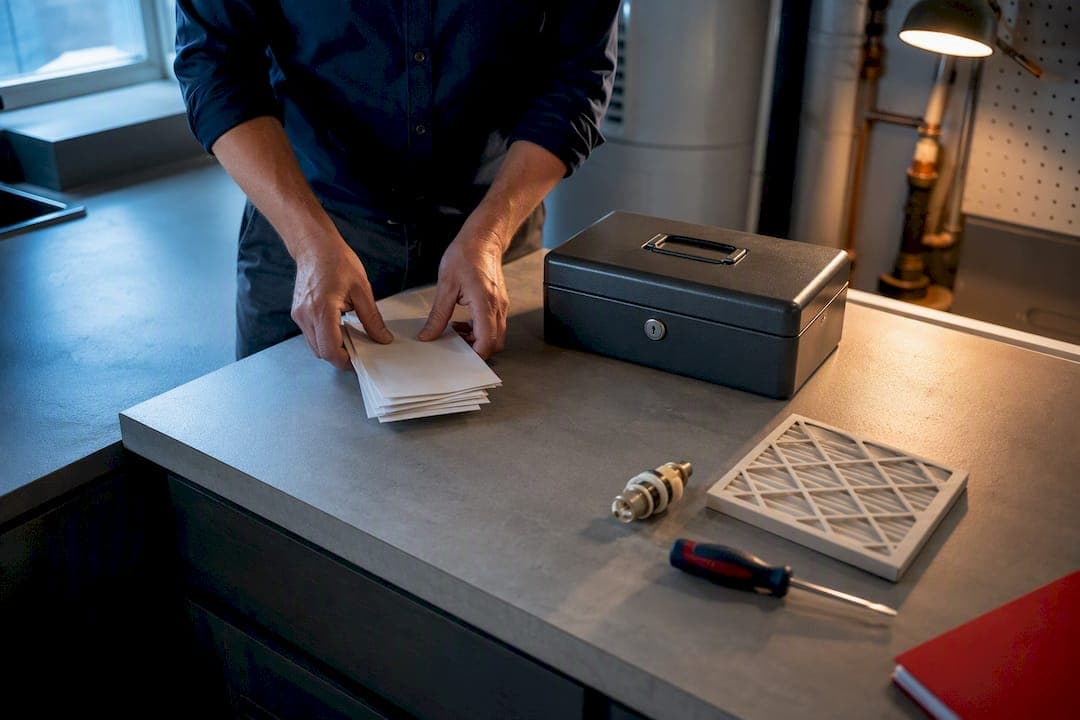
A maintenance reserve is a dedicated cash fund set aside for property repairs and replacements, kept separate from money used to cover monthly operating costs. Most owners should target somewhere between 10% and 15% of gross rent, or roughly 1% of the property's value per year, as a starting point. The right number depends on the property's age and condition, and tax treatment adds another layer worth understanding before you set the amount.
TL;DR:
- Proper reserve sizing depends on individual property age, condition, and whether capital needs assessments are conducted, rather than solely using fixed percentage rules.
- Enforcement of withdrawal governance and separate ledger accounts are more critical to reserve effectiveness than choosing an arbitrary reserve percentage.
- Documentation and tracking of reserve transactions as repairs or capital improvements are essential for accurate tax treatment and preventing over- or under-claiming deductions.
- A reserve fund typically should be about 10-15% of gross rent or roughly 1% of the property’s value annually, but higher for older or heavily used systems.
- A full-service property management company can help structure, monitor, and enforce reserve policies to protect asset value and cash flow.
Table of Contents
- What Is a Maintenance Reserve in Property Management?
- Why Do Owners and Investors Need a Reserve Fund?
- How Should Property Managers Set Up and Control Reserve Accounts?
- How Much Should You Set Aside for Maintenance?
- How Are Reserve Funds Treated for Tax Purposes?
- How Does OneSource Real Estate Apply Reserve Best Practices?
- The Gap Between Reserve Policy and Reserve Practice
- Let OneSource Real Estate Set Up Your Reserve the Right Way
- Sources
- FAQ
What Is a Maintenance Reserve in Property Management?
A maintenance reserve, sometimes called a reserve account or property reserve, is money held back specifically for repairs and capital replacements rather than day-to-day operating costs like utilities or management fees. Property managers typically define one as a fund shown on the owner's statement that covers both expected and unexpected upkeep.
The distinction between routine and capital expenses matters more than most owners realize. A clogged drain or a broken garbage disposal is a routine repair, paid from the reserve immediately and expensed at tax time. A new roof or an HVAC system replacement is a capital improvement, a much bigger draw that gets depreciated over years rather than deducted in one shot.
Mixing reserve money with operating funds is how owners lose track of both:
- Routine repairs (plumbing maintenance contracts, appliance fixes, pest control) drain the reserve slowly and predictably.
- Capital items (roofs, water heaters, parking lot resurfacing) drain it in large, infrequent chunks.
- Operating funds should never absorb either category, or you lose the ability to forecast next year's needs.
Why Do Owners and Investors Need a Reserve Fund?
Underfunded reserves force owners into a bad choice: delay a repair or pull cash from somewhere else, often at a worse rate than planned. Neither protects the property or the tenant relationship.
A well-funded reserve does three things well. It protects cash flow by absorbing surprise costs instead of forcing emergency borrowing. It preserves asset value by preventing deferred maintenance from compounding into bigger, costlier problems. And it builds trust between owner and manager, since a manager who tracks reserves accurately is one who reports numbers you can rely on.
Pro Tip: Ask your manager how many properties in their portfolio have hit a reserve shortfall in the past 12 months. The answer tells you more about their sizing method than any pitch deck will.
- Deferred maintenance rarely stays cheap. A small leak ignored for months becomes a mold remediation bill.
- Emergency withdrawals from operating cash disrupt distributions and erode owner confidence.
- Net operating income looks healthier on paper when reserve spending is planned instead of reactive.
How Should Property Managers Set Up and Control Reserve Accounts?
Reserve accounts fail quietly, usually through mixed ledgers or vague withdrawal rules. Three accounting controls separate a well-run reserve from a sloppy one, and every owner should ask for all three in writing.
- A separate reserve ledger per property. Commingled reserves across a multi-property portfolio make it nearly impossible to tell which asset is actually funded. A dedicated bank account for reserve funds and per-property ledgers give you an audit trail that survives a manager transition or an IRS inquiry.
- Reserve balance on every owner statement. If the balance isn't a line item you see monthly, you're flying blind between annual reviews.
- Written withdrawal governance. A clear definition of what counts as a capital expense, required documentation (invoice, vendor quote, photos), and a signature or approval threshold before funds move.
Withdrawal governance only works if it's paired with replenishment. When a big-ticket item drains the reserve, the manager should recalculate the monthly contribution and set a catch-up schedule rather than letting the balance sit depleted until the next annual review.
Pro Tip: *Request that your contract specify a replenishment timeline, not just a target balance.
How Much Should You Set Aside for Maintenance?
Three common rules of thumb get owners in the right neighborhood, and each fits a different situation.
- 1% of property value per year. Simple, widely used, and a reasonable default for a property in average condition.
- $1 per square foot annually. Useful for comparing properties of different values but similar size and construction.
- 5% to 10% of gross rent. Popular because it scales with cash flow, though it can undershoot on lower-rent properties that still carry full-sized mechanical systems.
None of these rules accounts for actual asset condition, which is why a capital needs assessment is the more defensible method when the stakes are higher, like a property over 20 years old or one you plan to hold for a decade.
Here's how to run one:
- Inventory every major component: roof, HVAC, water heater, appliances, flooring, exterior paint.
- Estimate each item's remaining useful life and replacement cost.
- Divide replacement cost by remaining years to get an annual contribution per item.
- Sum all items for a total annual capital reserve target.
- Add a separate operating reserve for routine repairs, sized using the percent-of-rent method.
A manager producing a 10-year capital plan with monthly contribution schedules is doing this work for you already. If yours isn't, ask for it. Owners in older properties, or anywhere winters are hard on roofs and pipes, should push toward the higher end of every range above and keep capital and operating reserves in genuinely separate buckets rather than one blended number.
How Are Reserve Funds Treated for Tax Purposes?
Reserve money itself isn't deductible. What matters to the IRS is what the money is spent on, and when.
Under cash-basis tax rules, repairs are deductible in the year you pay for them. A capital improvement, like a new roof or a full HVAC replacement, has to be depreciated instead, typically over 27.5 years for residential rental property. That's a meaningful difference in cash flow timing, and it means the classification decision your manager makes at the moment of withdrawal has tax consequences that follow you for years.
Good recordkeeping is what protects the deduction later:
- Label every reserve transaction as repair or capital improvement at the time it's recorded, not months later from memory.
- Keep every invoice and vendor quote, not just the paid receipt.
- Record the install date and expected useful life for anything capitalized, since your accountant needs both to calculate depreciation correctly.
A reserve fund sitting in a bank account earns you nothing on a tax return. It's the documented withdrawal that does the work, and sloppy classification at that stage is the single most common reason owners overpay or underpay come filing season.
How Does OneSource Real Estate Apply Reserve Best Practices?
Owners evaluating a property manager should treat reserve policy as a screening question, not a footnote. A property manager should structure reserve handling around established controls: per-property ledgers, a designated account separate from operating funds, and reserve activity reported on monthly owner statements rather than buried until year end.
Before signing with any manager, ask these questions directly:
- Is the reserve held in a per-property ledger or a pooled account?
- What dollar threshold triggers a required owner approval before withdrawal?
- How is the contribution amount recalculated after a large withdrawal, and on what timeline?
- Will the reserve balance appear on my monthly statement, or only on request?
Pro Tip: Get the withdrawal approval threshold and replenishment timeline written into the management contract itself, not just described verbally during onboarding. Verbal policies change when staff turn over; contract clauses don't.
The Gap Between Reserve Policy and Reserve Practice
Most advice on this topic treats reserve sizing like a math problem: pick a percentage, multiply, done. That's backwards. The number matters far less than whether anyone enforces the withdrawal rules around it.
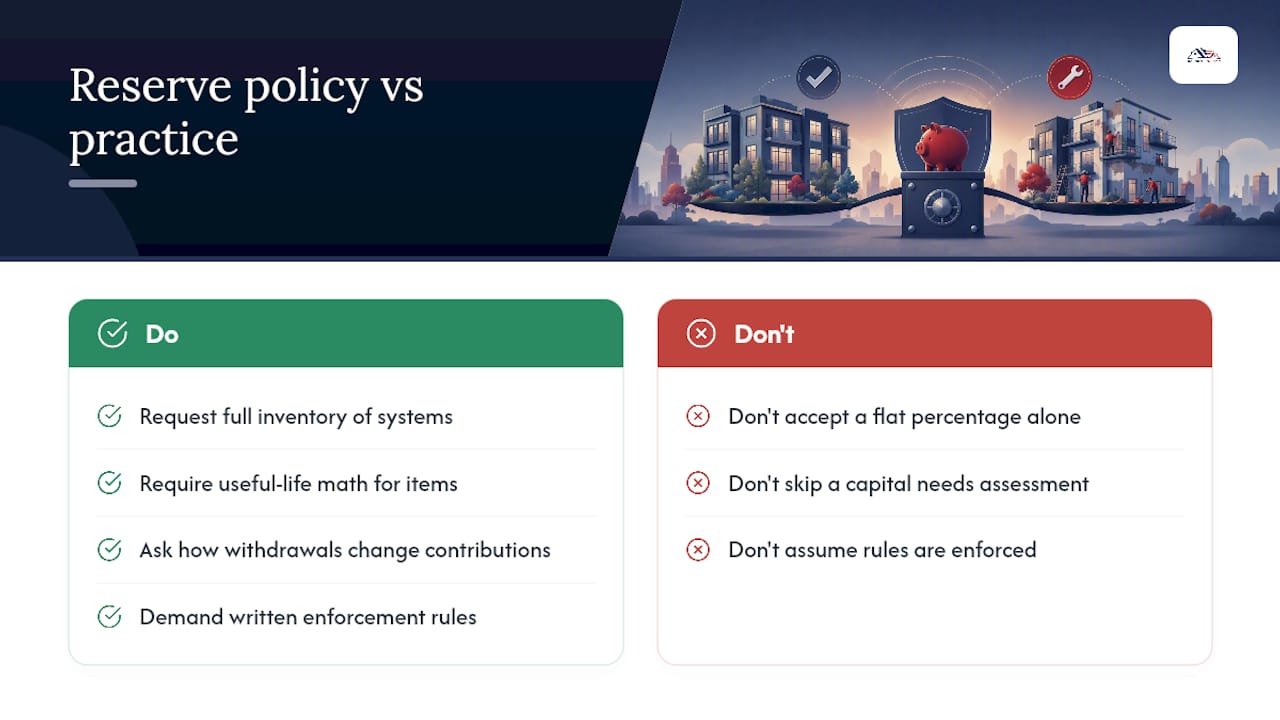
I've seen the flat-percentage approach fail in a specific, predictable way. The reserve covers half the replacement cost, operating cash covers the rest, and the owner never finds out the sizing method never accounted for the system's actual age in the first place. A capital needs assessment would have caught that years earlier.
If you take one thing from this article, make it this: don't just ask your manager for a reserve percentage. Ask for the underlying inventory and useful-life math behind it, and ask how contributions get recalculated after a withdrawal. Sizing methodology and enforcement discipline matter more than which flat rule someone picked off a spreadsheet template. The percentage is the easy part. The governance around it is where owners actually get protected or exposed.
— Matt
Let OneSource Real Estate Set Up Your Reserve the Right Way
Building a defensible reserve schedule and enforcing withdrawal discipline takes ongoing attention most owners don't have time for between a full-time job and everything else on the property. A full-service property management company can handle reserve assessment, monthly owner reporting, and contract-level withdrawal governance as part of its management services.
Onboarding starts with a capital needs walkthrough of your property, component by component, followed by a monthly contribution schedule you can review before it's ever put into your management contract. From there, every reserve withdrawal shows up on your statement with the documentation attached, not just a lower balance and a guess. If you're ready to see what a properly sized reserve looks like for your property, get a property management quote from OneSource Real Estate and bring your current reserve policy, if you have one, to compare against.
This article is general information, not a substitute for advice from a qualified financial advisor. Consult a qualified financial professional about your own circumstances before acting on anything here.
Sources
- Repairs vs Capital Improvements: Rental Property Tax
- Rental property maintenance budget calculator | Shuk
- Property management reserve funds: How to track and manage maintenance reserves
- Maintenance Budget Planning for Property Managers in 2026
FAQ
What Is a Maintenance Reserve?
A maintenance reserve is a dedicated cash fund, separate from operating money, set aside to cover both routine repairs and larger capital replacements on a rental property.
What Is the 1% Rule for Property Maintenance?
The 1% rule suggests setting aside about 1% of the property's total value each year for maintenance and repairs, though older properties or those with deferred maintenance often need more.
Why Would a Property Manager Have a Reserve Account?
A reserve account lets a property manager cover unexpected repairs immediately without pulling from an owner's operating cash or waiting for approval on every small expense, while keeping full documentation and reporting for every withdrawal.
What Is the Highest Paying Job in Property Management?
Senior roles like regional property manager, asset manager, or portfolio director tend to pay the most in property management, since compensation generally scales with the size and value of the portfolio managed rather than the day-to-day title.
Are Reserve Contributions Tax Deductible?
No. Money held in a reserve isn't deductible on its own; only the actual repair expense is deductible when paid, while capital improvements funded from the reserve must be depreciated over their useful life instead.