
For most Marietta rental owners, a local full-service property manager charges between 8% and 12% of collected rent, plus a one-time tenant placement fee. OneSource Real Estate falls squarely in that range and structures its billing so owners pay only when a property is occupied, a model built to keep the manager's incentives lined up with yours. Beyond that core group, you'll run into independent single-operator managers who often undercut on price but skip the reporting infrastructure, flat-fee platforms that charge a flat $75 to $150 a month regardless of rent collected, and short-term rental specialists who price by a percentage of nightly revenue instead of monthly rent.
Georgia's statewide average for full-service, percent-based management commonly runs 8% to 12%, which gives Marietta owners a solid benchmark before requesting quotes.
- Typical monthly fee: 8% to 12% of collected rent for full-service management
- Tenant placement fee: often a flat charge or a percentage of first month's rent, billed separately
- Trust signal to look for: pricing that only activates when rent is collected, not a flat charge regardless of occupancy
Key Takeaways
| Point | Details |
|---|---|
| Expect an 8%-12% band | Full-service management in Georgia typically falls in this range, per statewide industry benchmarks. |
| Placement fees are separate | Budget for a flat fee or percentage of first month's rent on top of the monthly management charge. |
| Billing timing matters most | Favor managers who only charge when rent is collected over flat charges during vacancy. |
| Get contract terms in writing | Confirm termination notice, renewal fees, and vacancy policy before signing anything. |
| OneSource Real Estate fits full-service seekers | It's positioned as a local, transparent-pricing option for owners wanting one point of contact for the entire rental process. |
Where to Verify Rates and Find Local Documentation
- Check statewide fee benchmarks against Georgia averages before comparing local quotes.
- Review sample owner guides for contract language examples.
- Match any "no fee when vacant" claim word-for-word against the actual management agreement.
Table of Contents
- Comparing Property Management Fee Structures in Marietta
- What Do Marietta Property Managers Actually Charge?
- Percent, Flat, or Hybrid: How Fee Models Actually Work
- How to Choose the Right Property Manager in Marietta
- What Marietta-Area Firms Actually Publish for Pricing
- How Long Are Property Management Contracts in Marietta?
- Single-Family vs. Multi-Family: How Fees Differ in Marietta
- Local Rules That Shape Marietta Property Management Costs
- Why Transparent Pricing Beats the Lowest Percentage
- Get a Custom Property Management Quote in Marietta
- Sources
- FAQ
Comparing Property Management Fee Structures in Marietta
Not every manager in Marietta prices the same way, and the differences matter more than the headline percentage. A local full-service broker, an independent single-manager operation, a flat-fee platform, and a short-term rental specialist can all quote you a number that sounds similar on paper while delivering very different scopes of work.
| Category | Fee Model | Tenant Placement Fee | Services Included | Common Guarantees | Typical Contract Length |
|---|---|---|---|---|---|
| Local full-service broker | 8%-12% of rent, billed when occupied | Flat fee or % of first month's rent | Screening, rent collection, maintenance coordination, eviction support, financial reporting | Lease-in-X-days offers, no fee while vacant | 12 months, auto-renewing |
| Independent single-manager | Flat monthly fee or lower % | Often a flat fee | Rent collection, basic maintenance coordination | Rarely written; verbal only | Month-to-month or 12 months |
| Flat-fee platform | Fixed monthly dollar amount | Flat fee, sometimes bundled | Rent collection, tenant screening, limited maintenance | Rarely offered | Month-to-month common |
| Short-term rental specialist | % of nightly or gross booking revenue | Not applicable | Guest turnover, dynamic pricing, cleaning coordination | Occupancy-based, not lease-based | Varies, often shorter |
Owners who want one point of contact, a written service scope, and billing that only kicks in when rent actually comes through tend to land with a local full-service broker. That's the category OneSource Real Estate operates in, and it's why the firm positions transparent pricing as a starting point for conversations with owners, not an afterthought buried in a contract.
Pro Tip: Ask any manager to show you their fee structure in writing before your first call ends. If they hesitate or talk in ranges without specifics, that's a red flag worth noting.
Single-family homes in stable neighborhoods generally fit the full-service or independent-manager categories well. Multi-family or higher-turnover properties tend to benefit more from firms with dedicated maintenance vendor networks, since coordination costs scale faster than rent does.
What Do Marietta Property Managers Actually Charge?
It does not automatically include tenant placement, lease renewals, or eviction filing fees, which typically show up as separate line items.
Tenant placement fees vary the most across providers. Some quote a flat dollar amount, others charge a percentage of the first month's rent, and a few bundle it into the annual fee for repeat clients. Owners should expect this charge even when the monthly management fee itself is modest, since placement work (marketing, showings, screening) is priced separately from ongoing management in most contracts.
Common one-time or recurring extras include:
- Setup fee: charged once when a property enters management, sometimes waived for multi-property owners
- Lease renewal fee: typically a smaller flat charge, applied when an existing tenant renews
- Maintenance markup: a percentage added to vendor invoices, ranging widely by company
- Eviction fees or holdbacks: funds held back or billed separately if legal action becomes necessary
The billing timing detail matters as much as the percentage. Charging only when rent is actually collected protects owners during vacancy periods, while some flat-fee models charge the same amount whether or not the unit is rented.
Percent, Flat, or Hybrid: How Fee Models Actually Work
Percentage-based fees scale with rent, which means a manager earns more from a $2,400 rental than a $1,600 one for comparable work. That alignment cuts both ways: it rewards managers for keeping rents competitive, but it can also mean less attention on lower-rent units if a company is stretched thin. Flat monthly fees remove that scaling effect entirely, which single-family owners with predictable rent often prefer for budgeting. Hybrid models split the difference, using a lower percentage plus a small flat administrative charge.
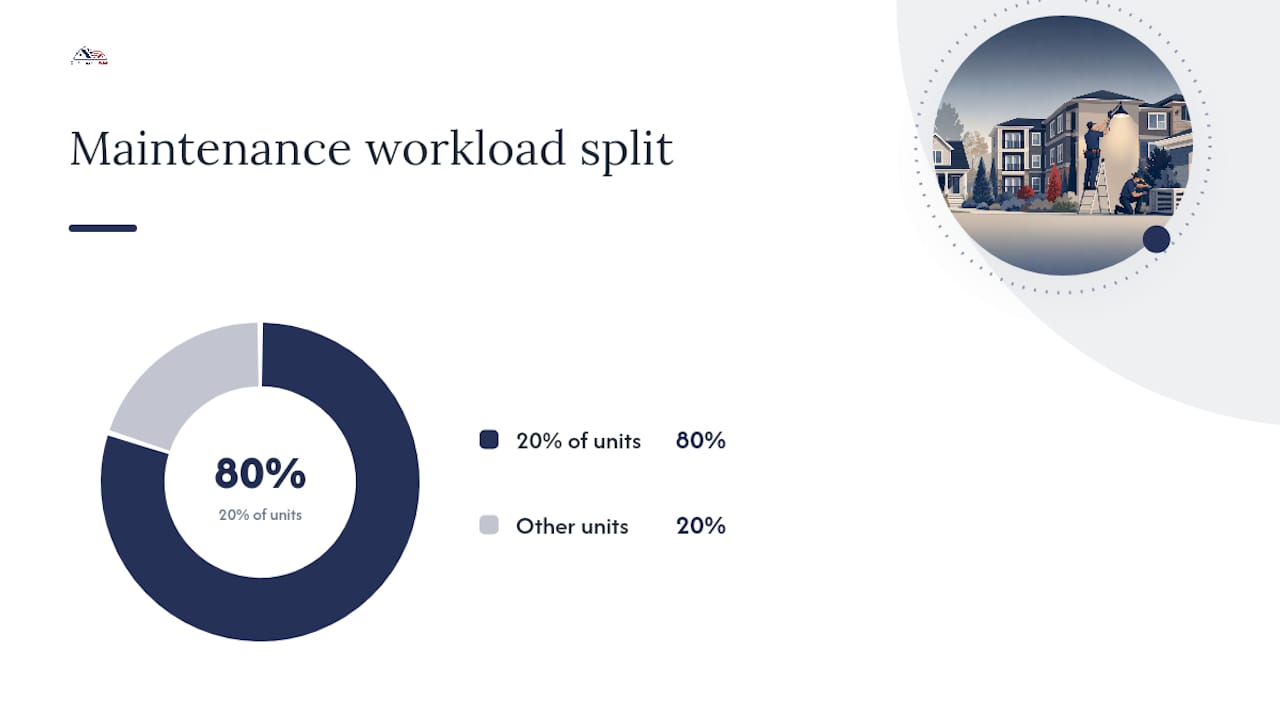
The "80/20 rule" you'll hear referenced in property management isn't a regulation. It's shorthand some managers use to describe how roughly 80% of maintenance requests and tenant issues come from about 20% of units or tenants, meaning fee structures should account for uneven workload rather than assuming every property costs the same to manage. Watch for it in how a contract handles maintenance markups and inspection frequency, since a manager who prices flat regardless of that imbalance may cut corners on the higher-maintenance properties.
- Percent fees: better alignment on rent growth, less predictable monthly cost
- Flat fees: predictable budgeting, weaker incentive to maximize rent
- Hybrid: moderate on both, but requires reading the fine print on what's included
Pro Tip: Ask directly how a manager handles the 80/20 imbalance. Their answer tells you more about their operations than their fee sheet does.
How to Choose the Right Property Manager in Marietta
Picking a manager comes down to matching services to what your property actually needs, then verifying that promises on a website match what's written in the contract. Here's a checklist that works whether you own one rental or five:
- Confirm the manager holds an active Georgia real estate license, since property management activities generally require one
- Ask what insurance coverage they carry and whether it protects you against contractor errors on-site
- Get their vacancy billing policy in writing: do they charge management fees when a unit sits empty?
- Ask about maintenance vendor markups and whether you can use your own contractors
- Confirm how often you'll receive financial reports and through what platform
- Ask what tenant screening criteria they use, including credit, income, and background check standards
During your calls, ask pointed questions: "What happens to my fee if the unit is vacant for 60 days?" and "Can I see a sample management agreement before I sign anything?" Requesting a written sample agreement upfront is standard practice, and any manager unwilling to share one is worth reconsidering.
Red flags to watch for:
- Vague fee language that avoids specific percentages or dollar amounts
- No written leasing guarantee or timeline commitment
- Fees charged during vacancy without explanation
Before signing, verify termination terms and notice periods, how security deposits are held, who is authorized to sign legal notices on your behalf, and what the renewal fee looks like at lease end. OneSource Real Estate's owner's guide content walks through these exact contract points for nearby Georgia markets.
What Marietta-Area Firms Actually Publish for Pricing
Local company pages and listings in the Marietta area frequently lead with phrases like "no management fee while vacant" or an "8% when occupied" starting point, sometimes paired with flat monthly offers around $100 for additional properties under the same owner. That kind of language signals a firm competing on transparency rather than burying costs in fine print.
Tenant placement fees published locally range from a flat charge up to a full month's rent, depending on the provider and property type. A few firms bundle placement into an annual retainer for owners with multiple units, which can lower the effective cost per property.
- Look for phrases like "no fee when vacant" and confirm they appear in the actual contract, not just marketing copy
- Compare placement fees as a separate line item, since bundling them into a monthly rate can obscure the real cost
- Ask every prospective manager for a written quote covering the same 12-month scenario so numbers are comparable
Requesting a custom quote from two or three providers using identical assumptions (rent amount, property type, expected turnover) is the only reliable way to compare across firms.
How Long Are Property Management Contracts in Marietta?
Most full-service managers in the Marietta area write initial contracts for 12 months, matching the standard residential lease term. Some auto-renew annually unless either party gives written notice, typically 30 to 60 days before the term ends. Independent managers and flat-fee platforms sometimes offer month-to-month arrangements, which sound flexible but often come with a slightly higher monthly rate to offset the lack of commitment.
Minimum commitment periods matter more than they seem to at first glance. A manager locked into placing a tenant and managing a property for a full year has more incentive to screen carefully and maintain the unit well, since a bad tenant or a costly repair becomes their problem for the duration. Shorter contracts shift more of that risk back onto the owner.
Termination clauses deserve close reading regardless of contract length. Look for early termination fees, required notice periods, and whether the manager retains any placement fee if you end the relationship shortly after a tenant moves in. A sample management agreement from a reputable local firm gives you language to compare against any contract you're handed. If a manager resists putting termination terms in writing or hedges when you ask about notice periods, treat that as a signal to keep shopping.
Single-Family vs. Multi-Family: How Fees Differ in Marietta
Multi-family properties, whether that's a duplex or a small apartment building, often carry either a slightly lower per-unit percentage or a hybrid structure, since economies of scale reduce the marginal cost of managing each additional unit.
Services included tend to shift with property type as well. Single-family management usually centers on tenant relations, one lease renewal cycle per year, and periodic inspections. Multi-family management adds common-area maintenance coordination, more frequent turnover cycles, and often a dedicated maintenance reserve or markup structure to handle the higher volume of service calls.
Tenant placement fees can differ too. A single-family placement fee is usually calculated per unit, while multi-family owners sometimes negotiate a blended rate across several units to lower the average cost. Owners with a mixed portfolio, say a single-family rental plus a duplex, should ask managers directly whether they'll quote a blended fee across the portfolio or price each property independently. That distinction alone can shift your effective annual cost by a meaningful margin, so it's worth clarifying before signing anything.
Local Rules That Shape Marietta Property Management Costs
Georgia requires anyone managing rental properties for compensation on behalf of another owner to hold an active real estate license, issued through the Georgia Real Estate Commission. That licensing requirement is part of why full-service brokers structure fees the way they do: licensed brokers carry compliance obligations, errors-and-omissions insurance, and trust account requirements that unlicensed operators don't.
Cobb County, where Marietta sits, doesn't impose a separate local licensing fee specific to property managers beyond standard business licensing, but landlords should confirm any property-specific requirements like rental registration or code compliance inspections that could affect a manager's scope of work and, indirectly, their pricing. Fair housing compliance is another factor baked into management fees, since a manager handling tenant screening and marketing needs to follow federal and Georgia fair housing rules carefully, and firms with dedicated compliance training often reflect that in their fee structure.
None of this means owners should expect wildly different pricing purely because of local regulation.
Why Transparent Pricing Beats the Lowest Percentage
The conventional advice tells owners to shop for the lowest percentage fee, but that's the wrong first filter. The number that matters isn't the headline percentage. It's what triggers the charge and what's bundled underneath it.
Owners also underestimate how much the 80/20 pattern in maintenance and tenant issues should shape their choice of manager. A property that's likely to generate frequent service calls needs a manager with real maintenance infrastructure, not just a low quoted rate. Prioritize written guarantees, occupancy-based billing, and a clear maintenance markup policy before you compare percentages side by side. Get those three things confirmed in writing, and the rest of the negotiation gets a lot simpler.
Get a Custom Property Management Quote in Marietta
Comparing percentages and flat fees only gets you so far when contracts hide the details that actually determine your annual cost. OneSource Real Estate handles the full loop for Marietta owners, tenant screening and placement, rent collection, maintenance coordination, financial reporting, and eviction support, under one contract with pricing that only activates when your property is occupied.

That structure matters most for owners who've been burned by vague fee language or vacancy charges buried in fine print elsewhere. Instead of piecing together separate vendors for leasing, maintenance, and accounting, you get one team accountable for the whole rental cycle. If you're weighing a quote from another provider, request a custom property management quote from OneSource Real Estate and compare it line by line against what you've been offered.
Sources
FAQ
What Is the Average Property Management Fee in Georgia?
Full-service property management in Georgia typically costs 8% to 12% of collected rent, plus a separate one-time tenant placement fee.
What Does the "80/20 Rule" Mean in Property Management?
What Percentage Do Most Property Management Companies Charge?
What Is the Most Common Payment Structure for a Property Manager?
A monthly fee based on collected rent, billed only when the unit is occupied, is the most common structure among full-service managers, supplemented by a separate tenant placement fee.
Does OneSource Real Estate Charge Fees During Vacancy?
OneSource Real Estate structures its property management pricing around occupancy, so owners avoid paying full management fees for units sitting vacant.