
Before you sign anything, confirm eight things: scope of services, fee structure and timing, spending limits, termination rights, notice periods, reporting cadence, insurance requirements, and who keeps the records after the contract ends. Insist on written spending caps, monthly financial reports, and a clean termination-for-cause clause before you initial a single page. OneSource Real Estate reviews these exact terms with owners across Atlanta and its surrounding suburbs every week, and the contracts that cause the most regret almost always share the same three gaps: vague spending authority, no real exit ramp, and reporting promises with no enforcement teeth.
TL;DR:
- Ensure the agreement specifies clear, detailed duties such as inspections and maintenance response times, avoiding vague language like "full management services."
- Confirm management fees are based on actual rent collected, with all additional charges explicitly listed, and avoid contracts with vague or undefined fee structures.
- Verify the contract includes a defined spending limit for routine repairs, a specific emergency authorization threshold, and distinct termination for cause versus without cause clauses to facilitate easy exit.
- Require monthly financial statements that reconcile against bank accounts, along with access to records after contract termination, and ensure the owner’s insurance and reserve responsibilities are clearly allocated.
- Be cautious of contracts lacking detailed record retention, vague reporting promises, auto-renewal terms with short notice periods, and indemnity clauses without proper liability carve-outs, which may favor the manager excessively.
Table of Contents
- Property Management Agreement Terms: A Quick Checklist Before You Sign
- What Each Clause in a Property Management Agreement Actually Means
- Owner Responsibilities vs. Manager Authority: Who Pays for What
- How Long the Contract Runs and How to Exit It
- Insurance, Liability, and Who Pays When Something Goes Wrong
- Financial Reporting, Rent Collection, and Record Access
- Customizing a Sample Property Management Agreement for Your Property
- Negotiation Priorities and Seven Red Flags to Watch For
- Copy-Ready Clauses to Add to Your Property Management Agreement
- OneSource Real Estate's Approach to Fair Management Terms
- How OneSource Real Estate Makes This Easier
- Sources
- FAQ
Property Management Agreement Terms: A Quick Checklist Before You Sign
Run any draft agreement against this list before you read the fine print line by line. It won't replace a full read, but it will tell you in five minutes whether the document deserves one.
Scope of services
- Does it name specific duties (leasing, rent collection, maintenance dispatch, inspections) instead of vague phrases like "full management services"?
- Is there a clear list of what's excluded, such as capital improvements or legal representation in eviction court?
Fees and compensation
- Is the management fee a flat dollar amount or a percentage of collected rent, not gross scheduled rent?
- Are leasing fees, renewal fees, and any add-on charges (inspection fees, maintenance markup) spelled out with numbers, not "as agreed"?
Term, renewal, and termination
- Is the initial term stated in months, with a defined auto-renewal window and required notice period?
- Is there a termination-for-cause clause with no fee, separate from termination-without-cause language?
Owner obligations and reserves
- Does the contract require you to fund a minimum reserve or escrow account for repairs?
- Are you responsible for property insurance, or does the manager carry it and bill you back?
Maintenance and spending authority
- Is there a dollar figure for the manager's spending limit without prior approval?
- Is emergency repair authority defined by category (burst pipes, no heat, safety hazards), not left open-ended?
Reporting and records
- Are financial statements promised monthly, and do they reconcile against a specific bank account?
- Do you retain audit rights and access to records after the contract ends?
Insurance and exclusivity
- Are minimum insurance limits named, and is the exclusivity period bounded rather than indefinite?
Pro Tip: Print the checklist and mark every unchecked box as a negotiation item, not a dealbreaker. Most managers will amend two or three of these on request. It's the ones who won't touch any of them that tell you something.
What Each Clause in a Property Management Agreement Actually Means
A property management service agreement is a stack of individually negotiable clauses, not one take it or leave it document. Understanding what each clause does, and where the standard language quietly favors the manager, is what separates an owner who negotiates from one who just signs.
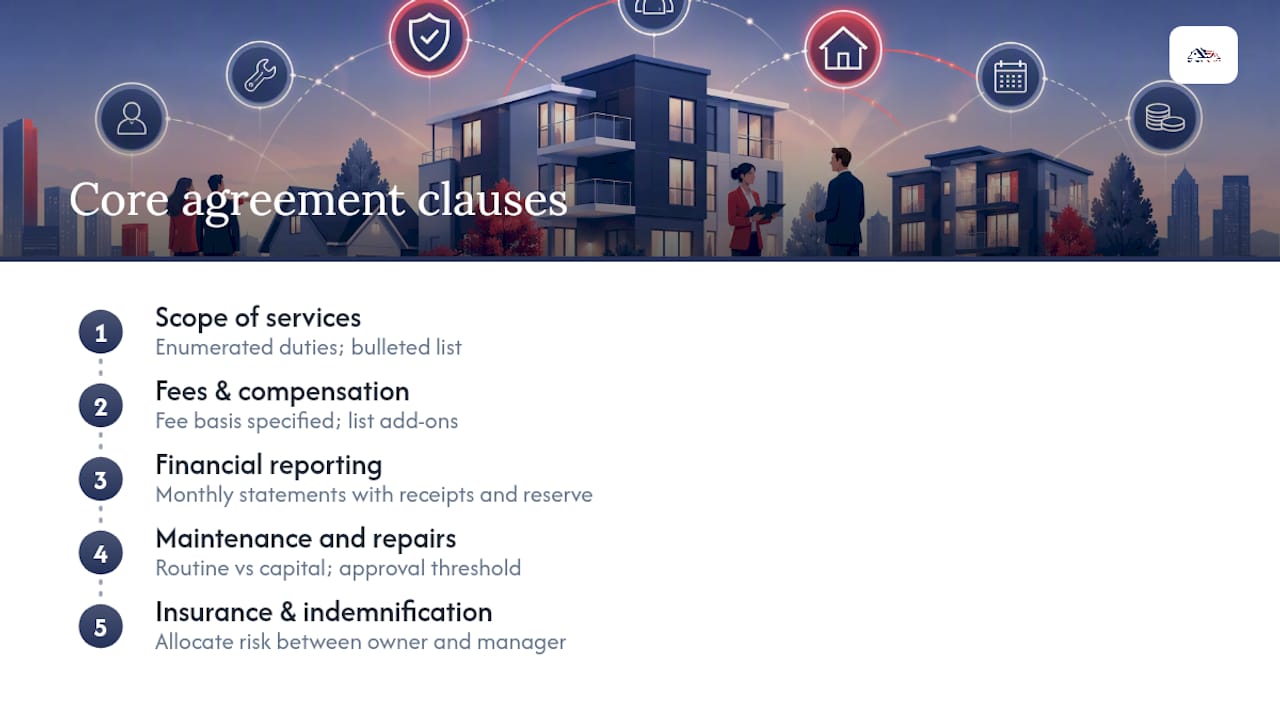
Scope of services. This clause defines what the manager will actually do, and just as important, what falls outside the contract. Public template language, like the sample Form of Property Management Agreement filed with the SEC, lists duties such as leasing, rent collection, maintenance coordination, and vendor management in specific enumerated paragraphs rather than one catch-all sentence. That structure matters. A contract that says the manager will provide "property management services" gives you nothing to hold them to if they skip inspections or ignore a maintenance request for three weeks. Push for a bulleted duties list with items like "conduct move-in and move-out inspections," "respond to maintenance requests within 48 hours," and "market vacancies within five business days of notice."
Fees and compensation. Property management contracts typically use one of a few common fee structures: a percentage of collected rent (most common), a flat monthly fee, a leasing commission charged when a new tenant signs, and assorted add-on fees for renewals, inspections, or maintenance markup. The percentage model sounds simple until you check whether it's based on rent actually collected or rent scheduled under the lease. That distinction alone can shift your effective cost by hundreds of dollars a year if a unit sits vacant or a tenant pays late repeatedly. Ask for the fee basis in writing, and get every add-on fee listed with a dollar figure or a clear formula, not "reasonable charges."
Financial reporting. This clause sets how often you get statements, what they include, and how disputes over numbers get resolved. A vague reporting clause ("owner will receive periodic statements") gives the manager total discretion over frequency and detail. Monthly statements showing rent collected, expenses paid with receipts, and a running reserve balance is the baseline you should require, not a favor.
Maintenance and repairs. The maintenance clause should draw a hard line between routine repairs (a leaky faucet, a broken screen) and larger capital items (roof replacement, HVAC system swap). It should also state a specific dollar threshold above which the manager needs your written approval before spending your money.
Insurance and indemnification. These two clauses often sit next to each other, and they allocate financial risk between you and the manager if something goes wrong, like a tenant injury or property damage during a repair. Watch for language that shifts too much liability onto you without a corresponding carve-out for the manager's own negligence.
Exclusivity. Most property management service agreements grant the manager exclusive rights to lease and manage the property during the contract term, which is standard, but the length of that exclusivity and what happens if you want to sell the property mid-term deserve a specific clause, not silence.
Termination. This is the clause owners underestimate most. It should distinguish "termination for cause" (the manager breaches the contract or performs poorly) from "termination without cause" (you simply want to end the relationship), and it should state what fees, if any, apply to each. Termination-for-cause should never carry an early-termination fee. If it does, that's a clause to reject outright.
State agencies reinforce why these clauses need to exist in writing at all: Oregon's Real Estate Agency requires written property management agreements and mandates that brokers retain them for a set period, precisely because verbal understandings about fees, scope, and termination create disputes that written clauses prevent. Templates from state realtor associations, including the NC Realtors exclusive property management agreement, organize these same clauses under numbered sections for duration, fees, owner responsibilities, and termination, which is worth studying even if your manager uses a different format.
Owner Responsibilities vs. Manager Authority: Who Pays for What
The core financial split in any property management contract comes down to this: owners fund the property, managers operate it day to day. Confusion happens in the gray zone between those two roles, particularly around repairs and emergency spending.
- Property insurance and taxes stay with the owner. The manager may recommend coverage levels or send reminders, but the underlying policy and the tax bill are almost always the owner's financial responsibility, not a line item the manager absorbs.
- Capital repairs and reserve funding fall to the owner. Routine maintenance gets paid from rental income or a managed account, but larger items like a new roof or a water heater replacement typically require the owner to fund the expense directly or replenish a reserve account the manager draws from.
- Tenant screening, rent collection, and routine maintenance dispatch belong to the manager. These are the operational tasks you're paying the management fee for, and they should be spelled out with specific service levels, not general promises.
- Emergency repair authorization needs a documented dollar threshold. A defined limit, say $500 or $750 per incident, that lets the manager act immediately on life-safety issues like a gas leak or a heating failure in freezing weather, paired with a requirement for post-action notice and receipts within 24 to 48 hours, keeps you informed without slowing down a genuine emergency.
The mistake most owners make is leaving the emergency authorization clause blank or accepting language like "manager may spend as reasonably necessary." That phrase has no ceiling. Set the number yourself, in the contract, before you sign, and require the manager to itemize anything spent under that authority in the next monthly report.
How Long the Contract Runs and How to Exit It
Most property management service agreements run an initial term of 12 months, though some managers offer 6-month terms for a trial period at a slightly higher fee. After the initial term, contracts typically auto-renew for successive periods, often month-to-month or another full year, unless either party gives written notice, usually 30 to 60 days before the renewal date.
The distinction that matters most is termination for cause versus termination without cause:
- Termination for cause applies when the manager breaches the agreement, misses reporting obligations repeatedly, or mishandles funds. This should let you exit immediately, with no fee, and ideally with a short cure period (10 to 15 days) where the manager can fix the problem before you're forced to terminate.
- Termination without cause applies when you simply want to end the relationship for reasons unrelated to performance, maybe you're selling the property or switching to self-management. This clause commonly carries a notice requirement, often 30 to 90 days, and sometimes an early-termination fee equal to one or two months of management fees.
Watch for contracts that blur these two categories into one termination clause with a single fee structure, because that language usually benefits the manager by attaching a penalty even when they're the one who dropped the ball. A fair agreement keeps them separate, waives the fee entirely for cause-based termination, and caps the without-cause fee at a reasonable, stated amount rather than leaving it open to "damages incurred."
Renewal notice periods deserve the same scrutiny. A 90-day notice window buried in dense paragraph text is easy to miss, and missing it can lock you into another full year you didn't intend to sign up for.
Insurance, Liability, and Who Pays When Something Goes Wrong
Liability allocation is where property management contracts get technical fast, and it's also where owners most often accept language they shouldn't. Three pieces matter: insurance requirements, indemnification, and limits on consequential damages.
Insurance owners should require:
- General liability coverage carried by the management company, naming you as an additional insured, with limits commonly starting around $1 million per occurrence.
- Property insurance on the physical structure, which typically remains your responsibility as the owner rather than the manager's.
- Workers' compensation coverage if the management company employs maintenance staff who work on your property directly.
Indemnification clauses state who covers legal costs and damages if a third party, usually a tenant or a vendor, sues over an incident at the property. Fair indemnity language works both directions: the manager indemnifies you for their own negligence or misconduct, and you indemnify the manager for issues arising from the property's condition that existed before they took over or that you controlled directly, like a structural defect you knew about and didn't disclose.
The riskiest indemnity clauses are the ones where the owner indemnifies the manager for "any and all claims" with no carve-out for the manager's own negligence. That language asks you to cover the manager's mistakes. Insist on a carve-out excluding claims caused by the manager's negligence, gross negligence, or willful misconduct.
Consequential damages are indirect losses that flow from a breach, like lost rental income during a delayed repair, rather than the direct cost of the repair itself. Cornell Law's overview of consequential damages explains why contracts commonly cap or waive this category of liability entirely, since consequential losses can be difficult to calculate and open-ended in a way direct damages aren't. A property management agreement that caps consequential damages, or waives them entirely for both parties, protects you from being on the hook for a tenant's speculative claim about lost wages from a maintenance delay.
Financial Reporting, Rent Collection, and Record Access
Reporting is the clause owners feel the impact of every single month, and it's also the one most likely to be written vaguely because vague language gives the manager flexibility they don't have to earn.
- Monthly financial statements should show rent collected per unit, expenses paid with itemized receipts, management fees deducted, and the net amount transferred to you.
- Reconciliation against the actual property management bank account should happen monthly, not annually, so discrepancies get caught while they're still fixable.
- Security deposit handling should follow your state's specific rules on separate escrow accounts, interest requirements, and return timelines. These rules vary significantly by state, so confirm your manager's practice matches your jurisdiction rather than a generic template.
- Audit rights should let you request underlying bank statements or ledgers on reasonable notice, not just the summary report the manager chooses to send.
- Record retention should extend beyond the contract term. Oregon's guidance on property management agreements requires brokers to retain agreements and related records for a defined period after termination, and that principle, keeping records accessible after the relationship ends, is worth writing into any contract regardless of state.
A rent collection service tied into the manager's platform can make reconciliation easier to verify in real time rather than waiting on a monthly PDF.
Customizing a Sample Property Management Agreement for Your Property
Templates give you a starting structure, but a document built for a generic single-family rental won't automatically fit a short-term rental, an HOA-governed condo, or a small commercial space. Work through it in this order:
- Fill in identifying details first, property address, owner and manager legal names, and the effective date, then move to the financial fields.
- Set the fee structure with actual numbers, not placeholders, whether that's a percentage of collected rent, a flat fee, or a leasing commission amount.
- Insert your spending limit figure for routine maintenance and confirm the emergency authorization dollar threshold matches what you're comfortable with.
- Define the term length and renewal notice period, and separate the termination-for-cause and termination-without-cause language into distinct clauses if the template combines them.
- Add property-specific riders. Short-term rentals need occupancy tax handling and local permitting language. HOA properties need a clause acknowledging association rules and who pays HOA-related fines. Commercial spaces need common area maintenance responsibilities spelled out separately from the base management fee.
- Confirm insurance minimums match what your state or mortgage lender requires, not just what the template defaults to.
When to bring in an attorney: any contract involving a commercial property, a portfolio of five or more units, an HOA with unusual restrictions, or any indemnity language you don't fully understand should get a legal review before signing. A one-hour consultation runs far cheaper than discovering a bad indemnity clause after a tenant lawsuit.
Pro Tip: Keep a version history of every template edit with the date and reason. If you negotiate three rounds of changes with a manager, having a clean record of what changed and why makes the final signed version much easier to enforce later.
Negotiation Priorities and Seven Red Flags to Watch For
Not every clause deserves equal negotiating energy. Focus first on the three that affect your money and control most directly: the spending limit, the reporting cadence, and the termination-for-cause language. Get those three right and most other clauses fall into acceptable ranges on their own.
Seven red flags that should stop you before you sign:
- No defined spending limit, just "reasonable expenses" language with no dollar figure attached.
- Termination-without-cause fees that exceed two months of management fees, which signals the manager expects churn, not renewal.
- No monthly reporting commitment, only "periodic" or "upon request" statements.
- Indemnification with no carve-out for the manager's own negligence.
- Auto-renewal with a notice period shorter than 30 days, easy to miss and hard to unwind.
- Exclusivity language with no defined end date tied to the contract term itself.
- No mention of what happens to records, keys, or tenant files if the contract ends.
Sample negotiation script for a spending limit: "We'd like to set the routine maintenance approval threshold at $400, with a defined emergency list, life-safety systems, heating failure below 40 degrees, active water leaks, that authorizes immediate action with notice to us within 24 hours."
Pro Tip: If a manager pushes back hard on writing a specific dollar figure into the spending limit clause, treat that resistance itself as information. A manager confident in their judgment usually has no problem putting a number on paper.
Copy-Ready Clauses to Add to Your Property Management Agreement
Use these as starting language, then adjust the numbers to your comfort level and have an attorney confirm they hold up under your state's law before finalizing.
Spending limit clause: "Manager shall obtain Owner's prior written approval for any single repair or maintenance expense exceeding $[amount]. Expenses below this threshold may be incurred without prior approval and shall be itemized in the next monthly statement."
Emergency repair authorization: "In the event of an emergency defined as an immediate threat to life, safety, or property, including but not limited to gas leaks, active flooding, or complete loss of heat during freezing conditions, Manager may authorize repairs necessary to address the emergency without prior Owner approval, provided Manager notifies Owner within 24 hours and provides receipts for all expenses incurred."
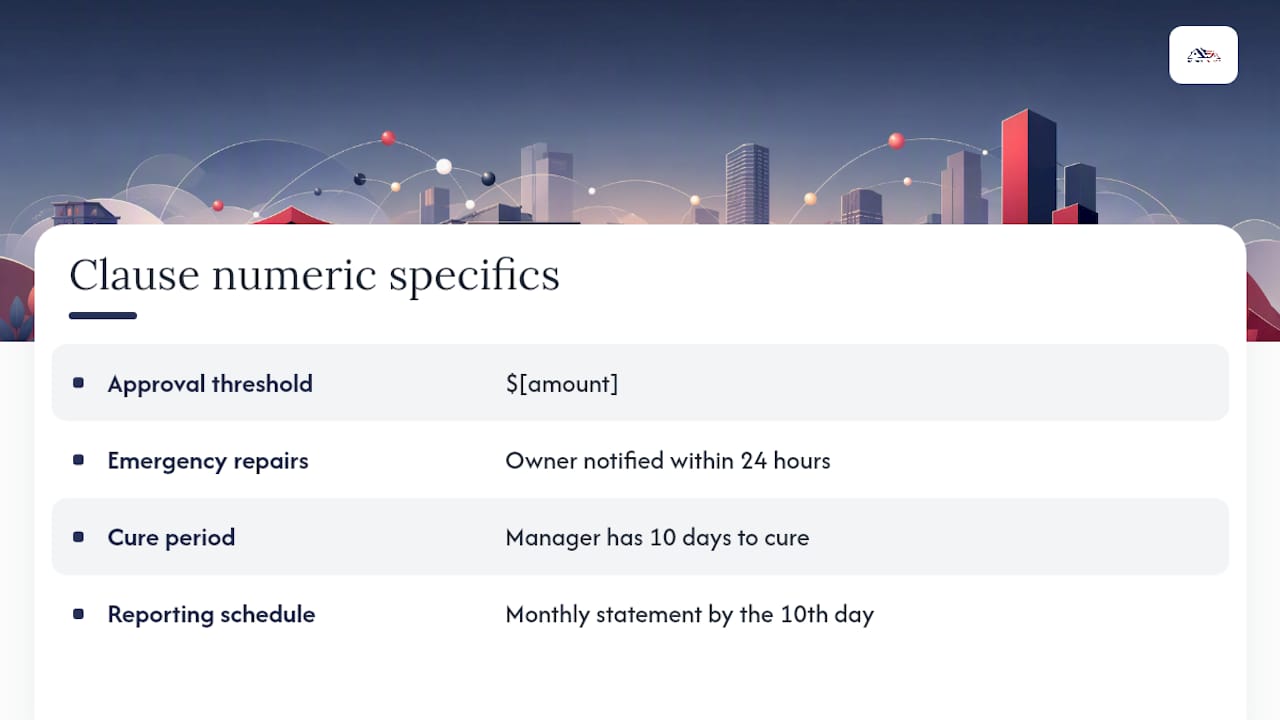
Termination for cause: "Owner may terminate this Agreement immediately upon written notice if Manager materially breaches this Agreement, including failure to provide monthly financial statements for two consecutive months or misappropriation of funds, provided Manager fails to cure such breach within 10 days of written notice, with no early termination fee owed."
Reporting schedule: "Manager shall provide Owner with a monthly financial statement no later than the 10th day of the following month, including rent collected, itemized expenses with receipts, management fees deducted, and net proceeds transferred to Owner."
Contract language works best when the numbers are specific and the triggers are objective. A clause that says "promptly" or "as needed" gives you nothing to point to when a dispute happens. A clause that says "within 24 hours" or "$400 threshold" gives you something enforceable.
Any material change beyond filling in blanks, especially around indemnification or liability caps, deserves a quick attorney review before you sign the final version.
OneSource Real Estate's Approach to Fair Management Terms
Every property management contract OneSource Real Estate drafts starts from the same checklist we'd want if we owned the property ourselves: transparent fee disclosure with no hidden add-ons, a defined owner reserve so repairs don't stall waiting on approval, and monthly reporting that actually reconciles against the bank account, not a summary that just says trust us.
We customize from there based on the property and the owner's goals. A single-family rental in Marietta gets different maintenance thresholds than a multi-unit property in Alpharetta, and an owner planning to sell within two years needs different exclusivity language than one holding long-term. We built our process around the same clause categories covered here, scope, fees, termination, insurance, because those are the terms that create disputes when they're vague and prevent them when they're specific.
If you're evaluating a management contract, current or prospective, we'll walk through it with you and point out exactly where the language favors one side unfairly. That conversation costs you nothing and usually takes less than 30 minutes.
— Matt
How OneSource Real Estate Makes This Easier
Reading contract clauses is one thing. Getting a management agreement that's actually written in your favor from the start is another. OneSource Real Estate is the alternative to signing a manager's standard template as-is: every agreement we offer Atlanta-area owners starts with the transparent fee structure, defined spending limits, and monthly reporting cadence covered throughout this article, already built in, not something you have to fight for after the fact.
Our property management services cover tenant screening and placement, rent collection, maintenance coordination with documented spending thresholds, and financial reporting you can actually reconcile. Owners across Atlanta, Marietta, Johns Creek, Alpharetta, Powder Springs, and Austell choose us because the contract itself reflects local market conditions rather than a generic national template, and because every clause gets explained before you sign, not after something goes wrong. For more on how property management fees typically break down in the Marietta area, that's a useful read alongside your own contract review.
If you already have a management agreement you're unsure about, or you're comparing your first one against what's covered here, bring it to us. We'll review the terms with you at no cost and tell you exactly what to renegotiate before you sign anything.
Sources
These sources back the clause language and legal background covered throughout this article, and they're worth a direct read if you want the full text rather than a summary.
- FORM OF PROPERTY MANAGEMENT AGREEMENT (SEC exhibit)
- EXCLUSIVE PROPERTY MANAGEMENT AGREEMENT (NC Realtors template)
- Elements of a property management agreement (Oregon Real Estate Agency)
- Consequential damages (Cornell Law WEX)
This article is general information, not a substitute for advice from a qualified lawyer. Consult a qualified legal professional about your own circumstances before acting on anything here.
FAQ
What does a property management agreement typically include?
A property management agreement typically includes scope of services, fee structure, term and renewal, termination rights, owner and manager responsibilities, maintenance and spending authority, insurance requirements, and financial reporting obligations.
What are the common terms used in a lease agreement?
Common lease agreement terms include the parties, rent amount and due date, security deposit, lease term, renewal conditions, maintenance responsibilities, and rules on occupancy and subletting, all separate from the property management contract that governs the manager's relationship with the owner.
How is a property management fee usually calculated?
Property management fees are usually calculated as a percentage of collected rent, a flat monthly amount, or a leasing commission for placing a new tenant, and the most common structures are detailed in standard fee templates.