
Yes, Georgia HOAs can restrict or even ban rentals, as long as that authority sits in the recorded declaration or in a properly adopted amendment. The legal backbone here is a mix of the Georgia Property Owners' Association Act (POAA), the Georgia Condominium Act, and O.C.G.A. §44-5-60, a statute that trips up more boards than any other single code section when they skip the proper procedural steps.
Here's what changes the calculus for 2026 and beyond: SB 406, the Property Owners' Bill of Rights Act, adds mandatory annual HOA registration with the Georgia Secretary of State starting January 1, 2027, along with a higher foreclosure threshold and a longer pre-foreclosure notice window. That means enforcement muscle boards took for granted could disappear if they don't register on time.
Before you do anything else:
- Pull the recorded declaration and every amendment from the county clerk of superior court, not the community's welcome packet or a homeowner association's website summary.
- Confirm whether your community is subject to the POAA or the Condominium Act, since that status determines whether §44-5-60's consent protections apply to you.
- Talk to a Georgia community-association attorney before your board passes a new leasing restriction or before you challenge one as a homeowner.
Quick fact: Common rental caps in Georgia communities that already restrict leasing run roughly 5% to 25% of total units, depending on the community's investor mix and board philosophy.
Key Takeaways
Georgia HOAs can lawfully restrict or ban rentals only through authority in the recorded declaration or a properly adopted, recorded amendment, and SB 406's 2027 registration requirement will determine whether that authority holds up in enforcement.
| Point | Details |
|---|---|
| Enforceability depends on recording | A restriction only binds owners if it's in the recorded declaration or a validly adopted, recorded amendment, ideally submitted to the POAA or Condo Act. |
| Watch the §44-5-60 trap | Amendments that add stricter use limits can fail against non-consenting owners unless the covenants are submitted to the POAA or Condominium Act. |
| SB 406 changes enforcement stakes | Annual Secretary of State registration starts January 1, 2027, and unregistered associations risk losing lien and foreclosure power. |
| HOA and city rules stack, they don't replace each other | An Atlanta STR license doesn't override an HOA ban; both layers of rules apply at once. |
| OneSource Real Estate manages the compliance layer | OneSource Real Estate offers lease drafting, tenant screening, HOA liaison, and rent-assignment support for Georgia landlords navigating these rules. |
Table of Contents
- How HOA Rental Restrictions Georgia Boards Adopt Actually Get Recorded
- Rental Caps, Bans, and Minimum Lease Terms: How the Models Differ
- Grandfathering Rules and Hardship Exceptions Boards Rely On
- Enforcement Tools: Fines, Liens, and Where HOAs Must Stop
- Tracking Leased Units Without Losing Track of Who's Compliant
- HOA Rules vs. City Rules for Short-Term Rentals in Atlanta
- Fair Housing Rules for HOA Tenant Policies Georgia Boards Must Follow
- A Practical Checklist Before Your Board Adopts a Rental Restriction
- If Your Community Just Adopted a Rental Restriction: Your Options
- SB 406 and What Changes for HOA Regulations Georgia Boards Face in 2027
- OneSource Real Estate's View From Property Management
- How OneSource Real Estate Helps With HOA Rental Restrictions Georgia Landlords Navigate
- Primary Sources for Verifying HOA Rental Restrictions Georgia Rules
- Sources
- FAQ
How HOA Rental Restrictions Georgia Boards Adopt Actually Get Recorded
A rental restriction isn't valid because the board announces it at a meeting or emails it to residents. It has to travel through a specific legal pipeline before it can be enforced against anyone who didn't vote for it.
Here's the sequence attorneys who handle these amendments in Georgia generally recommend:
- Legal review of the existing declaration. An attorney checks whether the community already has authority to add use restrictions, and whether it's currently governed by the POAA or Condo Act.
- Draft the amendment language, including a submission clause bringing the covenants under the POAA or Condo Act if they aren't already. This step matters more than most boards realize.
- Send formal notice to all owners, following whatever notice period and method the declaration specifies.
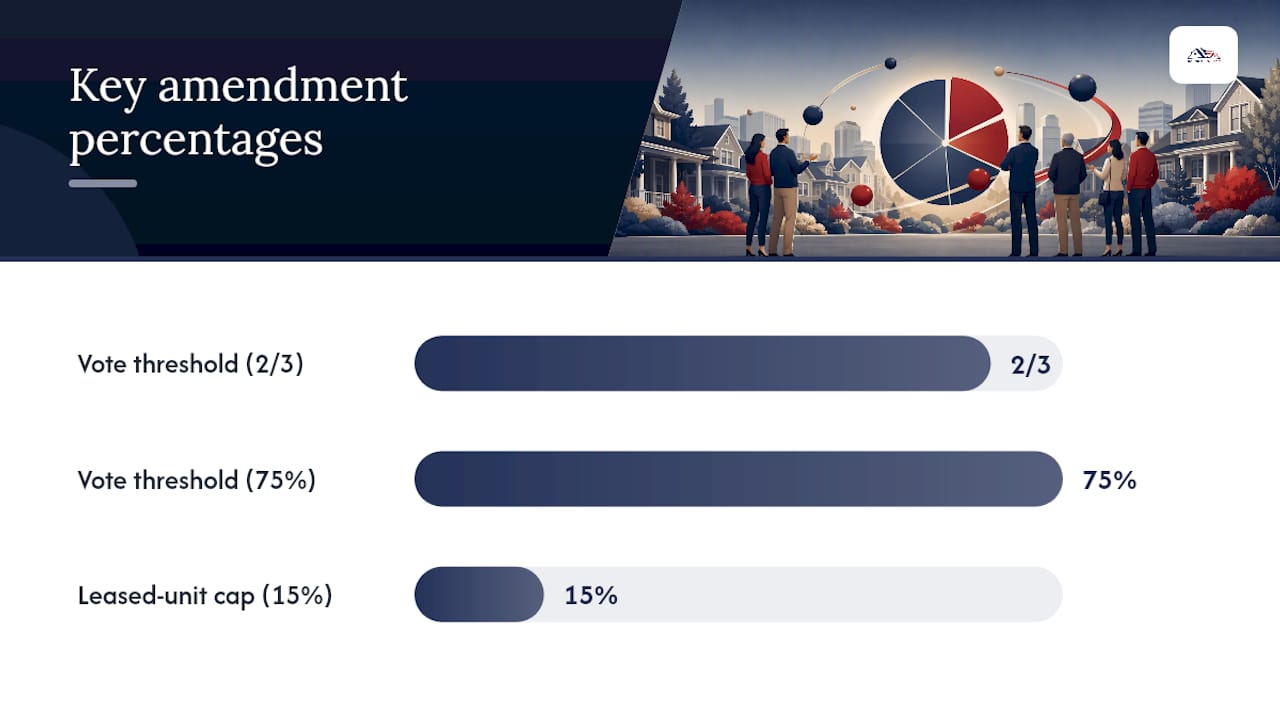
- Hold the vote, using the threshold your governing documents require, typically two-thirds or 75% of eligible votes, though condo associations under the Condo Act sometimes use different math.
- Record the amendment with the clerk of superior court in the county where the property sits.
Why does that submission clause in step 2 matter so much? Because of a quirk in Georgia law that catches boards off guard.
Under O.C.G.A. §44-5-60, an amendment that imposes a greater use restriction than what existed when an owner bought their property can be unenforceable against that owner without their written consent, unless the community's covenants are submitted to the POAA or the Condominium Act. Boards that skip this submission language often discover, usually during litigation, that their brand-new rental ban doesn't actually bind longtime owners.
Sample ballot language tends to read something like: "Shall the Declaration be amended to (a) submit the Community to the Georgia Property Owners' Association Act, and (b) limit the number of leased units to no more than 15% of total units, with existing leases grandfathered through their current term?" Bundling the POAA submission into the same vote as the leasing rule is standard practice for exactly this reason.
Recorded documents control, full stop. If you want to know what your community actually restricts, check the deed records at your county clerk's office or the Georgia Superior Court Clerks' Cooperative Authority online portal where your county participates. Board meeting minutes and resident newsletters are not legal instruments.
Rental Caps, Bans, and Minimum Lease Terms: How the Models Differ
Not every HOA reaches for a total leasing ban. Most communities pick from a handful of standard models, and which one fits depends heavily on how many units are already tenant-occupied and how resale-sensitive the board is.
Full leasing bans prohibit new rentals outright, usually with existing landlords grandfathered. Smaller, owner-occupied communities with few existing rentals tend to favor this model because there's less to unwind.
Leasing caps limit the percentage of units that can be rented at any given time, commonly somewhere between 5% and 25%, with a waitlist system for owners who want to rent once a cap has room. This is the most common approach in mixed-ownership communities that don't want to alienate existing investor-owners.
Minimum lease-term rules require leases of at least six or twelve months, effectively killing short-term and vacation rentals without touching long-term landlords at all.
Owner-occupancy requirements demand that a percentage of units remain owner-occupied, often tied to mortgage-lending eligibility standards rather than pure lifestyle preference.
| Restriction Model | Enforcement Complexity | Resale Impact | Typical Vote Difficulty |
|---|---|---|---|
| Full leasing ban | Low once grandfathering is settled | Can depress investor demand | High, often two-thirds or more |
| Leasing cap (5%–25%) | Moderate, needs an active registry | Minimal if cap has room | Moderate to high |
| Minimum lease term (6-12 months) | Low, easy to verify via lease copies | Low | Moderate |
| Owner-occupancy minimum | Moderate, tied to lender rules | Can help financing eligibility | High |
The tradeoff nobody advertises: a hard ban is the easiest rule to enforce but the hardest to pass, while a leasing cap is the easiest to pass but requires ongoing administrative work to track who's under the ceiling and who's waiting.
Grandfathering Rules and Hardship Exceptions Boards Rely On
Georgia doesn't let a board wipe out existing leases overnight. At minimum, owners who already have a valid lease in place when the amendment gets recorded are typically grandfathered through the end of that lease term. Most boards go further and grandfather the owner's right to keep renting indefinitely, sometimes until the property changes hands.
Common hardship criteria that show up in well-drafted amendments include:
- Active military deployment or PCS orders requiring relocation.
- Job transfer of more than 50 miles within a defined window.
- Documented medical hardship requiring the owner to move into care.
- Death of a co-owner or divorce forcing a sale that's temporarily stalled.
A workable hardship process usually asks the owner to submit a written application with supporting documentation, gives the board a defined window (commonly 30 days) to respond, and caps the exception at a fixed term, often 12 to 24 months, renewable on reapplication.
Boards that build hardship exceptions into the amendment itself, rather than handling requests case by case after the fact, cut down dramatically on the disputes that end up in front of an attorney. A written standard beats board discretion every time enforcement gets challenged.
Grandfathering language typically reads along the lines of: "Any owner with a lease validly executed and effective prior to [recordation date] may complete that lease term and any one renewal not to exceed 12 months, after which the owner shall be subject to the leasing cap set forth herein."
Enforcement Tools: Fines, Liens, and Where HOAs Must Stop
Enforcement in practice follows a fairly predictable escalation path, and boards that skip steps tend to lose in front of a judge or an arbitrator.
- Written notice of violation, specifying the covenant section violated and a cure period, commonly 10 to 30 days.
- Fines or a hearing, if the violation isn't cured, following whatever due-process procedure the declaration requires.
- Lien filing against the property for unpaid fines or assessments tied to the violation.
- Rent assignment, where the declaration allows the association to collect rent directly from the tenant when the owner is delinquent.
- Foreclosure, reserved for the most serious, unresolved cases, and only above the statutory dollar threshold.
Here's where a lot of boards get confused: an HOA cannot evict a tenant. Eviction is a landlord-tenant matter governed by Title 44, Chapter 7 of the Georgia Code, and only the property owner, or a landlord acting under a valid lease, can file that dispossessory action. An HOA can fine a tenant directly only when the governing documents explicitly authorize it, and even then, procedural due process still applies.
Pro Tip: Build a rent-assignment clause into your leasing amendment before you need it. It lets the association redirect rent payments straight from the tenant when an owner falls delinquent, which resolves collection disputes far faster than a lien that can take months to clear.
Foreclosure over a rental violation is the highest-stakes tool in the enforcement kit, and it's exactly where boards should stop and call counsel rather than move on board consensus alone. SB 406 raises the foreclosure threshold and extends the pre-foreclosure notice period, so the margin for procedural error just got smaller, not bigger.
Tracking Leased Units Without Losing Track of Who's Compliant
A leasing cap is only as good as the registry behind it. Boards that rely on memory or scattered emails to track which units are rented almost always end up either under-enforcing the cap or falsely accusing a compliant owner.
A functional leasing registry needs these fields at minimum:
- Owner name and parcel ID.
- Lease start date and end date.
- Tenant contact information.
- Hardship approval status and expiration date, if applicable.
- Copy of the signed lease on file.
- Board approval date and whether a rent-assignment clause is present.
The workflow that keeps this manageable: owner submits a leasing permit application before signing a new lease, the association verifies against the current cap count, the registry gets updated, and the board runs an annual audit to catch stale records and lapsed hardship exceptions. Community managers with experience running these systems increasingly use parcel-based digital records with automated cap counters and lease-expiration alerts, since a spreadsheet updated by hand tends to fall out of date within a year.
Pro Tip: Require a signed leasing permit application before any new lease begins, not after. Retroactive enforcement against a tenant who's already moved in creates far more legal exposure than catching the issue at the application stage.
HOA Rules vs. City Rules for Short-Term Rentals in Atlanta
Living in a covenant-controlled community and wanting to list your place on a short-term rental platform means clearing two separate hurdles, not one. The city's permission to operate doesn't override your HOA's ban, and that surprises a lot of owners.
Atlanta's short-term rental ordinance generally allows an owner to rent their primary residence plus one additional unit, with a required license, safety inspection, and hotel/motel tax collection. But that city license only means the city won't stop you. If your HOA's recorded declaration prohibits short-term rentals or imposes a minimum lease term of six or twelve months, that private restriction typically controls anyway.
Local ordinances and HOA covenants operate as two independent layers of regulation. A city permit resolves your obligations to the city; it does nothing to resolve your obligations to your homeowners association, and most Atlanta-area disputes over short-term rentals come down to owners who assumed the opposite.
Before you list a unit in a covenant-controlled community, check three things: the recorded declaration and any amendments for STR or minimum-lease-term language, the city's current registration requirements for your neighborhood, and whether your homeowners insurance policy even covers short-term guest occupancy. Skipping any one of the three has ended plenty of promising side-income plans.
Fair Housing Rules for HOA Tenant Policies Georgia Boards Must Follow
A board can set objective leasing caps and lease-term minimums. What it cannot do is use tenant screening or approval discretion in a way that discriminates against a protected class.
The Fair Housing Act, enforced by HUD, protects against discrimination based on race, color, national origin, religion, sex, familial status, and disability. Georgia adds its own state-level protections on top of the federal floor. That framework applies whether the HOA is screening a tenant directly or simply approving a lease submitted by the owner.
What boards and landlords should avoid:
- Subjective, unwritten approval criteria that give a board member discretion to reject a tenant without documented reasons.
- Blanket denials based on criminal history without an individualized assessment, which can trigger disparate-impact claims.
- Any inquiry into familial status, disability, or source of income (including Section 8 vouchers, where local law protects voucher holders) as a basis for denial.
- Refusing a reasonable accommodation request tied to a disability, such as an assistance animal that would otherwise violate a pet policy.
Neutral, documented screening criteria hold up far better: a minimum credit score, an income-to-rent ratio (commonly three times monthly rent), and a criminal-background policy that follows current federal guidance rather than a blanket exclusion. Boards are safest sticking to objective rules written into the leasing policy rather than case-by-case tenant approval, which is exactly the kind of discretionary power that invites a fair housing complaint.
A Practical Checklist Before Your Board Adopts a Rental Restriction
Boards that rush a leasing amendment to a vote without doing the groundwork almost always end up amending the amendment within two years. Here's the sequence that avoids that.
- Review the current CC&Rs and every prior amendment to see what authority already exists and whether the community is subject to the POAA or Condo Act.
- Get legal counsel involved early, not after a draft is already circulating among owners.
- Draft the amendment, including hardship criteria, grandfathering terms, and a POAA/Condo Act submission clause if needed.
- Notify members and hold an informational meeting well ahead of the vote, since surprised owners vote no more often than informed ones.
- Run the vote according to the threshold in your governing documents.
- Record the amendment with the county clerk immediately after passage.
- Set up the administrative registry and enforcement policy before the amendment takes effect, not after the first violation shows up.
Realistic timelines: drafting and legal review typically take 4 to 8 weeks, the notice period runs whatever your declaration specifies (often 10 to 30 days), the vote itself might take another 30 to 60 days to collect enough ballots, and recording is usually quick once the vote passes. Budget three to six months from first draft to recorded amendment for most communities.
Common traps: vague ballot language that doesn't specify the exact cap or ban, failing to escrow signed ballots for later verification, and skipping the POAA/Condo Act submission clause. Each one has sunk otherwise-valid amendments in court.
If Your Community Just Adopted a Rental Restriction: Your Options
If you're a homeowner and your HOA just passed a new leasing rule, don't assume it automatically applies to you.
Start here:
- Confirm the amendment is actually recorded, not just approved at a meeting. Pull it from the county clerk yourself.
- Check whether you're grandfathered under an existing lease or ownership date specified in the amendment.
- Apply for a hardship exception in writing if you have a qualifying circumstance, and keep documentation.
- Use the community's internal dispute resolution process if one exists before escalating to litigation, since courts often expect that step first.
- Consult a real estate attorney if you believe the amendment violates §44-5-60's consent protections because it wasn't properly submitted to the POAA or Condo Act.
Costs and timelines vary widely: an internal appeal typically costs nothing but your time and takes 30 to 60 days for a board response. Litigation challenging an amendment's validity can run into the thousands of dollars in legal fees and take six months to over a year. Selling the property outright, if the restriction makes ownership untenable, is usually the fastest resolution but comes with its own transaction costs.
For investors evaluating a purchase, due diligence should include: pulling the recorded declaration and all amendments, checking the leasing registry or waitlist status with the HOA management company, and asking the seller directly for written disclosure of any rental cap, waitlist position, or pending amendment votes. A Georgia lease agreement drafted without confirming HOA eligibility first is a common and expensive mistake.
SB 406 and What Changes for HOA Regulations Georgia Boards Face in 2027
The single biggest shift coming to Georgia HOA law isn't a leasing rule at all. It's a registration requirement that could strip an association's enforcement power if the board misses the deadline.
| SB 406 Provision | Prior Rule | New Rule |
|---|---|---|
| Association registration | Not required | Annual registration with Georgia Secretary of State required beginning January 1, 2027 |
| Foreclosure threshold | $2,000 | $4,000 |
| Pre-foreclosure notice period | 30 days | 60 days |
| Transparency obligations | Varied by community | Expanded disclosure requirements statewide |
The registration requirement is the part that should worry boards most. Legal commentators tracking the rollout note that an unregistered association may lose its ability to file a lien or initiate foreclosure against a delinquent owner, which guts the enforcement teeth behind a leasing cap or ban entirely. A rental restriction on paper means nothing if the association can't back it with a lien.
What boards should do now: start planning the registration process well before the January 1, 2027 deadline, update bylaws and enforcement procedures to reflect the new foreclosure threshold and notice period, notify members of the upcoming changes, and budget staff or management-company time for the added transparency and reporting work SB 406 requires. Waiting until late 2026 to start this process is a gamble few boards can afford.
OneSource Real Estate's View From Property Management
We spend a lot of time reading leasing amendments that were drafted with good intentions and enforced with no system behind them. The pattern repeats: a board passes a cap, nobody builds a registry, and eighteen months later three owners are arguing about who's actually over the limit because nobody kept records.

The fix isn't complicated, but it does require someone whose job is to stay on top of it. We've resolved compliance disputes for clients by putting a documented leasing-permit process in place before a lease is ever signed, so the HOA, the owner, and the tenant are all working from the same paperwork instead of competing memories of a board meeting from two years ago.
What tends to separate communities that manage rental restrictions well from ones that don't is local knowledge of how Atlanta-area associations actually enforce their covenants, plus a compliance-first habit of documenting everything before it becomes a dispute rather than after.
How OneSource Real Estate Helps With HOA Rental Restrictions Georgia Landlords Navigate
Reading through your community's covenants and cross-checking them against SB 406, the POAA, and your local ordinance is exactly the kind of work that eats an investor's weekend, and it's the first thing that gets skipped when you're managing three or four rental properties on your own.
OneSource Real Estate handles this as part of full-service property management for landlords and investors across Atlanta and the surrounding communities, including Marietta, Alpharetta, and Johns Creek. That means lease drafting that accounts for your specific HOA's restrictions, tenant screening built on neutral fair-housing-compliant criteria, direct liaison with your HOA's management company or board, and rent-collection systems that keep you covered if a rent-assignment clause ever comes into play. We also handle enforcement coordination, so if a compliance question comes up with your association, you're not fielding it alone.
If you own rental property in a Georgia HOA and want someone tracking the compliance side while you focus on the investment side, request a property management consultation and we'll walk through your specific covenants and current leasing status together.
Primary Sources for Verifying HOA Rental Restrictions Georgia Rules
- Georgia Secretary of State: Property Owners' Bill of Rights Act covers full SB 406 provisions and the 2027 registration process.
- City of Atlanta Short-Term Rental Ordinance lists the municipal licensing requirements that apply on top of HOA covenants.
- Georgia Landlord-Tenant Handbook, Georgia Department of Community Affairs explains eviction procedure and tenant protections under Title 44, Chapter 7.
- Lueder, Larkin & Hunter: Restricting Leasing Through Amendment walks through the amendment mechanics and §44-5-60 pitfalls in detail.
- HUD Fair Housing Complaint Process is where to file or research a discrimination complaint tied to tenant screening.
This article is general information, not a substitute for advice from a qualified lawyer. Consult a qualified legal professional about your own circumstances before acting on anything here.
Sources
- Property Owners' Bill of Rights Act — Georgia Secretary of State
- Short-Term Rental — City of Atlanta
- Georgia Landlord-Tenant Handbook — Georgia Department of Community Affairs
- Restricting leasing through amendment — Lueder, Larkin & Hunter
FAQ
What is the new HOA law in Georgia?
SB 406, the Property Owners' Bill of Rights Act, requires HOAs to register annually with the Georgia Secretary of State starting January 1, 2027, and it raises the foreclosure threshold from $2,000 to $4,000 while extending pre-foreclosure notice from 30 to 60 days.
Can an HOA restrict Section 8 rentals?
An HOA generally cannot deny a tenant solely because they use a Section 8 housing voucher if that would violate fair housing protections; screening decisions must rest on neutral, documented criteria rather than a tenant's source of income where local protections apply.
What are the new rental laws in GA?
Beyond SB 406's registration and foreclosure changes, Georgia rental law continues to run through the Landlord-Tenant Handbook under Title 44, Chapter 7, which governs leases, security deposits, and eviction procedures separately from HOA covenant enforcement.
What are the most common HOA violations?
The most frequent leasing-related violations are renting without a required permit, exceeding a community's leasing cap, and violating minimum lease-term rules by listing a unit as a short-term rental where covenants prohibit it.
Does an HOA need my consent to add a new rental restriction?
Under O.C.G.A. §44-5-60, a stricter use restriction can be unenforceable against you without written consent unless your community's covenants have been submitted to the POAA or Condominium Act, which is why boards typically bundle that submission into the same amendment vote.