
A cash-for-keys agreement is a voluntary, written contract where a landlord or lender pays a tenant or former homeowner to vacate a property by a set date, and it is fully enforceable under Georgia contract law. No state statute governs it, no minimum payment is required, and no court approval is needed. That simplicity is the point.
Here is what Georgia residents need to know immediately:
- Typical payouts run from roughly $500 to $2,500, with many landlords starting at about one month's rent and adjusting based on eviction cost estimates and urgency.
- Timing advantage: A formal Georgia dispossessory proceeding takes 30–60 days and carries filing, sheriff, and attorney fees. A signed cash-for-keys deal can clear a property in days.
- The must-do: Get everything in writing, exchange keys and payment simultaneously, and document the property's condition with time-stamped photos before anyone leaves.
- Tenants should accept when the payout covers relocation costs and the landlord's case is strong. They should push back or consult an attorney when the offer is below relocation costs or the agreement contains a broad release of habitability or security deposit claims.
- Landlords should offer when a unit is vacant-ready and the tenant is cooperative, because the math almost always favors a payout over court costs.
- The single largest legal risk: Any pressure, threat, utility shutoff, or lockout used to force acceptance, voids the voluntary nature of the deal and exposes the landlord to liability under Georgia law. Coercion is illegal, full stop.
Key Takeaways
A written, signed cash-for-keys agreement is the only version that protects either party in Georgia, and the simultaneous exchange of keys and payment is the single step that prevents most disputes.
| Point | Details |
|---|---|
| Legal basis in Georgia | These are private contracts under O.C.G.A. § 13-3-1; no state statute governs them and no court approval is needed. |
| Typical payout range | Most Georgia deals land between $500 and $2,500, often anchored at roughly one month's rent. |
| Eviction alternative math | A formal dispossessory takes 30–60 days and can cost $1,200–$1,800+ in fees; a cash payout is usually cheaper and faster. |
| Must-do documentation | Sign a written agreement, conduct a joint walkthrough, take time-stamped photos, and exchange keys and payment simultaneously. |
| Illegal landlord tactics | Utility shutoffs, lockouts, and coercive pressure void the voluntary nature of the deal and expose landlords to liability under Georgia law. |
Table of Contents
- What is a cash-for-keys agreement in Georgia?
- Why cash-for-keys beats a formal eviction in most cases
- How cash-for-keys works in Georgia: legal basis, timeline, and costs
- Typical payouts in Georgia and how to choose the right amount
- What to put in a Georgia cash-for-keys agreement, clause by clause
- How to negotiate safely in Georgia
- If something goes wrong: illegal tactics, breaches, and remedies in Georgia
- Tax and reporting implications for Georgia parties
- Sample cash-for-keys agreement and move-out checklist for Georgia
- A Georgia property manager's perspective on cash-for-keys
- Sources
- FAQ
What is a cash-for-keys agreement in Georgia?
Cash-for-keys is an informal industry term for what is legally a negotiated move-out contract. The landlord or property owner offers money; the tenant or occupant agrees to leave by a specific date in a specific condition. Both parties sign, and the deal is done outside of court.
Two scenarios come up most often in Georgia. The first is a standard landlord-tenant situation: a tenant is behind on rent, or the landlord wants the unit back for renovation or sale, and both sides prefer a clean break over a dispossessory filing. The second is post-foreclosure, where a lender or new REO owner needs possession from a former homeowner or holdover tenant. After foreclosure, lenders commonly use cash-for-keys to secure a faster, less adversarial vacancy and avoid the cost and uncertainty of eviction proceedings.
What makes cash-for-keys distinct from an eviction notice is that it is an offer, not an order. The occupant can say no. If they do, the landlord's only legal path is the dispossessory process. That voluntary nature is also what makes the agreement enforceable: both sides are choosing to enter it, which satisfies the mutual assent requirement under Georgia contract law.
Standard conditions attached to the deal typically include vacating by a specific date and time, leaving the unit broom-clean, returning all keys and access devices, and allowing a joint walkthrough inspection before payment clears.
Why cash-for-keys beats a formal eviction in most cases
The core argument for a negotiated payout is simple: eviction costs more than most landlords expect, and it takes longer than most tenants fear.
Advantages of a cash-for-keys agreement:
- Speed. A signed deal can move a tenant out in a week. A Georgia dispossessory, even uncontested, typically runs 30–60 days from filing to writ of possession.
- Lower direct costs. Filing fees, sheriff fees, and attorney costs add up fast. A cash payout that is less than those combined costs is a net win for the landlord.
- Reduced property damage risk. Tenants who feel cornered sometimes leave properties in rough shape. A tenant who receives fair compensation and leaves on their own terms rarely does.
- No public court record for the tenant, which matters when they are applying for their next rental.
- Certainty. A signed agreement with a clear move-out date removes the guesswork of a contested hearing.
Tradeoffs to weigh:
- The landlord gives up the right to pursue unpaid rent in exchange for a clean exit (unless the agreement explicitly preserves that claim, which most do not).
- The tenant may waive security deposit disputes if the release language is broad. The Atlanta Volunteer Lawyers Foundation recommends that tenants have any release clause reviewed before signing, because broad waivers can inadvertently bar deposit or habitability claims.
- Cash-for-keys payments are generally taxable income for the tenant, which is a detail many people miss until tax season.
For landlords, the cost of dispossessory filing, sheriff service, attorney fees, and vacancy losses can add up, making a reasonable cash-for-keys offer economically preferable without specifying exact amounts.
How cash-for-keys works in Georgia: legal basis, timeline, and costs
Georgia has no statute specifically governing cash-for-keys. These are private contracts, and their enforceability depends entirely on standard contract elements: offer, acceptance, consideration, and legally capable parties. O.C.G.A. § 13-3-1 is the governing framework, which means a written, signed agreement with clear terms is enforceable in magistrate or state court like any other contract.
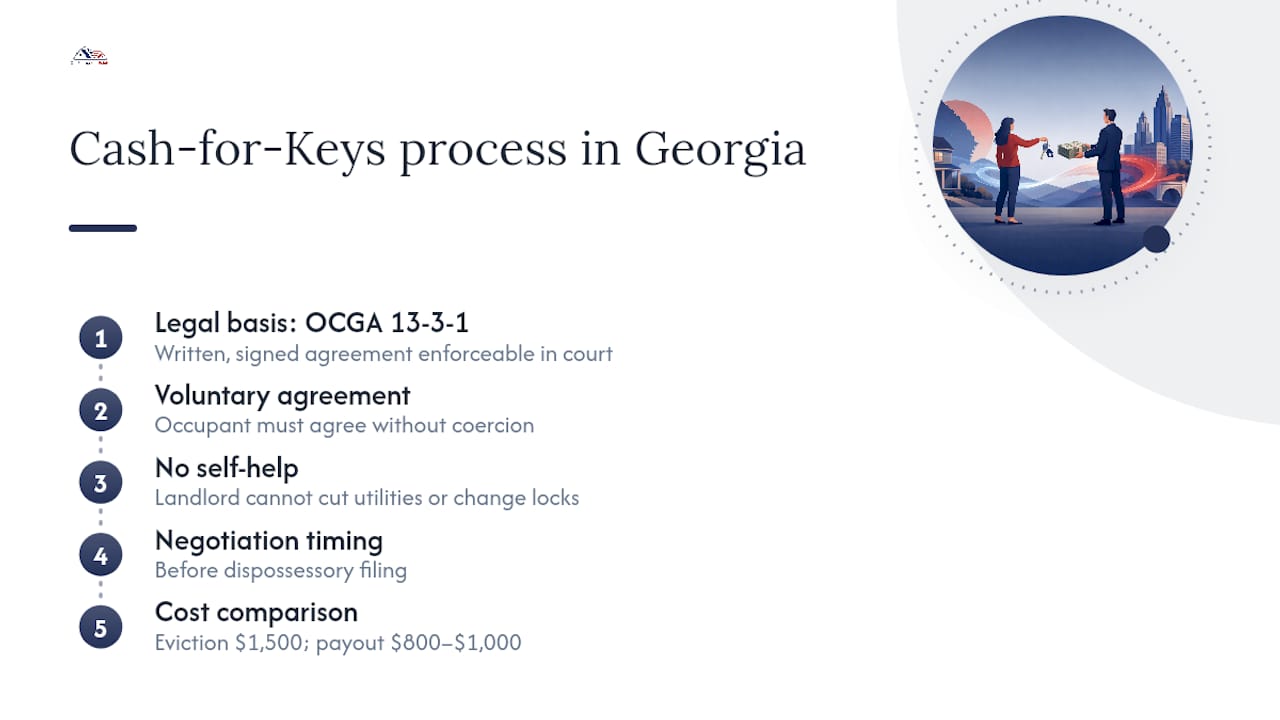
Atlanta and Georgia impose no required form, minimum payment, or approval process for these agreements. That is a feature, not a bug: it means the parties can negotiate terms that fit their specific situation. It also means a poorly drafted agreement offers little protection to either side.
What "voluntary" means under Georgia law: The occupant must agree without coercion. Georgia law prohibits self-help eviction tactics, and the Georgia DCA landlord-tenant handbook is explicit that landlords cannot terminate utilities, change locks, or remove doors to force a vacancy. Violations of O.C.G.A. § 44-7-14.1 can expose a landlord to damages. An agreement signed under those conditions is not voluntary and may not be enforceable.
Georgia dispossessory timeline vs. cash-for-keys:
The landlord's offer math: A landlord facing a $1,500 eviction cost (fees plus lost rent during proceedings) might offer $800–$1,000 as a cash-for-keys payout. The logic is that $800 now beats $1,500 later, especially when property condition risk is factored in. That calculation is the starting point for most Georgia negotiations.
Typical payouts in Georgia and how to choose the right amount
Most Georgia cash-for-keys deals land between $500 and $2,500, with the common anchor being roughly one month's rent. The actual number depends on leverage, urgency, and the landlord's eviction cost estimate.
Checklist for setting or evaluating an offer:
- Current monthly rent. This is the baseline anchor. One month's rent is a reasonable starting point for both sides.
- Remaining lease term. A tenant with six months left has more leverage than one who is month-to-month.
- Tenant's arrears. If the tenant owes back rent, the landlord has stronger legal footing and may offer less. The tenant may accept less to avoid a judgment.
- Comparable market rent. In a tight Atlanta rental market, a tenant who can quickly find comparable housing at similar cost has less leverage.
- Estimated eviction costs. The landlord's realistic all-in cost (fees, attorney, lost rent, potential damage) sets the ceiling for what makes a payout worthwhile.
- Urgency and timing. A landlord with a signed buyer or a hard closing date will pay more to guarantee a vacancy date.
- Property condition risk. A tenant who has maintained the unit well is a lower-damage risk; a contentious relationship raises that risk and may justify a higher offer.
For tenants: If your relocation costs (first month, deposit, moving expenses) exceed the offer, say so and counter. A landlord who has done the eviction math will often move. Ask for enough to cover at least one month's rent at a comparable unit plus a security deposit.
Anything above that erodes the financial logic of the deal. Split-payment structures (a small good-faith deposit upfront, balance on key handover) protect you if the tenant takes the money and stalls.
What to put in a Georgia cash-for-keys agreement, clause by clause
A handshake deal is not enforceable. A text message is barely better. A signed, written agreement with specific terms is what protects both parties in magistrate court if something goes wrong. Here is what every Georgia cash-for-keys agreement needs:
- Parties and property. Full legal names of all adult occupants and the landlord or authorized agent, plus the complete property address.
- Move-out/surrender date. A specific date and time. "As soon as possible" is not a date.
- Payment amount. Written in both numerals and words: "One Thousand Dollars ($1,000.00)."
- Payment method and timing. Specify cashier's check, cash, or electronic transfer, and state that payment is contingent on key handover. Sample language: "Payment shall be made simultaneously with Tenant's surrender of all keys and access devices to the Property."
- Condition standard. "Broom-clean" is the standard term. Define it: free of personal property, trash removed, appliances clean, no damage beyond normal wear.
- Security deposit handling. State explicitly whether the security deposit is returned separately under Georgia's deposit statute, applied to arrears, or addressed in the release. Do not leave this ambiguous.
- Mutual release of claims. Both parties release each other from claims arising from the tenancy. Sample language: "Except as expressly stated herein, each party releases the other from all claims, demands, and causes of action arising out of or related to the tenancy at the above-described property." Tenants: have an attorney review this clause before signing if you have unresolved habitability or deposit disputes.
- Remedies for breach. State what happens if the tenant does not vacate by the move-out date (landlord may file dispossessory and tenant forfeits the payment, or must return it). State what happens if the landlord does not pay (tenant may pursue breach of contract in magistrate court).
- Key and inventory list. List every key, fob, garage opener, and access code being returned.
- Inspection and photo evidence. Both parties agree to a joint walkthrough on the move-out date, with time-stamped photos taken before payment is exchanged.
- Signatures and dates. All adult occupants must sign. A landlord signature from an authorized agent is acceptable if the agent has written authority.
This gives the tenant an incentive to follow through while protecting the landlord from a full loss if the tenant defaults.
Pro Tip: Conduct the final walkthrough together, take time-stamped photos of every room before anyone leaves, and hand over the check and receive the keys in the same moment. That simultaneous exchange is the single most effective way to prevent disputes about whether the deal was completed.

How to negotiate safely in Georgia
Negotiation looks different depending on which side of the door you are on.
For landlords
Start with an offer slightly below your target. If your eviction cost estimate is $1,800, open at $700–$800 and leave room to move. Frame the offer as a business decision, not a threat: "I'd rather help you move on than go through the court process." That tone keeps the agreement voluntary and avoids any appearance of coercion.
Use a split-payment structure. A $200 good-faith payment when the agreement is signed, with $800 on key handover, gives the tenant a reason to follow through and limits your exposure if they do not.
File the dispossessory only after negotiations have clearly failed. Filing while negotiating can look coercive, and a judge may view a signed agreement differently if the tenant can show they felt pressured by a pending court action.
Document every communication. Texts, emails, and written offers create a paper trail that protects you if the tenant later claims the agreement was not voluntary.
For tenants and former homeowners
Get the offer in writing before you agree to anything. A verbal promise of $1,000 is worth nothing if the landlord changes their mind after you start packing.
Ask for a neutral reference letter as part of the deal. Many landlords will agree to provide a neutral rental reference (confirming dates of tenancy and rent amount, without negative commentary) in exchange for a clean, timely exit. This costs the landlord nothing and helps you secure your next home.
Read the release clause carefully. A broad mutual release that waives "all claims" could bar you from recovering a security deposit you are legally owed under Georgia's security deposit statute. Ask for the release to carve out deposit claims or habitability issues if those are unresolved.
Watch for red flags: a landlord who refuses to put terms in writing, who has already changed the locks or shut off utilities, or who is pressuring you to sign immediately without time to read the agreement. Any of those signals suggests the deal is not truly voluntary.
Pro Tip: Before you sign anything, insist on a written agreement, a 24-hour review period, and a simultaneous key-and-payment exchange on move-out day. Those three conditions protect you regardless of which side of the negotiation you are on.
If something goes wrong: illegal tactics, breaches, and remedies in Georgia
Illegal landlord actions
Georgia law is clear on what landlords cannot do to force a vacancy. The Georgia DCA landlord-tenant handbook prohibits:
- Shutting off utilities (water, electricity, gas) to pressure a tenant to leave
- Changing locks or removing doors without a court order
- Removing the tenant's personal property without legal authority
- Threatening or harassing a tenant to coerce acceptance of a cash-for-keys offer
These are self-help eviction tactics, and they are illegal under O.C.G.A. § 44-7-14.1. A landlord who uses them not only voids the voluntary nature of any agreement signed under duress, but also opens themselves to a damages claim from the tenant.
If the tenant breaches (accepts payment but does not vacate)
- Document everything. Preserve the signed agreement, proof of payment, and any communications showing the tenant acknowledged the move-out date.
- Do not attempt self-help. Even with a signed agreement in hand, a landlord cannot forcibly remove a tenant. The agreement is evidence, not a writ.
- File a dispossessory proceeding in the magistrate court of the county where the property is located. The signed agreement is strong evidence that the tenant acknowledged their obligation to vacate.
- Consult an attorney if the tenant contests the filing or claims the agreement was invalid.
A signed cash-for-keys agreement does not create a self-executing right of removal. If the occupant takes the money and refuses to leave, the landlord must still pursue a dispossessory, though the agreement significantly strengthens that case. For more on the eviction filing process in Georgia, the step-by-step process is worth reviewing before you get to that point.
If the landlord breaches (tenant vacates but payment is not made)
- Document your move-out. Time-stamped photos, a copy of the signed agreement, and any written confirmation of key handover are your evidence.
- Send a written demand for payment by certified mail.
- File a breach-of-contract claim in magistrate court (for amounts under $15,000) or state court. The signed agreement is your primary exhibit.
- Contact the Atlanta Volunteer Lawyers Foundation or Georgia Legal Aid if you need representation and cannot afford an attorney.
If you believe the landlord's conduct involved discrimination, HUD's Fair Housing Act protections apply, and you can file a complaint with HUD or the U.S. Department of Justice. Release language in a cash-for-keys agreement should never waive your right to pursue a fair housing claim.
Tax and reporting implications for Georgia parties
Cash-for-keys payments are not free money from a tax perspective.
For tenants and former homeowners: The IRS generally treats cash-for-keys payments as ordinary income, reportable on your federal return. Set aside a portion of any payment you receive to cover the tax liability, and consult a tax professional if the amount is significant. This applies whether you are a tenant receiving a landlord buyout or a former homeowner receiving a post-foreclosure payment from a lender.
For landlords and property owners: Payments made as part of a cash-for-keys agreement are generally deductible as an ordinary business expense, since the purpose is to secure possession of a business asset (the rental property). Keep records of the signed agreement, proof of payment, and the date of vacancy to support the deduction.
Federal 1099 reporting: If you are a landlord or business entity and you pay $600 or more to an individual in a calendar year, federal rules may require you to issue a Form 1099-MISC. Consult your accountant or tax advisor to confirm whether your specific payment triggers this requirement.
A note on foreclosure-related payments: Post-foreclosure cash-for-keys payments to former homeowners can sometimes be treated differently, potentially as sale proceeds rather than ordinary income depending on the structure of the transaction. This is a situation where a tax professional's guidance is not optional. The IRS rules in this area are fact-specific, and getting it wrong can be costly.
Sample cash-for-keys agreement and move-out checklist for Georgia
A fillable agreement does not need to be long to be enforceable. It needs to be specific. Here is how to use a template effectively in Georgia.
How to adapt a template for Georgia:
- Replace every bracketed field with the actual party names, property address, dollar amount (in numerals and words), and specific dates.
- Confirm the release language carves out any claims you are not willing to waive (security deposit, habitability, fair housing).
- Add a Georgia-specific clause confirming that the agreement is governed by Georgia law and that disputes will be resolved in the magistrate court of the county where the property is located.
- Have all adult occupants sign, not just the lease-holder. An unsigned occupant is not bound by the agreement.
Tenant move-out checklist:
- Remove all personal property and trash from every room, closet, and storage area
- Clean appliances, bathrooms, and kitchen surfaces to broom-clean standard
- Repair any damage beyond normal wear and tear (or document pre-existing damage with photos)
- Return all keys, fobs, garage openers, and access codes
- Confirm utility accounts are transferred or closed as agreed
- Attend the joint walkthrough and sign the inspection record
Landlord inspection and documentation checklist:
- Conduct the walkthrough with the tenant present and document every room with time-stamped photos
- Note the condition of appliances, walls, floors, fixtures, and any damage
- Verify all keys and access devices are returned and test them
- Sign a joint inspection record with the tenant before exchanging payment
- Keep copies of the signed agreement, inspection record, photos, and proof of payment for at least three years
Pro Tip: Use your phone's camera to take photos in sequence, starting at the front door and moving room by room. The metadata timestamp on each photo creates a reliable record that is difficult to dispute later. Email the photos to yourself immediately after the walkthrough so there is a dated, cloud-backed record.
A Georgia property manager's perspective on cash-for-keys
The most common mistake landlords make with cash-for-keys is treating it as an informal handshake rather than a legal transaction. Skipping the written agreement, or using a vague one-page template that does not address the security deposit or the release of claims, is how disputes end up in magistrate court anyway, which defeats the entire purpose.
At OneSource Real Estate, the standard process for owner-assisted buyouts includes a joint walkthrough before any payment changes hands, time-stamped photo documentation of every room, and a simultaneous key-and-payment exchange with both parties present. That sequence is not bureaucratic caution. It is the difference between a clean vacancy and a contested court filing three weeks later.
One practical note for Atlanta-area landlords: the re-renting timeline matters as much as the move-out date. A unit that clears on a Friday with no documentation, no inspection record, and keys handed over in a parking lot is a liability. A unit that clears with a signed inspection record, photos, and a dated receipt is a property you can list and show the following week.
For landlords managing multiple properties or dealing with a difficult vacancy situation, the documentation and process discipline that cash-for-keys requires is exactly the same discipline that good property management demands every day. If that process feels burdensome to manage alone, OneSource Real Estate's property management services cover eviction support, lease compliance, and tenant transitions for Atlanta and surrounding Georgia markets.

Managing a rental property in Atlanta and facing a difficult vacancy? OneSource Real Estate handles the full process, from cash-for-keys documentation to re-renting, so you do not have to navigate it alone. Contact OneSource Real Estate for landlord support across Atlanta and surrounding Georgia markets.
Sources
- Georgia Code § 13-3-1 – Essentials of Contracts Generally (FindLaw)
- Cash for Keys in Georgia: Agreements, Law, and Taxes - LegalClarity
- Georgia landlord-tenant handbook (DCA)
- Fair Housing Act overview | HUD
- Cash for Keys After Foreclosure Explained | Nolo
Keep copies of your signed agreement, all communications, inspection photos, and payment receipts for at least three years. If a dispute arises, those records are your case.
This article is general information, not a substitute for advice from a qualified lawyer. Consult a qualified legal professional about your own circumstances before acting on anything here.
FAQ
How much money do you get for cash for keys in Georgia?
Most Georgia cash-for-keys payments fall between $500 and $2,500, with many landlords starting at roughly one month's rent. The final amount depends on the tenant's leverage, the landlord's estimated eviction costs, and how urgently the owner needs the unit vacated.
Who typically offers cash for keys?
Landlords offer it when they want a faster, lower-cost alternative to a dispossessory filing. Lenders and new REO owners also offer it after foreclosure to secure possession from former homeowners or holdover tenants without going through eviction court.
Is cash for keys better than eviction in Georgia?
For most situations, yes. A formal Georgia dispossessory takes 30–60 days and can cost $1,200 or more in fees, while a cash-for-keys deal can clear a property in under two weeks at a fraction of that cost. The tradeoff is that the landlord pays out rather than recovering unpaid rent.
How do you do cash for keys in Georgia?
Both parties negotiate a payment amount and move-out date, then sign a written agreement that covers the payment terms, condition standard, mutual release of claims, and key handover. On the move-out date, conduct a joint walkthrough with time-stamped photos, then exchange keys and payment simultaneously.
Is a cash-for-keys payment taxable income in Georgia?
Yes, the IRS generally treats cash-for-keys payments as ordinary income for the recipient. Tenants and former homeowners should set aside funds for the tax liability and consult a tax professional, especially for post-foreclosure payments, which can sometimes be treated differently depending on the transaction structure.