
TL;DR:
- A proper 1031 exchange in Georgia allows deferment of both federal and state capital gains taxes when reinvesting into like-kind investment properties.
- Executing the exchange requires engaging a Qualified Intermediary before closing and adhering to strict identification and timing rules.
Yes, a properly structured 1031 exchange in Georgia can defer both federal and Georgia state capital gains taxes and depreciation recapture when you sell investment real estate and roll proceeds into like-kind replacement property, under IRC §1031. Georgia conforms to federal like-kind rules, but adds its own closing-day requirements you must handle before the deed transfers.
Immediate actions to protect your exchange:
- Engage a Qualified Intermediary before the relinquished property closes — constructive receipt disqualifies the exchange the moment you touch proceeds
- Direct all sale proceeds to the QI, never to yourself or your attorney's trust account
- File Form IT-AFF3 (Seller's Certificate of Exemption) at closing to avoid Georgia's 3% nonresident withholding under O.C.G.A. §48-7-128; the buyer reports using Form G-2RP
- Identify replacement property within a short calendar-window period; close within the federally mandated time frame or by your tax return due date (with extensions), whichever is earlier
Three instant disqualifiers: touching proceeds (constructive receipt), missing the 45-day identification window, and failing to replace equal-or-greater debt — which triggers taxable mortgage boot even when you reinvest all cash.
Consult a Georgia CPA and closing attorney before proceeding — this article is general information, not tax or legal advice.
Table of Contents
- How to complete a 1031 exchange in Georgia: step-by-step
- Which Georgia properties qualify — and which don't
- How Georgia market conditions affect your exchange timing
- Georgia recording and filing requirements during the exchange
- Recent Georgia legislative changes that affect 1031 exchanges
- OneSource Real Estate guides Georgia investors through every step
- FAQ
- Key Takeaways
How to complete a 1031 exchange in Georgia: step-by-step
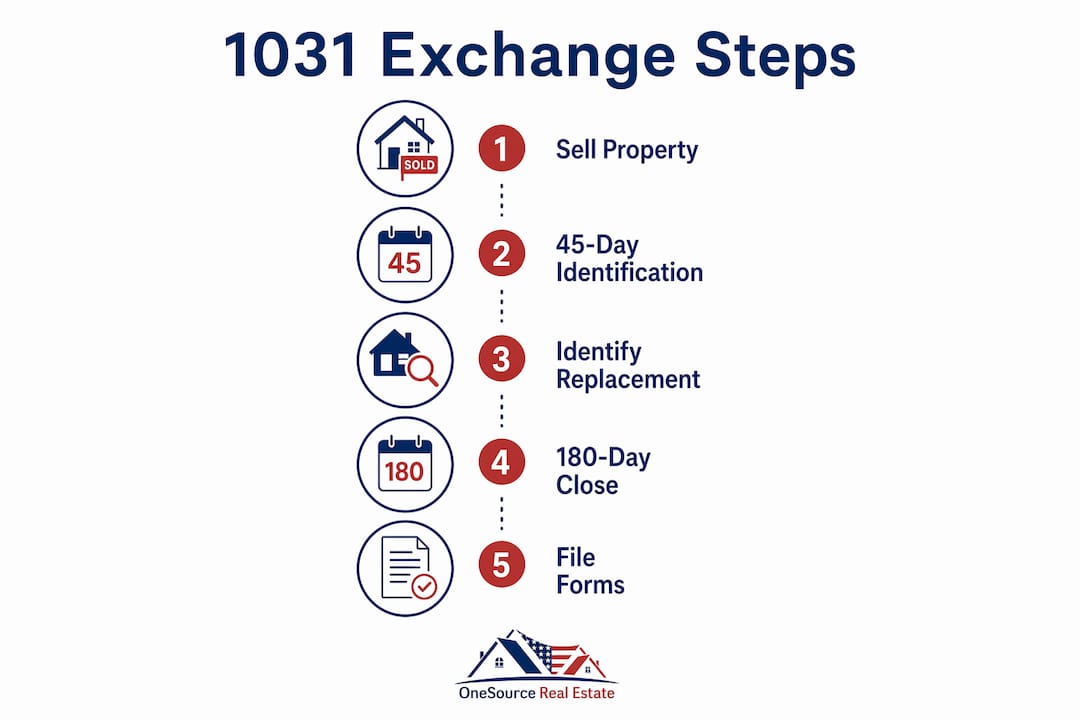
Follow this sequence before and after closing on the relinquished property.
- Hire a Qualified Intermediary first. Georgia's GAC Rule 80-5-6-.01 requires QIs acting through financial institutions to maintain GAAP-compliant, segregated accounts. Choose a QI that provides third-party audited statements.
- Engage a Georgia CPA. Model the debt replacement math before you list. Mortgage boot is the most overlooked trap: replacing less debt than you carried creates a taxable event even if every dollar of cash is reinvested.
- List and sell with a local broker. Coordinate the closing date with your QI so exchange documents are signed before the deed transfers.
- Prepare closing paperwork. Your title or escrow agent files Form IT-AFF3 for nonresident sellers and coordinates Form G-2RP reporting with the buyer's closing agent.
- Identify replacement property within 45 days. Submit a signed, written identification to your QI — a street address or legal description is required.
- Close on replacement property within 180 days. Your QI releases funds directly to the replacement property's closing.
Which Georgia properties qualify — and which don't
Georgia follows federal like-kind rules broadly. Eligible property includes rental single-family homes, multifamily apartments, commercial buildings, investment land, self-storage facilities, and industrial warehouses — anything held for investment or business use.
Not eligible: your primary residence, a vacation home used personally more than the IRS threshold, and fix-and-flip inventory held primarily for resale. A property you recently converted from personal use to rental may qualify if it has been held as investment property long enough — confirm the holding period with your CPA.
How Georgia market conditions affect your exchange timing
Atlanta's residential rental market moves fast. Tight inventory in submarkets like Buckhead, Decatur, and Gwinnett County means replacement properties can go under contract within days of listing. That 45-day identification window is unforgiving in a competitive market. Identify backup properties (you may name up to three under the standard rule) and have financing pre-approved before the relinquished property closes. Investors who treat the exchange as a last-minute tax move routinely miss the window.
Georgia recording and filing requirements during the exchange
Georgia deed transfers are recorded at the county level. The closing attorney — required by Georgia law for real estate closings — coordinates recording with the county clerk and files the appropriate withholding forms. For nonresident sellers, Form IT-AFF3 must be presented at closing to prevent the 3% withholding from being collected. If a partial exchange creates taxable boot, withholding may still apply to the recognized gain portion. The title agent and QI must coordinate these filings; a gap between them can freeze funds.

Recent Georgia legislative changes that affect 1031 exchanges
Georgia moved to a flat income tax structure with a scheduled decrease in the rate under legislation passed in recent years. Deferred gain from a 1031 exchange will be taxed at the applicable flat rate for the year in which gain is eventually recognized — deferral is not forgiveness. Plan your long-term exit with a CPA who tracks the current rate for the recognition year. No Georgia-specific legislation has decoupled the state from federal like-kind exchange rules as of 2026.
OneSource Real Estate guides Georgia investors through every step
Georgia investors completing a 1031 exchange need a broker who understands the closing-day coordination that prevents withholding and disqualification — not just a listing agent.

OneSource Real Estate handles the full transaction cycle in Atlanta and surrounding areas: listing and selling the relinquished property on your timeline, coordinating with your QI and closing attorney to ensure Form IT-AFF3 is filed correctly, and helping you identify replacement properties before the 45-day clock runs out. After closing, OneSource's full-service property management covers tenant screening, rent collection, maintenance, and lease compliance — so your replacement property generates income from day one without the operational burden. Investors who want post-exchange management in markets like Decatur or Gwinnett County can also explore partner home services for rapid property improvements as part of their replacement property strategy. Contact OneSource Real Estate to schedule an exchange-ready consultation before your relinquished property closes.
FAQ
Does Georgia have its own 1031 exchange rules?
Georgia conforms to federal like-kind exchange rules under IRC §1031 but adds a 3% nonresident withholding requirement under O.C.G.A. §48-7-128, which sellers must exempt using Form IT-AFF3 at closing.
What is the 45-day rule in a Georgia 1031 exchange?
You must identify replacement property in writing to your Qualified Intermediary within 45 calendar days of selling the relinquished property — no extensions are available.
Can I use a 1031 exchange on a Georgia rental home?
Yes. A residential rental property held for investment qualifies; your primary residence and fix-and-flip inventory do not.
What happens if I miss the 180-day deadline?
The exchange fails and the full gain becomes taxable in the year of sale, including depreciation recapture at the federal rate and Georgia's applicable flat income tax rate.
Can OneSource Real Estate help with a 1031 exchange?
OneSource Real Estate coordinates the sale, closing-day documentation, and post-exchange property management in Atlanta and surrounding Georgia markets — contact them before your relinquished property closes.
Key Takeaways
A fully deferred 1031 exchange in Georgia requires engaging a Qualified Intermediary before closing, filing Form IT-AFF3 for nonresident sellers, and meeting the 45-day identification and 180-day closing deadlines.
| Point | Details |
|---|---|
| Engage QI before closing | Constructive receipt disqualifies the exchange; the QI must be in place before the deed transfers. |
| File Form IT-AFF3 | Nonresident sellers must present this exemption certificate at closing to avoid Georgia's 3% withholding. |
| Meet federal deadlines | Identify replacement property within 45 days; close within 180 days of the relinquished property sale. |
| Replace equal-or-greater debt | Failing to match debt on the replacement property creates taxable mortgage boot even when all cash is reinvested. |
| OneSource Real Estate | Coordinates Georgia listings, closing-day documentation, and full-service property management for 1031 investors in Atlanta and surrounding areas. |