
TL;DR:
- Atlanta requires hosts to register for a Short-Term Rental License and meet safety and residency requirements before listing any property. Renters should verify the license number posted on listings, and owners must ensure compliance to avoid fines, with active enforcement since March 2023. Professional management services like OneSource Real Estate can help owners stay compliant and manage their rentals efficiently.
Licensed short-term stays exist across Atlanta right now, and you can book one today. Property owners, though, must first register a Short-Term Rental License (STRL) with the City of Atlanta, pay a $150 annual fee, and meet primary-residence and safety requirements before listing a single night. The City's Office of Short-Term Rentals manages the program, and enforcement has been active since March 2023.
Renters: Before you book, confirm the STRL number is posted on the listing. Owners: Start your STRL application through the City of Atlanta portal and budget for compliance costs beyond the license fee itself. OneSource Real Estate can handle the operational side once you're licensed.
Table of Contents
- What are the best short-term rental options in Atlanta right now?
- How to book safely in Atlanta: what you should check before you reserve
- Can you operate a short-term rental in Atlanta? Key rules hosts must know
- How to apply and stay compliant: a step-by-step for Atlanta hosts
- Should you self-manage or hire a pro? How to choose a short-term rental manager in Atlanta
- How OneSource Real Estate helps Atlanta hosts with compliance and management
- Key Takeaways
- What most hosts get wrong about Atlanta's STR rules
- OneSource Real Estate manages Atlanta STR compliance for you
- Useful sources for Atlanta hosts and renters
- FAQ
What are the best short-term rental options in Atlanta right now?
Atlanta's short-term rental market splits into two camps: individual hosts renting entire homes or apartments, and professional furnished operators offering month-to-month flexibility. Both serve different needs.

| Listing | What It Is | Best For | Neighborhood / Proximity | Host Type | Book Via |
|---|---|---|---|---|---|
| The Sage Haven Airbnb | Entire home | Couples, small groups | Local Atlanta neighborhood | Individual host | Airbnb |
| Historic Charmer | Entire home | History lovers, families | In-city historic district | Individual host | Airbnb |
| 3BR Downtown ATL | Entire house | Families, groups | Downtown Atlanta | Individual host | Airbnb |
| Walk to World Cup 2026 | 2-bedroom apartment | Event visitors, stadium access | Near Mercedes-Benz Stadium | Individual host | Airbnb |
| Landing Furnished Apartments at Buckhead and Vine | Managed furnished apartment | Professionals, relocating workers | Buckhead | Professional operator | Landing app |
| Modern Design 2BR Skyline Views | Apartment with balcony | Couples, remote workers | City-view location | Individual host | Airbnb |
| Blueground Atlanta | Furnished apartment | Expats, traveling professionals | Multiple Atlanta locations | Professional operator | Blueground.com |
| OneSource Real Estate managed units | Managed residential rental | Owners seeking compliance + guests | Atlanta metro | Professional manager | listtosellatl.com |
A few booking notes specific to Atlanta:
- Verify the STRL number. Every licensed listing must display it on the advertisement. If it's missing, ask the host directly before you pay.
- Watch for cleaning and service fees. On Airbnb, these can add 20–30% to the nightly rate. Read the full price breakdown before confirming.
- Professional operators like Blueground typically require a 30-day minimum stay, which suits relocating professionals but not weekend visitors. Confirm the minimum before you search.
How to book safely in Atlanta: what you should check before you reserve
Atlanta's STRL program puts the verification burden partly on renters. A listing can look polished and still be unlicensed.
- Confirm the STRL number is posted on the listing page itself. The City requires hosts to display it on all advertisements.
- Read the house rules and occupancy limits. City rules cap occupancy at two adults per bedroom. A listing advertising a 2-bedroom for eight guests is a red flag.
- Check cancellation and cleaning fees before booking. Non-refundable cleaning fees and strict cancellation policies are common on Atlanta listings.
- Assess host responsiveness. Send a message before booking. A host who takes days to reply will likely be slow during your stay.
- Verify host type. Professional operators (Landing, Blueground) carry their own compliance infrastructure. Individual hosts vary widely.
To confirm a listing is registered, ask the host for the STRL number and cross-reference it with the City of Atlanta's portal. A legitimate host will provide it without hesitation.
Pro Tip: If a listing has no STRL number posted and the host says "it's in process" or "we're exempt," walk away. The City has been enforcing since March 2023, and there is no grace period for active listings.
Can you operate a short-term rental in Atlanta? Key rules hosts must know
Atlanta's STRL program is built around one core principle: home-sharing, not investor-driven multi-unit operations. The rules reflect that directly.
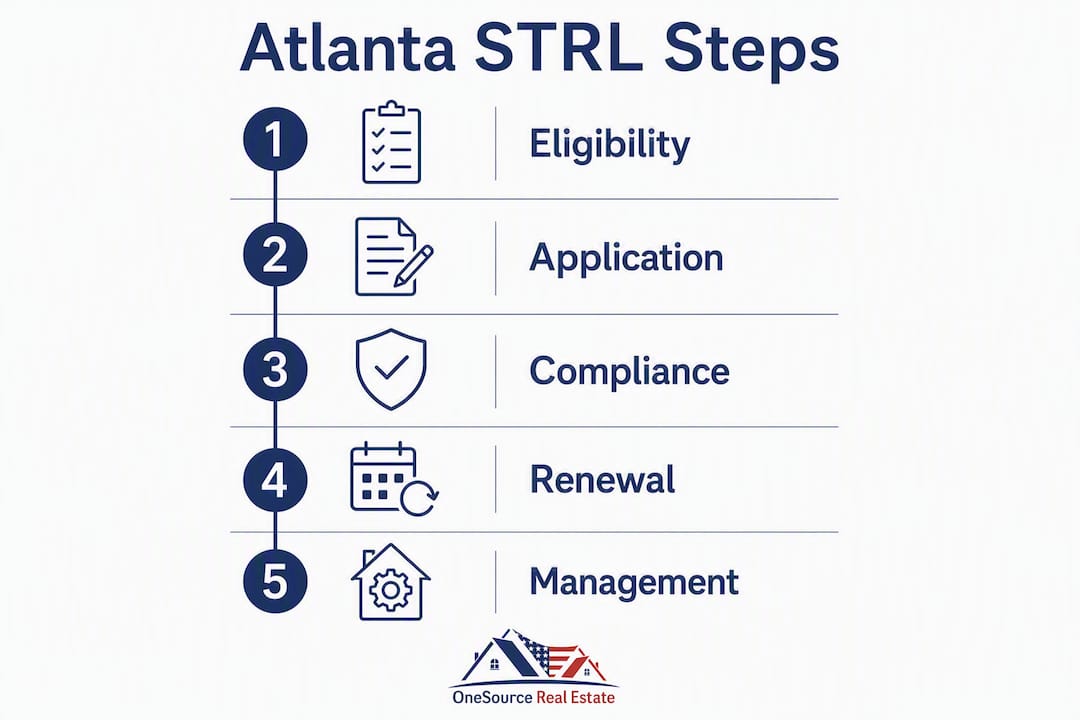
Who qualifies: Both property owners and qualifying long-term tenants can apply, but the license is tied to a primary residence. You must demonstrate that the property is your primary home. Owners with multiple properties cannot simply designate a secondary unit as "primary" to work around the limit.
What the license covers: One primary residence plus, in limited cases, one additional dwelling unit. That's the ceiling.
Post-license obligations every host must meet:
- Post the STRL number on every advertisement and listing platform
- Cap occupancy at two adults per bedroom
- Post written house rules inside the unit
- Remit hotel/motel (lodging) tax to the City
- Maintain insurance appropriate for short-term guests
Enforcement: The City's Office of Short-Term Rentals uses an electronic verification system, and platforms are required to verify registrations. Noncompliant listings can result in fines, license suspension, or revocation. Platforms that carry unlicensed listings face their own exposure.
The $150 annual fee is non-refundable. Pay it only after you've confirmed your property qualifies as a primary residence and you've reviewed the full compliance checklist.
How to apply and stay compliant: a step-by-step for Atlanta hosts
The application process is straightforward, but the timeline depends on how prepared you are before you log in.
- Gather primary-residence evidence. A Georgia driver's license, utility bill, or voter registration at the property address all work. Have at least two documents ready.
- Create a City of Atlanta portal account. The STRL application runs through the City's online licensing system.
- Complete the STRL application. Fill in property details, upload your primary-residence documents, and confirm occupancy and safety compliance.
- Pay the $150 non-refundable annual fee. Processing typically begins after payment clears.
- Post the license number on all listings. This is required before you accept your first booking.
- Meet safety and inspection requirements. Working smoke detectors, carbon monoxide detectors, and a visible emergency exit plan are standard inspection items.
- Remit lodging taxes on schedule. Atlanta hosts owe hotel/motel tax on short-term rental income. Set up a remittance process before your first guest checks in.
- Renew annually. The City issues renewal notices; keep records of all guest stays and tax payments for the renewal review.
Budget reality: The $150 fee is just the starting point. Insurance adjustments for short-term guests, safety equipment, and quarterly tax remittance add up. Owners who plan only for the license fee routinely get caught short at renewal.
For the renewal process specifically, the City publishes a step-by-step renewal guide that walks through the portal steps in detail.
Should you self-manage or hire a pro? How to choose a short-term rental manager in Atlanta
DIY hosting pros: Full control over pricing, guest selection, and scheduling. No management fee cutting into revenue.

DIY hosting cons: You own every compliance task. Missed tax remittance, an unlicensed listing period, or a guest dispute lands entirely on you. Atlanta's active enforcement makes this a real financial risk, not a theoretical one.
Professional management pros: Compliance handled, guest screening done, maintenance coordinated, and financial reporting delivered monthly. For owners with day jobs or multiple properties, the time savings alone often justify the cost.
Professional management cons: Management fees reduce net income. Quality varies significantly by provider.
What to ask when interviewing a manager
| Evaluation Area | What to Ask |
|---|---|
| STRL compliance track record | Have you filed STRLs for Atlanta properties? Can you show examples? |
| Tax remittance experience | Do you handle lodging tax filing directly, or does the owner do it? |
| Fee structure | What is the placement fee, monthly percentage, and any add-on costs? |
| Insurance and damage protection | What owner-protection options do you offer? |
| Response-time SLA | What is your guaranteed response time for guest issues? |
| Maintenance coordination | Do you have vetted vendors, including HVAC and mechanical services? |
| Transparent accounting | Can I see a sample monthly owner statement? |
Red flags: No local STR compliance knowledge, vague fee schedules, no owner references, and any manager who can't explain Atlanta's primary-residence rule clearly. See the top property management companies in Atlanta for a vetted shortlist.
How OneSource Real Estate helps Atlanta hosts with compliance and management
OneSource Real Estate is a local Atlanta brokerage and full-service property management firm. For STR hosts, that means STRL filing support, primary-residence verification help, guest screening, lodging tax remittance coordination, maintenance coordination, and monthly owner financial reporting.
A common scenario: an owner lists a property on Airbnb before confirming primary-residence eligibility, then faces an enforcement notice. OneSource works through the eligibility review, corrects the listing, and sets up a compliant tax remittance process before the next booking goes live. The owner keeps the revenue; OneSource handles the paperwork.
The City of Atlanta's STRL requirement is non-negotiable. Having a local brokerage that knows the program from the inside reduces the risk of a costly compliance gap.
Key Takeaways
Atlanta's short-term rental market is open to renters and owners alike, but every licensed host must hold a valid STRL tied to a primary residence and meet the City's posting, occupancy, and tax obligations.
| Point | Details |
|---|---|
| STRL is mandatory | Every Atlanta short-term rental requires a City-issued license; enforcement has been active since March 2023. |
| $150 annual fee | The non-refundable application fee is just the start; budget for insurance, safety equipment, and lodging tax remittance. |
| Primary residence only | The license covers your primary home and, in limited cases, one additional unit. Secondary properties do not qualify. |
| Renters: verify the license | Confirm the STRL number is posted on the listing before you book; unlicensed hosts face fines and potential removal. |
| OneSource Real Estate | Provides full STRL compliance support, guest screening, and property management for Atlanta hosts who want hands-off operations. |
What most hosts get wrong about Atlanta's STR rules
Atlanta's STRL program catches a lot of owners off guard, and the mistake is almost always the same: they treat the $150 fee as the whole compliance picture. It isn't. The lodging tax obligation, the insurance gap between a standard homeowner's policy and short-term guest coverage, and the occupancy-cap enforcement are where real costs and real penalties accumulate.
There's also a pattern specific to Atlanta's event calendar. Stadium events at Mercedes-Benz Stadium drive sharp demand spikes, and hosts who list only during those windows sometimes skip the STRL entirely, assuming short-duration hosting flies under the radar. It doesn't. The City's electronic verification system flags listings regardless of how many nights they've been active.
The practical habit that prevents most of this: before you list a single night, confirm your primary-residence documentation is in order and your lodging tax remittance process is set up. Those two steps eliminate the majority of enforcement exposure.
OneSource Real Estate manages Atlanta STR compliance for you
Owning a short-term rental in Atlanta means staying current on STRL renewals, lodging tax deadlines, occupancy rules, and guest screening. That's a real operational load on top of your day job.
OneSource Real Estate handles the full compliance and management stack for Atlanta property owners: STRL filing support, tax remittance coordination, guest screening, maintenance dispatch, and monthly financial reporting. No guesswork on whether your listing is current. No scrambling when a guest files a complaint.
Before you call, have your property address, primary-residence documentation, and current listing status ready. That's all it takes to get started. Talk to the OneSource team about a management contract today.
Useful sources for Atlanta hosts and renters
- City of Atlanta Short-Term Rental Program — Official STRL requirements, eligibility rules, occupancy limits, and the application portal.
- City of Atlanta STRL Renewal Guide — Step-by-step walkthrough of the annual renewal process through the City portal.
- OneSource Real Estate — Atlanta brokerage and property management firm offering full STR compliance support and management services.
- Homes for Rent in Atlanta, GA: 2026 Renter's Guide — OneSource's local renter resource covering neighborhoods, pricing, and what to expect in the Atlanta market.
FAQ
Does every Atlanta short-term rental need a license?
Yes. The City of Atlanta requires a Short-Term Rental License for any property rented for fewer than 30 consecutive days. The license is tied to a primary residence and carries a $150 non-refundable annual fee.
Can I rent out a property I don't live in as a short-term rental in Atlanta?
No. The STRL is limited to a host's primary residence. Owners cannot designate a secondary or investment property as their primary home to qualify; the City requires documented evidence of primary-residence status.
What taxes do Atlanta short-term rental hosts owe?
Atlanta hosts must remit hotel/motel (lodging) tax on short-term rental income. The City's STRL program requires hosts to set up tax remittance as part of compliance; platforms may collect some taxes automatically, but the host remains responsible for confirming remittance.
How do I verify a listing is licensed before I book?
Ask the host for the STRL number and confirm it appears on the listing advertisement. The City of Atlanta's portal allows verification of registered licenses. A host who cannot provide the number should be treated as unlicensed.
Can OneSource Real Estate handle my STRL application and ongoing compliance?
Yes. OneSource Real Estate provides STRL filing support, primary-residence verification assistance, lodging tax remittance coordination, and full property management for Atlanta hosts. Contact the team through listtosellatl.com/property-management to get started.