
TL;DR:
- Pay your county tax bill or file for relief before the deadline to avoid interest, penalties, and liens.
- Use your county's online portal to look up your parcel, confirm the responsible office, and pay or request exemptions promptly.
Find your county tax bill today and pay it or file for relief before the posted deadline. That single action protects you from interest, penalties, and the risk of a tax lien. Here is how to do it in under 20 minutes.
Three immediate actions:
- Look up your parcel and current bill online using your county's portal (Fulton, DeKalb, or City of Atlanta).
- Confirm which county or city office handles your address — the wrong office cannot accept your payment or process your exemption.
- Note your due date and available payment methods, then pay or file your homestead exemption application before that date.
Which office to contact first:
- Fulton County address: Start with the Fulton County Tax Commissioner for payments; contact the Fulton County Assessors Office for assessment questions or exemptions.
- DeKalb County address: Use the DeKalb County Tax Commissioner - North Office for payments, parcel search, and homestead exemptions.
- City of Atlanta taxes: The City of Atlanta Office of Revenue handles city-level property taxes separately from county bills.
- College Park address: College Park City Taxes manages local property-tax administration for that jurisdiction.
Bills are legally tied to the owner of record as of January 1. If you bought a property recently, verify your bill post-closing even if no mailed notice arrived.
Table of Contents
- Which Atlanta tax office handles your property?
- How Georgia calculates your property tax bill
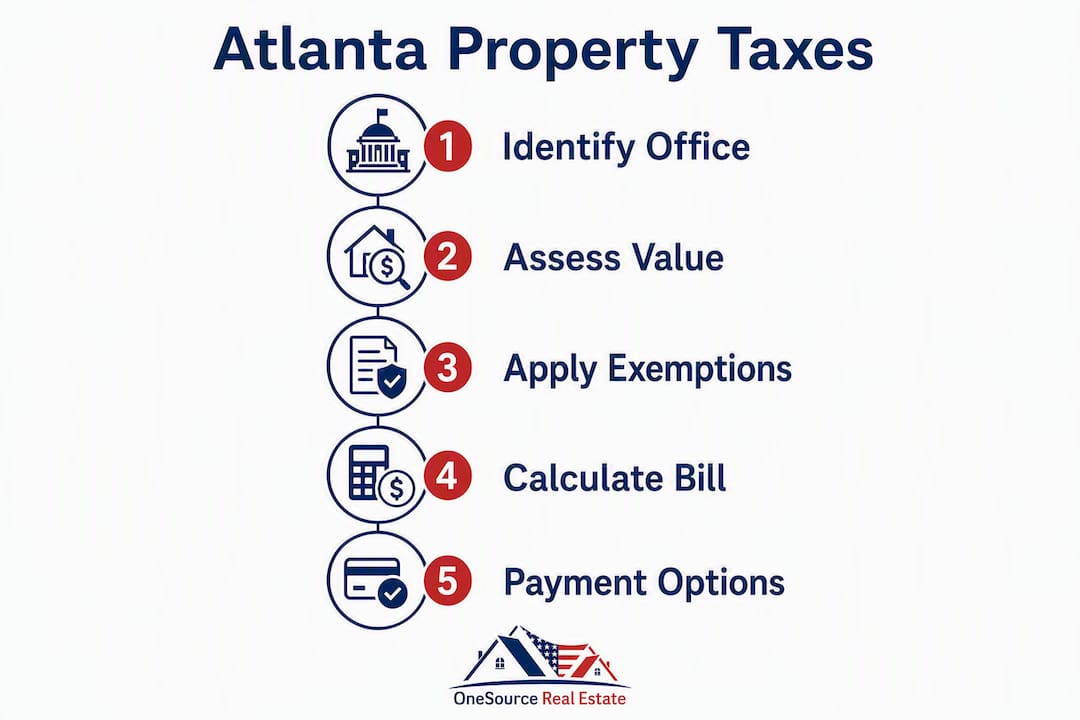
- How to look up and pay your Atlanta property tax bill
- What homestead exemptions can lower your bill
- How to challenge an assessment you think is wrong
- Deadlines, penalties, and payment plans
- Fulton vs. DeKalb vs. City of Atlanta: which office covers you?
- Key Takeaways
- A local agent's perspective on property taxes and rental income
- OneSource Real Estate makes Atlanta property ownership easier
- Useful resources for Atlanta property owners
- FAQ
Which Atlanta tax office handles your property?
Atlanta sits across two counties and multiple city jurisdictions. Knowing which office covers your address is the first step to paying correctly or filing an exemption.

| Office | Primary Services | Where They Serve | How to Access | Google Reviews |
|---|---|---|---|---|
| OneSource Real Estate LLC | Property management, owner accounting, tax-related coordination | Atlanta and surrounding areas | Online, phone | 4.8★ (113) |
| Fulton County Tax Commissioner | Tax collection, online payment, kiosks | Fulton County, including most Atlanta neighborhoods | Online portal, kiosks, in-person | 2.9★ (264) |
| DeKalb County Tax Commissioner - North Office | Tax collection, parcel search, homestead exemptions | DeKalb County addresses, east Atlanta, Decatur-adjacent | Online portal, North & Central offices | 3.8★ (295) |
| Fulton County Assessors Office | Appraisals, assessment notices, exemption eligibility | Fulton County | Online, in-person | 2.6★ (38) |
| Property Tax Consultants, LLC | Appeal representation, tax minimization | Commercial/investment properties, Southeast | Phone, consultation | 5★ (1) |
| Fulton County Tax Office (Greenbriar) | Property tax payments, in-person services | South Fulton / Greenbriar area | In-person, online | 3.7★ (262) |
| College Park City Taxes | City-level property tax administration | College Park addresses | In-person, phone | — |
| Tax Commissioner-Property | Local tax collection | Local jurisdiction | In-person | 5★ (5) |
When to contact each office:
- Pay a bill → tax commissioner's online payment portal (Fulton or DeKalb).
- Assessment dispute or exemption question → Board of Assessors (Fulton Assessors Office or DeKalb Property Appraisal).
- Formal appeal → Board of Tax Assessors within the appeal window.
- City of Atlanta city taxes → Atlanta Office of Revenue directly.
How Georgia calculates your property tax bill
Georgia law sets assessed value at 40% of fair market value. Taxable value is that assessed amount minus any exemptions. Your bill equals taxable value multiplied by the combined millage rate, where one mill equals $1 per $1,000 of taxable value.

Worked example:
| Step | Amount |
|---|---|
| Fair market value | a typical market price |
| Assessed value (40%) | 40% of market value |
| Less standard homestead exemption | a standard exemption amount |
| Taxable value | value after exemptions |
| Combined millage rate | rate set by county and local authorities |
| Estimated annual tax bill | calculated by multiplying taxable value by millage rate |
Two neighbors with similar market values can end up with materially different bills. The total millage rate is the sum of county, city, and school district levies — and those layers vary by exact address.
Key terms:
- Assessed value: 40% of fair market value, set by the county assessor.
- Millage rate: Tax rate expressed in mills; 1 mill = $1 per $1,000 of taxable value.
- Taxable value: Assessed value after subtracting approved exemptions.
- Homestead exemption: A reduction in taxable value for owner-occupied primary residences.
- SPLOST / special district levies: Additional local charges that can appear on the same bill.
How to look up and pay your Atlanta property tax bill
Your county's online portal is the fastest route. Here is the step-by-step path for each jurisdiction.
Fulton County:
- Go to the Fulton County Tax Commissioner portal.
- Search by parcel ID, owner name, or property address.
- Confirm the owner-of-record and the amount due.
- Pay by credit card, e-check, or visit a kiosk or branch office.
DeKalb County:
- Visit dekalbtax.org and use the parcel search tool.
- Enter your address or parcel ID to pull up the bill.
- Verify owner-of-record — critical if you closed recently.
- Pay online, by mail, or in person at the North or Central office.
City of Atlanta: The City of Atlanta Office of Revenue handles city-level taxes separately. Visit atlantaga.gov and search by address.
What you will need: parcel ID, property address, and your last-paid bill or closing statement. Your parcel ID appears on your deed, closing disclosure, or any prior tax bill.
Pro Tip: If you pay through a mortgage escrow account, still log into your county portal each year to confirm the payment posted. The legal responsibility stays with you as the property owner, not your mortgage servicer.
What homestead exemptions can lower your bill
A homestead exemption reduces your taxable value, which directly cuts your bill. File once and the exemption typically stays on your account — but confirm annually after assessment notices arrive.
Common exemptions in Atlanta:
- Standard homestead: Available to owner-occupants; reduces assessed value by a set amount.
- Senior exemption: Additional relief for qualifying homeowners above a certain age (varies by county).
- Disabled homeowner: Reduced taxable value for qualifying disabled residents.
- Disabled veteran: Significant relief for eligible veterans and surviving spouses.
To apply:
- Gather your government-issued ID, deed or closing statement, and proof of primary residency.
- File with the Fulton County Assessors Office or DeKalb County Tax Commissioner before the county deadline (typically April 1).
- Confirm the exemption appears on your next assessment notice.
To check if an exemption is already active: search your parcel on the county portal and review the exemption field. If a qualifying exemption is missing, contact the assessor's office immediately with your documentation.
Pro Tip: Set a calendar reminder each spring to check your assessment notice. State legislation periodically changes exemption rules, and the Fulton County Board of Assessors posts updates that can affect your eligibility.
How to challenge an assessment you think is wrong
File an informal review the moment you believe your assessed value is too high. The standard window is 45 days from the date on your annual notice.
Step-by-step appeal path:
- Informal review: Contact the county Board of Tax Assessors and request a review. Many errors (wrong square footage, incorrect property type) get corrected here without a formal filing.
- Formal appeal: File with the Board of Tax Assessors within the 45-day window. DeKalb County lists a $217 arbitration fee and a $25 Superior Court filing fee for formal proceedings.
- Arbitration or Superior Court: If the formal appeal is unresolved, you can escalate. During a pending appeal, you may be billed at 85% of the current assessed value or 100% of the prior year's approved value — a useful cash-flow consideration.
Evidence that strengthens an appeal:
- Recent comparable sales in your neighborhood.
- A professional appraisal dated close to the assessment date.
- Photos documenting property condition or deferred maintenance.
- Documented errors in county records (wrong bed/bath count, incorrect lot size).
For commercial or complex investment properties, Property Tax Consultants, LLC offers specialized appeal representation and tax-minimization services in the Atlanta area.
Deadlines, penalties, and payment plans
Most Atlanta-area property tax bills carry a December due date, though exact dates vary by county and city. Check your specific bill.
What happens when you miss the deadline:
- Interest begins accruing on the unpaid balance.
- Late-payment penalties are added, compounding the amount owed.
- Continued non-payment can result in a tax lien on the property.
- A lien can affect your credit, block a sale or refinance, and ultimately lead to a tax sale.
If you cannot pay in full, contact your county tax commissioner's office before the due date. Both Fulton and DeKalb offer options to discuss payment arrangements. Acting early keeps penalties manageable; waiting until a lien is filed significantly narrows your options.
Fulton vs. DeKalb vs. City of Atlanta: which office covers you?
County lines in Atlanta are not always obvious from a street address. Here is how to sort it out quickly.
- Decatur-adjacent and east Atlanta neighborhoods: — Many fall in DeKalb County. Use the DeKalb parcel search at dekalbcountyga.gov to confirm.
State legislation can shift assessment notice timelines and exemption rules, so checking the Fulton County Board of Assessors or DeKalb Tax Commissioner site each spring is worth the five minutes.
Pro Tip: When you close on a property, ask your closing attorney to confirm which county and city tax jurisdictions apply. Getting this wrong means paying the right amount to the wrong office — and still owing the correct one.
Key Takeaways
Atlanta property owners pay taxes to the county (Fulton or DeKalb), the City of Atlanta, and school districts combined — and the right office for your address determines everything from payment to exemptions to appeals.
| Point | Details |
|---|---|
| Georgia's 40% rule | Assessed value equals 40% of fair market value; your bill is taxable value times the combined millage rate. |
| Confirm your jurisdiction | Fulton, DeKalb, and City of Atlanta each have separate offices; use your county's parcel search to confirm. |
| File homestead exemptions | Apply by April 1 at your county assessor's office to reduce taxable value and lower your annual bill. |
| Appeal within 45 days | File an informal review or formal appeal with the Board of Tax Assessors within 45 days of your assessment notice. |
| OneSource Real Estate | Provides full-service property management for Atlanta landlords, including owner accounting and tax-related coordination. |
A local agent's perspective on property taxes and rental income
Property taxes are one of the most underestimated line items in a rental property's budget. Most landlords I work with focus on rent and maintenance costs, then get surprised when an assessment spike pushes their annual tax bill up by several hundred dollars mid-lease. That gap between what you projected and what you owe is the kind of thing that quietly erodes returns.
The practical fix is straightforward: pull your assessment notice every spring, verify your homestead exemption status after any tenant turnover (a rental property does not qualify for a homestead exemption the way an owner-occupied home does), and keep comparable sales data on hand in case you need to challenge the assessed value. Documentation assembled during normal property management — photos, maintenance records, lease agreements — doubles as appeal evidence if you ever need it.
One more thing worth saying plainly: if your mortgage servicer pays taxes through escrow, that is not a reason to stop checking. Escrow payment failures happen, and the county will hold you responsible, not your lender. Log into your county portal once a year and confirm the payment posted.
OneSource Real Estate makes Atlanta property ownership easier
Managing Atlanta rental properties means staying on top of assessment notices, exemption deadlines, and payment confirmations on top of everything else that comes with being a landlord, including how HVAC maintenance can save homeowners money. OneSource Real Estate handles the administrative load that most owners underestimate until something slips.

The full-service property management suite covers rent collection, owner financial reporting, maintenance coordination, lease drafting, and tenant placement — plus the kind of ongoing account oversight that catches a missed escrow payment or an expired exemption before it becomes a penalty. You get a local team that knows Atlanta's county split, tracks key tax dates on your behalf, and keeps your records organized if an appeal ever becomes necessary.
Ready to hand off the paperwork? Contact OneSource Real Estate to discuss a property management agreement for your Atlanta investment.
Useful resources for Atlanta property owners
- Fulton County Tax Commissioner — Pay your Fulton County property tax bill online or find a kiosk location.
- DeKalb County Tax Commissioner — Pay DeKalb taxes, search parcels, and file homestead exemptions online.
- DeKalb County Property Appraisal — View current and historical assessments, file an appeal, and download notices.
- City of Atlanta Office of Revenue — Manage city-level property taxes for Atlanta addresses.
- Georgia Department of Revenue — Property Tax — State-level rules, the 40% assessment formula, and taxpayer rights.
- Georgia.gov — Pay Property Taxes — Statewide payment guidance and links to county portals.
This article is general information, not legal or tax advice. Confirm current rates, deadlines, and eligibility rules with your county assessor, tax commissioner, or a qualified tax professional.
FAQ
Are property taxes in Atlanta high?
Atlanta property taxes vary by exact address because the total rate combines county, city, and school district millage. Two nearby homes can have noticeably different bills depending on which jurisdictions apply.
How do you look up property taxes in Georgia?
Search your county's online parcel tool — Fulton County or DeKalb County — by address or parcel ID to view your current bill, assessment, and payment status.
Is Georgia ending property taxes?
No. Georgia has not eliminated property taxes. Legislative changes periodically adjust exemption rules and assessment timelines, so checking your county assessor's site annually keeps you current on any changes that affect your bill.
How do I look up property taxes in Fulton County?
Go to the Fulton County Tax Commissioner's portal at fultoncountytaxes.org, enter your address or parcel ID, and your current bill and assessment details will appear. For exemption status, use the Fulton County Assessors Office site at fultonassessor.org.