
An owner statement is the financial report your property manager sends you, usually every month, summarizing rent collected, expenses paid, fees charged, and what actually landed in your bank account. Read one number first: net distribution, sometimes labeled "amount due to owner" or "ending cash to owner." That figure tells you, in seconds, whether the property generated cash or drained it this period.
Everything else on the page explains how the manager got to that number. Before you accept it, know this:
- You have the right to ask for invoice backup on any expense line.
- You have the right to see supporting reports: rent roll, general ledger, maintenance log.
- A statement without documentation behind it is a red flag, not a formality.
Pro Tip: Before reading a single expense line, flip to the bottom of the statement and check the net distribution against last month's. A sudden drop with no explanation is your cue to start asking questions before you even review the details above it.
Key Takeaways
Net distribution is the single number that tells an owner whether a property generated or drained cash this period, and every other line on the statement exists to explain how the manager arrived at it.
| Point | Details |
|---|---|
| Read net distribution first | Check this figure before anything else to know if the property made or lost money this period. |
| Reconcile rent roll to deposits | Compare expected rent from the rent roll against what actually landed as deposits each month. |
| Demand invoice backup | Every expense and management fee line should trace to a real invoice or signed work order. |
| Watch for repeat red flags | Repeated owner contributions or unexplained reserve draws across two or more months warrant a ledger review. |
| Choose invoice-backed reporting | OneSource Real Estate builds monthly owner packets with invoice-backed entries, rent rolls, and portal access built in. |
Table of Contents
- Understanding Owner Statements Line by Line
- How to Read and Verify an Owner Statement
- The Supporting Reports Behind Every Owner Statement
- Red Flags That Deserve a Second Look
- Questions to Ask Your Property Manager
- How OneSource Real Estate Handles Owner Reporting
- What Actually Matters When You Open a Statement
- Get Owner Statements You Don't Have to Second-Guess
- Sources
- FAQ
Understanding Owner Statements Line by Line
Owner statements property management companies send usually follow a predictable structure, even though formatting varies from one company to the next. Once you know what each section means, a five-minute skim tells you almost everything you need.
The header does more work than most owners give it credit for. It lists the reporting period (say, March 1 through March 31, 2026), the specific property or unit the statement covers, and the beginning balance, which should match last month's ending balance exactly. If it doesn't, that's your first checkpoint. Ask why before you read another line.
- Income items. This section shows rent collected, late fees, pet fees, and any reimbursements from tenants (for example, a tenant paying back a repair they caused). Compare this total to what the lease says rent should be. A gap here usually means a partial payment, a vacancy, or a rent concession that should be documented elsewhere.
- Expense categories. Maintenance and repairs, utilities (if the owner covers them), HOA dues, property taxes, and insurance premiums typically get their own lines. Vague descriptions like "repair" with no vendor name or invoice number are worth flagging immediately.
- Management and leasing fees. This is where you'll see the recurring management fee (often a percentage of collected rent), a leasing or placement fee for new tenants, a lease renewal fee, and sometimes markups passed through from third-party vendors.
- Reserves, contributions, and distributions. Reserves are funds held back for future repairs, often a set dollar amount specified in your management agreement. Owner contributions happen when expenses exceed income and the manager needs additional funds from you to cover the gap. Distributions are what's left over after fees, expenses, and reserve holdbacks. This is the number that hits your account.
According to Basic Property Management's breakdown of owner statements, a properly built statement itemizes each of these categories separately rather than lumping expenses into a single "misc" line. That itemization is what makes tax season easier and disputes rarer.
How to Read and Verify an Owner Statement
Reading a statement and verifying it are two different skills, and most owners only do the first one. Verification takes maybe ten minutes a month, and it's the difference between catching a $200 error in real time versus discovering a $2,400 pattern a year later.
- Compare the rent roll to actual deposits. The rent roll shows what should have been collected based on lease terms; the owner statement shows what was actually collected and paid out. If those two numbers don't align, ask whether it's a timing issue (rent posted late) or a collection problem (tenant behind).
- Match expense lines to invoices. Every repair or vendor charge should trace back to an actual invoice or signed work order. If a line item says "$340 plumbing repair" with no invoice number, request the backup document before you approve it.
- Recalculate the management fee. If your contract says 8% of collected rent, do the math yourself against the income total. Fee errors are rarely intentional, but they happen more often than most managers admit, especially when rent amounts change mid-lease.
- Verify reserve movements. If the statement shows a reserve draw, there should be a corresponding expense that explains it. An unexplained reserve withdrawal with no matching expense is one of the more common ways money disappears without a paper trail.
If the numbers don't reconcile:
- Ask for a corrected statement in writing, not just a verbal explanation.
- Request the full transaction ledger for the property, not just the summary page.
- If the discrepancy repeats across two or more months, loop in your accountant or a third-party bookkeeper before signing off again.
The Supporting Reports Behind Every Owner Statement
A single statement rarely tells the whole story. The reports behind it are what let you confirm the numbers are real rather than just plausible.
The rent roll and the owner statement answer different questions. The rent roll shows expected rent based on current leases; the statement shows what was actually collected and disbursed. Reconciling the two each month catches vacancies, partial payments, and rent concessions before they become mysteries three months later.
The general ledger, sometimes called the owner ledger, is the transaction-level detail behind the summary. Every deposit, every expense, every fee has its own line with a date and description. If a summary number looks off, the ledger is where you find out why.
Invoices and work orders are the proof layer. A maintenance line item without a matching invoice is a claim, not a documented expense. Reputable managers keep these on file and provide them on request, which industry reporting standards increasingly treat as baseline practice rather than a bonus feature.

Bank reconciliation confirms that deposits shown on your statement actually cleared and that payments listed as made were actually disbursed, not just recorded. This is the report that catches timing gaps between "recorded" and "real."
Finally, distinguish your monthly owner packet from your year-end tax reports. Monthly statements track cash flow in near real time. Year-end summaries roll everything into categories suited for Schedule E filing and should match your twelve monthly statements added together, dollar for dollar.
Red Flags That Deserve a Second Look
Most owner statements are boring in the best way: numbers that add up, categories that make sense, nothing surprising. When something feels off, it usually is. Here's what warrants immediate follow-up rather than a mental note for later:
- A gap between rent due and rent collected with no explanation. Partial payments and late rent happen, but they should be labeled, not buried inside a lump sum.
- Repeated owner contributions month after month. One bad month happens. Three in a row on a property that should be cash flow positive suggests either a vacancy problem or an accounting problem.
- Expenses with no invoice or vague descriptions like "maintenance" or "supplies" with no vendor name attached.
- Management fees that don't match your signed agreement. If your contract says a flat rate and the statement shows a percentage calculation, something's inconsistent.
- Vendor markups or duplicate charges. The same repair billed twice, or a vendor invoice for $150 showing up on your statement at $220, both deserve a direct question.
- Reserve draws with no corresponding expense. Money should never leave the reserve account without a paper trail explaining where it went.
Pro Tip: Keep a simple spreadsheet with one row per month: net distribution, management fee, and any reserve activity. Patterns that are invisible in a single statement often jump out the moment you see six months side by side.
If two or more of these show up in the same reporting period, it's reasonable to request an independent review of the ledger, either from your own accountant or a neutral third party.
Questions to Ask Your Property Manager
A short list of direct questions, asked consistently, tells you more about a management company than any glossy brochure ever will. Bring these to your next statement review or send them by email:
- Can you send the invoice and vendor contact for each maintenance charge over $100?
- Can you show me exactly how this month's management fee was calculated?
- What's your reserve policy, including the minimum balance and when you'd draw from it without asking me first?
- What day of the month do you cut off transactions for reporting, and how are you sending my distribution (ACH, check, portal transfer)?
- How are you handling the delinquent tenant in Unit 4, and what's the expected impact on next month's statement?
Managers who answer these clearly and quickly are usually running clean books. Managers who get defensive or vague about invoice backup are telling you something too.
How OneSource Real Estate Handles Owner Reporting
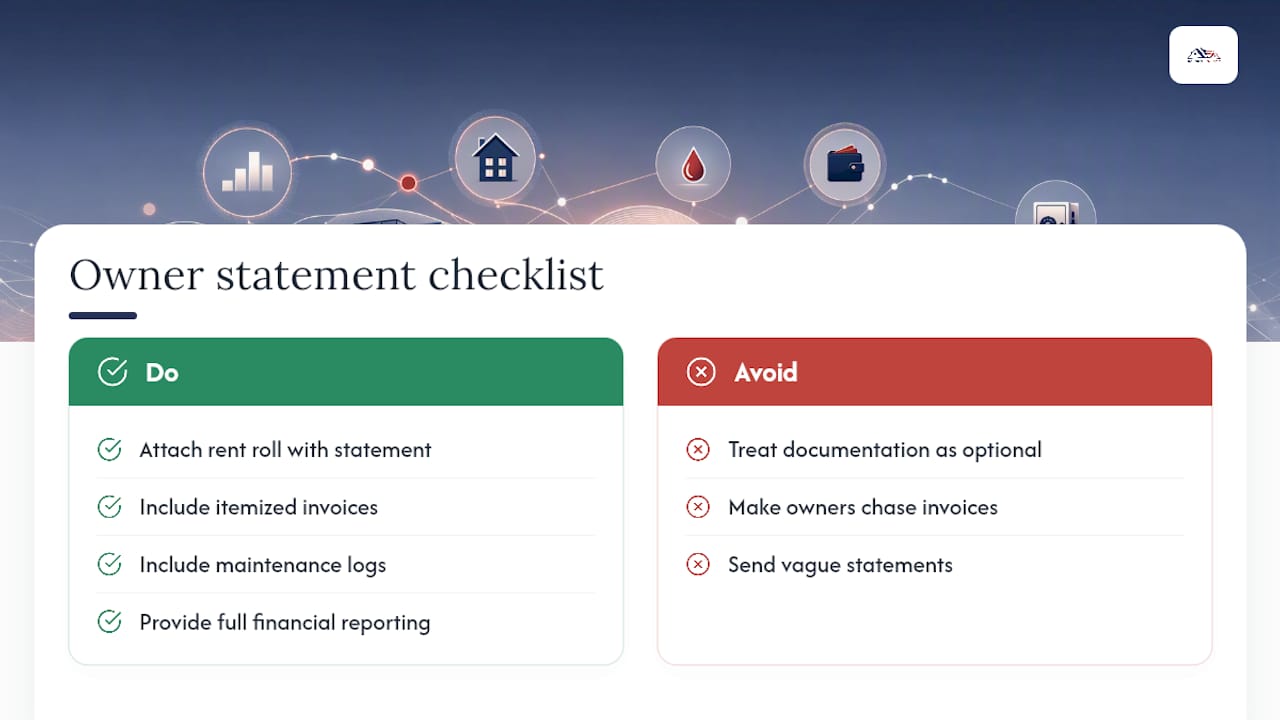
OneSource Real Estate builds its monthly owner packet around the same verification standard this article recommends: nothing goes on a statement without documentation behind it. Every packet includes the owner statement itself, a current rent roll, itemized invoices for the period, and a maintenance log showing open and completed work orders.
- Every expense line links to an invoice on file, not a summary description.
- Fee schedules are disclosed upfront in the management agreement, not buried in fine print.
- Owners get portal access to review transaction history between statements, not just at month-end.
This matches a growing standard across the industry: invoice-backed reporting and owner portal access reduce reconciliation time and cut down on the back-and-forth that erodes trust between owners and managers.
A statement you can't verify isn't a report. It's a claim. The value of invoice-backed reporting isn't the paperwork itself. It's that an owner never has to take a number on faith.
Local guidance on what full-service management looks like in practice is covered in OneSource Real Estate's broader owner's guide to property management services.
What Actually Matters When You Open a Statement
Most advice on owner statements treats every line item as equally important, and that's backward. Owners drown in categories when what they need is a hierarchy: check net distribution, then verify the two or three lines most likely to hide a problem, then move on with your day.
The conventional wisdom says read everything carefully every month. In practice, that's how owners burn out on reviewing statements after three months and start rubber stamping them. A tighter habit works better: spend real attention on reconciliation once a quarter, and do the sixty second net distribution check every month in between.
Where I'd push back hardest is on invoice backup. Too many owners treat it as something you request only when suspicious. It should be table stakes, the same way you'd never accept a receipt from a mechanic that just says "car repair, $600." A management relationship built on invoice-backed reporting from day one rarely turns into a dispute later, because there's nothing to hide and nothing to reconstruct after the fact.
— Matt
Get Owner Statements You Don't Have to Second-Guess
If you've made it this far, you already know the real cost of vague statements isn't confusion. It's the hours spent chasing down invoices that should have been attached from the start. OneSource Real Estate builds every owner packet around that principle: rent roll, itemized invoices, and maintenance logs included with the statement, not produced only after you ask.

That structure suits owners managing anywhere from a single rental to a growing portfolio across Atlanta and the surrounding area, especially owners who've been burned before by a manager who treated documentation as optional. OneSource Real Estate handles tenant screening, rent collection, maintenance coordination, and full financial reporting, so the statement you receive each month is something you can verify in minutes instead of interrogating for hours.
Ready to see what a properly documented owner statement looks like for your property? Visit OneSource Real Estate's property management page to get a quote and see how the reporting packet works before you sign anything.
This article is general information, not a substitute for advice from a qualified financial advisor. Consult a qualified financial professional about your own circumstances before acting on anything here.
Sources
For owners who want to go further than this guide, a few resources are worth bookmarking:
- What Is an Owner Statement? A Complete Guide for Landlords and Property Managers - TenantCloud
- Rental Property Owner Statements Explained - Basic Property Management
- Property management reporting - Buildium blog
FAQ
What Should a Landlord Statement Say?
A landlord statement should show the reporting period, beginning and ending balances, itemized income and expenses, management fees, reserve activity, and the net distribution paid to the owner.
What Is the 2% Rule for Rentals?
The 2% rule is a rough investment screening guideline suggesting monthly rent should equal roughly 2% of the property's purchase price, though most markets today make that threshold difficult to hit and it should never replace reviewing actual cash flow on your owner statement.
What Is the 7% Rule for Rental Property?
There's no widely recognized "7% rule" in property management or real estate investing; if you encountered this term, it likely refers to a specific lender's or investor's internal guideline rather than an industry standard.
What Does the 80/20 Rule Mean in Property Management?
In property management, the 80/20 rule generally refers to the idea that 80% of maintenance issues or tenant complaints tend to come from about 20% of units or tenants, which is why tracking patterns across your maintenance log matters as much as reviewing individual statements.
How Often Should I Receive an Owner Statement?
Most property managers, including OneSource Real Estate, issue owner statements monthly, with a more detailed annual summary provided at year-end for tax preparation.