
The moment multiple offers land, set a firm deadline, typically within a couple of days, and ask your agent for a net-proceeds comparison on every offer, not just the sticker price. Prioritize buyer strength (cash or a strong pre-approval) and minimal contingencies over a headline number that might not survive underwriting. How aggressive you can be depends on your price band and neighborhood; the metro's 4.7-month supply as of July 2026 means some sellers have more leverage than others.
TL;DR:
- A net-proceeds comparison on every offer helps identify the most financially beneficial deal, considering credits, financing, and contingencies rather than price alone.
- Focusing on offer strength, such as cash use and contingency waivers, outweighs headline price, especially in markets with 4.7 months of supply and variable seller leverage.
- Setting a firm offer review date, properly pricing the home, and enhancing presentation boost the likelihood of multiple offers in Atlanta’s competitive neighborhoods.
- Utilizing highest-and-best requests, capped escalation clauses, and verifying proof-of-funds are essential to winning multiple-offer situations and avoiding risky deals.
- Buyers' flexibility, including closing timelines and contingency waivers, often influences whether an offer closes smoothly more than the dollar amount offered.
Table of Contents
- Multiple Offers Strategy for Atlanta Sellers: Evaluating Competing Offers
- How to Set Up Your Atlanta Home to Attract Multiple Offers
- Should You Accept, Counter, or Ask for Highest and Best?
- Atlanta's Current Market: How Aggressive Should You Be Right Now?
- What OneSource Real Estate Has Seen Work in Real Multiple-Offer Deals
- Evaluating Non-Price Terms: Flexibility and Buyer Contingencies
- Mistakes Atlanta Sellers Make When Juggling Multiple Offers
- The Real Lesson From Atlanta's Multiple-Offer Deals
- How OneSource Real Estate Handles Multiple-Offer Situations for You
- Sources
- FAQ
Multiple Offers Strategy for Atlanta Sellers: Evaluating Competing Offers
Ranking offers by price alone is how sellers end up back on the market 30 days later after a deal falls through. Roughly 40% of failed real estate offers trace back to financing or appraisal problems, not cold feet. That single fact should change how you read every offer packet your agent hands you.
Compare offers across these components, not just the top line:
- Net proceeds after credits. A $460,000 offer with $8,000 in seller-paid closing costs nets less than a $450,000 offer with none.
- Financing type. Cash and conventional loans with strong down payments close more reliably than FHA or VA offers with thin reserves, though those aren't automatically weaker.
- Contingencies. Fewer contingencies, or a waived appraisal contingency, means fewer ways the deal collapses.
- Earnest money. Larger deposits signal buyer commitment; in competitive Atlanta submarkets, deposits above the typical 1% to 3% range are common.
- Closing date and rent-back requests. A buyer who needs to close in 21 days might beat a higher offer if you need to move fast, or hurt you if you need extra time.
Appraisal-gap guarantees and escalation clauses matter too. An appraisal-gap guarantee means the buyer covers the difference if the home appraises below the contract price, which protects your net number if the market is moving fast. Proof-of-funds documentation for cash buyers isn't optional. Ask for it before you take an offer seriously.
Score each offer 1 to 10 on each category, multiply by the weight, and add. A $470,000 cash offer with no contingencies will often outscore a $485,000 FHA offer with an appraisal contingency once you run the math.
Pro Tip: Ask your agent to build a one-page net-proceeds spreadsheet for every offer before you compare anything else. Numbers on a screen kill the "but it's the highest offer" instinct fast.
How to Set Up Your Atlanta Home to Attract Multiple Offers
Getting multiple offers isn't luck. It's a function of pricing, timing, and how the listing looks to buyers scrolling on their phones at 9 p.m.
- Price to the data, not your gut. In neighborhoods with fast turnover and low days-on-market, pricing slightly under recent comps often generates more competition than pricing at or above them. Well-priced, well-marketed homes still pull multiple offers in Atlanta's current market, particularly in price bands under the metro median.
- Set an offer review date. Instead of accepting offers as they trickle in, tell agents and buyers you'll review all offers on a specific date and time. This single move creates urgency and stops buyers from lowballing just to "get in early."
- Invest in presentation before you invest in ad spend. Professional photography, a clean staging pass, and a broker preview event do more to drive qualified traffic than boosting a social post to a generic buyer audience.
- Communicate the deadline everywhere. Put the offer review date in the listing remarks, tell every showing agent verbally, and confirm it in writing when buyers request disclosures.
Timing your listing to hit the market on a Thursday or Friday, so it's fresh for weekend showings, still works in most Atlanta submarkets. It's a small lever, but it compounds with everything else.
Should You Accept, Counter, or Ask for Highest and Best?
Accepting immediately makes sense only when an offer is clearly the strongest on price, financing, and terms, with no close competitor. That's rare. Most sellers with two or more comparable offers should run a highest-and-best request rather than negotiating with one buyer while others wait in the dark.
Here's how that process typically works:
- Notify all interested buyers' agents that you're requesting highest-and-best by a specific deadline, usually within 24 hours.
- Disclose that multiple offers exist (standard practice), but do not disclose competing offer terms unless the seller authorizes it. The NAR guide on multiple-offer negotiations outlines the ethical boundaries here.
- Ask each buyer for their best price, best terms, and any escalation clause they're willing to include.
A sample line an agent might send: "The seller has received multiple offers and is requesting highest-and-best terms by 6 p.m. Thursday. Please submit your strongest offer along with proof of funds or pre-approval."
Escalation clauses can work in your favor, but cap the escalation with a "not to exceed" ceiling and require the buyer to waive the appraisal gap above the original price. Keep one or two backup offers in writing with a kick-out clause option in case your primary contract falls through.
Pro Tip: Never let a buyer's agent talk you into skipping highest-and-best because "their buyer will walk." A serious buyer rarely walks over a fair, transparent process.
Atlanta's Current Market: How Aggressive Should You Be Right Now?
Metro Atlanta's median sales price hit $445,000 in July 2026, with an average sales price of $566,500 and homes moving in an average of 24 days.
By the numbers: 4.7 months of housing supply, 20,863 active listings, and a 24-day average time on market defined Metro Atlanta's July 2026 conditions.
A 4.7-month supply sits close to a balanced market, which means multiple-offer situations are far from universal across the metro. They're concentrated in specific pockets: starter homes under the median price, renovated properties in walkable neighborhoods, and anything priced noticeably below recent comps.
If your home sits above the metro median, expect fewer competing offers and more negotiating from buyers on inspection items and closing costs. If you're below the median in a high-demand submarket like parts of Decatur, East Atlanta, or Grant Park, expect the deadline-and-highest-and-best playbook above to apply in full. Adjust your pricing aggression to your specific price band, not the metro average.
What OneSource Real Estate Has Seen Work in Real Multiple-Offer Deals
A full-service real estate brokerage handling residential sales and property management in multiple metro area locations has observed a repeating pattern: sellers who chase the highest number without checking buyer strength often lose weeks. One seller accepted a $15,000-over-list cash-strapped offer over a clean, fully financed one at asking price; the deal collapsed at appraisal and the home relisted 19 days later. Another seller took a slightly lower, well-financed offer with a tight closing timeline and closed without a single delay.
Before your next agent call, request: proof-of-funds or pre-approval on every offer, a net-proceeds sheet, and a written contingency summary. Author Matt has reviewed enough of these deals to know the safe accept almost always beats the risky chase.
Evaluating Non-Price Terms: Flexibility and Buyer Contingencies
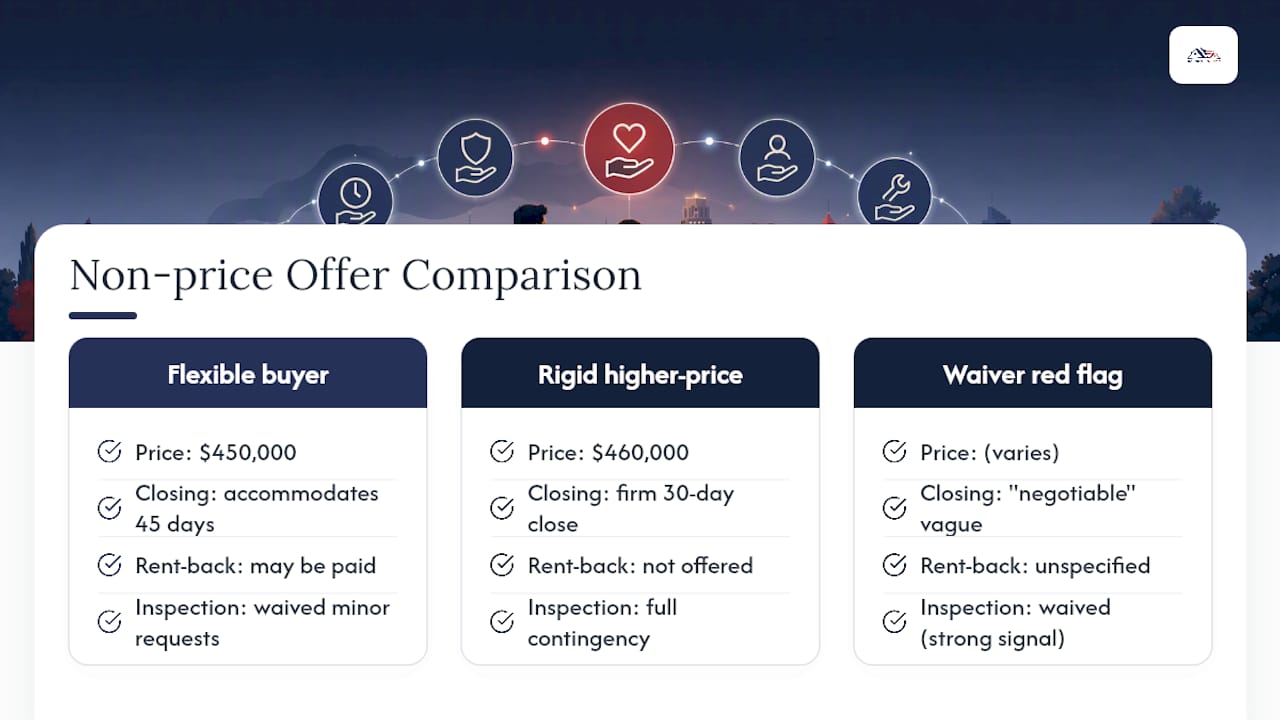
Price gets the headline, but non-price terms often decide which offer actually closes. A buyer offering $460,000 with a rigid 30-day close and a full inspection contingency can be riskier than a buyer at $450,000 who's flexible on your move-out date and has already waived minor repair requests.
Closing date flexibility matters more than most sellers expect. If you need 45 days to find your next home, a buyer willing to accommodate that, or offer a paid rent-back period, effectively adds value beyond their stated price. Ask every buyer's agent directly whether their client can flex on timing before you rank offers.
Contingency waivers deserve scrutiny too. A buyer who waives the inspection contingency entirely is taking on real risk, and that willingness usually signals confidence in their financing and their read of the property. But a waived financing contingency from a buyer with a shaky pre-approval letter is a red flag, not a strength.
Watch for buyers who bundle flexibility with vague language, "closing date negotiable, terms to be discussed," which sounds accommodating but leaves you with nothing enforceable. Get every flexible term in writing, with specific dates and dollar amounts, before you rank an offer above a firmer competing bid.
Mistakes Atlanta Sellers Make When Juggling Multiple Offers
The biggest mistake is treating the highest offer as automatically the best one. The second biggest is disclosing too much to competing buyers' agents, tipping your hand on exact competing terms instead of simply confirming multiple offers exist, which can violate the fair-dealing standards outlined in NAR's guidance.
Other recurring errors:
- Skipping proof-of-funds verification. Taking a buyer's word on cash or pre-approval without documentation invites the financing failures behind so many collapsed contracts.
- Setting a deadline and then caving early. If a buyer pressures you to respond before your stated offer review date, holding firm usually produces better terms from everyone, not worse.
- Ignoring earnest money size. A buyer offering the minimum earnest money deposit in a competitive situation is signaling less commitment than one offering double or triple that amount.
- Letting escalation clauses run uncapped. An escalation clause without a ceiling can push a buyer into a price they can't actually finance, setting up an appraisal fight later.
- Forgetting rent-back terms in the written contract. Verbal agreements about staying in the home after closing mean nothing without specific dates and daily rates in writing.
The Real Lesson From Atlanta's Multiple-Offer Deals
Most advice on handling multiple offers focuses too much on squeezing out the highest number and not enough on the buyer's ability to actually close at that number. That's backwards. A $10,000 premium is worthless if the deal dies at appraisal 25 days later and you're relisting in a market that's shifted against you.
The conventional wisdom, "take the highest bid," ignores that Atlanta's market right now rewards sellers who calibrate to their specific price band and neighborhood rather than reacting to headline numbers from a citywide average. A home priced under the median in a fast-moving pocket needs an aggressive deadline strategy. A home above the median needs more patience and more scrutiny on buyer flexibility.
If you take one thing from this: build the net-proceeds comparison before you fall in love with any single offer's top line. Everything else, escalation clauses, highest-and-best requests, rent-back negotiations, works better once that number is sitting in front of you in black and white.
— Matt
How OneSource Real Estate Handles Multiple-Offer Situations for You
OneSource Real Estate is the local alternative to going it alone with a part-time agent during a bidding war. As a full-service brokerage, the team builds your pricing and marketing strategy, runs the net-proceeds math on every offer you receive, and manages the highest-and-best process so you're never negotiating blind against buyers' agents who know more about the deal than you do.

That means listing strategy tuned to your specific Atlanta submarket, hands-on negotiation support through offer deadlines and escalation clauses, and closing coordination that catches financing red flags before they cost you weeks. If you're weighing whether to sell now or hold and rent instead, OneSource Real Estate also offers full-service property management for investors who'd rather keep the asset. Reach out for a consultation before your next listing goes live, and get a pricing and offer strategy built around your actual property and price band, not a generic script.
Sources
Review the Atlanta REALTORS® Market Brief, NAR's multiple-offer guide, and local guidance on contingencies in Georgia for deeper background.
- Atlanta REALTORS® Market Brief: July 2026
- How to Win a House Bidding War | Zillow
- 8 tips for winning a bidding war | Rocket Mortgage
- A Buyers' and Sellers' Guide to Multiple Offer Negotiations | NAR
FAQ
What Is the 3-3-3 Rule in Real Estate?
There's no single agreed-upon definition of a "3-3-3 rule" in residential real estate; the phrase is used inconsistently across markets and isn't a recognized industry standard, so treat any specific claim about it with caution.
How Much Should You Offer on a House With Multiple Offers?
There's no universal number. Base your offer on recent comps, then factor in financing strength, contingency waivers, and earnest money size, since buyer strength often matters as much as price to the seller reviewing your bid.
What Is the Hardest Month to Sell a House in Atlanta?
Winter months, particularly December and January, typically bring fewer buyers and slower activity than spring and summer in Atlanta, though a well-priced home in a tight-supply neighborhood can still draw offers year-round.
What Is the 80/20 Rule for Realtors?
It's a business-management concept, not a rule governing offer negotiations.
Should I Disclose Competing Offer Details to Buyers?
No. Standard practice is to confirm that multiple offers exist without revealing specific competing terms, which keeps the process fair and aligns with NAR's professional guidance on multiple-offer negotiations.