
Georgia buyers protect themselves by pairing a due diligence period (typically 10 to 14 days) with financing, inspection, and appraisal contingencies, then following GAR notice deadlines to the letter. That combination is what actually keeps your earnest money safe. The GAR Purchase and Sale Agreement gives you the forms; a local resource like OneSource Real Estate can help you use them correctly.
TL;DR:
- Including a broad due diligence period allows Georgia buyers to cancel for any reason and recover earnest money if they act within the deadline.
- Properly timing and completing inspections, financing, and title reviews during the due diligence window is crucial to avoid losing leverage or earnest money.
- Financing contingencies require active effort and timely document submission to ensure protection if the lender denies the loan under specified terms.
- Common contingencies like appraisal, title, and HOA reviews must be explicitly included and managed to prevent unexpected costs or deal cancellations.
- Accurate, calendar-specific deadlines and professional transaction management significantly reduce the risk of losing earnest money or facing contractual disputes.
Table of Contents
- What Home Offer Contingencies Should Georgia Buyers Include?
- Due Diligence Period in Georgia: What to Do and Why It Matters
- Financing Contingency: What "Good-Faith Effort" Actually Means
- Inspection Contingency: Turning Findings Into Leverage
- Appraisal, Title, and HOA Contingencies: The Overlooked Risks
- Earnest Money and Escrow: Getting Your Refund Right
- Writing Your Offer: A Field-Ready Checklist
- How OneSource Real Estate Helps Georgia Buyers Manage Contingencies
- The One Rule That Protects Georgia Buyers
- Let OneSource Real Estate Handle the Deadlines for You
- Sources
- FAQ
What Home Offer Contingencies Should Georgia Buyers Include?
A Georgia offer is only as strong as the exits it builds in. Here's the standard lineup buyers should have on their radar before writing an offer:
- Inspection contingency: triggered by what a licensed inspector finds, giving you room to negotiate repairs or walk away.
- Due diligence period: the broadest protection in the contract, letting you terminate for almost any reason and get your earnest money back if you act before the deadline.
- Financing contingency: tied to specific loan terms (rate, type, amount) rather than financing in general.
- Appraisal contingency: protects you if the lender's appraisal comes in below the contract price.
- Title, HOA, and survey contingencies: cover liens, association restrictions, and boundary issues; a sale-of-home contingency is worth adding if you're selling a current property to fund this purchase.
Each one solves a different problem. Layering them, rather than picking just one, is what Georgia's consumer guidance means when it says a good offer "gives you a way out."
Due Diligence Period in Georgia: What to Do and Why It Matters
The due diligence period is the closest thing to a free option a Georgia buyer gets. During this window, commonly 10 to 14 days, you can terminate for any reason at all and still get your earnest money back, as long as you send written notice before it expires.
Use the time deliberately. That means scheduling your general and specialty inspections, ordering a title search, pulling a survey if boundaries matter, reviewing HOA or condo documents for restrictions and fees, and pushing your lender toward conditional loan approval. Once due diligence ends, your ability to walk away narrows sharply, and other contingencies won't fully substitute for it.
If you need more time, ask for a due diligence extension in writing before the deadline hits, not after. Letting the period lapse without finishing your homework is the single most common way Georgia buyers lose leverage, and sometimes earnest money, over something that could have been caught in week one.
Financing Contingency: What "Good-Faith Effort" Actually Means
A financing contingency in a GAR contract isn't a blanket promise that you'll get a loan. It's tied to specific terms, loan type, amount, and rate ceiling, spelled out in the GAR financing exhibit. If your lender denies financing outside those parameters, the contingency may not protect you.
To keep the protection intact, you have to show a "good-faith effort" to get the loan: submitting documents on time, responding to underwriter requests promptly, and locking your rate when appropriate. Courts and contract language both look at whether you actively pursued financing, not whether financing simply fell through.
If trouble surfaces, appraisal gap, credit issue, underwriting delay, don't wait. Extend due diligence if you still have room, renegotiate terms with the seller, or add a stipulation addressing the specific problem before your deadlines close in.
Inspection Contingency: Turning Findings Into Leverage
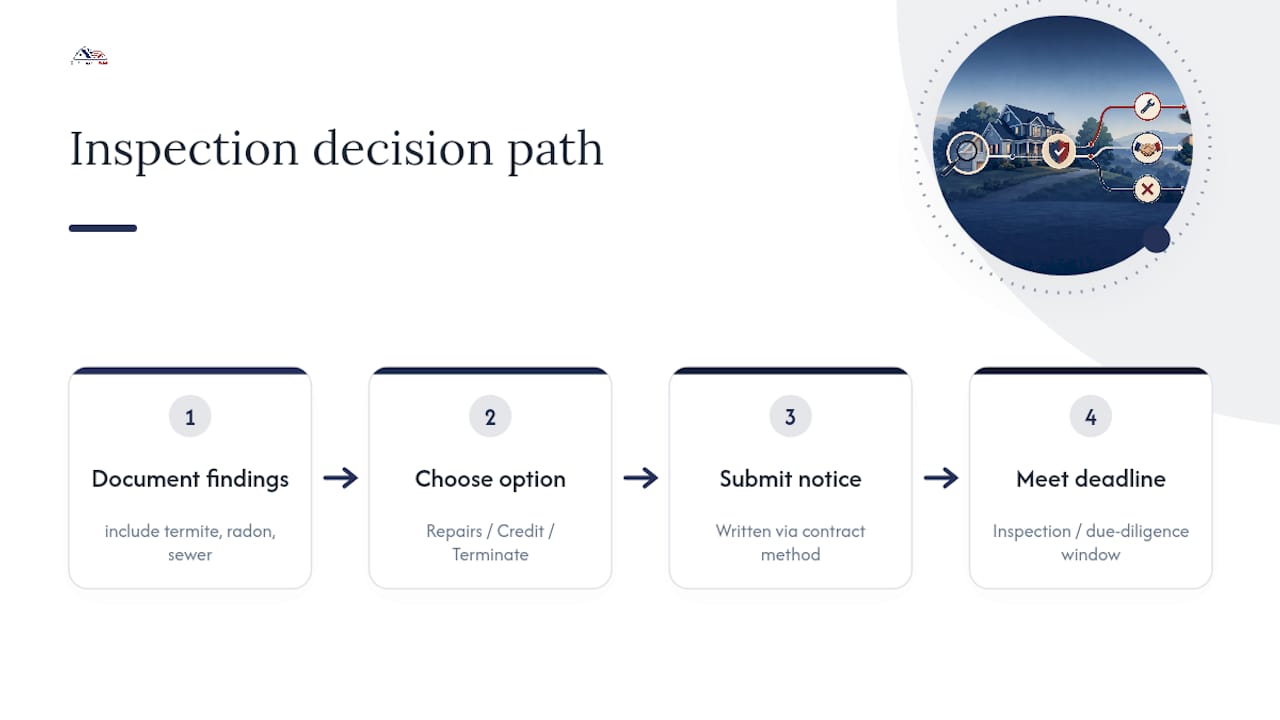
A general home inspection covers the big systems: roof, HVAC, plumbing, electrical, foundation. But Georgia's climate and housing stock make specialty inspections worth the extra cost, particularly wood-destroying organism (termite) reports, radon testing, and sewer scopes on older homes.

Once you have results, you've got three real paths: ask for repairs, negotiate a credit or price reduction, or terminate the contract outright, all of which need to happen inside the inspection or due diligence window. Whatever you choose, put it in writing and deliver it through the method your contract specifies, email, fax, or hand delivery, before the clock runs out. A verbal objection to your agent doesn't count for anything if a dispute comes up later.
Appraisal, Title, and HOA Contingencies: The Overlooked Risks
A low appraisal doesn't kill a deal automatically. You can renegotiate the price, pay the gap in cash, or cancel under the appraisal contingency, but only if that contingency is actually written into your offer.
Title issues, liens, judgments, clouded ownership, are a different animal. Insist the seller cure any defect before closing rather than accepting a promise to "handle it later." And if you're buying into an HOA or condo association, pull the resale certificate and financial disclosures early. Special assessments and pending litigation buried in those documents can change the math on a purchase fast.
Earnest Money and Escrow: Getting Your Refund Right
Georgia buyers typically put down 1% to 3% of the purchase price as earnest money, usually held by the closing attorney rather than a brokerage. That detail matters because the attorney's office, not your agent, controls the release of those funds.
To get a refund, you have to terminate correctly: written notice, delivered by the method the contract specifies, before the relevant contingency deadline, not after. GAR contracts often carry "time is of the essence" language, which means a late notice can convert a valid exit into a default. If the seller disputes your termination, the funds can end up in interpleader or mediation, which delays your refund even when you did everything right. That's the point where talking to a real estate attorney stops being optional.
Writing Your Offer: A Field-Ready Checklist
Vague language is what turns a good contingency into an unenforceable one. Before you submit an offer, confirm these fields are filled in with specifics, not placeholders:
- Binding agreement date (the anchor point every other deadline counts from).
- Due diligence deadline, written as a calendar date, not "10 days."
- Delivery method for inspection objections (email, fax, hand delivery).
- Escrow holder name and contact information.
- Earnest money amount and due date.
- Financing exhibit details: loan type, maximum interest rate, loan amount.
- Appraisal resolution window and remedy options.
Pro Tip: Always convert deadlines into actual calendar dates tied to the binding agreement date rather than relative terms like "within 10 days." If a dispute ever arises over the binding agreement date itself, GAR Form F733 exists specifically to confirm it, so keep every notice in writing and keep copies.
How OneSource Real Estate Helps Georgia Buyers Manage Contingencies
Missing a deadline by a day can cost you earnest money that a stronger process would have protected. A real estate firm helps Georgia buyers calendar every contingency deadline off the binding agreement date, coordinate inspectors, lenders, and appraisers on a workable timeline, and draft stipulation language specific to a property's issues instead of relying on boilerplate.
When a dispute over earnest money or a title defect moves past standard contract remedies, OneSource Real Estate advises bringing in a closing attorney or real estate litigator rather than trying to negotiate it out informally.
The One Rule That Protects Georgia Buyers
If I had to boil this whole process down to one rule, it's this: finish your inspections and lock down your financing during due diligence, not after. Most of the earnest money disputes I've seen trace back to buyers who assumed a later contingency would cover a problem they could have caught, and solved, in the first two weeks.
— Matt
Let OneSource Real Estate Handle the Deadlines for You
Reading a checklist is one thing. Tracking a due diligence clock, a lender's documentation requests, and an inspector's report all at once, while also negotiating with a seller's agent, is another. OneSource Real Estate offers buyer representation and full transaction management for Georgia buyers who want someone watching every deadline and drafting every stipulation with precision, not just handing over a template.
That means calendarizing your binding agreement date, coordinating inspections and lender conditions inside your due diligence window, and making sure your termination notices go out the right way, on time, every time. If you're preparing an offer anywhere in metro Atlanta, Marietta, Johns Creek, Alpharetta, Powder Springs, or Austell, visit the OneSource Real Estate property management and buyer services page to get in touch and start your transaction with someone managing the details from day one.
Sources
- Georgia Due Diligence Period & Purchase Contract Guide | Georgia Title & Escrow Company
- The buyer’s right to terminate a residential sales contract in Georgia | LegalClarity
- Making an offer - Consumer Ed - Georgia.gov
FAQ
What contingencies should be put in an offer for a house?
At minimum, include a due diligence period, an inspection contingency, a financing contingency tied to specific loan terms, and an appraisal contingency; add title, HOA, or sale-of-home contingencies as your situation requires.
What do sellers pay at closing in Georgia?
Sellers typically cover their own attorney fees, any agreed repair credits, and prorated property taxes, though exact terms depend on the purchase agreement negotiated between buyer and seller.
What is typical earnest money in Georgia?
Earnest money in Georgia usually runs 1% to 3% of the purchase price and is held in escrow by the closing attorney rather than the real estate brokerage.
Do most sellers accept contingent offers?
Sellers routinely accept offers with standard contingencies like due diligence, financing, and inspection, since these are built into the GAR Purchase and Sale Agreement that most Georgia transactions use; heavily stacked or unusual contingencies can weaken an offer in a competitive market.