
In Georgia, earnest money is a good-faith deposit that must be placed in escrow quickly and is refundable only while contract contingencies apply. The moment both parties sign and the Binding Agreement Date is established, the clock starts: Georgia requires the deposit into a trust or escrow account within five banking days of that date. Miss that window and you risk a technical default under the GAR contract.
The deposit is refundable during negotiated contingency periods (due diligence, financing, appraisal) and typically becomes non-refundable once those windows close. Here are three things every buyer should do the moment a contract is executed:
- Name the escrow holder and an alternate on the GAR F510 exhibit before signing.
- Record the Binding Agreement Date and count five banking days forward to set your deposit deadline.
- Get written confirmation of delivery and deposit from the holder.
Key Takeaways
Earnest money in Georgia must be deposited within five banking days of the Binding Agreement Date, is refundable during active contingency periods, and becomes the seller's liquidated damages if the buyer defaults after those windows close.
| Point | Details |
|---|---|
| Deposit deadline | Funds must reach escrow within 5 banking days of the Binding Agreement Date. |
| Typical deposit range | Georgia buyers commonly offer 1–3% of the purchase price as earnest money. |
| Refund window | Earnest money is fully refundable if the buyer terminates in writing during the due diligence period. |
| Dispute resolution | Holders stay neutral; disputes go to mediation, arbitration, or interpleader before funds are released. |
| OneSource Real Estate | Provides buyer representation, escrow coordination, and deadline tracking for Georgia buyers and investors. |
Table of Contents
- What earnest money in Georgia actually is — and why it matters
- How much earnest money to offer in Georgia
- When, how, and to whom earnest money must be delivered in Georgia
- When earnest money is refundable in Georgia
- What happens when buyer and seller disagree over the deposit
- Practical steps to protect your earnest money deposit
- Three realistic scenarios showing how earnest money plays out
- OneSource buyer strategy: balancing a competitive offer with earnest money risk
- Working with OneSource Real Estate on your Georgia purchase
- A note on protecting yourself in Georgia's market
- Sources
- FAQ
What earnest money in Georgia actually is — and why it matters
Earnest money is a deposit a buyer puts up to show the seller the offer is serious. At closing, it is credited toward the down payment or closing costs, so it is not an extra expense. Think of it as money you were going to spend anyway, just held in escrow until the deal closes.
What separates earnest money from a due diligence fee is refundability. Under standard GAR practice, a due diligence fee paid directly to the seller is almost always non-refundable from day one. Earnest money, by contrast, stays refundable throughout the negotiated contingency periods. Once those periods expire, the deposit generally "goes hard" and the seller can claim it if the buyer walks.

Who holds the money matters. In most Georgia residential transactions, the escrow holder is either the closing attorney or the listing broker. The holder's role is strictly neutral: they do not work for the buyer or the seller.
Sellers request earnest money for two practical reasons:
- It signals the buyer is financially committed, not just browsing.
- Under standard GAR remedy language, it serves as liquidated damages if the buyer defaults after contingencies expire, giving the seller a defined recovery without litigation.
How much earnest money to offer in Georgia
Earnest money deposits in Georgia commonly fall in the 1–3% range of the purchase price, though market conditions push that number around. That spread matters when you are weighing how much you are willing to put at risk.
Several factors should shape your number:
- Market temperature. In a competitive Atlanta seller's market, a 1% deposit may not stand out. Buyers in multiple-offer situations sometimes go to 2–3% or higher to signal commitment.
- Loan type. FHA and VA buyers often keep deposits lower because their financing contingencies carry more conditions. Conventional buyers with strong pre-approvals can afford to go higher.
- Investor vs. owner-occupant. Investors buying with cash or tight timelines sometimes offer larger deposits to accelerate negotiations, but they also tend to negotiate shorter due diligence periods.
- Your liquidity. A larger deposit is only a competitive advantage if you can actually fund it without straining your reserves.
Pro Tip: If you want to offer a higher deposit to win a competitive bid, protect yourself by negotiating a longer due diligence period. A bigger number with a strong contingency structure is almost always better than a smaller number with no contingencies.
When, how, and to whom earnest money must be delivered in Georgia
The GAR contract uses two forms together: the F201 purchase and sale agreement and the F510 escrow exhibit. F201 is the main contract. F510 identifies the escrow holder, sets the delivery requirements, and triggers the deposit timeline. Getting the F510 right is where most buyers make avoidable mistakes.
Here is the standard sequence when a closing attorney is named as holder:
- Binding Agreement Date is established. Both parties have signed; the clock starts.
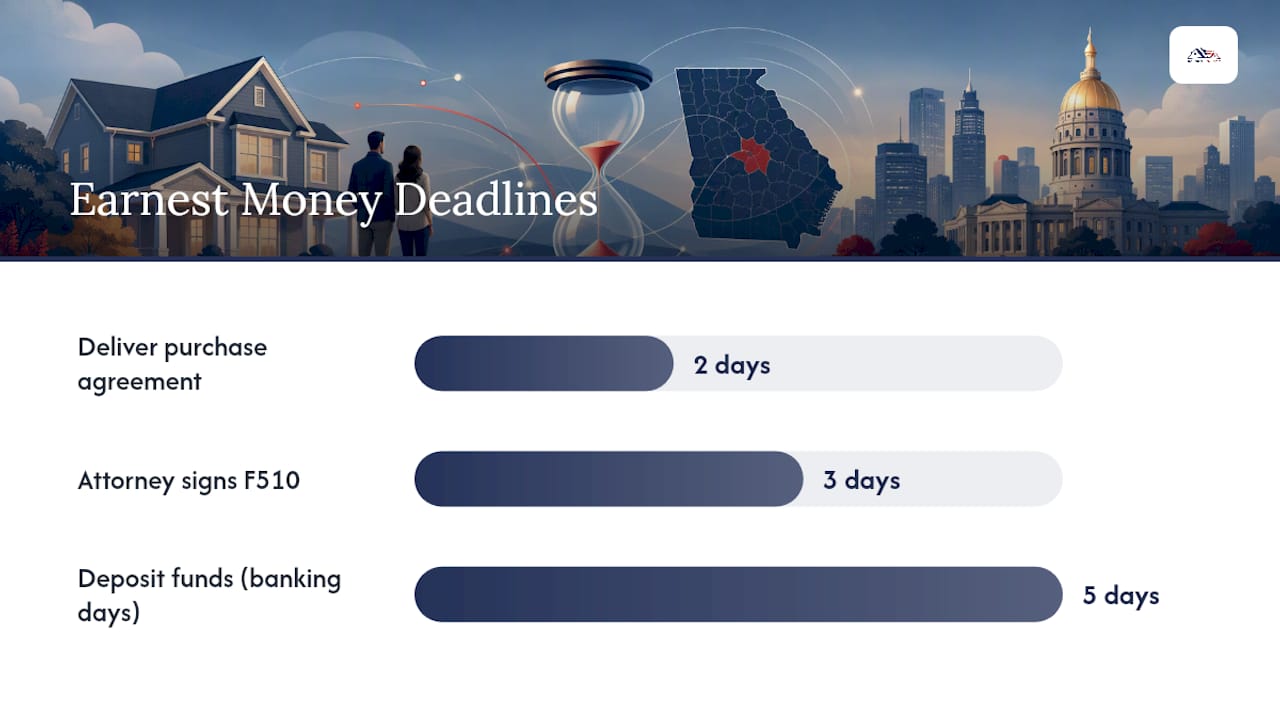
- Deliver the purchase agreement to the closing attorney within two days of the Binding Agreement Date.
- The attorney has three days to sign and return the escrow exhibit. If the attorney fails to sign within that window, the named alternate holder on the F510 steps in.
- Deposit funds into the escrow account within five banking days of the Binding Agreement Date. Banking days exclude weekends and federal holidays.
- Confirm receipt in writing. Get a written acknowledgment from the holder that the funds are in escrow.
When a closing attorney holds funds, the account is typically an IOLTA (Interest on Lawyers' Trust Accounts) account, which carries specific bar rules about chain of custody and interest handling. That structure actually reduces disputes because the attorney follows a clear professional protocol.
If the named holder fails to act and no alternate is listed on the F510, the deposit process stalls and you may face a default claim. Always name a backup.
Wire safety note: Verify wiring instructions by calling the closing attorney at a phone number you looked up independently, not one from an email. Wire fraud targeting real estate transactions is common, and a misdirected wire is nearly impossible to recover.
When earnest money is refundable in Georgia
The due diligence period generally gives the buyer an unrestricted right to terminate and recover the full earnest money deposit.. No reason required. The buyer simply delivers written notice of termination before the due diligence period expires, and the holder releases the funds. After that period closes, the deposit is generally at risk unless a surviving contingency still applies.
Common contingencies that can preserve refund rights after due diligence:
- Financing contingency. If the buyer cannot obtain the loan described in the financing exhibit and provides proper notice, the deposit is typically refundable. The exact language in the loan exhibit controls, so read it carefully.
- Appraisal contingency. If the property appraises below the purchase price and the parties cannot agree on a price adjustment, the buyer may be able to exit with the deposit intact, depending on the exhibit language.
- Title contingency. Unresolvable title defects can give the buyer an exit with a refund.
Timeline outcomes in plain terms:
- Buyer terminates during due diligence with proper written notice. Full refund of earnest money.
- Buyer terminates after due diligence without a surviving contingency. Deposit is at risk; seller can claim it as liquidated damages.
- Buyer loses financing after due diligence but within the financing contingency window. Refund depends on whether the buyer met all conditions in the financing exhibit and gave timely notice.
To preserve refund rights, buyers must:
- Deliver written termination notice before the applicable deadline, not after.
- Use the correct GAR notice form or a written notice that meets contract requirements.
- Keep dated proof of delivery (email with read receipt, certified mail, or hand-delivery confirmation).
- Never assume a verbal conversation with the listing agent counts as notice.
If the buyer's earnest money payment is dishonored or not delivered, the GAR contract gives the seller notice and cure rights, with a limited banking-day window for the buyer to fix the problem. Fail to cure and the seller can terminate and pursue the deposit.
What happens when buyer and seller disagree over the deposit
The escrow holder will not pick a side. When parties dispute earnest money disposition, the holder requires joint written instructions, a contract dispute resolution result, or a court order before releasing funds. That neutrality protects both parties, but it also means a disputed deposit can sit frozen for weeks or months.
When a dispute cannot be resolved by agreement, the escrow holder's most common legal move is to file an interpleader action — depositing the funds with the court and asking a judge to decide who gets them. The holder steps out of the conflict entirely, though the court may deduct reasonable filing costs from the funds before distribution.
Interpleader is a judicial procedure that lets the holder avoid liability by surrendering the money to the court. It is not a fast process, and the legal fees on both sides can eat into whatever amount is ultimately awarded.
Dispute paths, from fastest to slowest:
- Joint written instructions. Both parties agree in writing on how to release the funds. Fastest resolution, no cost.
- Mediation. GAR contracts typically include a mediation clause. A neutral mediator helps the parties reach a settlement. Usually faster and cheaper than litigation.
- Arbitration. Some GAR contracts include binding arbitration. The arbitrator's decision is final.
- Interpleader/litigation. The holder files with the court, or one party sues. Slowest and most expensive.
On the remedies side: sellers in standard GAR transactions typically rely on liquidated damages, meaning the earnest money is their full recovery for a buyer default. Buyers whose seller refuses to close have a different option. Because Georgia courts treat real estate as unique, specific performance is a recognized remedy — a court can order the seller to complete the sale rather than just pay damages.
Practical steps to protect your earnest money deposit
Most deposit losses are preventable. The buyers who lose money almost always missed a deadline, skipped a written notice, or wired funds to the wrong account.
- Name the closing attorney as holder and list an alternate on the F510. If the primary holder fails to act, the alternate steps in automatically.
- Count banking days, not calendar days. A deposit due "within five banking days" of a Friday Binding Agreement Date is not due the following Wednesday if there is a federal holiday in between.
- Wire funds only after verifying instructions by phone to a number you sourced independently.
- Get a written deposit confirmation from the holder the same day you wire.
- Keep every piece of paper: the signed F510, the wire confirmation, the delivery receipt, and any notice you send during the contingency period.
- Never pay by personal check without a backup plan. A bounced check triggers the GAR cure window and puts you in default territory immediately.
Pro Tip: A shorter due diligence period with a larger deposit is a competitive combination in Atlanta's tighter markets. But if you shorten due diligence, make sure your inspector can get in the property within the first two or three days, not the last.
Structuring contingencies well is as important as the deposit amount. A buyer who offers $10,000 in earnest money with a 10-day due diligence period and a solid financing contingency is in a stronger position than one who offers $15,000 with no contingencies and a rushed timeline.
Three realistic scenarios showing how earnest money plays out
Scenario 1: Buyer backs out during due diligence
A buyer goes under contract on a $350,000 home in Marietta with $5,000 in earnest money and a 10-day due diligence period. On day seven, the inspection reveals significant foundation issues. The buyer delivers written termination notice on day eight. The holder releases the full $5,000 to the buyer.
The action that protected the buyer: Written notice delivered before the due diligence deadline.
Scenario 2: Buyer misses the financing deadline
A buyer under contract on a $425,000 home in Alpharetta loses their loan approval after due diligence closes. The financing contingency had a hard deadline of 21 days from the Binding Agreement Date. The buyer's lender notifies them on day 24. Because the financing contingency expired before the denial, the $8,500 deposit is at risk. The seller claims it as liquidated damages.
The action that would have changed the outcome: Requesting a financing contingency extension in writing before day 21.
Scenario 3: Seller refuses to close
A buyer has a fully executed contract on a $500,000 home in Decatur. The seller receives a higher offer two weeks before closing and refuses to convey the property. The buyer's deposit is held in escrow. The buyer files for specific performance in Georgia Superior Court, seeking an order compelling the sale. If successful, the buyer gets the property and the deposit is applied at closing.
When to call a professional: Any time a seller refuses to close on a valid contract, contact a real estate litigation attorney and your buyer's agent immediately. OneSource Real Estate can coordinate referrals to qualified real estate counsel when disputes escalate.
OneSource buyer strategy: balancing a competitive offer with earnest money risk
The right earnest money amount depends on what you are trying to accomplish and how much risk you can absorb.
For investors, the calculus is different. A cash buyer or an investor using a hard money loan may offer a larger deposit with a shorter or waived due diligence period to close faster. That works when the investor has already done preliminary diligence. Owner-occupants should almost never waive due diligence entirely, regardless of market pressure.
That combination is competitive without leaving you exposed if the inspection turns up a problem.
The surrounding Atlanta market areas — Marietta, Alpharetta, Decatur, Smyrna, and Roswell — each have their own pace.
Working with OneSource Real Estate on your Georgia purchase

Tracking deposit deadlines, coordinating with closing attorneys, and structuring contingencies correctly are exactly where buyer representation pays for itself. OneSource Real Estate works with buyers and investors across Atlanta and the surrounding areas, handling the escrow coordination, deadline calendaring, and wiring verification that protect your deposit from day one. For investors managing multiple acquisitions, the firm's full-service property management in Atlanta means you have one team from offer to ongoing ownership. Contact OneSource Real Estate to get a buyer's agent on your side before you make your next offer.
A note on protecting yourself in Georgia's market
The buyers who get hurt on earnest money almost always knew the rules in theory but skipped a step under time pressure. They sent a notice a day late. They wired funds without calling to verify the account. They let the due diligence period expire while still negotiating repairs. Georgia's GAR contract is detailed and deadline-driven, and those deadlines do not bend because you were busy.
My honest advice: treat the Binding Agreement Date like a starting gun. The moment that date is set, calendar every deadline in banking days, confirm your holder, and get your funds wired. Everything else in the transaction is negotiable. The deposit timeline is not.
This article is general information, not a substitute for advice from a qualified lawyer. Consult a qualified legal professional about your own circumstances before acting on anything here.
Sources
Before you sign a GAR contract, these are the primary documents worth reviewing:
- Agency Law: In Georgia, earnest money must be deposited within: | Real Estate Exam Podcast | EstatePass
- How to fill out the GAR form F201 Georgia purchase and sale agreement
- Georgia Transaction Guide: How Closings Work — Deal Run
- interpleader — Wex Legal Encyclopedia | Cornell Law School
For investors comparing earnest money handling to security deposit rules in Georgia rental transactions, the Georgia security deposit law covers the parallel framework for landlords and tenants.
FAQ
Is earnest money refundable in Georgia?
Yes, earnest money is refundable in Georgia if the buyer delivers written termination notice before the due diligence period expires or while a surviving contingency (financing, appraisal, title) still applies. After those windows close, the deposit is generally non-refundable.
How much is earnest money on a $400,000 house in Georgia?
The right amount depends on market competition, loan type, and how much contingency protection the buyer negotiates.
Who keeps earnest money if a deal falls through in Georgia?
It depends on when and why the deal fell through. If the buyer terminates properly during due diligence or under a valid contingency, the buyer gets the deposit back. If the buyer defaults after contingencies expire, the seller typically keeps the earnest money as liquidated damages under standard GAR contract terms.
What do sellers pay at closing in Georgia?
Sellers in Georgia typically pay the real estate agent commissions, transfer taxes, and any agreed-upon closing cost credits. Earnest money is a buyer's deposit credited at closing, not a seller's cost.
What happens if earnest money is not deposited on time in Georgia?
Missing the five-banking-day deposit deadline under Georgia rules and GAR practice puts the buyer in default. The GAR contract gives the seller notice and cure rights, but if the buyer fails to cure within the specified window, the seller can terminate the contract and pursue the deposit.