
An appraisal gap clause is contract language stating who pays if a home appraises below the agreed purchase price. In most Georgia contracts, that burden falls on the buyer unless the clause says otherwise, and once it comes into play, you have three real options: bring extra cash to closing, renegotiate the price with the seller, or terminate the deal if your appraisal contingency allows it.
TL;DR:
- Most appraisal gap clauses in Georgia specify a fixed dollar or percentage cap, determining how much the buyer is responsible for if the appraisal is low.
- The median home price in Georgia remains around $360,000, making tight bidding situations and market acceleration likely to produce appraisal gaps.
- Lenders base loan amounts on the appraised value, not the contract price, which can leave buyers responsible for sizable shortfalls if the appraisal comes in below offer.
- Buyers should prioritize capped gap clauses combined with proof of funds and understand response deadlines, rather than waiving appraisal contingencies entirely.
- Negotiating favorable contract language and preparing for low appraisals can help buyers avoid significant unexpected expenses in a competitive market.
Table of Contents
- How Do Appraisal Gap Clauses Affect Your Loan Amount?
- Why Are Appraisal Gaps More Common in Georgia Right Now?
- What Types of Appraisal Gap Clauses Exist?
- How Do You Calculate the Cash Gap on a Low Appraisal?
- How Can You Protect Yourself When Making an Offer?
- What Are the Georgia Contract Deadlines You Need to Know?
- What Local Agents Actually See on the Ground
- What This Means for Georgia Buyers Right Now
- How OneSource Real Estate Helps You Navigate an Appraisal Gap
- Sources
- FAQ
How Do Appraisal Gap Clauses Affect Your Loan Amount?
Lenders never loan against the price you agreed to pay. They loan against whichever number is lower: the contract price or the appraised value. A licensed appraiser determines that value by pulling recent comparable sales, walking the property's condition, and weighing local market trends, then submitting a report the lender relies on to finalize your loan.
Here's where the gap becomes a real cash problem. If the appraisal comes back at $385,000, your lender won't loan more than the loan-to-value ratio allows on that lower number. The shortfall between your contract price and what the lender will actually fund becomes your responsibility, not the seller's, unless your contract shifts that risk elsewhere.
A few mechanics worth knowing before you sign anything:
- Loan-to-value ratios are calculated off the appraised value, not the price you offered.
- A low appraisal can also shrink your down payment percentage on paper, since the lender treats the gap as unfinanced.
- The CFPB's appraisal rules require lenders to give you access to your appraisal report, which matters if you need to dispute the number later.
- Federal guidance also pushed for improved consumer access to appraisal reports, so ask your loan officer for the report the moment it's ready, not the day before closing.
Statistic Callout: Georgia's statewide median sales price sat around $360,000 in late 2025 and into 2026, with homes spending more days on market than during the pandemic peak. That combination, slower pace plus elevated pricing, is exactly the setup where appraisals lag behind what buyers are willing to pay.
Why Are Appraisal Gaps More Common in Georgia Right Now?
Georgia's market hasn't cooled uniformly. Some Atlanta submarkets still see bidding wars that push contract prices well past what recent comps support, and appraisers are contractually bound to the data, not the emotion of a multiple-offer situation.
A few patterns show up again and again in metro Atlanta transactions:
- Bidding wars in tight inventory pockets push prices above what comparable closed sales justify.
- Rapid price growth in a specific zip code outpaces the comps an appraiser can legally use.
- Unusual renovations or additions (a finished basement, a custom kitchen) don't always translate to dollar-for-dollar value in an appraisal.
- Timing mismatches, where comps used are three or four months old, miss a market that moved since then.
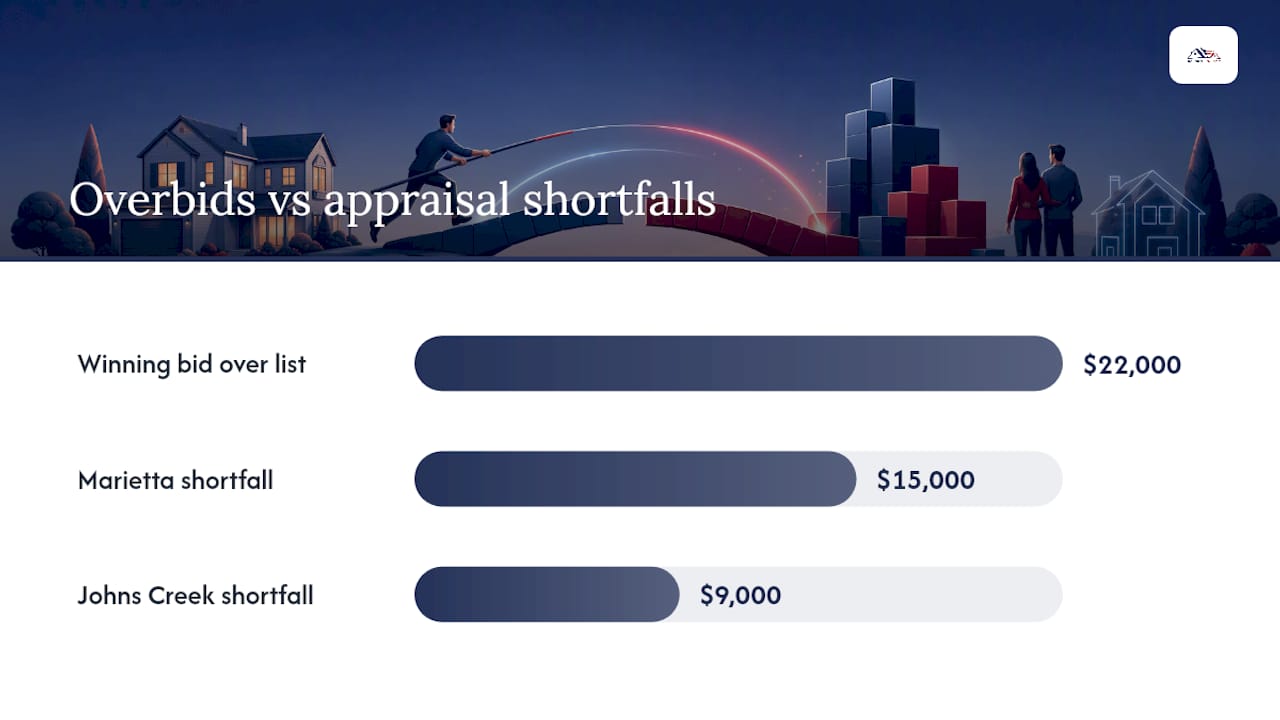
Two quick scenarios illustrate this. In a Marietta subdivision with eleven offers on one listing, the winning bid landed $22,000 over list, and the appraisal came in $15,000 short of that final price. Separately, a seller in an older Johns Creek neighborhood who'd updated the kitchen and bathrooms expected top dollar, but the appraiser weighted the home's 1990s bones more heavily than the recent updates, landing the value $9,000 under contract.
What Types of Appraisal Gap Clauses Exist?
Not every gap clause carries the same risk. The version you agree to shape how much leverage you keep if the number comes back low.
- Fixed-dollar cap. You agree to cover a specific amount, say up to $5,000, if the appraisal falls short. Beyond that number, you can renegotiate or exit. This is the most common structure agents see in competitive Atlanta offers.
- Percentage cap. You commit to covering a gap up to a percentage of the purchase price, often 2% to 3%. On a $450,000 home, a 3% cap means you're on the hook for up to $13,500 before the clause runs out of coverage.
- Full-gap coverage. You agree to pay whatever gap appears, with no ceiling. This is the most attractive offer to a seller and the riskiest for you, since your cash exposure has no defined limit.
- Mixed structure. A capped gap paired with a time-limited amendment right, so if the shortfall exceeds your cap, you get a short window (often a few days) to renegotiate before the contract terminates.
A few drafting notes matter here:
- A fixed-dollar cap gives you the clearest exit point and the easiest math to plan around.
- A percentage cap scales with price, which helps in higher-price listings but adds a step of math buyers often skip.
- Full-gap offers win multiple-offer situations more often, but only make sense with substantial cash reserves behind them.
How Do You Calculate the Cash Gap on a Low Appraisal?
Here's the math, step by step, using a realistic Atlanta-suburb scenario.
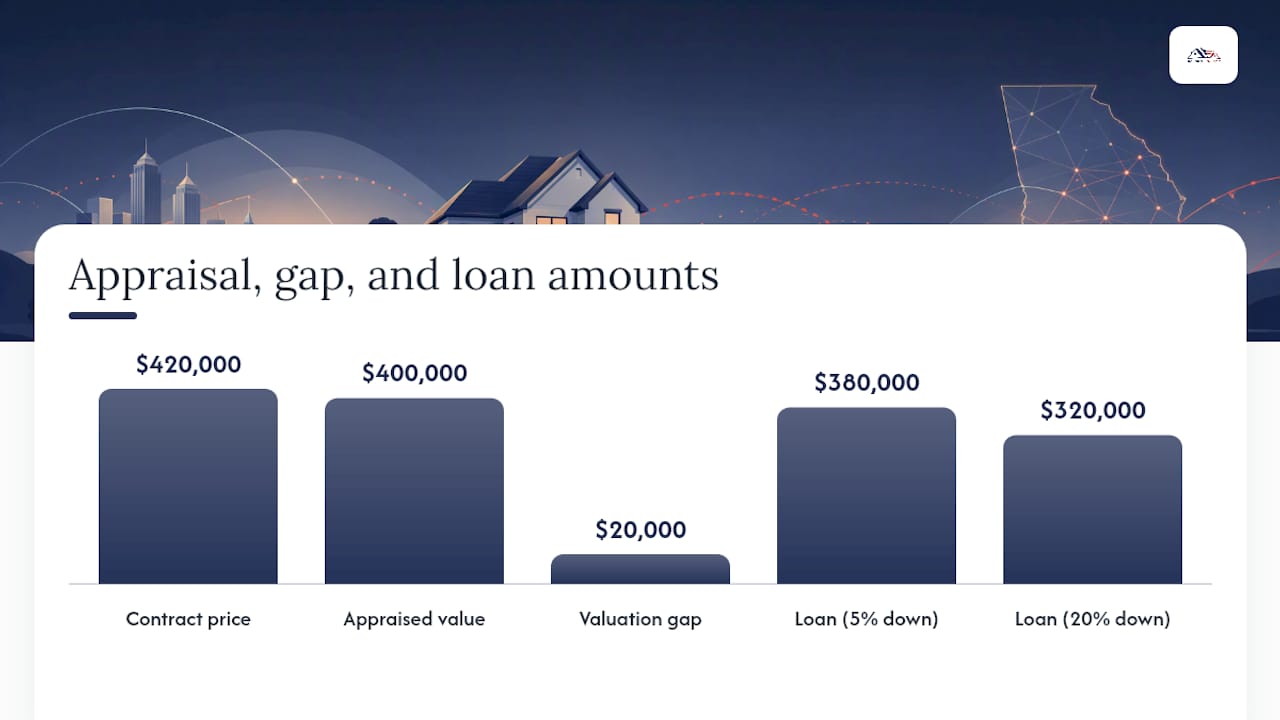
Contract price: $420,000. Appraised value comes back at $400,000. You're financing with a conventional loan at 5% down, so your lender will fund based on the lower number, not the contract price.
Statistic Callout: That $20,000 gap is the difference between the contract price and appraised value, since the lender simply won't fund against the higher number. Change the down payment to 20% instead of 5%, and the loan amount shrinks accordingly, but the $20,000 valuation gap itself doesn't move. Only your loan program and your gap clause terms determine who absorbs it and how much of it lands on you.
How Can You Protect Yourself When Making an Offer?
The strongest offers in Georgia's competitive submarkets pair a capped gap with proof you can actually cover it.
- Cap your gap coverage at a specific dollar figure rather than agreeing to cover the full shortfall.
- Attach proof of funds showing you have reserves beyond your down payment and closing costs.
- Weigh an escalation clause against an appraisal contingency. An escalation clause raises your price automatically against competing offers, but it can push you further from appraised value if it triggers.
- After a low appraisal, request an appraisal reconsideration using well-documented, recent comparable sales the appraiser may have missed.
- Propose a seller price amendment splitting the gap, sometimes called a split-the-difference approach, using specific negotiation language rather than a vague request.
- Understand negotiation tactics that keep leverage on your side even after a disappointing appraisal.
Waiving your appraisal contingency entirely is a common tactic in hot Atlanta-area listings, but it removes your exit ramp completely. If the appraisal misses by a wide margin and you've waived the contingency, you're contractually obligated to close regardless, or you risk losing your earnest money.
Pro Tip: Before you waive an appraisal contingency to win a bidding war, run the worst-case math first. If a 10% miss would wipe out your cash reserves, a capped gap clause protects you almost as well without the same exposure.
What Are the Georgia Contract Deadlines You Need to Know?
The Georgia Association of Realtors purchase and sale agreement typically handles appraisal protection through a specific contingency section, where buyers can state a minimum appraised value and attach a gap variance amount as a special stipulation.
- Locate the appraisal contingency section in your GAR contract and confirm whether a minimum value or gap cap is already written in.
- Note your response window, often a matter of days after receiving the appraisal, during which you must notify the seller in writing if you're terminating or requesting an amendment.
- If you terminate within your contingency period, your earnest money should be protected and returned, but confirm this in writing with your agent.
- Send your agent a short email stating the appraised value, your contract's cap amount, and your intended response, creating a timestamped record that protects your position.
For a broader view of buyer deadlines during this window, the Georgia due diligence period guide covers related notice requirements worth reviewing alongside your appraisal contingency.
What Local Agents Actually See on the Ground
Before submitting an offer, ask your lender how quickly they can turn an appraisal and ask your agent to spell out the exact gap wording, not just "we'll cover some of it." In Atlanta suburbs, sellers often respond more favorably to a capped gap with proof of funds than to a fully waived contingency with none. First-time buyers especially should treat a full-gap waiver as a last resort, not a default strategy, since one appraisal miss can drain savings meant for repairs or moving costs.
What This Means for Georgia Buyers Right Now
The advice that circulates most, "just waive your appraisal contingency to win," ignores what happens when the number actually comes in low. A capped gap clause with solid proof of funds wins nearly as many competitive offers while keeping an exit ramp intact. That's the trade-off conventional wisdom skips.
What the research here actually supports is narrower and more useful: know your lender's loan-to-value math before you write an offer, not after. Understand your GAR contract's response window before an appraisal lands, not while the clock is running. And treat a fixed-dollar or percentage cap as your default position unless your cash reserves can comfortably absorb an uncapped shortfall.
Georgia's current market, with prices holding near $360,000 statewide and days on market stretching longer than they did two years ago, rewards buyers who plan the math ahead of time. Prioritize your cap amount and your response deadline first. Everything else in the negotiation follows from those two numbers.
— Matt
How OneSource Real Estate Helps You Navigate an Appraisal Gap
Getting the gap clause wording right on your offer, and knowing exactly how to respond if the appraisal comes back low, is where buyer representation earns its keep. Some real estate agents work with Atlanta-area buyers on contract review, gap clause negotiation, and pulling the local comps that support a reconsideration request when a number looks off.

When you work with an agent who reviews your GAR contract line by line before you sign, you know your cap amount, your response deadline, and your fallback options before you're staring down a low appraisal with a clock running. Prospective buyers may expect full contract review, negotiation support if the appraisal comes in short, and comps pulled specifically for their submarket rather than a generic citywide average. If you're preparing an offer in metro Atlanta, reach out to discuss your purchase and get your contract terms checked before you submit.
Sources
Review the CFPB's appraisal guidance, verify any lender through NMLS Consumer Access, and check Georgia-specific appraisal process details for additional buyer context.
- CFPB — Appraisal rules and guidance
- Georgia home appraisal process: what first-time buyers need to know
FAQ
How Does an Appraisal Gap Clause Work?
It's a contract provision stating who covers the difference if the appraised value comes in below the purchase price, typically committing the buyer to pay up to a set dollar amount or percentage before either side can renegotiate or terminate.
How Much of an Appraisal Gap Should You Offer to Cover?
Most competitive Atlanta-area offers use a fixed-dollar cap within a typical moderate range or a percentage cap around a few percent of the purchase price, based on how much cash reserve you can comfortably part with beyond your down payment.
What Does an Appraisal Gap Clause Mean?
It means you've agreed to pay up to a specified amount out of pocket if the home appraises below your contract price, and if the shortfall exceeds that amount, your contract typically lets you renegotiate or exit the deal.
Can You Give an Example of an Appraisal Gap Clause?
A typical clause reads something like: "Buyer agrees to pay up to a specified amount above the appraised value if the appraisal is lower than the purchase price, with any shortfall beyond that amount subject to renegotiation or termination within a short notice period."