
Set your Atlanta asking price using three inputs: closed comparable sales from the last 90 days, current local market signals like inventory and days on market, and a professional CMA or pre-listing appraisal. Weight those three toward speed if you need to move fast, or toward ceiling price if you can wait out the market. Skip any of the three and you're guessing.
TL;DR:
- Using recent closed sales within a mile and adjusting for specific home differences provides the most accurate pricing foundation for Atlanta homes.
- A pre-listing appraisal helps clarify value when comparable data is inconsistent or your property has unique features, costing between a few hundred and $700.
- Atlanta's current market favors sellers with less than three months of supply, but rising days on market and frequent price cuts suggest caution against overpricing.
- Initial listing performance in the first two weeks is critical; strong showings confirm pricing accuracy, while weak traffic indicates most adjustments are needed.
- Combining CMA, formal appraisal, and local micro-market data yields the best chance to set a price that balances quick sale goals with maximum value.
Table of Contents
- How to Price a Home in Atlanta Step by Step
- What's the Best Way to Value a House Before Listing?
- What Do Atlanta's Current Market Signals Say About Pricing?
- Pricing Tactics That Support Your Asking Price
- When Should You Reduce Your Asking Price?
- How Does Your List Price Affect What You Actually Keep?
- How OneSource Real Estate Supports Pricing Decisions
- Legal Considerations and Disclosure Requirements That Affect Pricing
- Pricing Mistakes Atlanta Sellers Make Most Often
- Why I Trust Early Buyer Feedback Over Gut Instinct
- Get a Free Pricing Consultation for Your Atlanta Home
- Where to Verify Atlanta Market Data Yourself
- Sources
- FAQ
How to Price a Home in Atlanta Step by Step
Getting to a defensible number takes a specific sequence, not a hunch. Here's the order that actually works.
- Pull closed comps, not active listings. Find homes that sold within the last three months, within half a mile to one mile of your address, or inside the same subdivision. Closed sales tell you what buyers actually paid; active listings only tell you what sellers hoped for.
- Adjust each comp for real differences. A comp with a finished basement, a renovated kitchen, or an extra half bath isn't equal to your house. Common adjustments include:
- Square footage (typically $50 to $150 per square foot depending on the neighborhood)
- Lot size and usable yard space
- Major system age (roof, HVAC, water heater)
- Recent renovations versus dated finishes
- Decide your actual objective. Maximizing price and selling quickly pull in opposite directions. Pick one, because it determines where inside your comp-based range you land.
- Set the list price inside that range. If speed matters most, price near the bottom third of your adjusted comp range. If you can wait for the right buyer, price near the top.
Ordering a pre-listing appraisal makes sense when your comps are inconsistent or your home has unusual features that make adjustments tricky. Fees vary by property size and complexity, and sellers typically pay anywhere from a few hundred dollars up into the $700 range for this service.
Pro Tip: Pull your comps before you talk to any agent about price. It's the fastest way to tell whether an agent's suggested number is grounded in data or just optimism.
What's the Best Way to Value a House Before Listing?
No single method gets you to the right number alone. Combining them does.
A comparative market analysis (CMA) is the primary tool for pricing in a market as neighborhood-specific as Atlanta, where prices can shift block by block. An agent builds a CMA from recent closed sales, adjusts for differences, and lands on a defensible range grounded in what buyers actually paid.
Appraisals serve a different purpose. A lender-ordered appraisal protects the bank's loan amount and only happens once you're under contract. A pre-listing appraisal, ordered by you before listing, gives an independent opinion of value and typically runs from a few hundred dollars to over $700 depending on the property.
Automated valuation models (AVMs) like Zillow's market data are useful for a quick sanity check but shouldn't set your price. These tools pull from broad datasets that miss micro-market quirks, a renovated kitchen, or a busy street, the kind of detail that moves value by tens of thousands of dollars in specific Atlanta pockets.
- CMA: most accurate for setting list price, built from local closed sales
- Appraisal: independent, formal opinion, useful pre-listing for confidence
- AVM: fast cross-check, not a standalone number
- Cash/investor offers: trade price for speed and certainty, detailed further below
Opendoor's guide to selling in Atlanta notes that pricing accuracy depends heavily on treating each submarket individually rather than applying citywide averages.
What Do Atlanta's Current Market Signals Say About Pricing?
Months of supply tells you who holds the leverage. Under three months of supply favors sellers and supports pricing at the top of your range. Four to six months is balanced, meaning your comps should guide the price closely with little room to stretch. Above six months favors buyers, and overpricing in that environment leads directly to stale listings.
Recent data puts this in sharp focus. Atlanta's median list price sat near $429,000 in June 2026, with homes spending a median of about 52 days on market, and roughly one in four listings took a price cut that same month. That's not a market where you can price on last year's numbers and expect the same result.
- Check the Atlanta REALTORS® Association for official monthly market indicators
- Cross-reference Zillow's Atlanta market page for trend direction
- Compare your specific zip code against citywide averages, since neighborhood variance is often wider than the citywide trend suggests
Two neighborhoods five minutes apart can call for opposite pricing strategies depending on their own supply and buyer demand.
Pricing Tactics That Support Your Asking Price
The first 7 to 14 days of a listing tell you almost everything. Strong showing volume and multiple offers confirm you priced correctly, or even left room on the table. Weak traffic and no offers by day 14 usually mean the price, not the house, is the problem.
- Update kitchens and improve curb appeal before listing. These consistently generate the strongest buyer reaction per dollar spent in Atlanta's market.
- Stage rooms to photograph well online, since most buyers filter listings before they ever request a showing.
- Consider pricing just under a round number ($424,900 instead of $430,000) to capture buyers searching just below that threshold.
- Offer a closing-cost credit or minor concession before cutting the list price outright. It preserves your number while still sweetening the deal.
Pro Tip: If your first open house draws heavy foot traffic but zero offers, that's a pricing signal wearing a disguise. Buyers who look but don't act are telling you the number feels close but not quite right.
When Should You Reduce Your Asking Price?
Watch for three signals: showing activity below what similar homes in your area are getting, repeated buyer or agent feedback that the price feels high, and no offers once you've passed the typical days-on-market for your neighborhood.
- Re-evaluate at the 7 to 14 day mark using showing counts and feedback, not gut feeling.
- Make your first cut meaningful. A 3% to 5% reduction signals seriousness; nickel-and-dime cuts under 1% often get ignored by buyers watching your listing.
- Save larger cuts for cases with clear data, such as a full six weeks of silence in an active submarket.
- Compare the cost of a price cut against the cost of a quick improvement (fresh paint, decluttering) before choosing either path.
- Time a reduction to coincide with a listing refresh so it appears as a new opportunity, not a red flag.
How Does Your List Price Affect What You Actually Keep?
Your list price sets the ceiling, but closing costs, commissions, and concessions determine your real payout. Georgia sellers typically cover agent commissions, standard closing costs, prorated taxes, and any negotiated repairs or credits.
Here's a simplified comparison of two pricing approaches for the same $450,000 home:
The two scenarios land within roughly $1,000 of each other, but one seller carried an extra 54 days of mortgage payments, utilities, and uncertainty. For the full cost breakdown, including prorations and typical repair credits, see OneSource Real Estate's guide to seller closing costs in Georgia and how realtor commissions in Georgia factor into your bottom line.
How OneSource Real Estate Supports Pricing Decisions
A pricing plan is only as good as the data behind it, and that's where local expertise earns its place. OneSource Real Estate builds pricing recommendations from recent Atlanta-area closed sales, current inventory data, and micro-market adjustments specific to your block, not just your zip code.
- A OneSource CMA includes adjusted comps, a recommended pricing band, and a written summary of local demand signals
- Sellers weighing a faster exit can review our cash sale guide for Atlanta homeowners alongside a traditional listing strategy
- Consultations cover timing, staging priorities, and how your specific neighborhood is trending relative to the broader Atlanta market
Legal Considerations and Disclosure Requirements That Affect Pricing
Georgia requires sellers to disclose known material defects that affect a property's value or safety, and skipping this step doesn't just create legal exposure, it can also force a price renegotiation mid-contract if issues surface during inspection. Buyers who discover an undisclosed foundation crack or water intrusion problem after going under contract often come back demanding a price cut far steeper than if you'd priced the issue in from the start.

Georgia is a "buyer beware" state in some respects, meaning sellers aren't required to volunteer every flaw unprompted, but any known defect that a seller actively conceals or misrepresents when asked directly can create liability. That distinction matters when you're setting a price around a home with known issues: pricing to reflect a needed repair upfront is almost always cheaper than fighting a disclosure dispute after the fact.
Working with a licensed agent or attorney to complete Georgia's seller disclosure statement accurately protects your pricing strategy in two ways. First, it prevents last-minute renegotiation that erodes your net proceeds. Second, it lets you price transparently around known issues rather than hoping they go unnoticed, a strategy that rarely survives a home inspection.
If your home has unresolved permit issues, past insurance claims for water or fire damage, or known structural concerns, factor the cost of resolving or disclosing those issues into your initial price rather than treating them as a problem for later. A price that already accounts for a known issue rarely triggers the same buyer pushback as one that gets discovered mid-contract.
Pricing Mistakes Atlanta Sellers Make Most Often
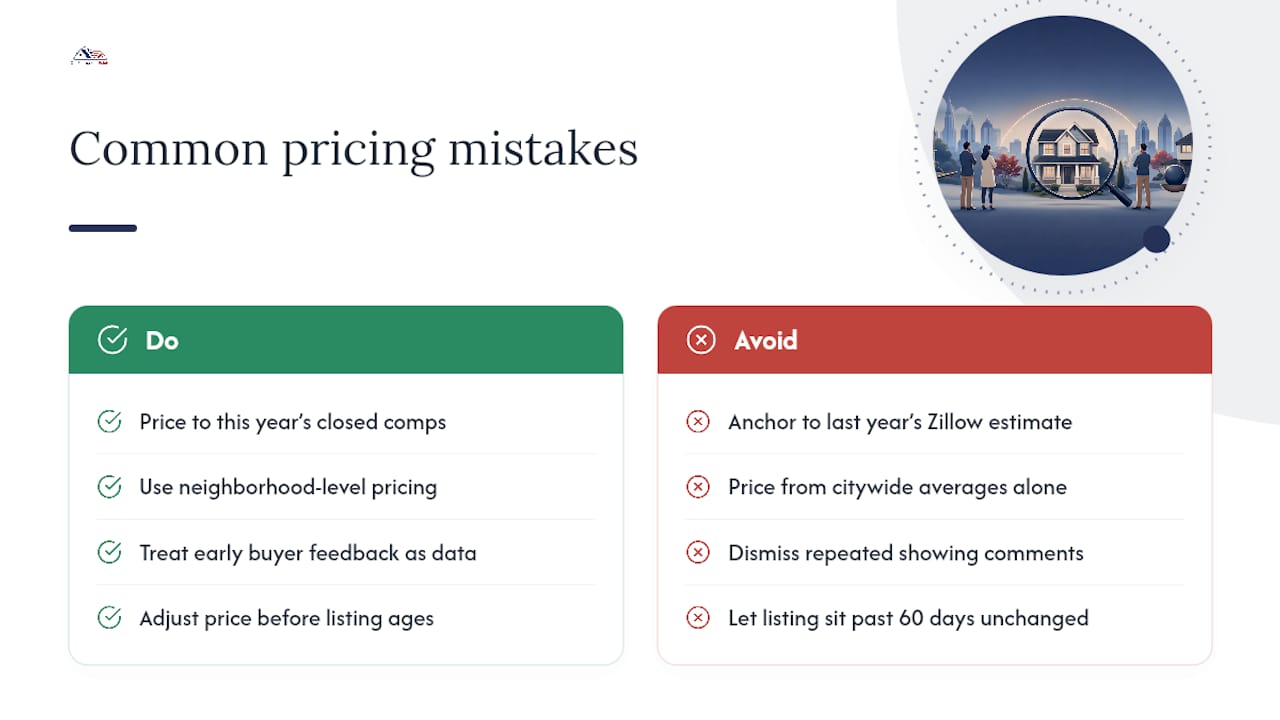
The most common mistake is anchoring to last year's Zillow estimate instead of this year's closed comps. Atlanta's market has cooled in specific ways since 2025, with longer days on market and more price cuts, so a number that felt right twelve months ago is often several percentage points too high today.
A close second: ignoring neighborhood-level variance and pricing off citywide averages. A home in a submarket with rising inventory needs a different strategy than one three miles away where listings are still moving in under two weeks. Treating Atlanta as one market instead of dozens of smaller ones is where a lot of overpricing starts.
Sellers also frequently misread early showing feedback, dismissing three or four buyer comments about price as noise rather than a pattern. When multiple independent parties raise the same objection in the first two weeks, that's data, not coincidence.
Finally, many sellers wait too long to act on weak signals, hoping the "right buyer" will eventually show up rather than adjusting price while the listing is still fresh. Listings that sit past 60 days without a price change often get passed over by buyers who assume something's wrong with the property, not just the price.
Why I Trust Early Buyer Feedback Over Gut Instinct
I've watched sellers pick a price band based on the top end of their comps, then get quiet showings for two weeks straight. The fix was never a full relist. It was a small, deliberate adjustment guided by what buyers actually said.
If you're prepping to list, do this today: pull three recent closed comps within a mile of your home. That's the fastest gut check you'll get before talking price with anyone.
— Matt
Get a Free Pricing Consultation for Your Atlanta Home
Skip the spreadsheet guesswork and the outdated Zillow estimate. OneSource Real Estate builds pricing recommendations from live, closed Atlanta comps and current neighborhood-level demand, not a citywide average that ignores what's happening on your specific block.

Pricing consultations typically include a review of recent comparable sales, current local inventory trends, and a recommended pricing band tailored to the seller's goals, such as a fast sale or maximizing sale price. Consultations often cover Atlanta and the surrounding metro area. Request a property management and seller consultation to get a pricing plan built around your street, not the whole city.
Where to Verify Atlanta Market Data Yourself
- Atlanta REALTORS® Association: official monthly market reports covering inventory, median price, and sales pace
- Zillow's Atlanta market page: trend visuals and rental context useful for cross-checking neighborhood direction
Sources
FAQ
Are House Prices Dropping in Atlanta?
Prices have held relatively steady year-over-year, but days on market have stretched to around 52 days and roughly a quarter of listings saw price cuts in June 2026, signaling a slower, more selective market rather than an outright decline.
Is $100,000 a Good Salary in Atlanta?
Housing costs vary widely by submarket, which is exactly why hyper-local pricing matters as much for buyers budgeting a purchase as it does for sellers setting a list price.
How Can I Estimate My Home's Value?
Combine recent closed comps from your immediate area, a professional CMA, and an AVM cross-check like Zillow's data as a starting point rather than a final number. A OneSource Real Estate consultation adds micro-market adjustments an automated tool can't account for.
What Is the Average Cost of a Home Appraisal in Atlanta, Georgia?
Pre-listing appraisal fees typically range from a few hundred dollars up to $700 or more, depending on your home's size and complexity, and they're worth the cost when your comps are inconsistent or your home has unusual features.