If you're buying inside the City of Atlanta, start with Invest Atlanta's forgivable grants and Atlanta Housing's Down Payment Assistance. If you're buying anywhere in Georgia, including metro Atlanta suburbs, the Georgia Dream Homeownership Program gives you statewide reach. These are not equally useful for every buyer, so here is the short version:
- City of Atlanta buyers: Invest Atlanta runs HOME Atlanta (a 3.5% forgivable grant for FHA/VA loans), AAHOP (up to $20,000 forgivable over time), and IMAP ($10,000 deferred). These are the fastest ways to cut cash-to-close.
- Public-safety, education, and military buyers: Atlanta Housing's DPA goes up to $25,000 for eligible professionals vs. $20,000 standard. That $5,000 difference is worth verifying your eligibility.
- Low-income buyers: Georgia Dream's deferred second mortgage pairs well with city grants and covers buyers who fall just under AMI thresholds.
- Buyers outside city limits: Georgia Dream is your primary tool. Fulton County HOP and Clayton County's program fill gaps for buyers in those specific counties.
Your first two moves: complete a HUD-approved eight-hour homebuyer education course and contact a participating lender. Both are required by nearly every program listed here, and the education certificate often has to come before the lender can submit your application.
Key Takeaways
Atlanta first-time buyers inside city limits should prioritize Invest Atlanta's forgivable grants first, then layer Georgia Dream or county deferred loans to cover remaining closing costs.
| Point | Details |
|---|---|
| Start with education | Complete the eight-hour HUD-approved course before anything else — most programs require it upfront. |
| Match your lender carefully | Only participating lenders can process program funds; confirm lender status before signing. |
| Forgivable grants first | Use HOME Atlanta or Atlanta Housing DPA to cover the down payment before adding deferred loans. |
| Verify vendor registration | For Fulton County HOP, the closing attorney must register as a county vendor before funds release. |
| Stack strategically | City grants plus Georgia Dream can bring cash-to-close close to zero for eligible FHA/VA buyers. |
Table of Contents
- What first-time home buyer Atlanta programs are available?
- What do "grant," "forgivable," and "deferred" actually mean for your closing costs?
- Who qualifies and the common program requirements you must meet
- How do you apply for down payment assistance in Atlanta?
- How can you stack Atlanta programs with Georgia Dream?
- Profiles of local programs and how to contact each one
- How OneSource Real Estate helps you use these programs
- What most guides get wrong about Atlanta homebuyer programs
- Sources
- FAQ
What first-time home buyer Atlanta programs are available?
The table below covers the major programs. Amounts and limits are subject to program updates, so confirm current figures directly with the administering agency or a participating lender.
Most city programs require that funds be stacked in a specific order. Confirm stackability with your lender before submitting any application.
What do "grant," "forgivable," and "deferred" actually mean for your closing costs?
These three terms determine how much cash you need at the table and what you owe later.
- Grant: Free money. No repayment, no conditions after closing. Rare in large amounts.
- Forgivable grant: Forgiven after you meet an owner-occupancy period (often five to ten years). If you sell or refinance before that window closes, you repay a prorated share. Invest Atlanta's HOME Atlanta grant is forgiven at closing for FHA/VA borrowers, which is unusually clean.
- Deferred 0% second mortgage: You borrow the money at zero interest, but repay the full principal when you sell, refinance, or pay off the first mortgage. No monthly payment, but the balance follows you.
Here is what that looks like in practice. On a $250,000 purchase, a $10,000 forgivable grant drops your cash-to-close by $10,000 immediately. A $10,000 deferred loan does the same at closing, but when you sell five years later for $300,000, that $10,000 comes off your proceeds first.
Pro Tip: Use forgivable grants to cover your down payment first. Then layer a deferred second mortgage on top to handle remaining closing costs. That order minimizes your upfront cash and keeps the repayable balance as small as possible.
Who qualifies and the common program requirements you must meet
Most programs use the same core definition: a first-time homebuyer is someone who has not owned a primary residence in the past three years. Per the Atlanta Housing lender guidelines, this three-year lookback is standard. Veterans and active-duty military often qualify regardless of prior ownership history.
Income limits are tied to Area Median Income (AMI). AMI is the midpoint income for a household of a given size in a given metro area, set annually by HUD. Check the current HUD AMI figures for the Atlanta metro before assuming you qualify or don't.
Other common requirements across programs:
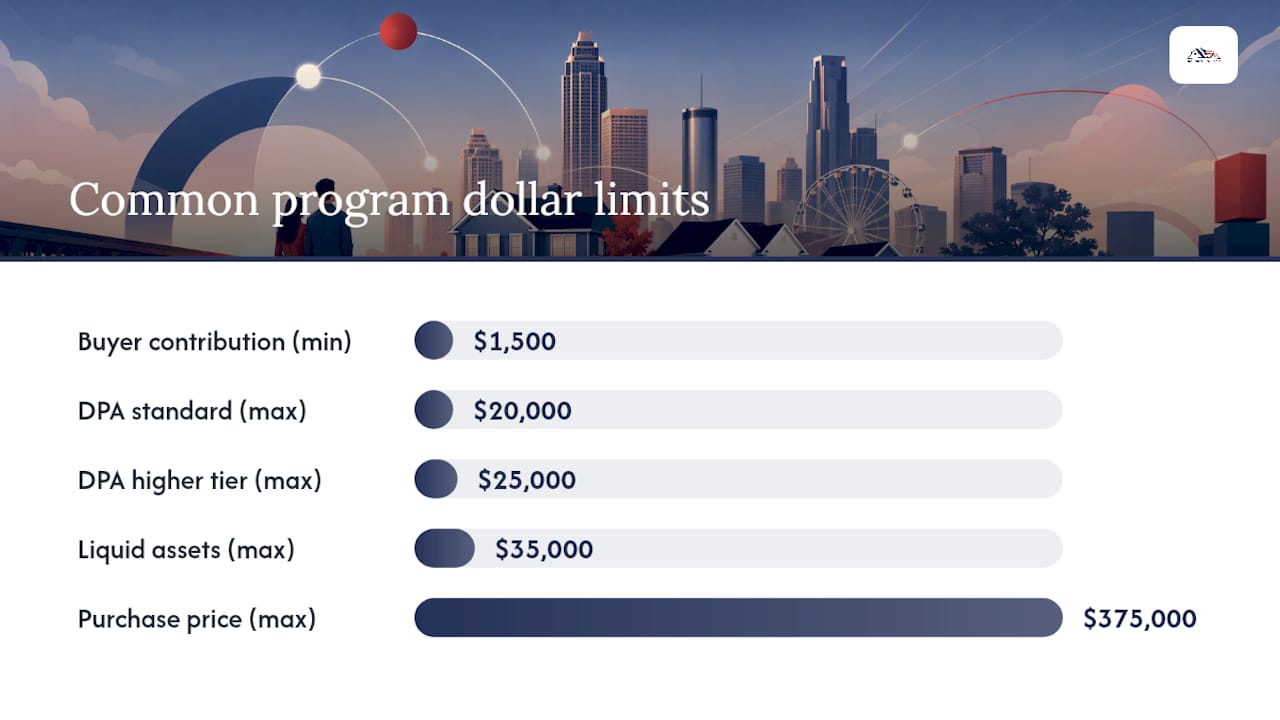
- Minimum buyer contribution of $1,500 (Atlanta Housing DPA)
- Maximum liquid assets of $35,000 (Atlanta Housing DPA)
- Purchase price at or below $375,000 (Atlanta Housing DPA example)
- Eight-hour HUD-approved homebuyer education course, completed before closing
- Property must be owner-occupied; investment properties are excluded
- Single-family homes, condos, and townhomes are typically eligible; confirm by program
Statistic callout: Atlanta Housing's standard DPA reaches up to $20,000, with a higher tier of $25,000 for public-safety officers, educators, and military buyers who meet program criteria.
How do you apply for down payment assistance in Atlanta?
- Complete HUD-approved homebuyer education first. Most programs require the certificate before your lender can submit the application. Don't wait until you're under contract.
- Get prequalified with a participating lender. Each program maintains its own lender list. A lender not on that list cannot process the funds, no matter how qualified you are. Ask specifically: "Are you a participating lender for Atlanta Housing, Invest Atlanta, and Georgia Dream?"
- Gather your documents. You'll need government-issued ID, two years of tax returns, recent pay stubs, two months of bank statements, and proof of any other assets.
- Choose your program stack and confirm with your lender. Map which programs you're eligible for and in what order they'll be applied. Your lender submits most program applications on your behalf.
- Submit the program application through your lender. For Invest Atlanta and Atlanta Housing, the lender handles the submission. For Fulton County HOP, the lender and closing attorney both have roles.
- Verify vendor/closing-entity registration. For Fulton County HOP, the closing attorney or title company must register as a county vendor before HOP funds are released. Confirm this weeks before your closing date, not the day before.
- Close. Expect program processing to add one to three weeks to a standard timeline. Programs with manual review steps (county-level programs especially) can run longer.
The single biggest bottleneck: a lender who is unfamiliar with the program's vendor registration or submission process. Vet your lender's experience with these specific programs before you sign anything.
How can you stack Atlanta programs with Georgia Dream?
Stacking is allowed by most programs, but it requires explicit lender approval and a clear funding order. Here is how it typically works:
- City of Atlanta buyer, FHA loan: HOME Atlanta 3.5% forgivable grant covers the FHA down payment requirement. Georgia Dream deferred second mortgage covers closing costs. Net result: near-zero cash-to-close.
- Low-income buyer, City of Atlanta: Atlanta Housing DPA (up to $20,000) stacked with Georgia Dream's deferred second. The AH grant handles the down payment; Georgia Dream absorbs remaining closing costs.
- Fulton County buyer outside city limits: Fulton County HOP (up to $22,500 deferred) combined with Georgia Dream. Both are deferred second mortgages, so lender approval of the combined debt-to-income picture is critical.
Pro Tip: Map your full stack before making an offer. Sellers and listing agents respond better to offers where the buyer's lender has already confirmed program approval. A pre-stacked offer is a cleaner offer.
Invest Atlanta's forgivable grants are often the fastest route to reducing cash-to-close for buyers inside city limits. Pair them with Georgia Dream for any remaining gap.
Profiles of local programs and how to contact each one
Atlanta Housing DPA
Atlanta Housing offers up to $20,000 standard and up to $25,000 for public-safety officers, educators, and military buyers. Requires an eight-hour HUD-approved education course, a minimum $1,500 buyer contribution, and a maximum $35,000 in liquid assets. Purchase price cap is $375,000. Apply through a participating lender listed on the AH website.
Invest Atlanta programs
Invest Atlanta runs four products inside City of Atlanta boundaries. AAHOP provides up to $20,000 forgivable over an occupancy period. IMAP offers $10,000 as a deferred second mortgage. Targeted district funds (including VCRI and Perry Bolton) carry zip-code restrictions. Minimum credit scores apply; confirm current thresholds with a participating lender.

Georgia Dream (DCA)
The Georgia Dream Homeownership Program covers the entire state. Products include Georgia Dream (standard), Peach Plus (for buyers with higher needs), and Peach Select Veterans Assistance. All are structured as deferred second mortgages paired with FHA, VA, or conventional first mortgages. Income and sales-price caps vary by county. Apply through the Georgia.
Fulton County HOP
Deferred, zero-percent second mortgages up to $22,500 for eligible buyers in Fulton County. Requires HUD counseling and vendor registration by the closing entity. Contact Fulton County Community Development directly for lender application forms and vendor registration instructions.
Clayton County DPA
Clayton County offers grant tiers in the $7,500–$10,000 range for eligible buyers within county limits. Smaller amounts than city programs, but useful for buyers priced out of Fulton or DeKalb.
Atlanta Habitat for Humanity and ANDP
Atlanta Habitat for Humanity provides a nonprofit homeownership pathway through volunteer-built and renovated homes. Eligibility differs significantly from city/state DPA programs. The Atlanta Neighborhood Development Partnership (ANDP) offers community development support and referrals for buyers navigating affordable housing options.
How OneSource Real Estate helps you use these programs
Working with an agent who knows these programs changes the transaction. Here is what that looks like in practice:
- Pre-screening your profile against program eligibility before you start touring homes
- Matching you with lenders who are already participating lenders for your target program, cutting weeks off the process
- Coordinating homebuyer education timing so your certificate is ready before the lender needs it
- Confirming that your closing attorney is registered as a vendor for county programs like Fulton County HOP
- Mapping your full stack before you make an offer, so your financing is clean and credible
The vendor registration step alone has derailed closings that were otherwise ready to fund. An agent who has navigated this before knows to check it at the start, not the end.
OneSource Real Estate specializes in buyer representation across Atlanta and surrounding areas. If you're weighing whether to buy or keep renting, the Atlanta renter's guide is a useful starting point. For post-purchase planning, the best home inspectors in Atlanta guide covers what to expect from the inspection contingency. And if you're budgeting for long-term ownership costs, roof maintenance tips for Atlanta homeowners is worth a read before you close.
Contact OneSource Real Estate directly to get matched with a participating lender and map your program stack before you make your first offer.
What most guides get wrong about Atlanta homebuyer programs
Most articles on this topic list programs and stop there. That is not enough. The real decision is sequencing: which program do you apply to first, and in what order do you stack the rest?
The conventional advice is to "find a program you qualify for." That framing misses the point. Most buyers in Atlanta qualify for more than one program. The question is which combination maximizes forgiven dollars and minimizes the deferred balance you'll repay at sale. A buyer who takes a $10,000 deferred loan when they could have had a $10,000 forgivable grant just cost themselves money at resale.
The other thing guides underplay: lender selection is the highest-leverage decision you make before going under contract. A lender unfamiliar with Invest Atlanta's submission process, or one who hasn't done a Fulton County HOP closing before, will slow you down or lose the funds entirely. That is not a paperwork problem. It is a deal problem.
If you are a public-safety officer, educator, or veteran, check Atlanta Housing's $25,000 tier before assuming the standard $20,000 is your ceiling. That extra $5,000 is real money, and it is underused because buyers don't know to ask.
This article is general information, not a substitute for advice from a qualified financial advisor. Consult a qualified financial professional about your own circumstances before acting on anything here.
Sources
- Georgia Dream — Georgia Department of Community Affairs
- Fulton County — Homeownership Program (HOP)
- GENERAL GUIDELINES & INFORMATION FOR LENDERS – Revised / Updated Effective 03-01-2026
- Down Payment Assistance Program - Clayton Grants
FAQ
What grants are available for first-time homebuyers in Georgia?
The main statewide option is Georgia Dream, which provides deferred down payment assistance through the Georgia Department of Community Affairs. Inside Atlanta, Invest Atlanta's HOME Atlanta and AAHOP are forgivable grants, and Atlanta Housing offers up to $25,000 for eligible buyers.
Is $10,000 enough for a down payment on a house in Atlanta?
It depends on the purchase price and loan type. Programs like HOME Atlanta and IMAP are designed specifically to bridge that gap.
What is the $5,000 grant for first-time home buyers?
The $5,000 figure often refers to the difference between Atlanta Housing's standard $20,000 DPA and the $25,000 tier available to public-safety officers, educators, and military buyers. Some county programs also offer smaller grant tiers in that range.
What is the income limit for first-time homebuyers in Georgia?
Income limits vary by program, county, and household size, tied to HUD's Area Median Income figures. Check current limits directly with the administering agency or a participating lender, as HUD updates AMI figures annually.