
List between March and June, with May typically the strongest month, if your priority is price. List in fall or winter if you'd rather deal with fewer competing homes and don't mind a longer wait for the right buyer. The trade-off is real: spring brings buyer competition and stronger offers, but also more listings to compete against and a tighter window shaped by Atlanta's school calendar and relocation season.
TL;DR:
- Listing in May can yield the highest sale premiums, especially in well-priced, competitive neighborhoods, but timing depends heavily on local inventory and demand.
- Spring (March to June) offers the busiest market with the shortest days on market, while fall and winter bring fewer listings but motivated buyers with less competition.
- Neighborhood-specific factors, such as current inventory and local events, often outweigh seasonal trends when deciding the optimal listing time.
- Preparing a home typically takes six to eight weeks, including repairs, staging, and marketing, making early planning essential for peak seasons or off-season sales.
- Sellers focused on certainty or faster sales may benefit from off-peak months, but should consult local market data to avoid waiting through slower seasons unless their finances and timeline permit.
Table of Contents
- When Is the Best Time to Sell a House in Atlanta?
- Which Month Actually Sells Homes for the Most Money?
- What Local Signals Should Override the Seasonal Calendar?
- How Do You Prepare a Home to List in 6 to 8 Weeks?
- Does Metro Atlanta Seasonality Apply to Every Neighborhood?
- Price, Speed, or Certainty: Which Should Drive Your Decision?
- How OneSource Real Estate Helps You Time It Right
- Sources
- FAQ
When Is the Best Time to Sell a House in Atlanta?
The recommended window for the best time to sell Atlanta homes runs from March through June, and the season breaks down differently depending on what you're optimizing for.
Spring (March through June) is when Atlanta's market runs hottest. Buyers who've been waiting out winter come out in force, families push to close before the school year ends, and inventory hasn't yet piled up to match demand. May tends to stand out within that window, likely because it hits the sweet spot between buyer urgency and school-year timing without the summer slowdown that follows.
Summer keeps some of that momentum going through June and into July, but by August, family buyers have mostly finished their moves and vacation schedules start pulling attention away from house hunting. Homes listed in late summer often sit a bit longer than their spring counterparts.
Fall offers a smaller, quieter opportunity. September and October bring a secondary wave of serious buyers, often people relocating for work who aren't tied to a school calendar. Competition from other sellers thins out, which can work in your favor if your home is priced right.
Winter is the slow season, but "slow" doesn't mean "dead." Atlanta's mild winters mean fewer weather-related showings are canceled, and the buyers who do shop in December and January are usually motivated: relocating employees, investors, or people who need to close on a timeline. You'll likely see fewer competing listings and more negotiating room, but expect the home to sit longer on the market than it would in May.
- Spring: highest demand, most competition among sellers, shortest time on market
- Summer: still active, but momentum fades by late summer
- Fall: quieter but often serious, relocation-driven buyers
- Winter: fewest listings, longer days on market, motivated buyer pool
Which Month Actually Sells Homes for the Most Money?
Multi-year data on seller premiums, the gap between sale price and a home's automated valuation, points to a clear ranking: May ranks highest, followed by February, April, June, and March.
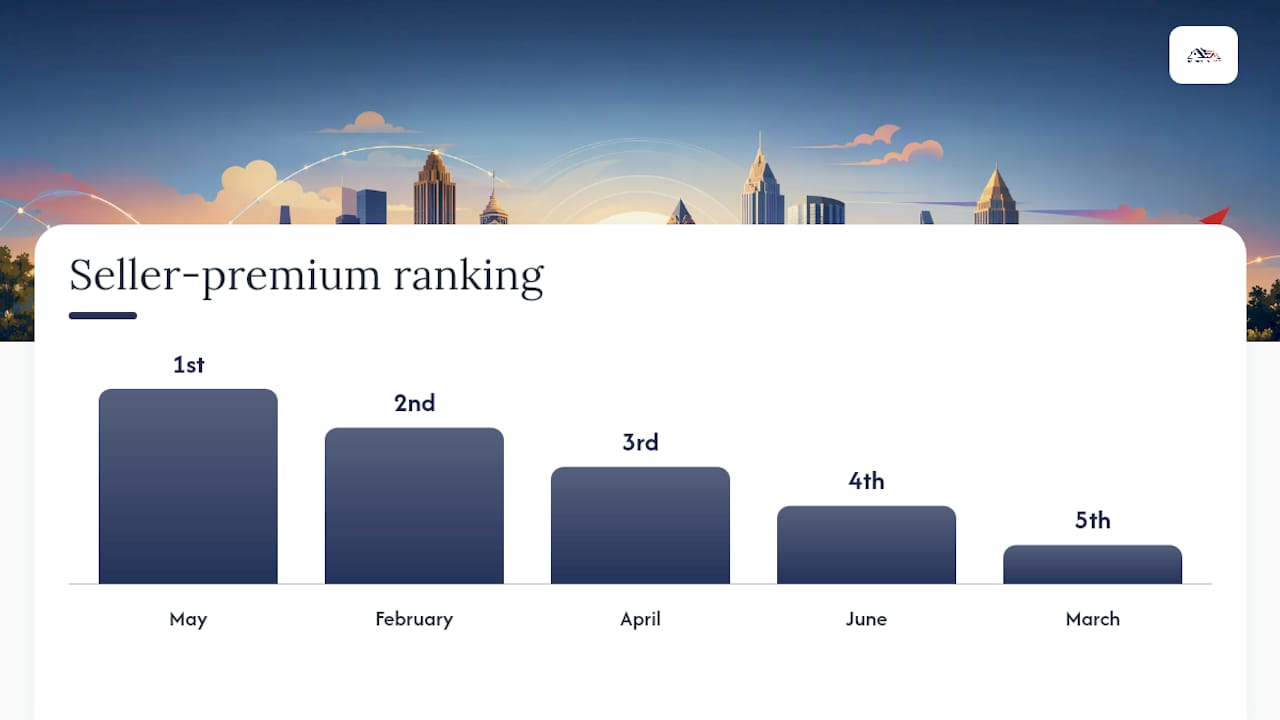
Why does May outperform even other spring months? It combines late-spring buyer urgency with school-year timing. Families house hunting in May can typically close by July and move before the new school year starts, which pulls buyer demand forward and tightens bidding.
That said, a seller premium isn't a guarantee tied to a calendar date. A well-priced home in a hot intown neighborhood can outperform the metro average in October. A poorly staged or overpriced home won't necessarily benefit from listing in May just because the data favors that month.
When does the month actually matter for your bottom line?
- If your home is in a competitive price bracket where multiple similar listings exist nearby
- If you're flexible on your move date and can wait for peak demand
- If your neighborhood closely tracks metro-wide seasonal patterns rather than running counter to them
For a home priced around the typical local median, the difference between a strong May premium and a flat winter sale could be significant, though the exact amount depends heavily on your specific property and neighborhood.
What Local Signals Should Override the Seasonal Calendar?
Seasonal trends are a starting point, not a rulebook. Before you pick a listing date, check what's actually happening in your specific ZIP code.
Start with current inventory and days on market for homes similar to yours. If your neighborhood has unusually low inventory right now, even in a typically slow month, that scarcity can matter more than the calendar. Watch new-listing volume too; a sudden wave of competing homes hitting the market changes your negotiating position fast.
Mortgage rate context also shapes buyer urgency; rate movement can pull demand forward or push it back regardless of season. Layer in local factors: school calendars in suburban school districts, corporate relocation announcements from major Atlanta employers, and big local events that pull buyer attention away from house hunting for a few weeks.
- Check active listings and average days on market in your specific neighborhood, not just the metro average
- Track new listings coming onto the market weekly, not just current inventory
- Note any major local employer relocation or hiring news that could bring buyers into your area
- Confirm your target school district's calendar if you're marketing to families
Pro Tip: If your neighborhood's current inventory is already thin, don't wait for "peak season." A scarce market in October can outperform a crowded one in May.
How Do You Prepare a Home to List in 6 to 8 Weeks?
A 6 to 8 week prep window is the practical standard most Atlanta brokers recommend before a home hits the market, whether you're aiming for the May peak or a quieter fall window.
- Weeks 1 to 2: Handle repairs and deferred maintenance; get a pre-listing inspection if your home hasn't had work done recently.
- Weeks 3 to 4: Declutter and stage the home; schedule professional photography right after staging is finished.
- Week 5: Finalize your listing price based on recent comparable sales and current neighborhood inventory.
- Weeks 6 to 7: Build your marketing plan and prep for showings; line up an open house within the first 7 to 10 days of listing.
- Week 8: List late in the week. A common pattern shows more new listings hit the market on Thursdays, which can help capture stronger weekend showing traffic.
If your timeline doesn't allow for 6 to 8 weeks, or your home needs more work than you want to fund, selling as-is or to a cash buyer trades some price for speed and certainty.
Does Metro Atlanta Seasonality Apply to Every Neighborhood?
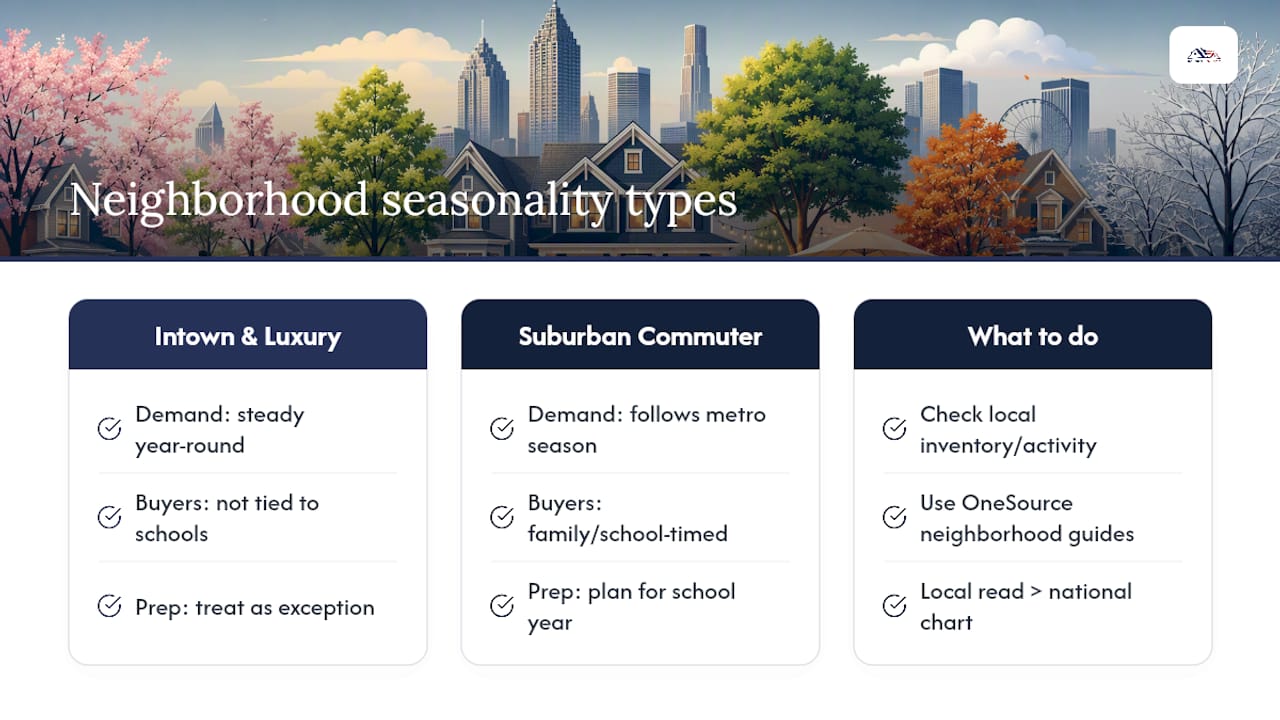
Not evenly. Intown pockets and luxury segments often deviate from the metro-wide pattern; some hold steady demand year-round regardless of season, because their buyer pool isn't as tied to school calendars or relocation cycles. Suburban commuter neighborhoods, by contrast, tend to track the seasonal calendar closely, since family buyers there are often planning around the school year.
OneSource Real Estate's ongoing Atlanta market guides track these neighborhood-level differences rather than relying on metro averages alone. If you're unsure whether your street behaves like the broader trend or like an exception, a local read on current inventory and buyer activity in your specific area is worth more than any national seasonal chart.
Price, Speed, or Certainty: Which Should Drive Your Decision?
Most sellers frame this as a calendar question. It's really a priorities question. If maximizing price is your goal, wait for spring, ideally May, and accept more competing listings. If avoiding a long, uncertain sale matters more, fall or winter can work in your favor precisely because fewer sellers are competing for the same buyers.
I'd only recommend waiting for the seasonal window if your finances and timeline can absorb a few extra months. If you need certainty now, a strong off-season price beats a hypothetical spring premium you might not have the runway to wait for.
— Matt
How OneSource Real Estate Helps You Time It Right
Picking the right month only gets you part of the way there. The bigger lever is having someone who knows how your specific block, not just the metro average, has been performing lately.

Experienced local real estate professionals handle the parts of timing that a seasonal chart can't: reading current inventory in your neighborhood, pricing against real comparable sales, and coordinating staging, photography, and marketing on a schedule that fits your goals. If you're managing rental property alongside a potential sale, a local team may also handle tenant placement, rent collection, and maintenance coordination, so timing decisions don't have to happen in isolation from the rest of your property portfolio. Whether you're aiming for a May listing or need to move faster than that, a property evaluation is the fastest way to find out what your specific home and neighborhood actually support right now. Request one to see where your property stands before you commit to a listing date.
FAQ
Is Atlanta a Buyer's or Seller's Market Right Now?
Conditions shift by neighborhood and season, but Atlanta has generally favored sellers in low-inventory pockets and spring months, while slower months and higher-inventory suburban areas can tilt toward buyers. Check current listings and days on market in your specific ZIP code rather than relying on a single metro-wide label.
What Is the Hardest Month to Sell a House?
Winter months, particularly December and January, tend to be the toughest for sellers in Atlanta, with fewer active buyers and longer days on market. Buyer competition thins out considerably compared to the March through June window.
What Is the 3-3-3 Rule in Real Estate?
Definitions of this rule vary across the industry, and no single Atlanta-specific standard applies to every listing. Rather than rely on a general rule, check your specific neighborhood's current inventory and days on market before setting expectations for how fast your home should move.
Is Now a Good Time to Sell a House in Atlanta?
It depends on your priorities and your specific neighborhood's inventory levels. If you're weighing price against speed, a local property evaluation from OneSource Real Estate can tell you whether your area currently favors listing now or waiting for the spring window.